
The cat words Japanese people actually use
Neko (猫) is cat, and you will hear it with a suffix more often than alone: neko-chan when talking to or about a cute cat, nyanko as a playful word, uchi no neko for your own. Kaineko is a pet cat, noraneko a stray. Body parts matter more than you expect, because nikukyū, the paw pads, are a national obsession, and hige, whiskers, and shippo, tail, come up in every description.
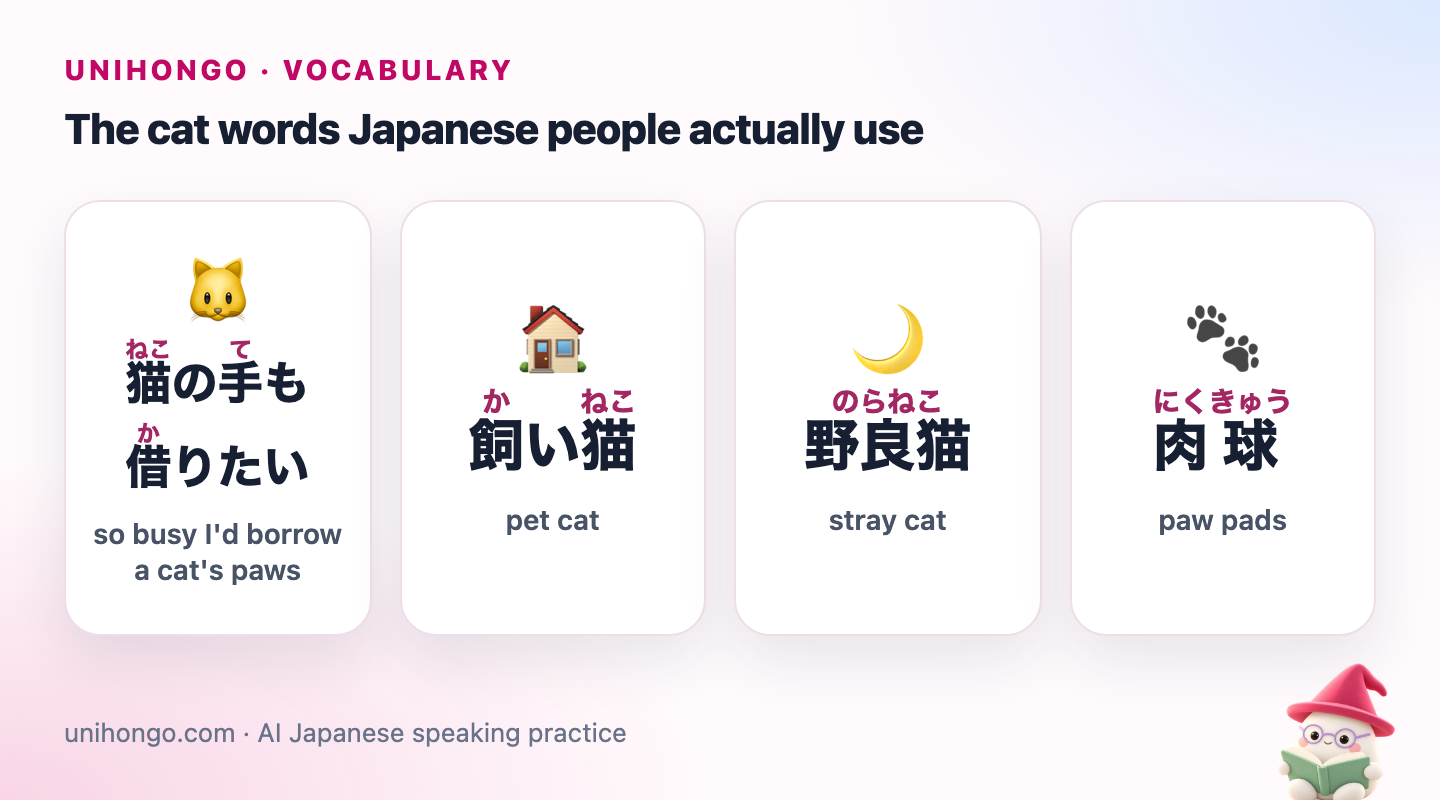
The first card is the idiom everyone knows. Learn it first and you will recognise it in the office by Friday.
| Japanese | Romaji | Meaning |
|---|---|---|
| 猫の手も借りたい | neko no te mo karitai | so busy I'd borrow a cat's paws |
| 飼い猫 | kaineko | pet cat |
| 野良猫 | noraneko | stray cat |
| 肉球 | nikukyū | paw pads |
| 子猫 | koneko | kitten |
| しっぽ | shippo | tail |
| ひげ | hige | whiskers |
| 爪とぎ | tsumetogi | scratching post, scratching |
| 三毛猫 | mikeneko | calico cat |
| 茶トラ | chatora | orange tabby |
| キジトラ | kijitora | brown tabby |
How owners talk about their cats
Two things mark a Japanese cat owner's speech. The first is the verb kau, to keep an animal: Neko o katte imasu, I have a cat. The second is uchi no ko, our kid, which owners use for a cat exactly as parents use it for a child. The counter is hiki, with the sound changes ippiki, nihiki, sanbiki, roppiki, happiki, juppiki. The question Neko ha desu ka, inu ha desu ka, are you a cat person or a dog person, is a standard icebreaker.
Personality words are where the fun is. Amaenbō is a cat that wants to be held and fussed over; hitonatsukkoi is friendly to people; keikaishin ga tsuyoi is wary; kimagure is moody or capricious; tsundere, borrowed from anime, describes a cat that ignores you and then climbs onto your lap. Owners also joke about the evening undōkai, the sports day, when a cat suddenly races round the flat, and use gorogoro for purring.
| Japanese | Romaji | Meaning |
|---|---|---|
| 猫を二匹飼っています。 | Neko o nihiki katte imasu. | I have two cats. |
| 猫派ですか、犬派ですか。 | Neko ha desu ka, inu ha desu ka. | Are you a cat person or a dog person? |
| うちの子は甘えん坊です。 | Uchi no ko wa amaenbō desu. | Our cat is very clingy. |
| 最初は警戒心が強かったです。 | Saisho wa keikaishin ga tsuyokatta desu. | At first she was very wary. |
| 名前はモモで、三歳です。 | Namae wa Momo de, sansai desu. | Her name is Momo and she's three. |
| Word | Reading | The cat it describes |
|---|---|---|
| 甘えん坊 | amaenbō | clingy, loves attention |
| 人懐っこい | hitonatsukkoi | friendly with people |
| 警戒心が強い | keikaishin ga tsuyoi | wary, takes time to trust |
| 気まぐれ | kimagure | moody, does what it wants |
| おとなしい | otonashii | calm, quiet |
| やんちゃ | yancha | naughty, boisterous |
| ツンデレ | tsundere | cold, then suddenly affectionate |
| 食いしん坊 | kuishinbō | greedy, food-obsessed |
Neighbourhood cats, shrine cats and the signs around them
Outside the home, cat Japanese is about etiquette. Chiikineko, community cats, are strays that a neighbourhood looks after in an organised way, often with a clipped ear to show they have been neutered. Signs saying Esa o agenaide kudasai, please do not feed, are common at parks, stations and apartment buildings, and the custom varies: some temples and shrines are known for their well-fed cats, while other towns ask firmly that visitors leave them alone. Ask before you feed, and never assume a confident cat is a stray; many wear collars under the fur.
The beckoning cat, manekineko, is the ceramic cat with one paw raised in shop windows. A raised left paw is said to invite customers and a raised right paw money, though explanations differ by region and by the person selling it.
| Japanese | Romaji | Meaning |
|---|---|---|
| この辺、猫が多いですね。 | Kono hen, neko ga ōi desu ne. | There are a lot of cats around here. |
| 触ってもいいですか。 | Sawatte mo ii desu ka. | May I touch it? |
| 人に慣れていますね。 | Hito ni narete imasu ne. | It's used to people, isn't it? |
| 餌をあげないでください。 | Esa o agenaide kudasai. | Sign: Please do not feed the cats. |
| 地域猫 | chiikineko | community cat |
| 招き猫 | manekineko | beckoning cat |
| 猫の島 | neko no shima | cat island |
A conversation at a cat café, about the cats
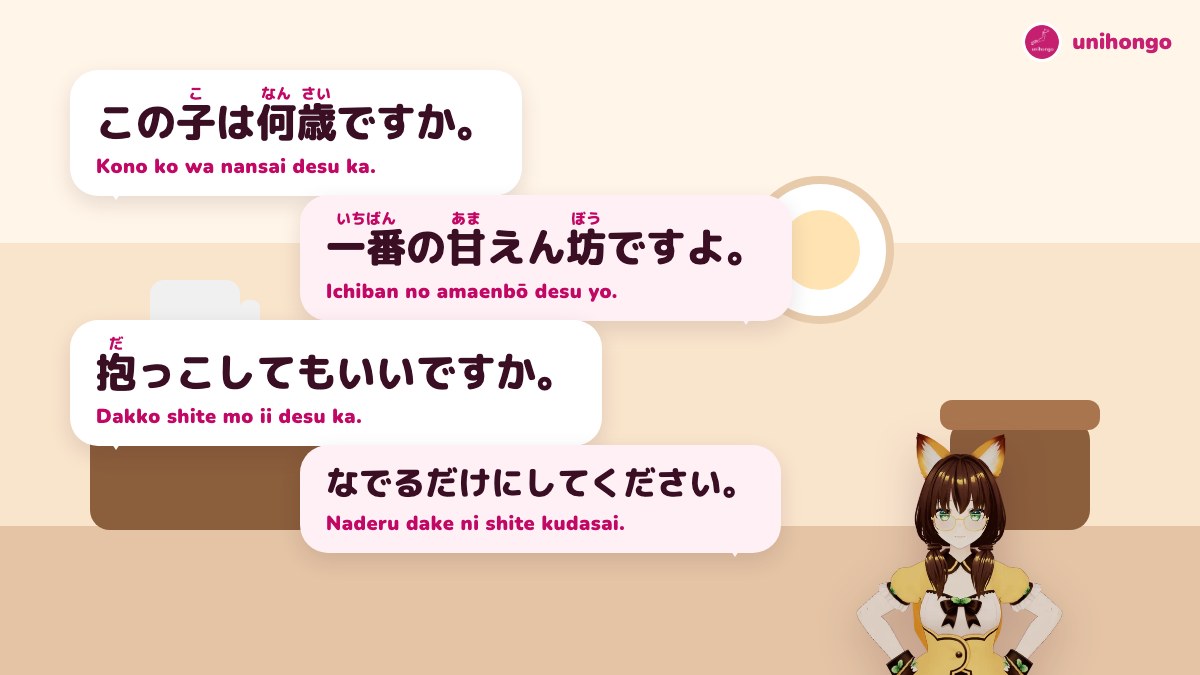
Cat cafés have rules and time fees, but once you are sitting on the floor, the real Japanese is about the cats themselves. Staff know every cat's name, age and temperament, and they love being asked. The dialogue below is the one you will have at any cat café, and it works just as well at a friend's house with their cat.
| Japanese | Romaji | Meaning |
|---|---|---|
| この子は何歳ですか。 | Kono ko wa nansai desu ka. | You: How old is this one? |
| 三歳です。一番の甘えん坊ですよ。 | Sansai desu. Ichiban no amaenbō desu yo. | Staff: Three. He's the clingiest of all. |
| 名前は何ですか。 | Namae wa nan desu ka. | You: What's his name? |
| モモです。おやつが大好きです。 | Momo desu. Oyatsu ga daisuki desu. | Staff: Momo. He loves treats. |
| 抱っこしてもいいですか。 | Dakko shite mo ii desu ka. | You: May I pick him up? |
| 抱っこは苦手なので、なでるだけにしてください。 | Dakko wa nigate na node, naderu dake ni shite kudasai. | Staff: He doesn't like being held, so just stroke him, please. |
| かわいいですね。ゴロゴロ言ってる。 | Kawaii desu ne. Gorogoro itteru. | You: So cute. He's purring. |
Kono ko, this kid, is what everyone says for a cat whose name they do not know yet, and it sounds far warmer than kono neko. Dakko is the baby word for being carried, and it is the normal word for picking up a cat.
Cat idioms that are real
Japanese has many cat idioms, and the ones below are genuinely common. Each has a literal picture, which is what makes them easy to remember. The table shows the picture; the phrase rows show the idiom inside a sentence, because an idiom you cannot put in a sentence is just trivia.
| Japanese | Romaji | Meaning |
|---|---|---|
| 今週は猫の手も借りたいくらい忙しい。 | Konshū wa neko no te mo karitai kurai isogashii. | This week I'm busy enough to borrow a cat's paws. (casual) |
| 彼は初対面では猫をかぶる。 | Kare wa shotaimen de wa neko o kaburu. | He puts on a sweet act when he first meets people. |
| うちの庭は猫の額ほどです。 | Uchi no niwa wa neko no hitai hodo desu. | Our garden is the size of a cat's forehead. |
| 猫舌なので、少し冷まします。 | Nekojita na node, sukoshi samashimasu. | I can't take hot food, so I'll let it cool a little. |
| 猫背になっていますよ。 | Nekoze ni natte imasu yo. | You're hunching your back. |
| 新しい職場では借りてきた猫みたいでした。 | Atarashii shokuba de wa karitekita neko mitai deshita. | At the new job I was as quiet as a borrowed cat. |
| Idiom | Literal picture | What it means |
|---|---|---|
| 猫の手も借りたい neko no te mo karitai | I'd borrow even a cat's paws | desperately busy |
| 猫をかぶる neko o kaburu | to wear a cat | to act sweeter or quieter than you are |
| 猫の額 neko no hitai | a cat's forehead | a tiny space, usually a garden or room |
| 猫舌 nekojita | cat tongue | unable to eat or drink hot things |
| 猫背 nekoze | cat back | hunched posture |
| 猫に小判 neko ni koban | gold coins to a cat | something valuable wasted on someone |
| 借りてきた猫 karitekita neko | a borrowed cat | unusually quiet in an unfamiliar place |
Cat sounds and the words for fluff
Japanese cats say nyā, and Japanese people describe them with sound words that double as verbs. Gorogoro is purring, shā is a hiss, surisuri is rubbing against your leg, fumifumi is kneading, and mofumofu is the fluffy feel of a long-haired cat; it is also a verb, mofumofu suru, to bury your hands in the fluff. These words appear on every cat-related post online, so they are worth knowing for reading as well as speaking.
| Japanese | Romaji | Meaning |
|---|---|---|
| にゃーと鳴きました。 | Nyā to nakimashita. | It meowed. |
| すりすりしてきた。 | Surisuri shite kita. | It came and rubbed against me. (casual) |
| もふもふしたい! | Mofumofu shitai! | I want to bury my hands in that fluff! |
| シャーって言われた。 | Shā tte iwareta. | I got hissed at. (casual) |
| ふみふみしている。 | Fumifumi shite iru. | It's kneading. |
Mistakes and register notes
- Motte imasu for having a cat. Use katte imasu; motsu is for objects. Neko ga imasu, there is a cat at my place, also works.
- Mixing up the hiki counter. Ippiki, nihiki, sanbiki, yonhiki, gohiki, roppiki, nanahiki, happiki, kyūhiki, juppiki. The b and p changes are what listeners notice.
- Calling your own cat petto in conversation. Owners say uchi no neko or uchi no ko; petto is for forms and shop signs.
- Neko-san for a cat. Chan is the affectionate suffix for animals; san sounds like a joke, which is sometimes intended.
- Saying neko no te mo karitai when you are only a little busy. It implies a crisis; for a normal busy week, say chotto isogashii.
- Feeding a confident cat at a shrine or park. Check for a sign first, and ask Esa o agete mo ii desu ka if staff are nearby.
Turn your cat into a study partner
A cat is a daily event: it eats, sleeps, knocks things over and wants attention at six in the morning. Describe each event in one Japanese sentence as it happens and you have a study routine that never needs a reminder.
If you want the sentences checked, sign in to Unihongo and send them to Mocchi, the study assistant: type /correct and three lines about what your cat did today, and Mocchi returns the natural version with the particles and counter fixed and a note on any word an owner would phrase differently. Mocchi keeps track of the idioms you have met, so a later /quiz can test neko o kaburu and nekojita without you asking. For the vocabulary, /create-flashcards with a photo of your own cat makes cards that are hard to forget, and Flashcard Flip in the games section turns them into a two-minute match. Everything here works on a free account at unihongo.com/login, which takes less time than feeding the cat.
Your turn
Answer these out loud about a real cat, your own or a neighbour's.
- Name, age, coat pattern and two personality words.
- What did the cat do this morning? One sentence with a sound word.
- Is your home neko no hitai or big enough for a cat tower?
- Are you nekojita? What do you let cool first?
- Ask a cat-café staff member two questions about a cat you cannot see.