
The words on the trail map
A Japanese piste map is a vocabulary lesson you can hold in a glove. Runs are colour-coded and labelled shokyū, chūkyū or jōkyū, with the pattern X sha muke, for X-level riders, on the signs. Lifts are rifuto, gondolas are gondora, and the base is often called the beesu or simply shita, down there. Night skiing is naitā, from night game, and a run through the trees is a rinkan kōsu.
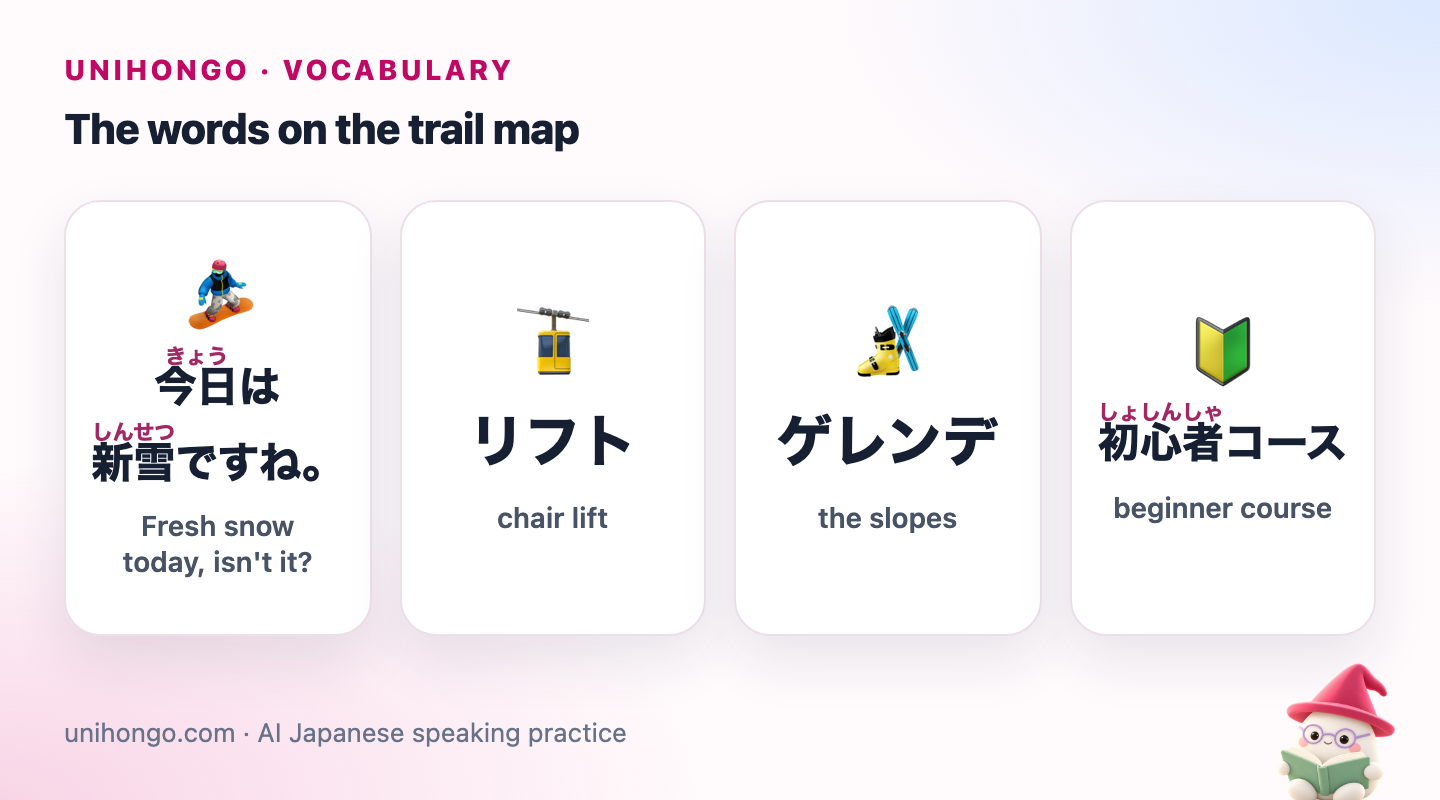
The first card is the sentence that starts every lift conversation on a good morning. The next three are the words you will read most on the map.
| Japanese | Romaji | Meaning |
|---|---|---|
| 今日は新雪ですね。 | Kyō wa shinsetsu desu ne. | Fresh snow today, isn't it? |
| リフト | rifuto | chair lift |
| ゲレンデ | gerende | the slopes |
| 初心者コース | shoshinsha kōsu | beginner course |
| 上級者向け | jōkyūsha muke | for advanced riders |
| 圧雪 | assetsu | groomed snow |
| 非圧雪 | hiassetsu | ungroomed |
| コブ | kobu | moguls |
| 林間コース | rinkan kōsu | run through the trees |
| ナイター | naitā | night skiing |
| 滑走禁止 | kassō kinshi | Sign: no skiing or riding |
Snow talk: the conditions and how to say them
Snow conditions are the small talk of every mountain, and Japanese riders discuss them in the same detail as anyone else. The word for snow quality is yukishitsu, and Yukishitsu ga saikō desu, the snow quality is superb, is the highest praise. The table covers what you will hear in the lift queue and at breakfast.
| Japanese | Romaji | Meaning |
|---|---|---|
| 今日はパウダーですね。 | Kyō wa paudā desu ne. | Powder today! |
| 雪質が最高です。 | Yukishitsu ga saikō desu. | The snow quality is superb. |
| 朝はアイスバーンでした。 | Asa wa aisubān deshita. | It was icy this morning. |
| 午後は雪が重くなりますね。 | Gogo wa yuki ga omoku narimasu ne. | The snow gets heavy in the afternoon. |
| 夜にたくさん降ったそうです。 | Yoru ni takusan futta sō desu. | I hear it snowed a lot overnight. |
| 明日は吹雪の予報です。 | Ashita wa fubuki no yohō desu. | The forecast says a blizzard tomorrow. |
| Condition | Japanese | When you hear it |
|---|---|---|
| fresh snow | 新雪 shinsetsu | the morning after a snowfall |
| powder | パウダー paudā | deep, dry snow, the reason people come |
| groomed | 圧雪 assetsu | corduroy runs early in the day |
| icy | アイスバーン aisubān | cold mornings, late season |
| heavy, wet | 重い omoi | warm afternoons, spring |
| slushy | シャバシャバ shabashaba | spring slush, casual |
| whiteout | ホワイトアウト howaitoauto | blizzard days, stay low |
Sō desu after a plain verb, as in futta sō desu, means I hear that; it is how you pass on the morning snow report you read on your phone. Yohō is a forecast, and fubuki a blizzard, both common on the resort's status board.
Asking about courses
The questions below are the ones you will ask at the information desk, the lift attendant or the stranger beside you. Staff answers lean on three adjectives: haba ga hiroi, wide; nadaraka, gentle; kyū, steep. They also use the colours on the map, so learn midori, ao and aka for green, blue and red, with the warning that colour schemes vary between resorts.
| Japanese | Romaji | Meaning |
|---|---|---|
| 初心者でも大丈夫なコースはどれですか。 | Shoshinsha demo daijōbu na kōsu wa dore desu ka. | Which course is fine even for a beginner? |
| このリフトは上級者向けですか。 | Kono rifuto wa jōkyūsha muke desu ka. | Is this lift for advanced riders? |
| 下まで滑って降りられますか。 | Shita made subette oriraremasu ka. | Can I ride all the way down to the base? |
| 一番長いコースはどれですか。 | Ichiban nagai kōsu wa dore desu ka. | Which is the longest course? |
| ゴンドラは何時までですか。 | Gondora wa nanji made desu ka. | Until what time does the gondola run? |
| 中級者向けですが、幅が広いので大丈夫ですよ。 | Chūkyūsha muke desu ga, haba ga hiroi node daijōbu desu yo. | Staff: It's intermediate, but wide, so you'll be fine. |
| あそこは急なので気をつけてください。 | Asoko wa kyū na node ki o tsukete kudasai. | Staff: That part is steep, so take care. |
The rental counter in one exchange
The rental counter asks the same questions in every resort: what you want, for how long, your height and boot size, and for snowboarders your stance. Regyurā and gūfī, regular and goofy, are used in Japanese exactly as in English, and the staff will ask Sutansu wa? while they set the bindings. Boot sizes are in centimetres.
| Japanese | Romaji | Meaning |
|---|---|---|
| スノーボードのセットを一日お願いします。 | Sunōbōdo no setto o ichinichi onegai shimasu. | You: A snowboard set for one day, please. |
| 身長と靴のサイズを教えてください。 | Shinchō to kutsu no saizu o oshiete kudasai. | Staff: Please tell me your height and shoe size. |
| スタンスはレギュラーですか、グーフィーですか。 | Sutansu wa regyurā desu ka, gūfī desu ka. | Staff: Regular or goofy stance? |
| レギュラーで、ブーツは二十六です。 | Regyurā de, būtsu wa nijūroku desu. | You: Regular, and boots in twenty-six. |
| ウェアも借りられますか。 | Wea mo kariraremasu ka. | You: Can I rent outerwear too? |
| 返却は四時までにお願いします。 | Henkyaku wa yoji made ni onegai shimasu. | Staff: Please return everything by four. |
Chair-lift small talk
A chair lift is a five-minute conversation with a stranger who shares your hobby, which is the best language practice a trip can offer. Japanese riders tend to open with where you are from and how long you have been riding; the n desu ka ending makes the questions sound curious rather than official. Keep answers short, add one comment on the snow, and say Ki o tsukete when you unload.
Register: lift talk sits between polite and casual. Use desu and masu with the n desu ka softener; if the other person switches to casual, you can follow, but you do not have to.
| Japanese | Romaji | Meaning |
|---|---|---|
| どちらから来たんですか。 | Dochira kara kita n desu ka. | Stranger: Where did you come from? |
| オーストラリアからです。初めての日本です。 | Ōsutoraria kara desu. Hajimete no Nihon desu. | You: From Australia. My first time in Japan. |
| スノボは長いんですか。 | Sunobo wa nagai n desu ka. | Stranger: Have you been snowboarding long? |
| 二年目です。まだ転んでばかりです。 | Ninenme desu. Mada koronde bakari desu. | You: Second season. I still fall all the time. |
| 今日はどのコースを滑りましたか。 | Kyō wa dono kōsu o suberimashita ka. | You: Which course did you ride today? |
| 降りるとき、気をつけてね。 | Oriru toki, ki o tsukete ne. | Stranger: Careful getting off. (casual) |
Koronde bakari, falling all the time, uses te form plus bakari for a habit you are not proud of. It is self-deprecating in the right way and reliably gets a laugh and a Daijōbu, minna sō desu yo, everyone's like that.
Après-ski: talking about the day
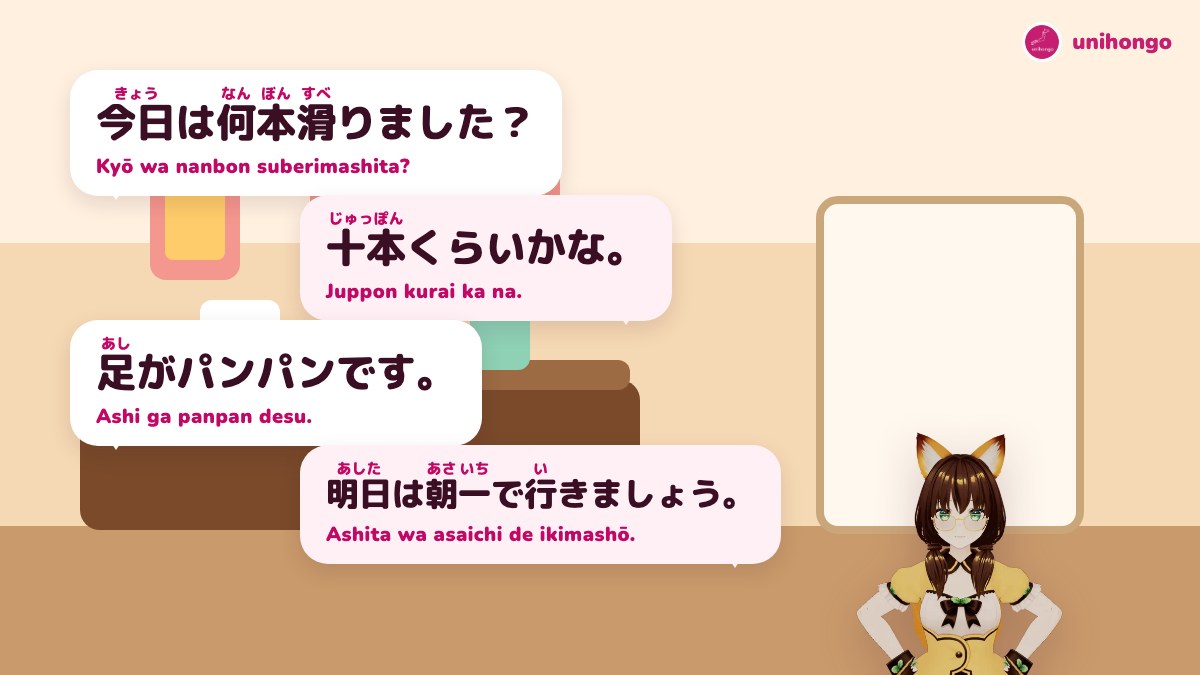
The best Japanese of the trip happens at dinner, when everyone compares the day. The unit is hon, the counter for long things, which riders use for runs: nanbon, how many runs. The body is the other topic: Ashi ga panpan, my legs are stuffed tight, is the universal end-of-day sentence, and Onsen ni haitte kara neru, I'll get in the hot spring and then sleep, is the universal plan.
| Japanese | Romaji | Meaning |
|---|---|---|
| 今日は何本滑りました? | Kyō wa nanbon suberimashita? | Friend: How many runs did you do today? |
| 十本くらいかな。午前中はパウダーで最高でした。 | Juppon kurai ka na. Gozenchū wa paudā de saikō deshita. | You: About ten, maybe. The morning powder was the best. |
| 足がパンパンです。 | Ashi ga panpan desu. | You: My legs are completely done. |
| 明日も滑りますか。 | Ashita mo suberimasu ka. | Friend: Riding again tomorrow? |
| 温泉に入ってから寝ます。 | Onsen ni haitte kara nemasu. | You: I'll get in the hot spring and then sleep. |
| 明日は朝一で行きましょう。 | Ashita wa asaichi de ikimashō. | Friend: Let's go first thing tomorrow. |
Mistakes and register notes
- Saying sukī for snowboarding. Suberu, to slide, covers both sports; say sunobo o suru or sunobo for snowboarding specifically. Sunōbōdo is the full word and sounds a little formal in conversation.
- Erebētā for the lift. The chair lift is rifuto; an erebētā is in the hotel.
- Ochiru for a fall. Korobu is to fall over on the snow; ochiru is to fall off something, such as the lift, which is a different conversation.
- Replying Arigatō to Jōzu desu ne. When someone praises your riding, Mada mada desu, I've still got a long way to go, is the expected modest reply.
- Reading every resort's colours the same way. Colour grading differs between resorts; the words shokyū, chūkyū and jōkyū on the map are what count.
- Using panpan outside the body. Ashi ga panpan is for tired, swollen legs; the word also means stuffed full, so an onigiri can be panpan too, but your day cannot.
Make the trip your study plan
A trip has a date, which is what most study plans lack. Count back two weeks and give each week a job: the first for the map words and conditions, the second for the lift and dinner conversations. Say your morning snow report aloud every day, even if the only snow is on your phone screen.
Mocchi, the study assistant at Unihongo, can run those two weeks for you: tell it the date of your trip and ask for a plan with /plan, and it builds daily tasks around the words in this post, moves them if you miss a day, and ticks them off as you go. For the spoken part, open AI Sensei and ask Ibuki-sensei to play a local snowboarder you met on the lift; run the small talk, then the après-ski dialogue, and ask Ibuki-sensei to switch to casual speech so you hear how friends actually sound. The session report tells you which run-counting and snow words came out wrong before the mountain does. A free account at unihongo.com/login is enough to start the two weeks tonight.
Your turn
Say these out loud before the trip; by the second day they will come out on their own.
- Give today's snow report in three sentences, even from your sofa.
- Ask which course is fine for a beginner and whether you can ride to the base.
- Tell a stranger on the lift where you are from and how long you have been riding.
- Count your runs and say which was the best.
- Describe how your legs feel and what you will do before bed.