
The tools on the desk
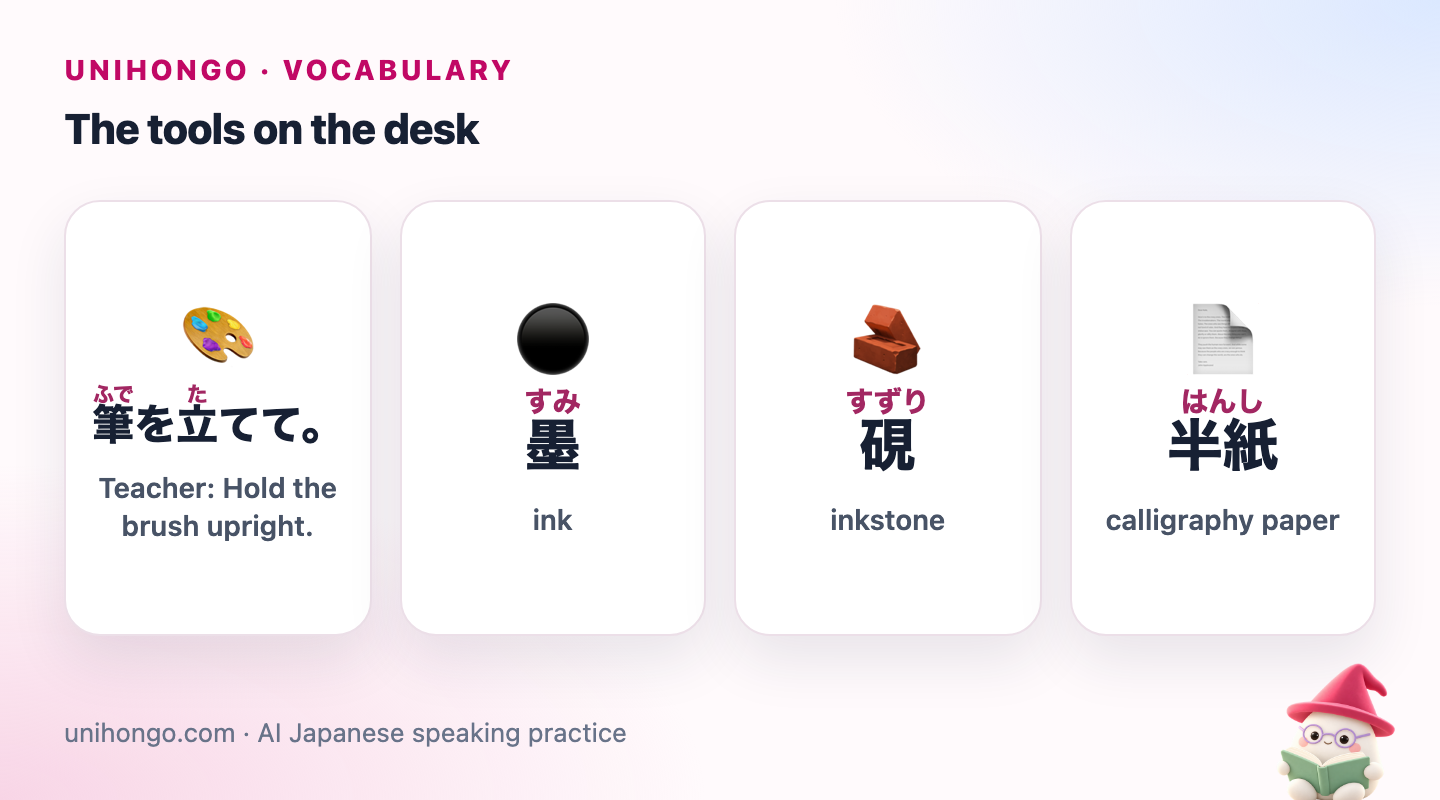
The classic set is called the bunbō shihō, the four treasures of the study: fude, the brush; sumi, the ink stick; suzuri, the inkstone; and kami, the paper, which in a class is hanshi, a standard half-size sheet. Around them sit the bunchin, a metal paperweight; the shitajiki, a felt mat under the paper; the fudeoki, a brush rest; and often a bottle of bokujū, ready-made liquid ink, which most classes use instead of grinding a stick.
The first card is the instruction you will hear most in your first month. The others are the three things you will touch every time you sit down.
| Japanese | Romaji | Meaning |
|---|---|---|
| 筆を立てて。 | Fude o tatete. | Teacher: Hold the brush upright. |
| 墨 | sumi | ink |
| 硯 | suzuri | inkstone |
| 半紙 | hanshi | calligraphy paper |
| 文鎮 | bunchin | paperweight |
| 下敷き | shitajiki | felt mat under the paper |
| 筆置き | fudeoki | brush rest |
| 墨汁 | bokujū | liquid ink |
| 墨をすります。 | Sumi o surimasu. | I grind the ink. |
| 筆を洗います。 | Fude o araimasu. | I wash the brush. |
Strokes: tome, hane and harai
Every character is built from strokes, kaku, and each stroke ends in one of three ways. Tome is a firm stop: the brush presses and lifts. Hane is a flick: the brush stops, then springs off in a new direction. Harai is a sweep: the brush lifts gradually so the line tapers. A horizontal stroke is ōkaku, a vertical one jūkaku, and a dot is ten. Stroke order, kakijun, matters more in shodō than in handwriting, because the brush shows where you hesitated.
| Japanese | Romaji | Meaning |
|---|---|---|
| とめ | tome | a firm stop |
| はね | hane | a flick or hook |
| はらい | harai | a tapering sweep |
| 点 | ten | a dot |
| 横画 | ōkaku | horizontal stroke |
| 縦画 | jūkaku | vertical stroke |
| 書き順 | kakijun | stroke order |
| ここはしっかりとめます。 | Koko wa shikkari tomemasu. | Teacher: Stop firmly here. |
| 最後は右にはらいます。 | Saigo wa migi ni haraimasu. | Teacher: Sweep to the right at the end. |
| はねる前に一度止めて。 | Haneru mae ni ichido tomete. | Teacher: Stop once before you flick. |
Notice the verbs behind the nouns: tomeru, haneru, harau. Teachers switch between the noun, Hane ga yowai, your hook is weak, and the verb, Motto hanete, flick more. Learn both forms together.
The three scripts
Beginners start with kaisho, the square, print-like script where every stroke is separate. Gyōsho is semi-cursive: strokes connect and the brush rarely leaves the paper. Sōsho is fully cursive and often unreadable without training. Two older scripts, reisho and tensho, appear on seals and formal works. A teacher will say Mazu wa kaisho kara, kaisho first, and may keep you there for a year.
| Japanese | Romaji | Meaning |
|---|---|---|
| まずは楷書から始めましょう。 | Mazu wa kaisho kara hajimemashō. | Teacher: Let's start with the square script. |
| 行書は難しそうです。 | Gyōsho wa muzukashisō desu. | The semi-cursive script looks hard. |
| 草書は読めません。 | Sōsho wa yomemasen. | I can't read cursive script. |
| Script | Reading | What it looks like |
|---|---|---|
| 楷書 | kaisho | square, every stroke separate; the beginner script |
| 行書 | gyōsho | semi-cursive, strokes flow together |
| 草書 | sōsho | fully cursive, abbreviated forms |
| 隷書 | reisho | clerical script, wide and flat |
| 篆書 | tensho | seal script, used on stamps |
What the teacher says
Instructions come in the te form without kudasai, which is normal from a teacher to a student and is not rude. Posture comes first: Shisei o tadashite, straighten your posture; Sesuji o nobashite, stretch your spine. Then the brush: Fude o tatete, upright; Hitsuatsu ga tsuyosugimasu, too much pressure. Then ink: Sumi o tsukesugi desu, too much ink. Then speed: Ikki ni kaite, write it in one go, because a hesitant stroke shows. And always, at the end, Mō ichimai, one more sheet.
| Japanese | Romaji | Meaning |
|---|---|---|
| 姿勢を正して。 | Shisei o tadashite. | Teacher: Straighten your posture. |
| 背筋を伸ばして。 | Sesuji o nobashite. | Teacher: Stretch your back. |
| 筆圧が強すぎます。 | Hitsuatsu ga tsuyosugimasu. | Teacher: You're pressing too hard. |
| もっと太く。 | Motto futoku. | Teacher: Thicker. |
| 墨をつけすぎです。 | Sumi o tsukesugi desu. | Teacher: Too much ink on the brush. |
| 一気に書いて。 | Ikki ni kaite. | Teacher: Write it in one go. |
| お手本をよく見て。 | Otehon o yoku mite. | Teacher: Look carefully at the model. |
| もう一枚書いてみましょう。 | Mō ichimai kaite mimashō. | Teacher: Let's try one more sheet. |
A correction at the desk
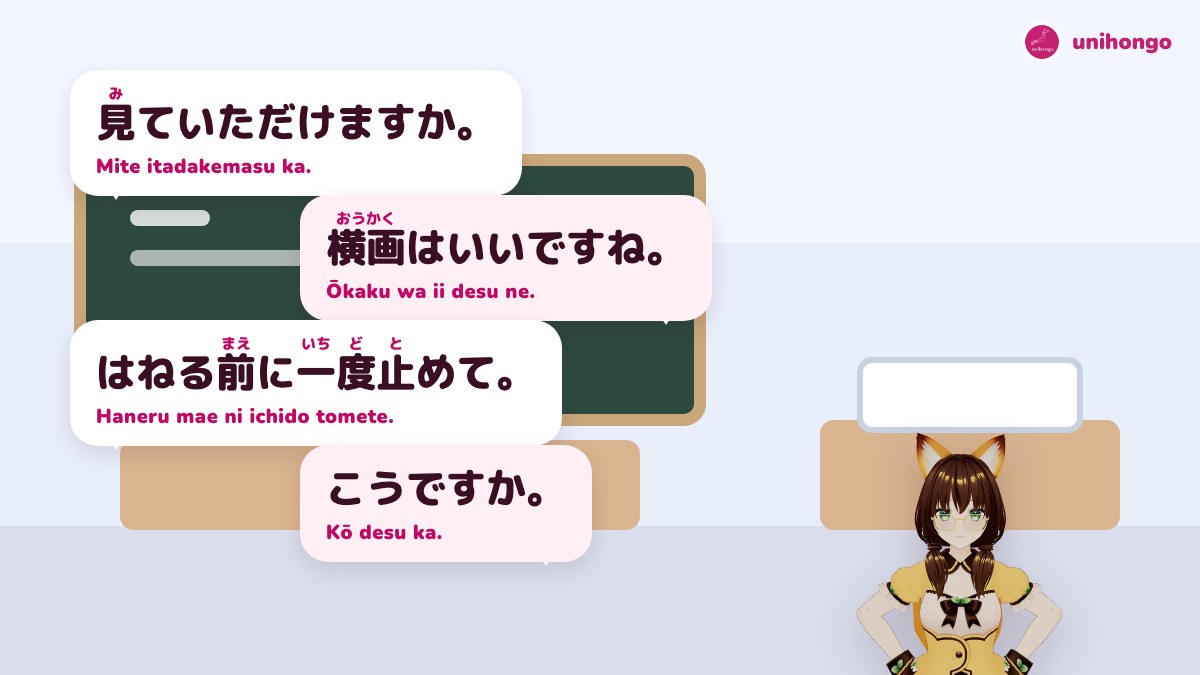
Corrections in a shodō class are visual: the teacher takes your sheet, writes over your weak stroke in red ink, shu, and says one or two sentences. Your job is to answer briefly, try again and ask when you do not understand. The dialogue below is the whole exchange. Say Hai while they talk, Kō desu ka while you try, and Arigatō gozaimashita when they hand the sheet back.
| Japanese | Romaji | Meaning |
|---|---|---|
| 見ていただけますか。 | Mite itadakemasu ka. | You: Could you look at this, please? |
| うん、横画はいいですね。 | Un, ōkaku wa ii desu ne. | Teacher: Yes, the horizontal strokes are good. |
| ありがとうございます。はねが難しいです。 | Arigatō gozaimasu. Hane ga muzukashii desu. | You: Thank you. The flick is hard. |
| はねる前に、一度筆を止めて。 | Haneru mae ni, ichido fude o tomete. | Teacher: Stop the brush once before you flick. |
| こうですか。 | Kō desu ka. | You: Like this? |
| そうそう。もう一枚書いてみましょう。 | Sō sō. Mō ichimai kaite mimashō. | Teacher: That's it. Let's try one more sheet. |
| ここはどう直せばいいですか。 | Koko wa dō naoseba ii desu ka. | You: How should I fix this part? |
Kō desu ka, like this?, said while you make the movement, is the most useful question in any physical lesson. It gets you a yes or a corrected demonstration without a long sentence.
Class words: model, practice and fair copy
A class runs on a few nouns. The tehon, or otehon with the polite prefix, is the model you copy. Renshū is practice, and the sheets pile up. Seisho is the fair copy, the one sheet you write carefully at the end to submit or keep. A finished work is a sakuhin, and it may carry a rakkan, the signature and seal, and a gagō, an art name given by the teacher after some years. Many schools run a grading system of kyū and dan ranks, but the systems belong to individual associations and are not comparable between them.
| Japanese | Romaji | Meaning |
|---|---|---|
| お手本 | otehon | the model to copy |
| 練習 | renshū | practice |
| 清書 | seisho | the fair copy |
| 作品 | sakuhin | a finished work |
| 落款 | rakkan | signature and seal |
| 書き初め | kakizome | the first writing of the year |
| 今日は清書を出します。 | Kyō wa seisho o dashimasu. | Today I'll submit my fair copy. |
| 練習は何枚書きましたか。 | Renshū wa nanmai kakimashita ka. | Teacher: How many practice sheets did you write? |
Etiquette, praise and the mistakes to avoid
Praise in a shodō class is specific: Ii sen desu ne, that is a good line; Koko ga yoku narimashita, this part has improved. Answer with Arigatō gozaimasu and, if you like, Mada mada desu, there is still a long way to go. Thank the teacher at the end with Arigatō gozaimashita in the past tense, because the lesson is over.
| Japanese | Romaji | Meaning |
|---|---|---|
| いい線ですね。 | Ii sen desu ne. | Teacher: That's a good line. |
| ここがよくなりました。 | Koko ga yoku narimashita. | Teacher: This part has improved. |
| まだまだです。 | Mada mada desu. | You: I still have a long way to go. |
| 今日もありがとうございました。 | Kyō mo arigatō gozaimashita. | You: Thank you for today's lesson. |
- Blowing on the ink to dry it. Let it dry, or move the sheet carefully to the drying space; blowing spatters ink and looks careless.
- Leaving the brush standing in ink. Wash it, shape the tip and lay it on the fudeoki or hang it; a teacher will notice a brush that was left to dry hard.
- Calling the work an e, a picture. It is a sakuhin, a work, or simply ji, characters.
- Saying shūji for an adult art class. Shūji is school penmanship; adults say shodō, and a teacher is shodō no sensei.
- Asking what rank the teacher is. Grades belong to associations and differ widely; it is not a polite first question.
- Replying Hai, jōzu desu when praised. Praise goes one way; the reply is thanks and modesty, never agreement.
Rehearse the class before the class
Because a shodō lesson repeats the same instructions, you can learn them before your first class and spend the class on the brush instead of the vocabulary. Read the teacher lines aloud with the gesture; after a week they are reflexes.
Two tools help. Ask Mocchi, Unihongo's study assistant, for /kanji 永 and it explains the character whose eight strokes are traditionally taught as the basic brush movements, with stroke order and readings; then ask it to quiz you on the tool and stroke words with /quiz, and it remembers which ones you missed for next time. For the spoken side, choose Yamada-sensei in AI Sensei and ask Yamada-sensei to play a shodō teacher; have Yamada-sensei instruct you, correct a stroke and praise one, and reply the way this post shows. Ask him to speak slowly the first time and at class speed the second. The session report lists the instructions you did not catch. A free account at unihongo.com/login is enough to try this before your first lesson.
Your turn
Say these with a brush in your hand, or a pen if that is what you have.
- Name the four treasures on your desk, and the three things beside them.
- Say the three stroke endings as you write a character with all three.
- Give yourself three teacher instructions and obey them.
- Ask the teacher to look at your sheet and how to fix the weak stroke.
- Respond to praise, then thank the teacher for today's lesson.