
The condition words on the tag
Every tag in a Japanese game shop uses the same fixed phrases, which is why the hobby is such a good reading lesson. Zumi after a noun means done: dōsa kakunin zumi, operation checked; denchi kōkan zumi, battery replaced; seisō zumi, cleaned. Tsuki means included and nashi means without: hako tsuki, hako nashi. Ari means present: kizu ari, has scratches; hiyake ari, has yellowing. Bihin, a beautiful item, is a clean example; ryōhin is good; the shop's own grades vary, so read the words rather than the letters.
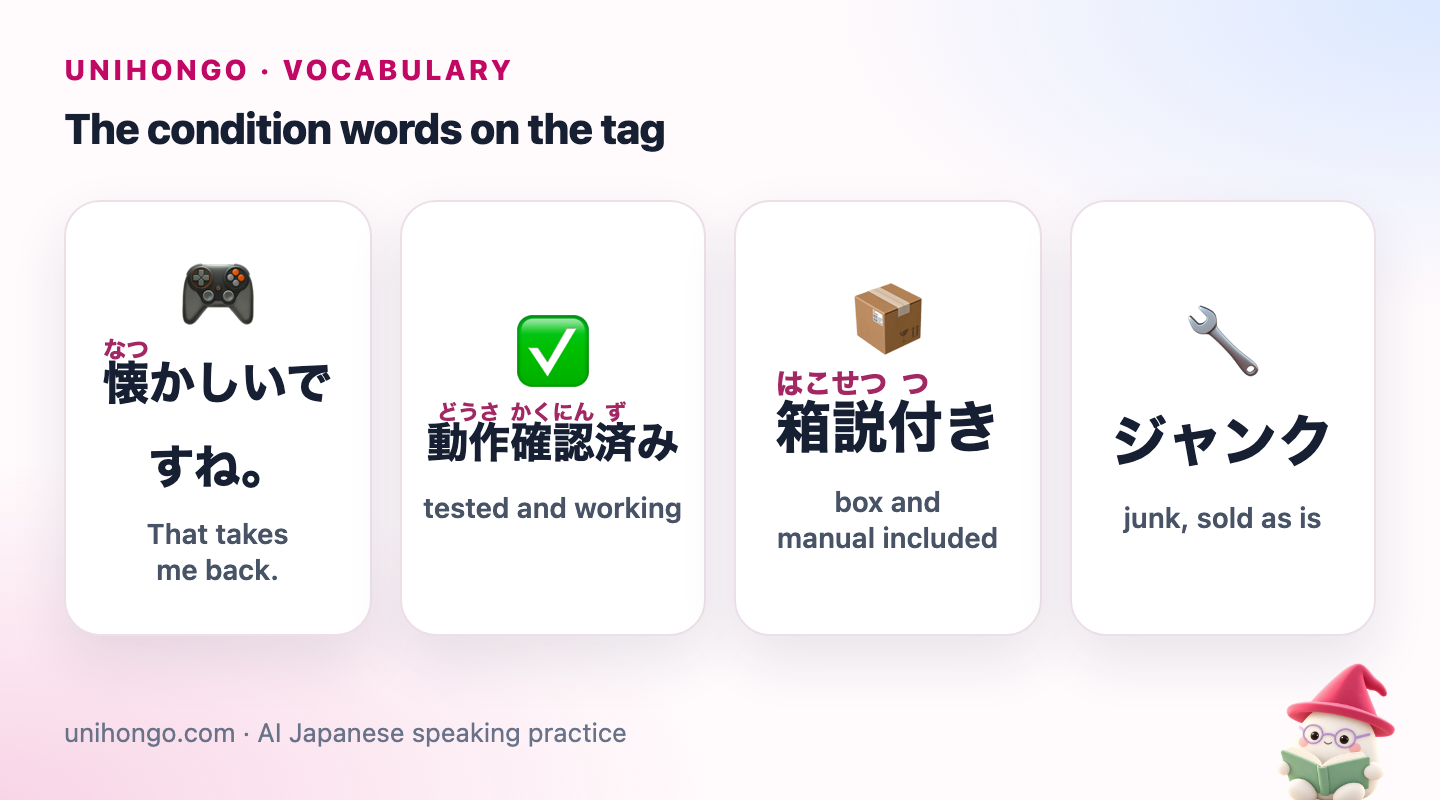
The first card is what you will say when you find a game from your childhood. The next three are the tag words you will read most.
| Japanese | Romaji | Meaning |
|---|---|---|
| 懐かしいですね。 | Natsukashii desu ne. | That takes me back. |
| 動作確認済み | dōsa kakunin zumi | tested and working |
| 箱説付き | hako setsu tsuki | box and manual included |
| ジャンク | janku | junk, sold as is |
| ソフトのみ | sofuto nomi | cartridge or disc only |
| 動作未確認 | dōsa mikakunin | untested |
| 日焼けあり | hiyake ari | has sun-yellowing |
| 傷あり | kizu ari | has scratches |
| 美品 | bihin | clean example |
| 欠品 | keppin | missing parts |
| 電池交換済み | denchi kōkan zumi | save battery replaced |
Consoles, cartridges and the nicknames
Hardware is hontai, the main body, and a game is sofuto, software, even when it is a plastic cartridge; the cartridge itself is a kasetto, and a disc a disuku. Controllers are kontorōrā, cables kēburu, and the connector pins on a cartridge are tanshi, which is where the classic problem lives: sesshoku ga warui, bad contact. The console nicknames are what everyone says. Famikon is the Famicom, Sūfami the Super Famicom, Purestē the PlayStation, Mega Dora the Mega Drive; the Game Boy is usually said in full, Gēmu Bōi. Shodai means the first model; kōkigata the later revision. Kokunaiban is the Japanese release and kaigaiban the overseas one.
| Japanese | Romaji | Meaning |
|---|---|---|
| 本体 | hontai | the console itself |
| ソフト | sofuto | a game |
| カセット | kasetto | cartridge |
| 端子 | tanshi | connector, pins |
| 付属品 | fuzokuhin | accessories, what comes with it |
| 初代ファミコンを探しています。 | Shodai Famikon o sagashite imasu. | I'm looking for a first-model Famicom. |
| 国内版ですか、海外版ですか。 | Kokunaiban desu ka, kaigaiban desu ka. | Is it the Japanese or the overseas release? |
| Nickname | Full name | What you may hear |
|---|---|---|
| ファミコン Famikon | Family Computer | the console that started it; shodai, first model |
| スーファミ Sūfami | Super Famicom | hiyake is common on the grey plastic |
| メガドラ Mega Dora | Mega Drive | ask about the region, kokunaiban or kaigaiban |
| ゲームボーイ Gēmu Bōi | Game Boy, said in full | check the screen, gamen, for dead lines |
| プレステ Purestē | PlayStation | the disc tray, yomikomi, reading, can fail |
| ピーシーエンジン | PC Engine | small, pricey, and often sold hontai nomi |
Sofuto for a game surprises English speakers, who expect gēmu. Gēmu is the activity or the title in conversation; sofuto is the physical product on the shelf, and the shop's signs say sofuto.
The signs on the shelves
Shop signs use a written register with its own fixed words, and the same signs hang in every retro shop in the country. Nyūka is new stock, kaitori is the shop buying from customers, satei is the appraisal they give you for yours, hoshō is the warranty, and hoshō nashi its absence. Puremia means a title that has become expensive, and reagēmu a rare one. Gekiyasu, cheap, and sēru, sale, are the two words collectors scan for.
| Japanese | Romaji | Meaning |
|---|---|---|
| 本日入荷 | honjitsu nyūka | Sign: in today |
| 買取強化中 | kaitori kyōkachū | Sign: we are buying, good prices |
| 査定無料 | satei muryō | Sign: free appraisal |
| 中古品は保証なし | chūkohin wa hoshō nashi | Sign: no warranty on used items |
| お一人様一点限り | ohitorisama itten kagiri | Sign: one per customer |
| ジャンクコーナー | janku kōnā | Sign: junk corner |
| プレミアソフト | puremia sofuto | Sign: premium-priced titles |
| 税込 | zeikomi | Tag: tax included |
| 試遊できます | shiyū dekimasu | Sign: you can try it |
Questions at the counter
Before buying, three questions cover what a tag cannot: does it work, can I try it, and can I return it if it does not. Many shops let you test a cartridge on a console at the counter if you ask politely; some do not, and will point to dōsa kakunin zumi on the tag instead. Returns on used goods are rarely accepted beyond a short period for a dead item, so ask before you pay. The staff forms are polite; yours are plain polite with sumimasen first.
Register note: the clerk will say Henpin wa uketsukete orimasen, we do not accept returns, in humble keigo. You only need to understand it. Your side is Dōsa shimasu ka and Tameshite mo ii desu ka.
| Japanese | Romaji | Meaning |
|---|---|---|
| すみません、これ、動作しますか。 | Sumimasen, kore, dōsa shimasu ka. | You: Excuse me, does this work? |
| 確認済みです。 | Kakunin zumi desu. | Clerk: It's been tested. |
| 試してもいいですか。 | Tameshite mo ii desu ka. | You: May I try it? |
| セーブはできますか。 | Sēbu wa dekimasu ka. | You: Can it save? |
| 電池は交換してあります。 | Denchi wa kōkan shite arimasu. | Clerk: The battery has been replaced. |
| 動かなかったら返品できますか。 | Ugokanakattara henpin dekimasu ka. | You: If it doesn't work, can I return it? |
| 一週間以内なら大丈夫です。 | Isshūkan inai nara daijōbu desu. | Clerk: Within a week is fine. |
| 箱に日焼けがありますが、中はきれいです。 | Hako ni hiyake ga arimasu ga, naka wa kirei desu. | Clerk: The box is yellowed, but the inside is clean. |
Shite arimasu, as in kōkan shite arimasu, means something has been done and is in that state now. Shops use it for repairs and replacements; it is the spoken cousin of the tag word zumi.
Talking games with the owner
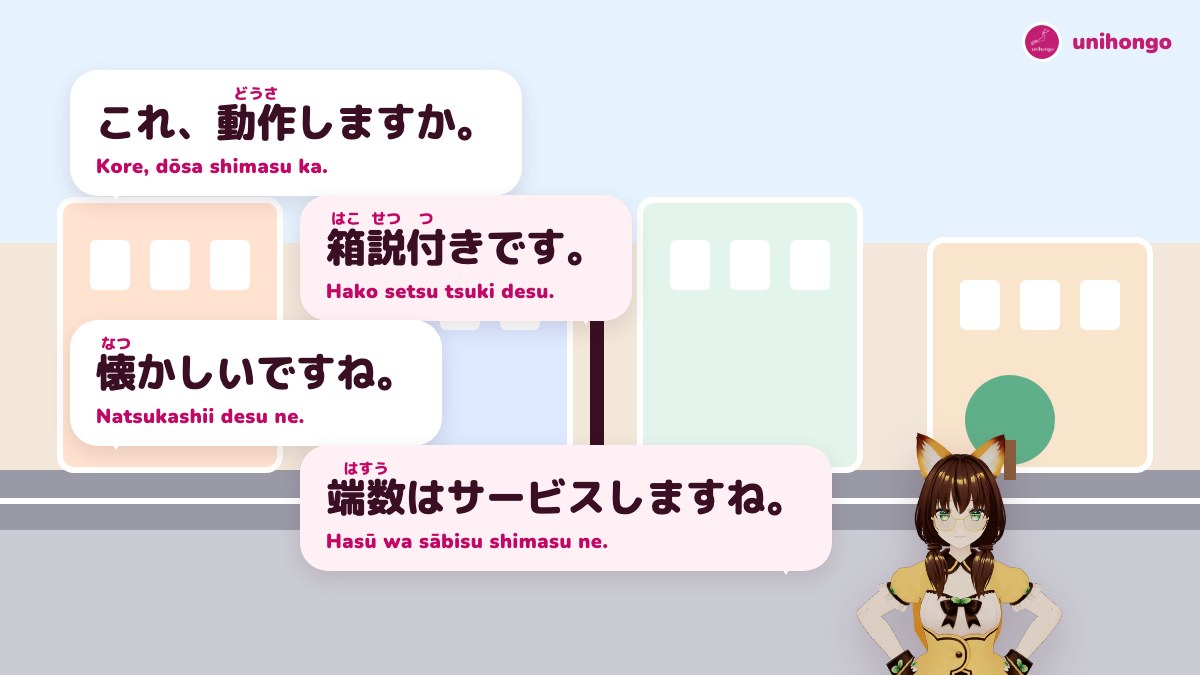
The best part of a small retro shop is the owner, who has usually played everything on the shelves and is pleased when a visitor cares about the games rather than the resale price. Say which game you came for and why, and the conversation starts itself. Natsukashii is the word that carries it: the owner says it about your childhood game, you say it about theirs. The dialogue below ends with the one polite attempt at a discount that is acceptable in a small independent shop when you buy several items.
| Japanese | Romaji | Meaning |
|---|---|---|
| このソフト、子どものころによく遊びました。 | Kono sofuto, kodomo no koro ni yoku asobimashita. | You: I played this one a lot as a child. |
| 名作ですよね。私もハマりました。 | Meisaku desu yo ne. Watashi mo hamarimashita. | Owner: A classic, isn't it. I was hooked too. |
| 箱と説明書は付いていますか。 | Hako to setsumeisho wa tsuite imasu ka. | You: Does it come with the box and manual? |
| 箱説付きです。説明書に少し折れがあります。 | Hako setsu tsuki desu. Setsumeisho ni sukoshi ore ga arimasu. | Owner: Box and manual. The manual has a small crease. |
| 三本まとめて買うので、少し安くなりませんか。 | Sanbon matomete kau node, sukoshi yasuku narimasen ka. | You: I'm taking all three; could you do a little off? |
| じゃあ、端数はサービスしますね。 | Jā, hasū wa sābisu shimasu ne. | Owner: All right, I'll knock off the odd amount. |
| ありがとうございます。また来ます。 | Arigatō gozaimasu. Mata kimasu. | You: Thank you. I'll be back. |
Asking for a discount, and when not to
Haggling is not part of normal shopping in Japan, and in chain stores and most Akihabara shops the price on the tag is the price; asking makes the clerk apologise, which helps nobody. Three situations are different, and even there the request is made once, softly, and dropped at the first no. Buying several things at a small independent shop, buying at a flea market or a retro game event, and buying a janku item with a visible fault all allow Sukoshi yasuku narimasen ka. Shops also sometimes round the odd amount off themselves, hasū o sābisu, as a courtesy you thank them for rather than expect.
| Japanese | Romaji | Meaning |
|---|---|---|
| まとめて買うので、少し安くなりませんか。 | Matomete kau node, sukoshi yasuku narimasen ka. | Since I'm buying several, could you do a little off? |
| これとこれで、いくらになりますか。 | Kore to kore de, ikura ni narimasu ka. | For this and this together, how much? |
| すみません、値引きはしていないんです。 | Sumimasen, nebiki wa shite inai n desu. | Clerk: Sorry, we don't do discounts. |
| わかりました。このままで大丈夫です。 | Wakarimashita. Kono mama de daijōbu desu. | You: Understood. This is fine as it is. |
| Where | Asking for a discount | What to say instead |
|---|---|---|
| chain shop, big Akihabara store | not done; prices are fixed | Zeikomi desu ka, is tax included? |
| small independent shop, several items | once, politely, when paying | Matomete kau node, sukoshi yasuku narimasen ka |
| flea market, retro game event | normal, still gentle | Kore to kore de ikura ni narimasu ka |
| a janku item with a fault | reasonable to mention the fault | Koko ga kowarete iru node, sukoshi… |
Yasuku narimasen ka, won't it become cheaper, asks the price to move by itself, which is softer than asking the person to lower it. Nebiki is the noun for a discount; Nebiki dekimasu ka is the blunter version, and the one to avoid.
Mistakes and register notes
- Gēmu for the product. Ask for sofuto when you mean the cartridge or disc; gēmu is the activity or the title.
- Reading bihin as mint. Bihin means clean and good-looking by the shop's own standard, which varies; look at the item, not the word.
- Trusting dōsa kakunin zumi for the save battery. Tested means it boots; ask Sēbu wa dekimasu ka separately if saving matters to you.
- Haggling in a chain store. It is not done, and the clerk cannot say yes; save the question for a small shop and ask once.
- Opening sealed items to check. Mikaifū, unopened, is a selling point; ask before touching anything in a glass case, and expect to be shown rather than handed it.
- Kai for buying. Shops write kaitori for buying from you; your buying is kau. Kaitori shite moraitai desu is the sentence if you are selling, not buying.
Your collection as a study plan
A collection is a vocabulary list you already care about. Each item has a title you can read, a condition you can describe and a story about where you found it; said aloud in Japanese, that is a short monologue per cartridge and a shelf's worth of practice.
- Catalogue in Japanese: for each item, console, hako setsu tsuki or sofuto nomi, tested or not, any hiyake or kizu. Read the shelf aloud once a week.
- Sign in to Unihongo and ask Mocchi, the study assistant, to make flashcards from a photo of a real tag or a listing with /create-flashcards. Mocchi pulls out the condition words and keeps track of the ones you miss, so /review-flashcards starts with those.
- When a tag or a listing is unclear, paste it to Mocchi and ask what it means; the zumi, tsuki and ari endings are explained in one answer.
- For the counter, open AI Sensei, pick Haru-sensei and ask Haru-sensei to play a small-shop owner: check a game works, ask about the box, say you played it as a child and make one polite request about the price. The report afterwards shows the lines she corrected.
- The first step is a free account at unihongo.com/login, which takes less time than finding the cartridge you came for.
Your turn
Say these out loud about your own shelf, before looking back at the phrase rows.
- Read three items from your collection as shop tags, condition words and all.
- Ask whether a game works, whether it saves and whether you can try it.
- Tell an owner which game you played as a child and that it hooked you.
- Make one polite request for a discount when buying several, and accept a no gracefully.
- Explain the difference between a janku item and a tested one to a friend.