
Four symptom words to know before you get sick
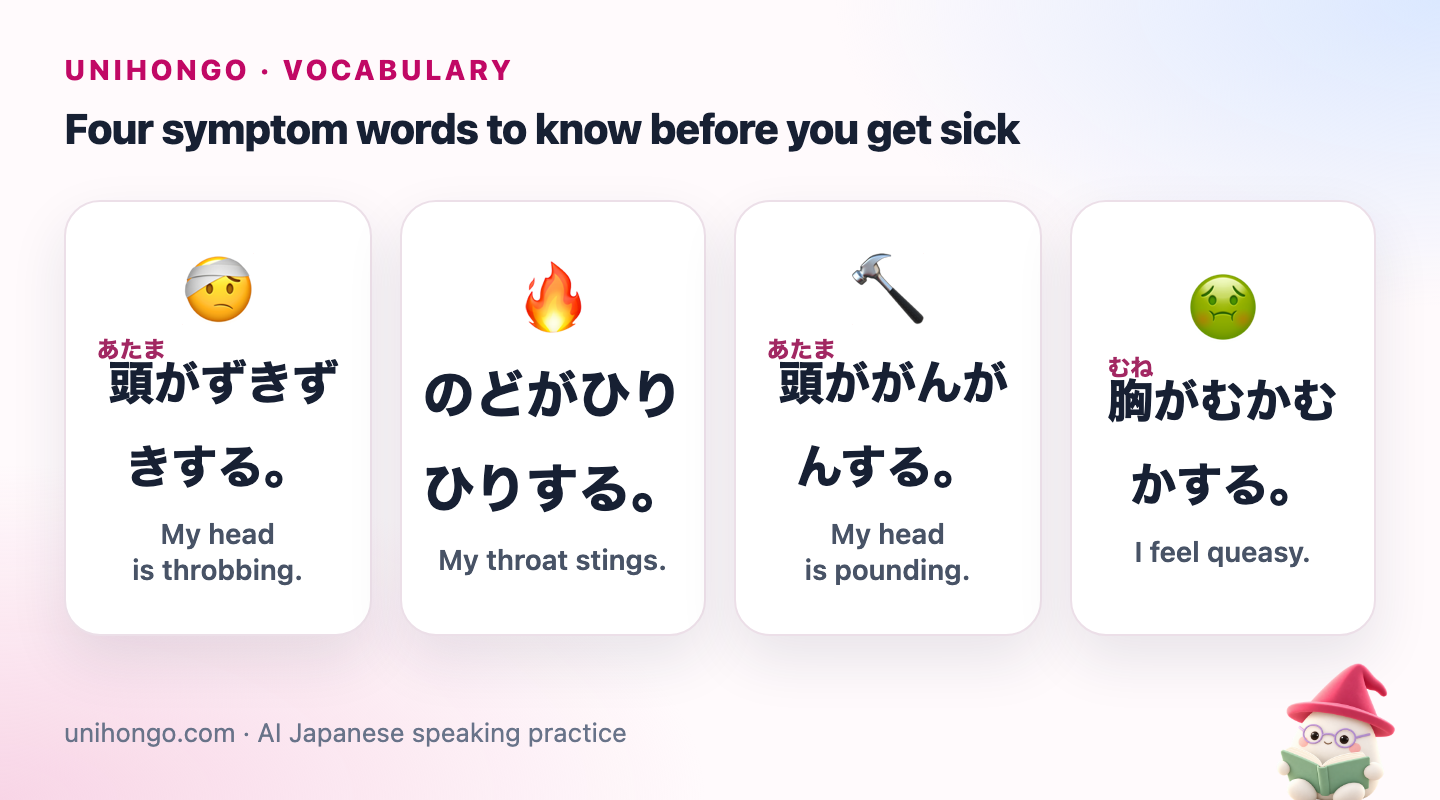
These four words cover the complaints learners most often need: a headache, a sore throat, a heavy hangover head and nausea. All four are gitaigo, words for a feeling rather than a sound you hear, and all four take suru when you describe your own symptoms. They are neutral in register: you can say them to a friend, and with shimasu to a doctor.
| Japanese | Romaji | Meaning |
|---|---|---|
| 頭がずきずきする。 | Atama ga zukizuki suru. | My head is throbbing. |
| のどがひりひりする。 | Nodo ga hirihiri suru. | My throat stings. |
| 頭ががんがんする。 | Atama ga gangan suru. | My head is pounding. |
| 胸がむかむかする。 | Mune ga mukamuka suru. | I feel queasy. |
Zukizuki follows the rhythm of your pulse; gangan feels heavier, as if someone were hitting a bell inside your head. Hirihiri is a stinging, raw feeling, used for a sore throat, sunburn or spicy food on your tongue. Mukamuka is nausea or heartburn; people usually say mune (chest) or i (stomach) ga mukamuka suru.
Fever and chills: zokuzoku, furafura, bōtto
A fever often starts with chills. Zokuzoku is the shivery feeling running up your back; people often pair it with samuke, chills: samuke ga shite zokuzoku suru. Once the fever rises, your body may feel weak and unsteady, which is furafura, and your head may feel foggy, which is bōtto. Kurakura is a spinning, light-headed dizziness, and guruguru describes the room going round.
All of these take suru. Bōtto also works with a verb: atama ga bōtto shite iru, my head is in a fog.
| Japanese | Romaji | Meaning |
|---|---|---|
| 朝から寒気がしてぞくぞくします。 | Asa kara samuke ga shite zokuzoku shimasu. | I've had chills since this morning. (polite) |
| 熱があって、ふらふらする。 | Netsu ga atte, furafura suru. | I've got a fever and feel unsteady. |
| 頭がぼーっとしています。 | Atama ga bōtto shite imasu. | My head feels foggy. (polite) |
| 立つとくらくらします。 | Tatsu to kurakura shimasu. | I feel dizzy when I stand up. |
| 目がぐるぐる回る感じです。 | Me ga guruguru mawaru kanji desu. | It feels like everything is spinning. |
Coughs, sneezes and noses
Coughs are giongo, words that copy the sound. Gohogoho is a heavy, chesty cough; konkon is a lighter, drier cough and is often used about children; kehokeho is a thin, dry cough. For the nose, guzuguzu describes a stuffy, runny nose, zuruzuru is the sound of sniffling, and muzumuzu is the tickle you feel before a sneeze, also used for itchy eyes or skin.
When you describe your own cough to a doctor, the verb is usually seki ga deru, a cough comes out, and the sound word goes before it.
| Japanese | Romaji | Meaning |
|---|---|---|
| 夜になるとごほごほ咳が出ます。 | Yoru ni naru to gohogoho seki ga demasu. | I get a heavy cough at night. |
| 子どもがこんこん咳をしています。 | Kodomo ga konkon seki o shite imasu. | My child has a dry little cough. |
| 花粉で鼻がぐずぐずする。 | Kafun de hana ga guzuguzu suru. | Pollen makes my nose stuffy and runny. |
| 鼻がむずむずして、くしゃみが止まらない。 | Hana ga muzumuzu shite, kushami ga tomaranai. | My nose tickles and I can't stop sneezing. |
| Word | Type | Meaning | Usual pattern |
|---|---|---|---|
| gohogoho | Giongo | Heavy, chesty cough | gohogoho seki ga deru |
| konkon | Giongo | Light, dry cough, often a child's | konkon seki o suru |
| guzuguzu | Gitaigo | Stuffy, runny nose | hana ga guzuguzu suru |
| muzumuzu | Gitaigo | Tickle before a sneeze; itch | hana ga muzumuzu suru |
Stomach trouble: mukamuka, kirikiri, shikushiku
Stomach symptoms need careful words, because the treatment a pharmacist suggests depends on what you describe. Mukamuka is nausea. Kirikiri is a sharp, twisting or cramping pain, often linked with stress. Shikushiku is a dull, nagging ache that keeps going. Mukatsuku, the verb, is also used for nausea, but in casual speech it more often means that something makes you angry, so at a clinic the safer phrase is hakike ga shimasu, I feel nauseous.
| Japanese | Romaji | Meaning |
|---|---|---|
| 食べた後、胃がむかむかします。 | Tabeta ato, i ga mukamuka shimasu. | My stomach feels queasy after eating. |
| 吐き気がします。 | Hakike ga shimasu. | I feel nauseous. (clear, neutral) |
| おなかがきりきり痛みます。 | Onaka ga kirikiri itamimasu. | I have sharp cramps in my stomach. |
| おなかがしくしく痛いです。 | Onaka ga shikushiku itai desu. | I have a dull, nagging stomach ache. |
Grammar: building a full symptom sentence
A clear symptom sentence has three parts: the body part with ga, the sound word, and suru or a verb. Add when it started with kara and how often with words like zutto (all the time) or tokidoki (sometimes). Here is the same skeleton at three levels of detail.
| Japanese | Romaji | Meaning |
|---|---|---|
| 昨日の夜から頭がずきずきします。 | Kinō no yoru kara atama ga zukizuki shimasu. | My head has been throbbing since last night. |
| 飲み込むと、のどがひりひりします。 | Nomikomu to, nodo ga hirihiri shimasu. | My throat stings when I swallow. |
| ずっとふらふらしています。 | Zutto furafura shite imasu. | I've felt unsteady the whole time. |
| Level | Structure | Example in romaji |
|---|---|---|
| Basic | Body part + ga + word + shimasu | Nodo ga hirihiri shimasu. |
| With time | Time + kara + basic sentence | Kinō kara nodo ga hirihiri shimasu. |
| With detail | Add zutto or tokidoki, or a condition | Nomikomu to, nodo ga hirihiri shimasu. |
At the clinic reception: a short dialogue
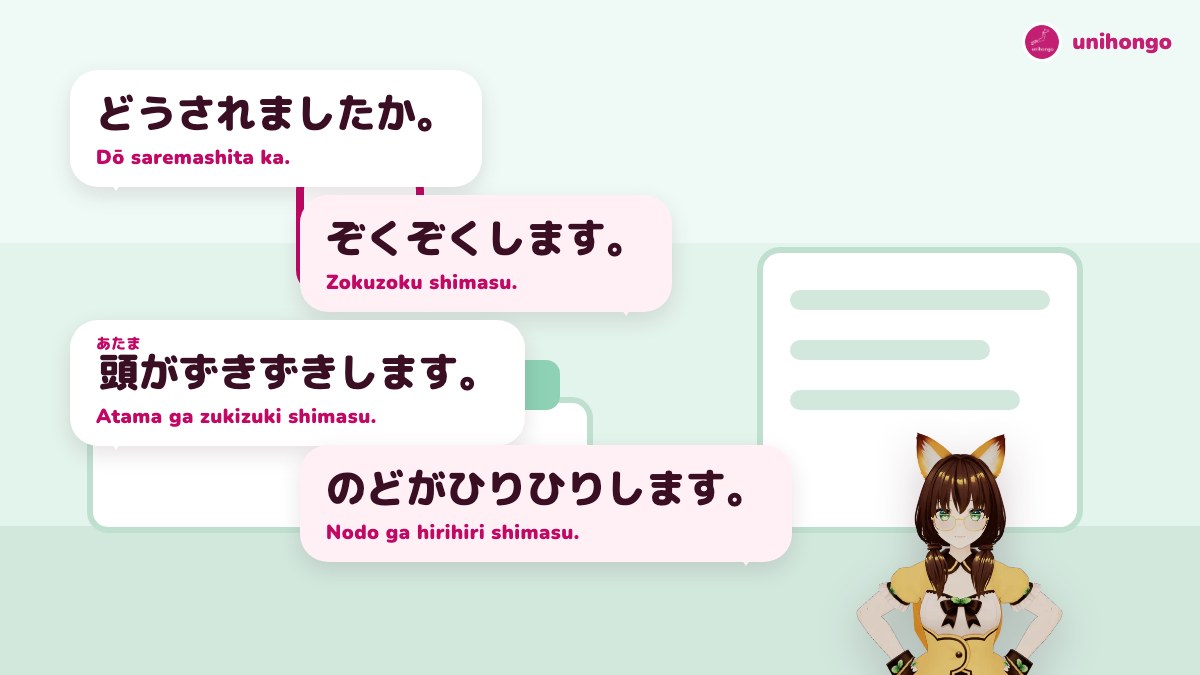
At many clinics you first tell the receptionist why you came, then fill in a questionnaire. Procedures vary by clinic and city, so follow the staff. The dialogue below uses polite Japanese throughout; the receptionist uses standard polite service language.
| Japanese | Romaji | Meaning |
|---|---|---|
| 今日はどうされましたか。 | Kyō wa dō saremashita ka. | Receptionist: What brings you in today? |
| 昨日から熱があって、ぞくぞくします。 | Kinō kara netsu ga atte, zokuzoku shimasu. | You: I've had a fever since yesterday and chills. |
| ほかに症状はありますか。 | Hoka ni shōjō wa arimasu ka. | Receptionist: Any other symptoms? |
| 頭がずきずきして、のどもひりひりします。 | Atama ga zukizuki shite, nodo mo hirihiri shimasu. | You: My head throbs and my throat stings too. |
| では、こちらの問診票にご記入ください。 | Dewa, kochira no monshinhyō ni gokinyū kudasai. | Receptionist: Then please fill in this questionnaire. |
| すみません、少しふらふらするので、座ってもいいですか。 | Sumimasen, sukoshi furafura suru node, suwatte mo ii desu ka. | You: Sorry, I feel a bit unsteady. May I sit down? |
Mistakes that confuse doctors and friends
- Using mukatsuku for nausea with friends. They may hear I'm angry. Use mukamuka suru or hakike ga suru for feeling sick.
- Saying zokuzoku without context. It can mean chills or thrills; add samuke ga shite at a clinic.
- Dropping the body part. Zukizuki shimasu alone is understandable, but atama ga or ha ga (tooth) makes it precise.
- Mixing up hirihiri and chikuchiku. Hirihiri is a raw, burning sting; chikuchiku is prickly, like a needle or wool on skin.
- Using itai with every word. Some words are already complete with suru; itamimasu fits best with kirikiri, shikushiku and zukizuki.
Rehearse the clinic before you need it
Write your symptom card and paste it to Mocchi with /correct, adding a note such as: I want to tell a doctor I have chills and a sore throat. Mocchi fixes the particles, suggests a more natural sound word if you picked the wrong one, and explains each change.
Then say it out loud. In AI Sensei, choose Haru-sensei and ask Haru-sensei to be a clinic receptionist and then a doctor asking follow-up questions; the Describe Symptoms at a Clinic mission gives you the same situation with a clear goal. Ask him to slow down if the questions come too fast.