
The sky words
Start with the eye-level words, the ones Japanese speakers use when they look up without a telescope. Hoshi is a star, and hoshizora is a starry sky, the word on every tourism poster for a mountain village. Amanogawa, the river of heaven, is the Milky Way. Nagareboshi is a shooting star, and a ryūseigun is a meteor shower; the big ones, the Perseids in August and the Geminids in December, are Peruseusuza ryūseigun and Futagoza ryūseigun, and the news reports their peak nights. The moon has its own set: mangetsu, full moon; shingetsu, new moon; mikazuki, a crescent.
The first card is the line you say when you step outside and the sky is good. The next three are the sights you will name most.
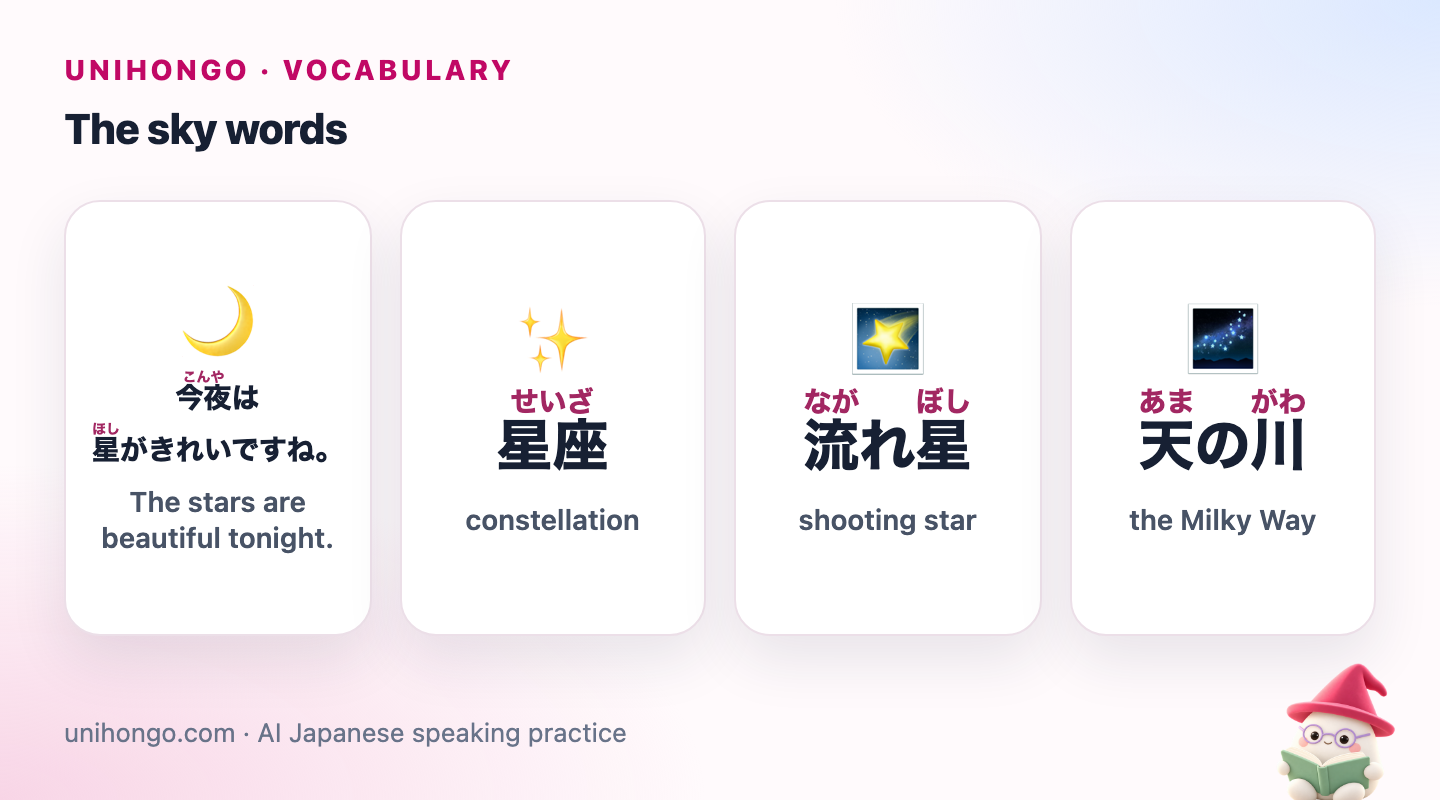
| Japanese | Romaji | Meaning |
|---|---|---|
| 今夜は星がきれいですね。 | Kon'ya wa hoshi ga kirei desu ne. | The stars are beautiful tonight. |
| 星座 | seiza | constellation |
| 流れ星 | nagareboshi | shooting star |
| 天の川 | amanogawa | the Milky Way |
| 星空 | hoshizora | starry sky |
| 流星群 | ryūseigun | meteor shower |
| 満月 | mangetsu | full moon |
| 三日月 | mikazuki | crescent moon |
| 一番星 | ichibanboshi | the first star of the evening |
| 惑星 | wakusei | planet |
| 天体観測 | tentai kansoku | astronomical observation |
The seasonal sky, in Japanese
Japanese stargazers organise the year by signature shapes, and the names are worth learning because every planetarium show and observatory page uses them. Spring has the Big Dipper, Hokuto Shichisei, and the spring curve that runs from it to Arcturus. Summer has the Milky Way and the Summer Triangle. Autumn has the great square of Pegasus. Winter has Orion and the Winter Triangle. The table lists them; constellation names end in za, the character for seat.
| Japanese | Romaji | Meaning |
|---|---|---|
| 夏の大三角が見えます。 | Natsu no daisankaku ga miemasu. | I can see the Summer Triangle. |
| オリオン座は冬の星座です。 | Orionza wa fuyu no seiza desu. | Orion is a winter constellation. |
| 北極星はどれですか。 | Hokkyokusei wa dore desu ka. | Which one is the North Star? |
| 北斗七星から探します。 | Hokuto Shichisei kara sagashimasu. | I find it from the Big Dipper. |
| ベガは織姫星です。 | Bega wa Orihimeboshi desu. | Vega is the weaver star. |
| Season | Signature shape | Constellations you will hear |
|---|---|---|
| 春 haru | 北斗七星 Hokuto Shichisei, the Big Dipper | おおぐま座 Ōgumaza, しし座 Shishiza |
| 夏 natsu | 夏の大三角 natsu no daisankaku | こと座 Kotoza, わし座 Washiza, はくちょう座 Hakuchōza, さそり座 Sasoriza |
| 秋 aki | 秋の四辺形 aki no shihenkei, the Great Square | ペガスス座 Pegasusuza, カシオペヤ座 Kashiopeyaza |
| 冬 fuyu | 冬の大三角 fuyu no daisankaku | オリオン座 Orionza, おおいぬ座 Ōinuza, おうし座 Ōshiza |
Orihime and Hikoboshi, Vega and Altair, meet across the Milky Way once a year in the Tanabata story, which is why a July observing night often starts with the Summer Triangle. The Western constellation names are standard in Japanese astronomy; the Tanabata names are the folk layer on top.
A planetarium visit
Planetariums are everywhere in Japan, from science museums to shopping malls, and they are a gentle listening lesson: the show is a kaisetsu, a narrated explanation, spoken slowly and clearly over the dome. A show is a tōei, a projection, with start times listed on a board. The narrator, kaisetsuin, usually begins with kon'ya no hoshizora, tonight's sky, and walks through what you could see from the car park if the city were dark. Phones go off, and the chairs recline.
| Japanese | Romaji | Meaning |
|---|---|---|
| 次の投影は何時からですか。 | Tsugi no tōei wa nanji kara desu ka. | What time is the next show? |
| 大人一枚お願いします。 | Otona ichimai onegai shimasu. | One adult, please. |
| 今夜の星空 | kon'ya no hoshizora | Programme: tonight's sky |
| 投影中の撮影はご遠慮ください。 | Tōeichū no satsuei wa goenryo kudasai. | Announcement: No photography during the show. |
| 解説員 | kaisetsuin | the narrator |
| 南の空をご覧ください。 | Minami no sora o goran kudasai. | Narrator: Please look at the southern sky. |
| あの明るい星が木星です。 | Ano akarui hoshi ga mokusei desu. | Narrator: That bright star is Jupiter. |
An observing night: the conversation
Public observatories and astronomy clubs run kanbōkai, observing nights, often free and often on a Saturday. A volunteer sets up a telescope, lines up the easiest bright object and invites the queue to look. The exchange is short and repeats for each person, which makes it ideal practice. The dialogue below is the version with Jupiter; swap in dosei and its ring, wa, in a different season.
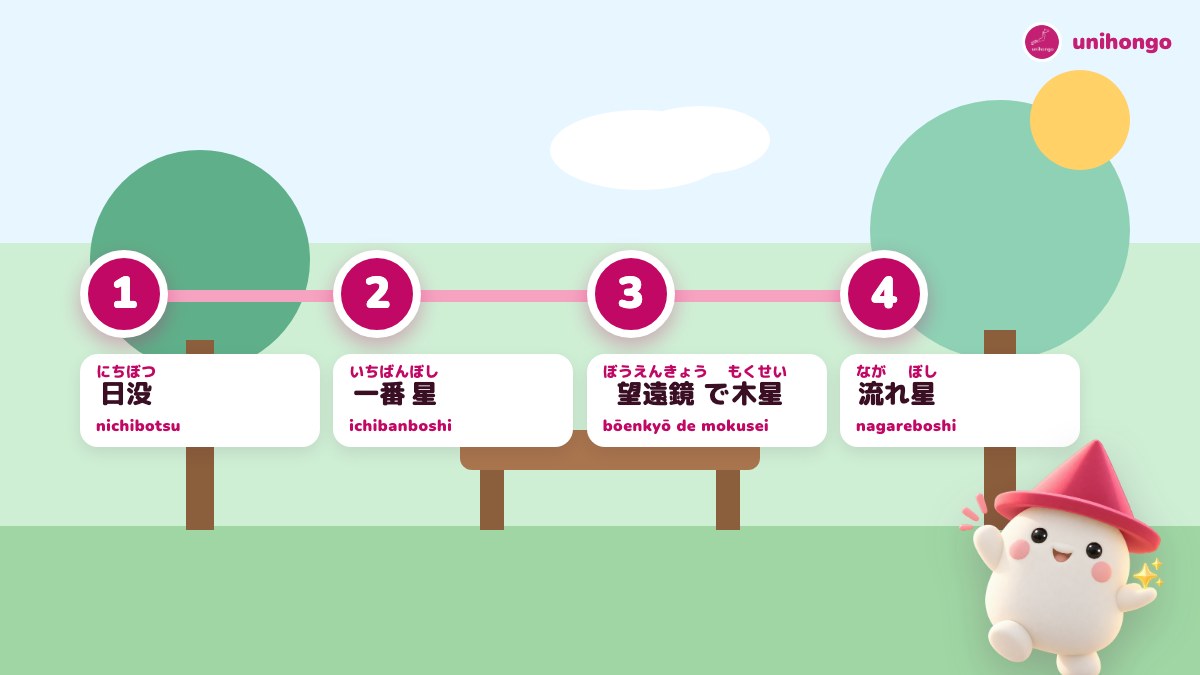
| Japanese | Romaji | Meaning |
|---|---|---|
| 今日は木星がよく見えますよ。 | Kyō wa mokusei ga yoku miemasu yo. | Volunteer: Jupiter is showing well tonight. |
| 望遠鏡で見てもいいですか。 | Bōenkyō de mite mo ii desu ka. | You: May I look through the telescope? |
| どうぞ。ピントはここで合わせます。 | Dōzo. Pinto wa koko de awasemasu. | Volunteer: Go ahead. You focus with this. |
| 見えた!縞模様が見えます。 | Mieta! Shimamoyō ga miemasu. | You: I see it! I can see the bands. |
| 横の小さい点は衛星です。 | Yoko no chiisai ten wa eisei desu. | Volunteer: The small dots beside it are moons. |
| 土星の輪も見えますか。 | Dosei no wa mo miemasu ka. | You: Can we see Saturn's ring too? |
| 今日は低いので、ちょっと難しいかな。 | Kyō wa hikui node, chotto muzukashii ka na. | Volunteer: It's low tonight, so maybe not. (casual) |
Mieta, the past of mieru, is the shout of every observing night, and it is what children and professors both say. Eisei means both a natural moon and an artificial satellite; by a telescope it means the moons.
Gear, conditions and the words on the forecast
The gear words are mostly Sino-Japanese: bōenkyō, telescope; sōgankyō, binoculars; sankyaku, tripod; bairitsu, magnification; and pinto, the focus, from Dutch. Conditions are what stargazers actually talk about. Kōgai, light pollution, is the enemy, and sora ga kurai, the sky is dark, the praise. The weather forecast for stargazers is the hoshizora shisū, a starry-sky index that some weather sites publish, and the word for haze or thin cloud is kasumi. A red torch, akai raito, protects everyone's night vision, and bōkan, cold protection, is the first thing experienced people mention.
| Japanese | Romaji | Meaning |
|---|---|---|
| 望遠鏡 | bōenkyō | telescope |
| 双眼鏡 | sōgankyō | binoculars |
| 倍率 | bairitsu | magnification |
| ピントを合わせます。 | Pinto o awasemasu. | I adjust the focus. |
| 光害 | kōgai | light pollution |
| ここは空が暗いですね。 | Koko wa sora ga kurai desu ne. | The sky is really dark here. |
| 肉眼でも見えます。 | Nikugan demo miemasu. | You can see it with the naked eye too. |
| 今夜は雲が多いです。 | Kon'ya wa kumo ga ōi desu. | It's cloudy tonight. |
| 防寒をしっかりしてください。 | Bōkan o shikkari shite kudasai. | Organiser: Dress warmly. |
The grammar of seeing
Stargazing lives on one verb pair. Miru is to look at, something you do: hoshi o miru, I look at the stars. Mieru is to be visible, something the sky does: hoshi ga mieru, the stars can be seen. The particle changes with the verb, o with miru and ga with mieru, and the second is the one you say at the eyepiece. For what you want to see, use tai on miru: dosei no wa o mitai, I want to see Saturn's ring. For what you managed to see, mieta. For asking an expert what something is, Are wa nan desu ka, what is that, with are because it is far away.
| Japanese | Romaji | Meaning |
|---|---|---|
| 星を見に行きます。 | Hoshi o mi ni ikimasu. | I'm going to look at the stars. |
| ここから天の川が見えます。 | Koko kara amanogawa ga miemasu. | You can see the Milky Way from here. |
| 流れ星を見たいです。 | Nagareboshi o mitai desu. | I want to see a shooting star. |
| あれは何ですか。星ですか、惑星ですか。 | Are wa nan desu ka. Hoshi desu ka, wakusei desu ka. | What's that? A star or a planet? |
| 見えた! | Mieta! | I saw it! |
| 三つ見えました。 | Mittsu miemashita. | I saw three. (shooting stars) |
Mi ni iku, go to see, uses the verb stem plus ni iku for purpose, and it is the pattern for every hobby outing: tori o mi ni iku, raibu o mi ni iku. Learn it here under the stars and it travels.
Mistakes and register notes
- Hoshi for a planet. Everyday speakers do call Jupiter a hoshi, but at an observing night the volunteer will say wakusei, and copying them is both correct and a small compliment.
- Kansatsu for the science and kansoku for the hobby. Both mean observation, but tentai kansoku is the fixed term for astronomy; kansatsu is for birds, insects and classrooms. You will be understood either way.
- Miru at the eyepiece. Mieru is the word for whether the thing is visible; Miemasu ka, can you see it, is what the volunteer asks, and Miemasu or Mieta is the answer.
- Tsuki ga kirei desu ne to a stranger. The line is harmless, but a popular story says it was once offered as a translation of I love you, and some Japanese people will smile; stick to hoshi ga kirei at an observing night.
- A white torch on the field. Ask for the akai raito rule before switching anything on; it is the one etiquette point every club shares.
- Reading 座 as suwaru. In constellation names the character is za: Orionza, Sasoriza. The seat meaning is the same, the reading is not.
Make a clear night a lesson
The sky changes slowly, which is good for review: the constellation you learned in Japanese this week is still there next week, a little further west. Name what you see every clear night, in a sentence with mieru, and the vocabulary and the grammar arrive together.
For the grammar, sign in to Unihongo and ask Mocchi, the study assistant, with /grammar to explain miru against mieru with examples about the night sky, then to give you five sentences to turn from one into the other; Mocchi checks your particles and remembers which way round you get them wrong. For the sound of it, the astronomy words are full of long vowels, bōenkyō, sōgankyō, ryūseigun, and Unihongo's pronunciation coach has long-vowel drills you can record and score, so that your bōenkyō does not come out as a different word. The free account that opens Mocchi is at unihongo.com/login, and the first lesson takes about as long as your eyes take to adjust to the dark.
Your turn
Say these tonight, outside if the sky allows, before you check the phrase rows.
- Describe tonight's sky: the moon phase, the brightest object, and how dark it is.
- Name the signature shape of the current season and one constellation in it.
- Ask to look through a telescope, and say what you can and cannot see.
- Ask what a bright object is, and whether it is a star or a planet.
- Tell a friend when the next meteor shower is and what you want to see.