
The questions you will hear about music
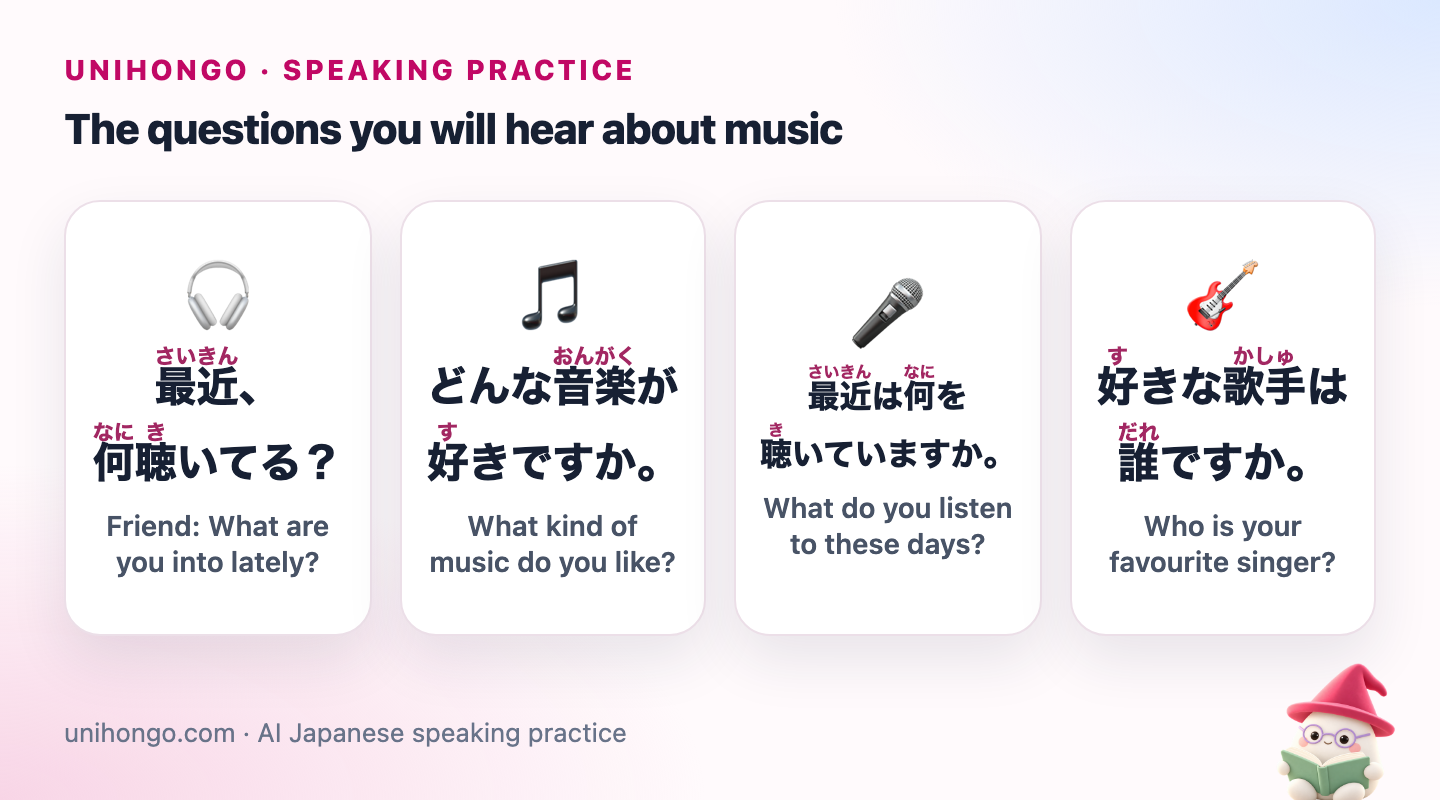
The first row is the one friends actually ask, casual, with the o particle dropped and kiite iru shortened to kiiteru. The polite versions follow. Donna asks for a kind of music; kashu, singer, asks for a person. If someone asks ongaku wa kikimasu ka, do you listen to music, they are opening the topic gently and expect a yes followed by a genre.
| Japanese | Romaji | Meaning |
|---|---|---|
| 最近、何聴いてる? | Saikin, nani kiiteru? | Friend: What are you into lately? |
| どんな音楽が好きですか。 | Donna ongaku ga suki desu ka. | What kind of music do you like? |
| 最近は何を聴いていますか。 | Saikin wa nani o kiite imasu ka. | What do you listen to these days? |
| 好きな歌手は誰ですか。 | Suki na kashu wa dare desu ka. | Who is your favourite singer? |
Model answer 1: a genre, a habit and an honest limit
At the start, a genre with ~ga suki desu, what you listen to often with yoku ~o kikimasu, and one honest sentence about the lyrics are enough. The honest sentence matters: a Japanese listener will relax when you admit you do not follow the words yet, and will often offer to explain a line.
| Japanese | Romaji | Meaning |
|---|---|---|
| ロックが好きです。 | Rokku ga suki desu. | You: I like rock. |
| 最近は日本のバンドをよく聴いています。 | Saikin wa Nihon no bando o yoku kiite imasu. | You: Lately I've been listening to Japanese bands a lot. |
| 歌詞はまだ分かりません。 | Kashi wa mada wakarimasen. | You: I don't understand the lyrics yet. |
Kashi is lyrics; uta is a song as something sung. Kashi wa mada wakarimasen, with mada, not yet, tells the listener you are learning, and is a much better line than wakarimasen on its own.
Model answer 2: what you are into right now and when you listen
The second level says what you are hooked on at the moment with ~ni hamatte imasu, when you listen with ~chū ni, during, and adds one thing music does for you with ~ni mo narimasu, it also serves as. Choosing a single favourite is avoided at the end with a line that every music fan will nod at.
| Japanese | Romaji | Meaning |
|---|---|---|
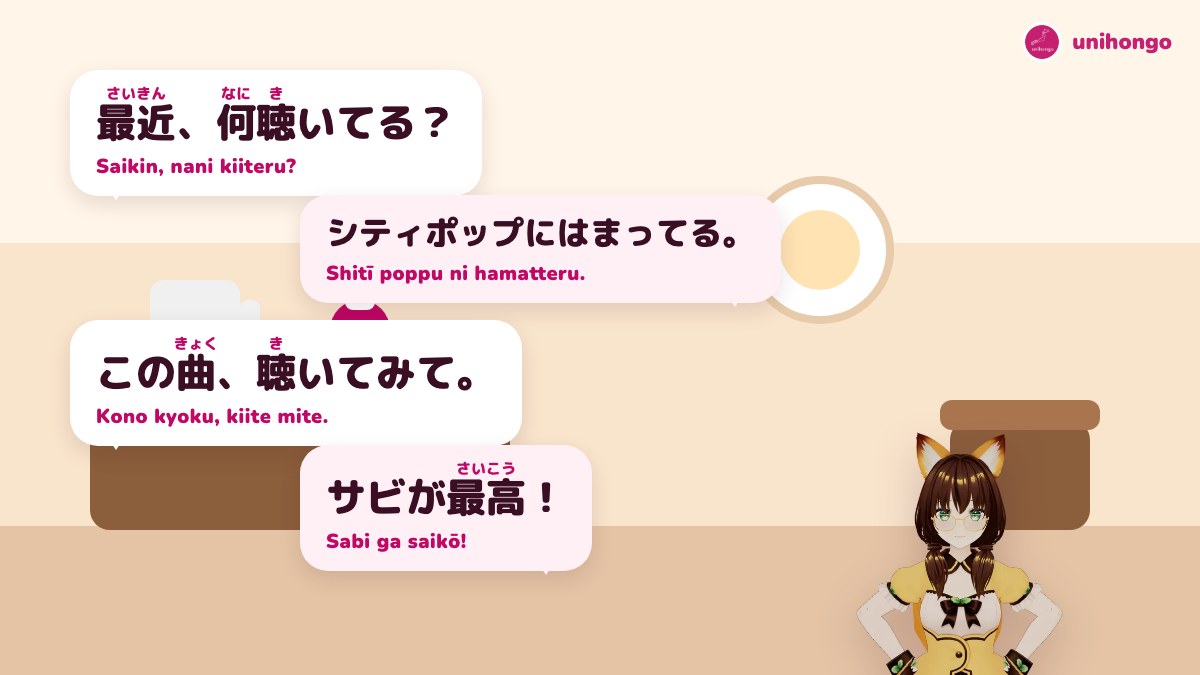
| 最近、シティポップにはまっています。 | Saikin, shitī poppu ni hamatte imasu. | You: Lately I'm really into city pop. |
| 通勤中にいつも聴いています。 | Tsūkinchū ni itsumo kiite imasu. | You: I always listen on my commute. |
| 歌詞を見ながら聴くと、日本語の勉強にもなります。 | Kashi o minagara kiku to, Nihongo no benkyō ni mo narimasu. | You: Listening while reading the lyrics doubles as Japanese study. |
| 一番好きな曲は多すぎて、選べません。 | Ichiban suki na kyoku wa ōsugite, erabemasen. | You: I have too many favourite songs to pick one. |
~chū ni after a noun means during: tsūkinchū ni, during the commute, shigotochū ni, during work. Shitī poppu, city pop, is the usual name in Japan for the late-1970s and 1980s Japanese pop that found a new audience abroad; it is a safe genre to name, and people will have opinions.
Model answer 3: two genres, a change, and a recommendation
An intermediate answer shows range with to, a change in habits with ~yō ni narimashita, I've started to, and ends with a recommendation that has a reason. The reason is what makes a recommendation land in Japanese: not this is good, but the lyrics are sad and I never tire of it.
| Japanese | Romaji | Meaning |
|---|---|---|
| ジャズとヒップホップを、気分によって聴いています。 | Jazu to hippu hoppu o, kibun ni yotte kiite imasu. | You: I listen to jazz or hip-hop depending on my mood. |
| 最近はライブにもよく行くようになりました。 | Saikin wa raibu ni mo yoku iku yō ni narimashita. | You: Lately I've started going to live shows a lot too. |
| もしよかったら、この曲、聴いてみてください。 | Moshi yokattara, kono kyoku, kiite mite kudasai. | You: If you like, give this song a listen. |
| 歌詞が切なくて、何度聴いても飽きません。 | Kashi ga setsunakute, nando kiite mo akimasen. | You: The lyrics are bittersweet, and I never get tired of it. |
The words this topic needs: genres, people and parts of a song
Most genre names are loanwords, but a few are not, and a few loanwords have shifted meaning. The table gives the ones that come up in conversation. Below it, the phrase rows show the verbs that go with music: kiku for listening, hamaru for being into, osusume for recommending, and sabi, the chorus, which is the part people talk about.
| Japanese | Romaji | Meaning |
|---|---|---|
| おすすめの曲はありますか。 | Osusume no kyoku wa arimasu ka. | Do you have a song to recommend? |
| この曲、おすすめです。 | Kono kyoku, osusume desu. | I recommend this song. |
| サビが最高です。 | Sabi ga saikō desu. | The chorus is the best part. |
| 声が好きで聴いています。 | Koe ga suki de kiite imasu. | I listen for the voice. |
| 一回聴いてみて。 | Ikkai kiite mite. | Friend: Just give it one listen. (casual) |
| Japanese word | Romaji | What it means in conversation |
|---|---|---|
| ロック / ポップス | rokku / poppusu | rock / pop; poppusu is the genre, poppu the adjective |
| J-POP / K-POP | jeipoppu / keipoppu | Japanese pop / Korean pop; written with Latin letters |
| ヒップホップ / ラップ | hippu hoppu / rappu | hip-hop / rap |
| ジャズ / クラシック | jazu / kurashikku | jazz / classical; kurashikku, not kurashikaru |
| 演歌 | enka | traditional-style Japanese ballads, often associated with older listeners |
| アニソン | anison | anime songs; a genre in its own right in Japan |
| 歌手 / アーティスト | kashu / ātisuto | singer / artist; ātisuto covers bands and producers |
| 曲 / 歌 / アルバム | kyoku / uta / arubamu | a track / a sung song / an album |
| ライブ / フェス | raibu / fesu | a concert / a festival; raibu is any live show |
Osusume is both the noun, a recommendation, and the adjective, recommended, so osusume no kyoku and kono kyoku wa osusume desu are both correct. Kiite mite, listen and see, is the casual shape of kiite mite kudasai; ~te miru, try doing, is what makes it a suggestion rather than an order.
Follow-up questions and the reactions you will hear
Once you name a genre or an artist, the conversation branches. Did you go to a show, do you sing it at karaoke, since when: these are the follow-ups, and they are easy to answer with ~ta koto ga arimasu, I have done, and ~kara, since. The reactions are what you need to recognise: igai, unexpected, is a compliment about your taste, and shiranakatta, I didn't know that one, is an invitation to recommend.
| Japanese | Romaji | Meaning |
|---|---|---|
| ライブに行ったことがありますか。 | Raibu ni itta koto ga arimasu ka. | Friend: Have you been to one of their shows? |
| カラオケで歌いますか。 | Karaoke de utaimasu ka. | Friend: Do you sing it at karaoke? |
| へえ、意外ですね。 | Hee, igai desu ne. | Friend: Oh, I wouldn't have guessed. (polite) |
| 知らなかった。今度聴いてみる。 | Shiranakatta. Kondo kiite miru. | Friend: Didn't know that one. I'll give it a listen. (casual) |
| 私も好きです! | Watashi mo suki desu! | You: I like them too! |
| 今度、おすすめを教えてください。 | Kondo, osusume o oshiete kudasai. | You: Recommend me something next time. |
Igai desu ne is said with a smile and means your taste is more interesting than expected; it is not a criticism. Kondo, next time or sometime, is how both sides promise to continue the topic without fixing a date.
Mistakes and register notes
- Answering donna ongaku ga suki desu ka with ongaku ga suki desu. That says I like music, which was not the question. Name a genre or an artist, even a vague one: iroiro kikimasu, I listen to all sorts, is fine.
- Saying raibu to mean live, as in live broadcast. In everyday Japanese raibu is a concert; a live stream is namahaishin or raibu haishin. Konsāto exists but leans towards classical and large halls.
- Using kurashikaru for classical music. The genre is kurashikku; kurashikaru is a style word for clothes and design.
- Translating I love this band as kono bando o aishite imasu. Aisuru is for people and is heavy even then. Daisuki desu, or ~ni hamatte imasu for a current obsession, is what people say.
- Using uta for every song. Uta is something sung; an instrumental track, a piece in a game or a film score is kyoku. When in doubt, kyoku covers everything.
- Replying to a casual nani kiiteru? with masu. Among friends: saikin wa jazu kana, rokku ga suki, kono kyoku kiite mite. Keep kiite mite kudasai for coworkers and people you have just met.
Practise with the music you already play
You listen to music every day anyway, so the material is free. Each time a song comes on, say one sentence about it aloud: the genre, how you found it, or what the sabi does to you. Over a week that is thirty or forty sentences about real songs, and the words stop being a list.
To get the words you are missing, ask Mocchi, Unihongo's study assistant, for /vocab with the genre you listen to most, for example ten words for talking about hip-hop in Japanese, then put three of them into a recommendation and send it with /correct. Mocchi keeps track of the loanwords you get slightly wrong, kurashikaru for kurashikku and the like, and brings them back in a later /review. For the conversation itself, open AI Sensei, choose Ibuki-sensei and ask Ibuki-sensei to play a friend at a café who asks what you have been listening to lately, reacts to your answer, and then asks for one recommendation with a reason. If you want to try it, unihongo.com/login opens a free account; bring one song you love and the reason you love it.
Your turn: talk about your music aloud
- Saikin nani o kiite imasu ka. Answer with an artist and when you listen, using ~chū ni.
- Donna ongaku ga suki desu ka. Name two genres with to and say which mood each one fits.
- Ima nani ka ni hamatte imasu ka. Answer with ~ni hamatte imasu and say since when with ~kara.
- Recommend one song with kiite mite kudasai and one reason: the sabi, the kashi, or the koe.
- React to an unfamiliar recommendation with shiranakatta and promise to listen with kondo kiite mimasu.