
Four songs to start with
These four are among the best known traditional songs in Japan, and each teaches something different. Haru ga Kita is a school song about spring with simple, repeated questions. Kagome Kagome is a circle game. Tōryanse is a gate game with a slightly eerie melody. Yuki is a winter school song with a famous, often misheard first line.
The lines below are the titles, which are also the opening words, which is all you need to recognise each song and start learning it.
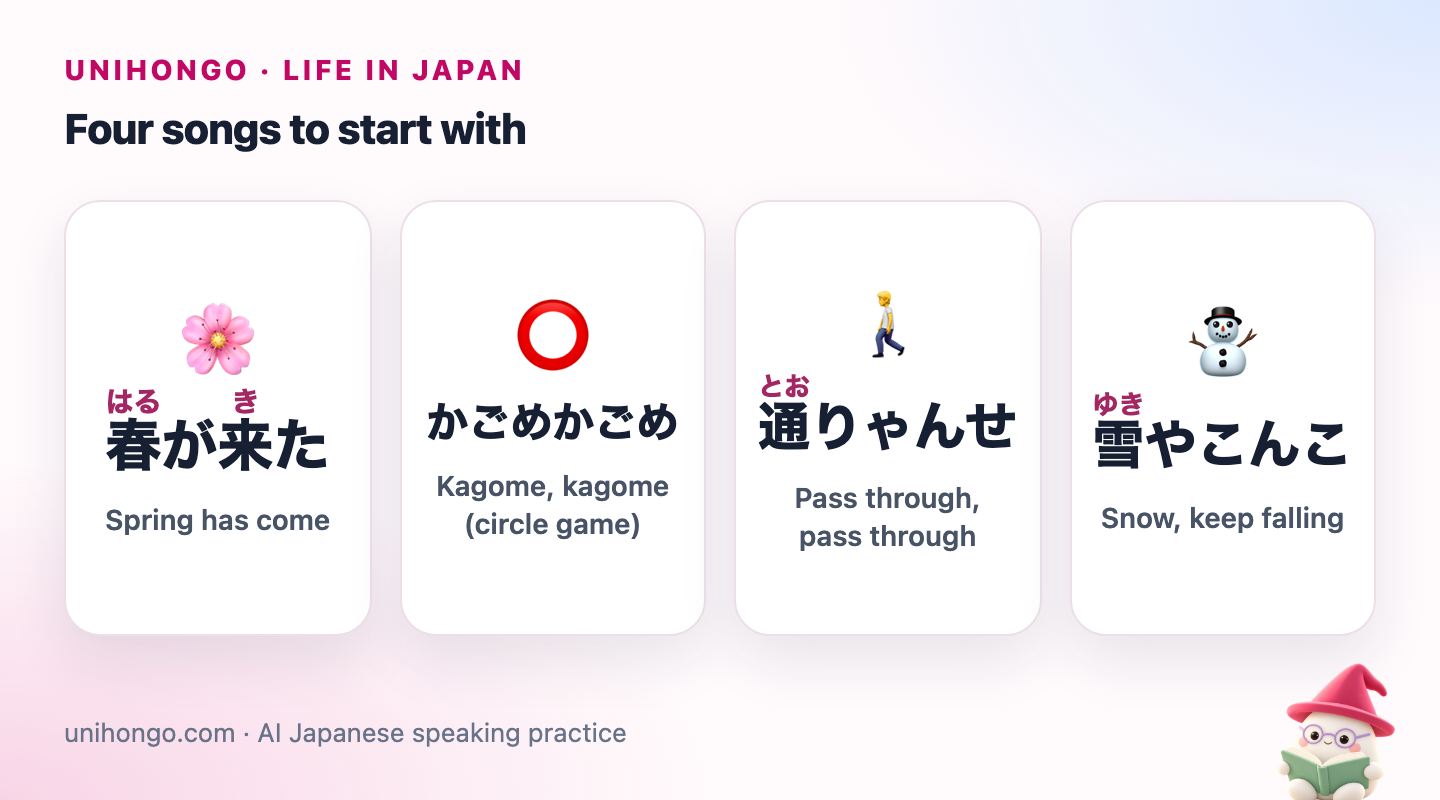
| Japanese | Romaji | Meaning |
|---|---|---|
| 春が来た | Haru ga kita | Spring has come |
| かごめかごめ | Kagome kagome | Kagome, kagome (circle game) |
| 通りゃんせ | Tōryanse | Pass through, pass through |
| 雪やこんこ | Yuki ya konko | Snow, keep falling |
Dōyō and warabe uta: what the words mean
Warabe uta are play songs passed down from child to child. Nobody knows who wrote them, and the words often vary between regions. Dōyō, children's songs, usually means songs written for children by known poets and composers, many from the early twentieth century. School songs from the official songbooks of that time, called shōka, are often grouped with them.
For learners, the difference matters in one way: warabe uta often contain dialect, old forms and words whose meaning even Japanese adults are unsure of. School songs are usually clearer and closer to standard Japanese.
| Japanese | Romaji | Meaning |
|---|---|---|
| 童謡 | dōyō | children's song |
| わらべうた | warabe uta | traditional play song |
| 歌詞 | kashi | lyrics |
| Type | Examples | What learners get |
|---|---|---|
| Warabe uta (play songs) | Kagome Kagome, Tōryanse | Rhythm, games, cultural references |
| School songs and dōyō | Haru ga Kita, Yuki, Momotarō | Clear vocabulary and seasons |
Haru ga Kita and Yuki: seasons in simple words
Haru ga Kita asks and answers a simple question: spring has come, where has it come? The answer is mountains, villages and fields. It repeats the verb kita, has come, again and again, which makes it a good first song for beginners. Later verses swap in hana ga saku (flowers bloom) and tori ga naku (birds sing).
Yuki starts with a line that many Japanese people mishear as konkon. The song says konko, an old word linked to snow falling, whose origin is debated. The verse goes on to describe the dog running happily around the garden and the cat curled up by the kotatsu.
| Japanese | Romaji | Meaning |
|---|---|---|
| 春が来た 春が来た どこに来た | Haru ga kita, haru ga kita, doko ni kita | Spring has come, spring has come, where has it come? |
| 雪やこんこ あられやこんこ | Yuki ya konko, arare ya konko | Snow, keep falling; hail, keep falling |
| 花が咲く | hana ga saku | flowers bloom |
Kagome Kagome and Tōryanse: songs with games
Kagome Kagome is played in a circle. One child crouches in the middle with eyes covered, and the others walk round holding hands and singing. When the song ends with ushiro no shōmen daare, who is right behind you, the child in the middle guesses. The rest of the words are famously mysterious, and many theories about their hidden meaning circulate; none is agreed.
Tōryanse is a gate game: two children form an arch with their arms, and the others walk under it until the song ends and the arch comes down. The words are a conversation with a gatekeeper on a narrow path to a shrine. Some pedestrian crossings in Japan once played its melody to signal that it was safe to cross, and a few still use it or a similar tune.
| Japanese | Romaji | Meaning |
|---|---|---|
| 後ろの正面だあれ | Ushiro no shōmen dāre | Who is right behind you? |
| ここはどこの細道じゃ | Koko wa doko no hosomichi ja | Whose narrow path is this? |
Dāre is a sung, stretched form of dare, who, and it is how children call out the question in the game. Tōryanse is an old imperative of tōru, to pass, made polite with the old ending -nse. You will not use it in conversation, but recognising it helps with period dramas.
More songs for the whole year
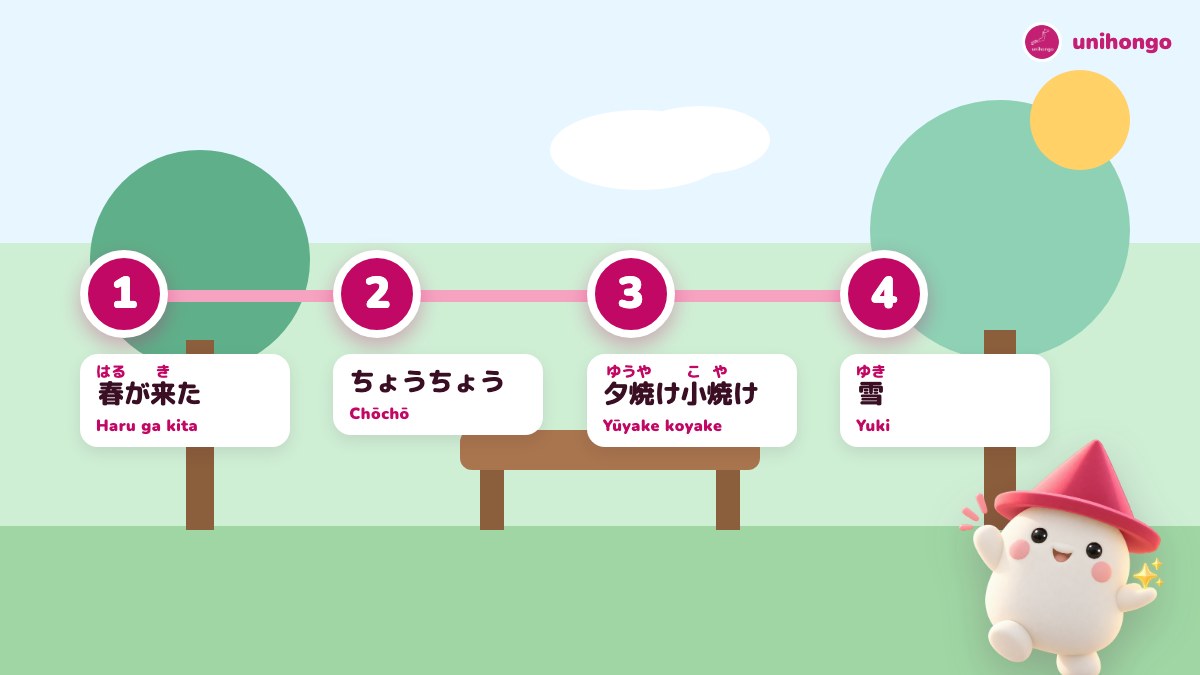
Once you have the first four, add songs that match the season or your child's interests. All of these are traditional or old school songs that Japanese children still learn.
| Japanese | Romaji | Meaning |
|---|---|---|
| ちょうちょう ちょうちょう 菜の葉にとまれ | Chōchō, chōchō, na no ha ni tomare | Butterfly, butterfly, land on the rape leaf |
| もしもし かめよ かめさんよ | Moshimoshi, kame yo, kamesan yo | Hey there, tortoise, Mr Tortoise |
| 桃太郎さん 桃太郎さん | Momotarō-san, Momotarō-san | Momotaro, Momotaro |
| 夕焼け小焼け | Yūyake koyake | Sunset glow (song title) |
Moshimoshi kame yo is the opening of Usagi to Kame, the hare and the tortoise. Momotarō retells the peach boy folk tale. Yūyake Koyake is the evening song that many towns play as the late-afternoon chime; its lyrics are newer than the other songs here, so learn it from a licensed songbook or recording.
Old forms you will meet in these songs
Traditional songs keep forms that modern speech has dropped. Knowing four of them removes most of the confusion.
| Song form | Modern Japanese | Meaning |
|---|---|---|
| じゃ (ja) | だ (da) | is; plain copula |
| 〜よ after a name (kame yo) | name + ne or san | calling someone |
| とまれ (tomare) | とまって (tomatte) | land, stop: blunt imperative |
| Stem + comma (yorokobi) | て-form (yorokonde) | and, linking actions |
A routine for learning one song
- Read the first line with a translation, word by word, and look up anything unclear.
- Listen three times without reading, then three times while following the words.
- Speak the line without the melody at normal speed, which shows you where the long vowels are, such as tōryanse and shōmen.
- Sing along, then sing alone; record yourself and compare.
- Teach it to someone, or play the game that goes with it, which locks it into memory.
Sing it, then say it
Paste the first line of a song into the chat with Mocchi, for example /explain ここはどこの細道じゃ, and Mocchi gives the reading, the meaning of each word and the modern form of anything old-fashioned. Ask Mocchi to make flashcards of the song words with /create-flashcards, so you can review them before you sing.
Songs stretch vowels, which can hide how a word is really pronounced. On the pronunciation coach, the long vowels drill helps you hear the difference between tōru and toru, so the words you learned from a song sound right when you speak.