
Four lines for a child's birthday party
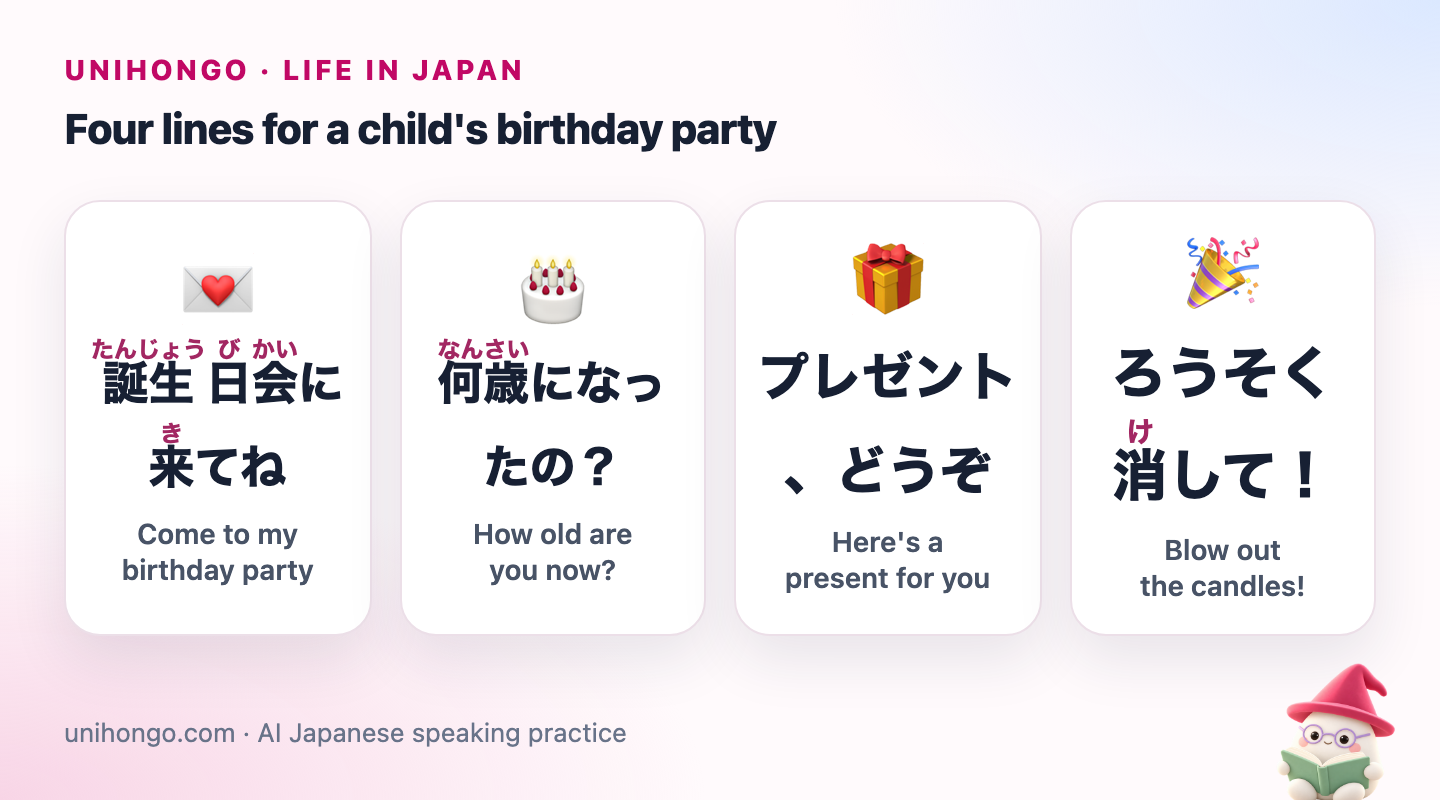
The four lines below cover the whole arc of a small party: the invitation, the question every adult asks the birthday child, handing over a present and the moment with the candles. All four are casual, because they are said to or by children.
Kite ne is the te-form of kuru, to come, softened with ne. It is how a child, or a parent speaking for the child, invites a friend.
| Japanese | Romaji | Meaning |
|---|---|---|
| 誕生日会に来てね | Tanjōbikai ni kite ne | Come to my birthday party |
| 何歳になったの? | Nansai ni natta no? | How old are you now? |
| プレゼント、どうぞ | Purezento, dōzo | Here's a present for you |
| ろうそく消して! | Rōsoku keshite! | Blow out the candles! |
How children's parties usually work in Japan
Many Japanese families celebrate a child's birthday at home, with a strawberry shortcake, a favourite dinner and grandparents on a video call or at the table. A party with friends is common in some families and rare in others. When it happens, it is often a few friends from nursery, school or the neighbourhood, at home, in a park, at a rented party room or at an indoor play space.
Some nurseries and schools ask parents not to hand out party invitations on the premises, so that children who are not invited do not feel hurt. Invitations therefore usually travel between parents. If you plan a party, the safest approach is to invite either a small group of close friends quietly, or everyone in an obvious group, such as all the girls in a small class.
| Japanese | Romaji | Meaning |
|---|---|---|
| 誕生日会 | tanjōbikai | birthday party |
| お誕生日おめでとう! | Otanjōbi omedetō! | Happy birthday! |
| 家族でお祝いします。 | Kazoku de oiwai shimasu. | We celebrate as a family. |
Inviting another parent
An invitation between parents is short and polite. Give the date, the time, the place and whether parents should stay, and add a question about allergies. Polite desu and masu is right unless you already speak casually with that parent.
| Japanese | Romaji | Meaning |
|---|---|---|
| 来週の土曜日、ミアの誕生日会をするんですが、 | Raishū no doyōbi, Mia no tanjōbikai o suru n desu ga, | We're having Mia's birthday party next Saturday, |
| よかったらソウタくんも来ませんか。 | Yokattara Sōta-kun mo kimasen ka. | would Sota like to come? |
| 家で二時から四時ごろまでの予定です。 | Ie de niji kara yoji goro made no yotei desu. | It'll be at our home from two until about four. |
| 食物アレルギーはありますか。 | Shokumotsu arerugī wa arimasu ka. | Does he have any food allergies? |
| プレゼントは気をつかわないでくださいね。 | Purezento wa ki o tsukawanaide kudasai ne. | Please don't worry about a present. |
Replying: yes, no and the questions to ask
When you are invited, reply quickly and ask the practical questions: whether you should stay, what time to pick your child up and whether to bring anything. Declining is easy if you thank the parent and keep the reason short.
| Japanese | Romaji | Meaning |
|---|---|---|
| 誘ってくれてありがとうございます。ぜひ。 | Sasotte kurete arigatō gozaimasu. Zehi. | Thank you for inviting us. We'd love to. |
| 親も一緒にいたほうがいいですか。 | Oya mo issho ni ita hō ga ii desu ka. | Should a parent stay too? |
| 何時にお迎えに来ればいいですか。 | Nanji ni omukae ni kureba ii desu ka. | What time should I come to pick him up? |
| 何か持っていくものはありますか。 | Nanika motte iku mono wa arimasu ka. | Is there anything we should bring? |
| 残念ですが、その日は都合が悪くて… | Zannen desu ga, sono hi wa tsugō ga warukute... | Sadly, that day doesn't work for us... |
Omukae, pick-up, is a word every parent uses daily, from nursery onwards. Tsugō ga warui, the timing is bad, is the standard neutral excuse; nobody expects more detail.
Mini dialogue: dropping off at the party
| Japanese | Romaji | Meaning |
|---|---|---|
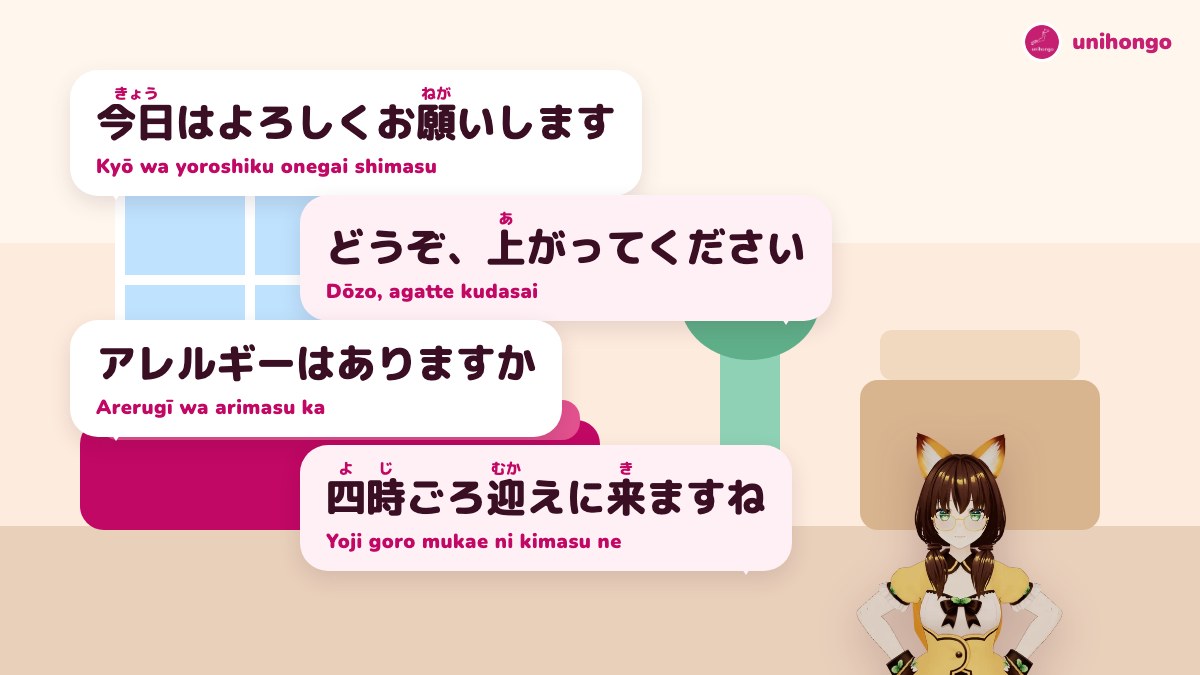
| 今日はよろしくお願いします。 | Kyō wa yoroshiku onegai shimasu. | Guest parent: Thank you for having him today. |
| いらっしゃい。どうぞ、上がってください。 | Irasshai. Dōzo, agatte kudasai. | Host: Welcome. Come on in. |
| これ、ささやかですが、ミアちゃんに。 | Kore, sasayaka desu ga, Mia-chan ni. | Guest parent: It's only something small, for Mia. |
| わあ、ありがとうございます。 | Wā, arigatō gozaimasu. | Host: Oh, thank you so much. |
| 四時ごろ迎えに来ますね。 | Yoji goro mukae ni kimasu ne. | Guest parent: I'll come back for him around four. |
| はい、お待ちしています。 | Hai, omachi shite imasu. | Host: Sure, see you then. |
During the party: lines for the children
With children, keep it casual and cheerful. The song is usually Happy Birthday in English, sung with Japanese pronunciation, followed by clapping. Asking the birthday child their age, and letting them show it on their fingers, is a classic moment.
| Japanese | Romaji | Meaning |
|---|---|---|
| みんなで歌おう! | Minna de utaō! | Let's all sing! |
| 五歳になった! | Gosai ni natta! | Child: I'm five now! |
| ケーキ、切るよ。 | Kēki, kiru yo. | I'm cutting the cake. |
| いちごがいい人? | Ichigo ga ii hito? | Who wants a strawberry? |
| 順番ね。 | Junban ne. | Take turns, OK? |
| 来てくれてありがとう! | Kite kurete arigatō! | Thanks for coming! |
A strawberry shortcake, ichigo no shōto kēki, is the classic Japanese birthday cake. Some hosts give each guest a small bag of sweets or a little toy to take home; it is a nice touch but not expected everywhere.
Gifts, budgets and other small customs
- Keep gifts small. Stationery, stickers, a picture book or a small toy is typical, and some groups of parents agree a rough budget.
- Ask before giving sweets. Allergies and family rules about sugar vary, so check with the parents.
- Write the child's name on any thank-you card in hiragana if they cannot read kanji yet.
- If your child is invited, a short thank-you message to the host parent afterwards is appreciated: kyō wa arigatō gozaimashita.
- Do not post photos of other people's children online without asking their parents first.
Rehearse the doorstep conversation
Write your invitation message in Japanese and send it to Mocchi with a note about who it is for, for example: /correct a message to a parent I've met three times, inviting her son to my daughter's party. Mocchi checks the Japanese, adjusts the politeness and explains why each change sounds more natural.
Then practise the spoken part. Ask Ibuki-sensei in AI Sensei to play a parent arriving at your door with a child, and run through the welcome, the present, the allergy check and the pick-up time. Ask Ibuki-sensei to switch to casual speech when you play the role of talking to the children.