
Why the first bill arrives in your second year
Japan has two income-based taxes that most residents pay. Income tax, shotokuzei (所得税), is national and is withheld from each payslip as you earn. Resident tax, jūminzei (住民税), is local: it combines a prefectural part and a municipal part, and your city or ward collects both together.
The key is the timing. Jūminzei for one fiscal year, which runs from June to the following May for payment purposes, is calculated on your income from January to December of the previous year. It is charged by the municipality where your resident record was on 1 January. So if you arrive in April and start work, there is no resident tax that year, because you had no Japanese income the year before. In the following June, the city calculates your tax on those first months of salary and the bill begins.
This also explains why the deduction on your payslip can jump when you get a raise or change jobs: the resident tax line reflects what you earned a year ago, not what you earn now.
| Japanese | Romaji | Meaning |
|---|---|---|
| 住民税の通知が来た。 | Jūminzei no tsūchi ga kita. | The resident tax notice has arrived. (casual) |
| 去年の収入にかかる税金です。 | Kyonen no shūnyū ni kakaru zeikin desu. | It is a tax on last year's income. |
| 今年は住民税がかかりません。 | Kotoshi wa jūminzei ga kakarimasen. | There is no resident tax this year. |
Four words that explain the system
If you learn only four expressions, learn these. They appear on city websites, on the notice itself and in what the clerk says to you.
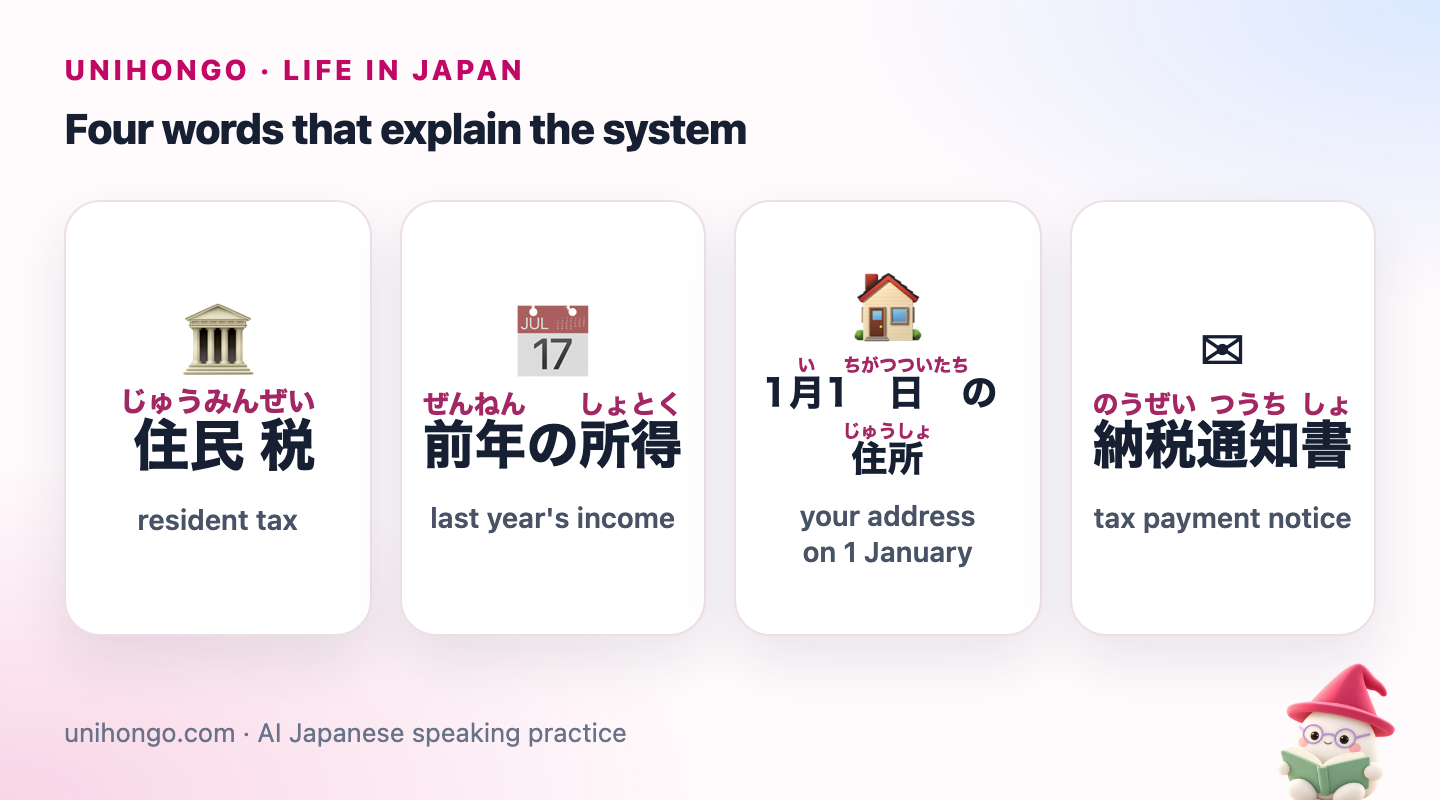
| Japanese | Romaji | Meaning |
|---|---|---|
| 住民税 | jūminzei | resident tax |
| 前年の所得 | zennen no shotoku | last year's income |
| 1月1日の住所 | ichigatsu tsuitachi no jūsho | your address on 1 January |
| 納税通知書 | nōzei tsūchisho | tax payment notice |
| 市民税・県民税 | shiminzei kenminzei | city and prefectural tax |
In Tokyo's wards the same tax is called tokubetsu kuminzei and tominzei (特別区民税・都民税), and in some places you will see chōminzei for towns. They are all jūminzei. The amount has two parts: a flat per-person part, the kintōwari (均等割), and an income-based part, the shotokuwari (所得割), which is roughly a fixed percentage of your taxable income after deductions. A small national forest environment tax is now collected together with the flat part. People with very low income may owe nothing; the limits differ by household and city.
Two ways to pay: from salary or with slips
How you pay depends on your situation, not on your choice. The city decides the collection method from the information it receives from employers and tax returns.
| Japanese | Romaji | Meaning |
|---|---|---|
| 特別徴収 | tokubetsu chōshū | deduction from salary by the employer |
| 普通徴収 | futsū chōshū | paying it yourself with slips |
| 第1期 | dai ikki | first instalment |
| 全期分 | zenkibun | the full year in one payment |
| 口座振替 | kōza furikae | automatic debit from a bank account |
| Point | Special collection (tokubetsu chōshū) | Ordinary collection (futsū chōshū) |
|---|---|---|
| Who | Most company employees | Self-employed, freelancers, many people between jobs |
| How | Employer deducts it from salary | You pay with slips, at a bank, konbini or by app or auto-debit |
| When | Twelve months, June to the following May | Usually four instalments; months vary by city |
| Notice goes to | Your employer, who hands you a copy | Your home address, around June |
With ordinary collection, the notice comes with one slip for each instalment, often marked 第1期 to 第4期, and sometimes a slip for the whole year. You can pay each slip by its due date, or the whole amount at once. Many cities also accept smartphone app payment by scanning the slip's barcode, and you can set up automatic debit from your bank account.
Reading the notice, line by line
The notice is dense, but most of it is the calculation. Look for these labels first. If you are an employee, the version your company gives you is often a narrow slip called the special collection tax decision notice, with the twelve monthly amounts printed in a row.
| Japanese | Romaji | Meaning |
|---|---|---|
| 税額決定通知書 | zeigaku kettei tsūchisho | tax amount decision notice |
| 総所得金額 | sōshotoku kingaku | total income |
| 所得控除 | shotoku kōjo | income deductions |
| 課税標準額 | kazei hyōjungaku | taxable amount |
| 年税額 | nenzeigaku | tax for the year |
| 納期限 | nōkigen | payment deadline |
| 延滞金 | entaikin | late payment charge |
Changing jobs, quitting or losing income
Because special collection runs through your employer, leaving a job changes how you pay. In general, if you leave between June and December, the remaining months switch to slips sent to your home. If you leave between January and May, the rest of the year is usually taken from your final pay in one deduction. A new employer can often take over the monthly deductions if you ask HR to arrange the transfer paperwork.
The year-behind timing hurts most when income falls: a student who worked full-time the year before, or someone who lost a job, may receive a full bill with little money coming in. Do not ignore the slips. Cities can agree a payment plan, and some reduce or exempt tax in specific hardship cases. The rules are local, so go to the tax window, explain your situation and ask what is possible.
| Japanese | Romaji | Meaning |
|---|---|---|
| 会社を辞めたので、普通徴収に変わりました。 | Kaisha o yameta node, futsū chōshū ni kawarimashita. | I left my company, so I now pay it myself. |
| 分割で払うことはできますか。 | Bunkatsu de harau koto wa dekimasu ka. | Can I pay in instalments? |
| 減免の対象になりますか。 | Genmen no taishō ni narimasu ka. | Do I qualify for a reduction? |
| 新しい会社で特別徴収にしたいです。 | Atarashii kaisha de tokubetsu chōshū ni shitai desu. | I'd like my new company to deduct it from salary. |
Leaving Japan: the 1 January rule
If you were registered in a Japanese municipality on 1 January, you owe resident tax for that year, calculated on the previous year's income, even if you leave Japan in February. Moving out does not cancel it. There are two common ways to deal with it.
| Japanese | Romaji | Meaning |
|---|---|---|
| 来月、帰国します。 | Raigetsu, kikoku shimasu. | I'm leaving Japan next month. |
| 出国前に住民税を払いたいです。 | Shukkoku mae ni jūminzei o haraitai desu. | I'd like to pay my resident tax before I leave. |
| 納税管理人の届出をしたいです。 | Nōzei kanrinin no todokede o shitai desu. | I'd like to register a tax agent. |
- Settle it before you leave. Visit the tax section when you file your moving-out notice and ask to pay the remaining amount. If the year's figure is not fixed yet, the city may calculate it early or explain the alternatives.
- Appoint a tax agent, a nōzei kanrinin (納税管理人). This is a person in Japan, often a friend or your company, who receives the notices and pays on your behalf. You file a short form at the city office.
- If you are leaving under special collection, ask HR whether the remaining amount will be taken from your final salary.
- If you leave Japan in December and file your moving-out notice before 1 January, you are generally not charged resident tax the next year on that year's income. Confirm your own case at the window.
At the tax window: a short dialogue
The tax section is usually signposted 市民税課, 住民税係 or 税務課. Take a number, bring the notice and your residence card, and say what you need in one sentence. Clerks are used to questions about the notice and will often show you the line on your own document.
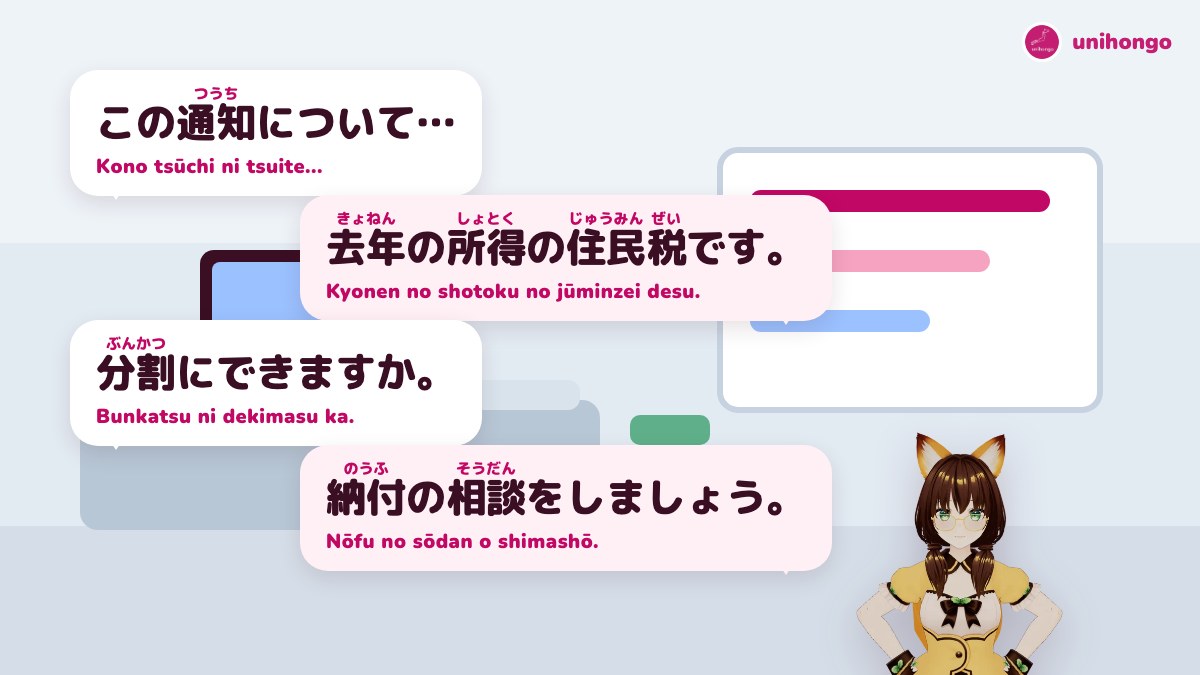
| Japanese | Romaji | Meaning |
|---|---|---|
| すみません、この通知について聞きたいのですが。 | Sumimasen, kono tsūchi ni tsuite kikitai no desu ga. | You: Excuse me, I have a question about this notice. |
| はい、在留カードをお持ちですか。 | Hai, zairyū kādo o omochi desu ka. | Clerk: Sure. Do you have your residence card? |
| はい。この金額は何の税金ですか。 | Hai. Kono kingaku wa nan no zeikin desu ka. | You: Yes. What tax is this amount for? |
| 去年の所得にかかる住民税です。 | Kyonen no shotoku ni kakaru jūminzei desu. | Clerk: It's resident tax on last year's income. |
| 一度に払えないので、分割にできますか。 | Ichido ni haraenai node, bunkatsu ni dekimasu ka. | You: I can't pay it all at once. Can I split it? |
| では、納付の相談をしましょう。 | Dewa, nōfu no sōdan o shimashō. | Clerk: Then let's talk about a payment plan. |
| もう少しゆっくり話していただけますか。 | Mō sukoshi yukkuri hanashite itadakemasu ka. | You: Could you speak a little more slowly? |
Mistakes that cost newcomers money
- Assuming your income tax withholding covers everything. Resident tax is separate and comes a year later.
- Spending the extra take-home pay of the first year and being caught out by the June deduction.
- Ignoring slips after leaving a job. Unpaid instalments add late charges and the city can eventually seize assets.
- Leaving Japan without settling or appointing an agent. Unpaid tax can complicate a later return to Japan and a future visa application.
- Forgetting to update your address. Notices go to your registered address, and a returned envelope does not stop the deadline.
Rehearse the tax window before you go
Paste the confusing line from your notice into Mocchi, Unihongo's study assistant, and ask it to explain each word, with /explain for a whole sentence. Mocchi keeps track of the words you miss and can turn them into a short quiz the next day.
Then practise the conversation aloud. In AI Sensei, ask Yamada-sensei to play a city office tax clerk who speaks at normal speed, and request an instalment plan, ask about a reduction and say you are leaving Japan. The session report afterwards lists the corrections and the vocabulary you used.