
Rescue phrases for the frozen moment
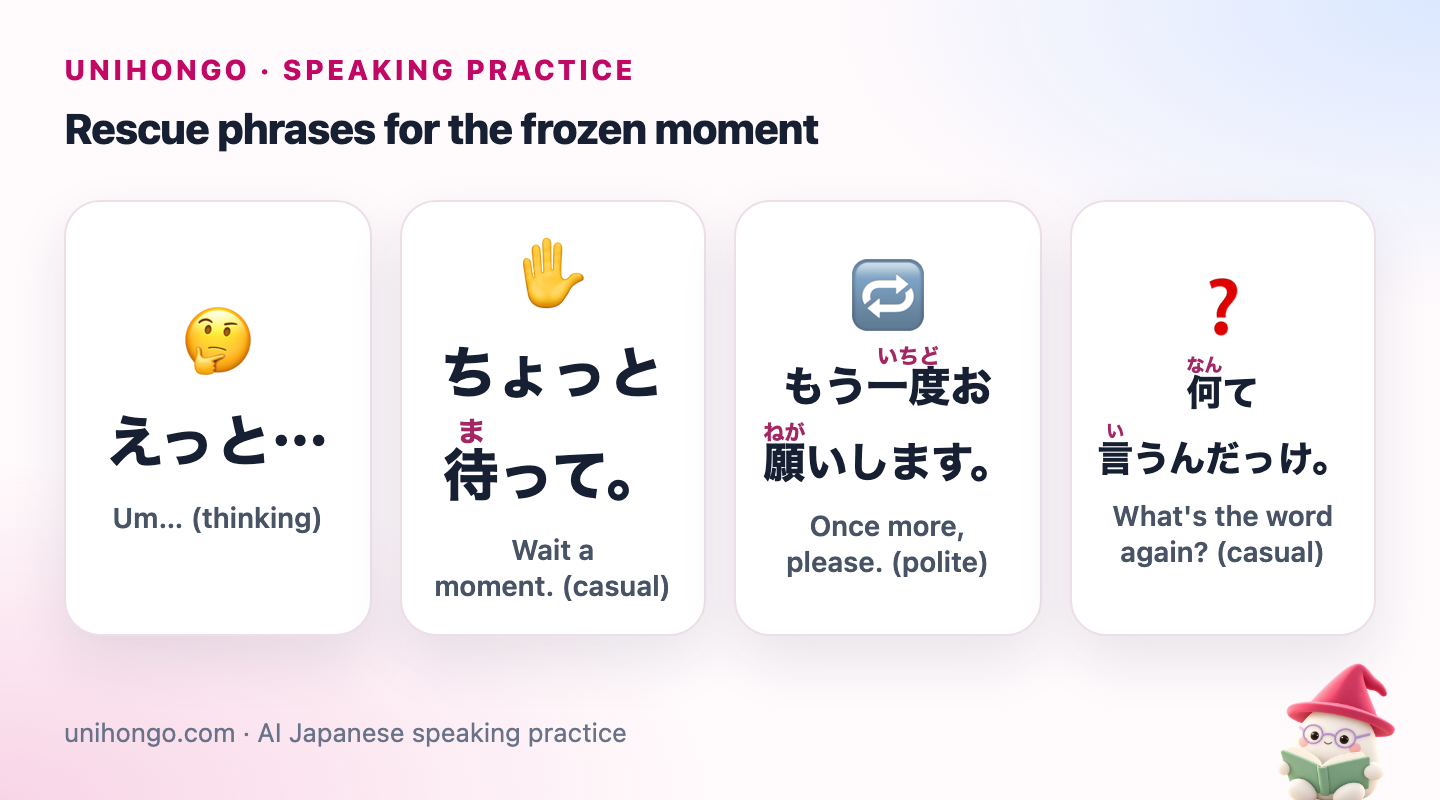
Before the causes, the emergency kit. These lines keep you in the conversation while you think. Etto is the everyday filler, the sound people make while searching for words. Chotto matte is casual; with people you do not know well, say chotto matte kudasai. Nante iu n dakke is what Japanese speakers say themselves when a word escapes them.
| Japanese | Romaji | Meaning |
|---|---|---|
| えっと… | Etto… | Um… (thinking) |
| ちょっと待って。 | Chotto matte. | Wait a moment. (casual) |
| もう一度お願いします。 | Mō ichido onegai shimasu. | Once more, please. (polite) |
| 何て言うんだっけ。 | Nante iu n dakke. | What's the word again? (casual) |
| これは日本語で何と言いますか。 | Kore wa nihongo de nan to iimasu ka. | How do you say this in Japanese? |
| 簡単に言うと… | Kantan ni iu to… | To put it simply… |
Five causes of the freeze
Think back to your last freeze. Which of these was happening? Most learners recognise one or two as their main pattern.
| Cause | What it feels like | Fix |
|---|---|---|
| Translating from your first language | You build a long sentence in your head, then cannot convert it | Start from Japanese you know; say short sentences |
| Register panic | You stop to choose between casual, polite or keigo | Default to desu and masu; switch later |
| Conjugation overload | You know the verb but get stuck on its form | Drill the forms you use most until they are automatic |
| Listening lag | You are still decoding the question when it is your turn | Repeat the key word back to buy time |
| Empty topic | You have nothing to say, even in your own language | Prepare short stories about yourself in advance |
Cause 1: you are translating
Many learners plan the sentence they would say in their own language and then try to translate it. The original sentence is usually too complex for their current Japanese, so the conversion stalls. The fix is to think in the Japanese you already have: break the idea into two or three short sentences.
| Japanese | Romaji | Meaning |
|---|---|---|
| 週末は家にいました。 | Shūmatsu wa ie ni imashita. | I stayed home at the weekend. |
| 雨でした。 | Ame deshita. | It was raining. |
| 映画を二本見ました。 | Eiga o nihon mimashita. | I watched two films. |
In English you might plan: because it rained all weekend I ended up staying in and catching up on films. In Japanese, three short sentences carry the same information and come out at once. Linking them comes later.
A useful habit is to start from the end of the Japanese sentence: what is the verb? Once you know it is imashita, mimashita or ikimashita, the rest of the sentence often falls into place in front of it. Learners who start from the subject and the first English words tend to get stuck halfway, because Japanese word order puts the key word last.
Causes 2 and 3: register panic and conjugation overload
Register panic happens when you stop to decide how polite to be. In most first conversations with adults you do not know, desu and masu are safe; if the other person switches to casual speech and you are friends, follow them. Making the choice quickly matters more than making it perfectly.
Conjugation overload is the freeze on the verb form: you know iku but stall on itte shimatta. The cure is drilling the handful of forms you use most, past, te-form and negative, with your own common verbs until they come without thinking.
Choose your ten most-used verbs, the ones you need to talk about your own life, such as iku, taberu, miru, suru and hataraku, and say each in the forms below until you can produce all of them in one breath. It is a dull drill, but a few minutes a day for two weeks makes a noticeable difference to how quickly verbs come out in conversation.
| Japanese | Romaji | Meaning |
|---|---|---|
| 行きます、行きました、行って | ikimasu, ikimashita, itte | go, went, going and (te-form) |
| 食べます、食べました、食べて | tabemasu, tabemashita, tabete | eat, ate, eating and (te-form) |
| します、しました、して | shimasu, shimashita, shite | do, did, doing and (te-form) |
Causes 4 and 5: listening lag and the empty topic
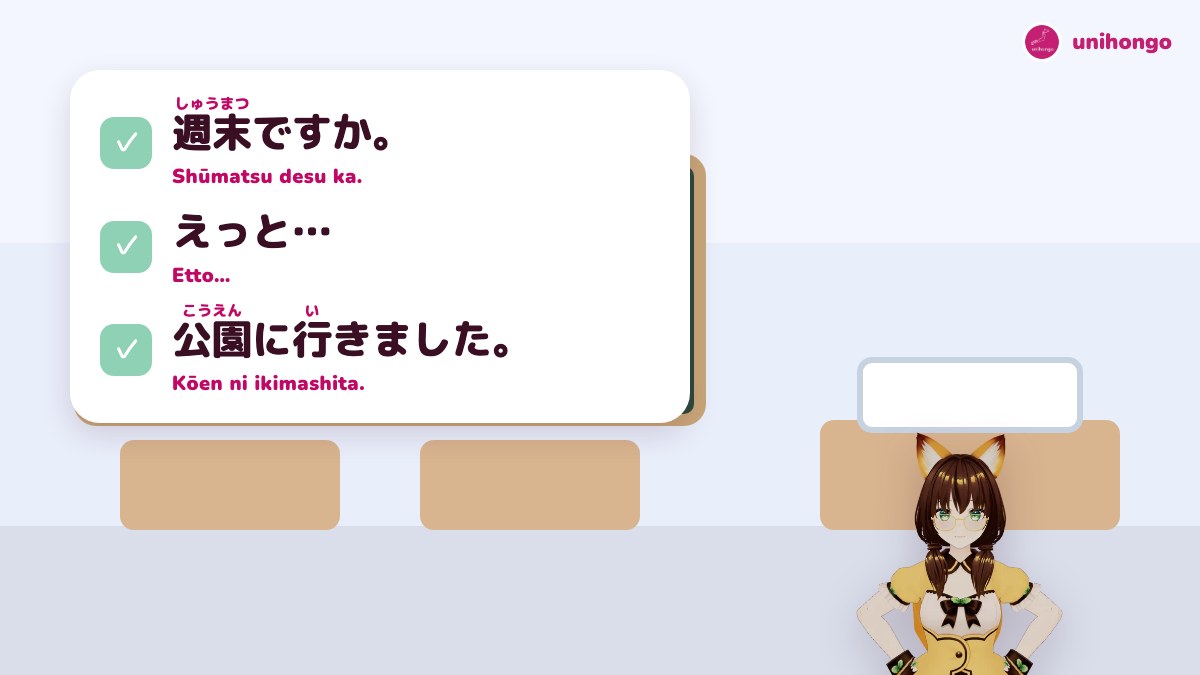
Listening lag means you are still working out the question when it is your turn. Repeating the key word back is natural in Japanese and buys you a second or two: shūmatsu desu ka? Then answer.
The empty topic is a freeze that would happen in any language: someone asks about your hobbies and you have nothing ready. Prepare four or five short stories about yourself, your job or studies, a hobby, a recent trip, why you learn Japanese, and practise them until they flow.
| Japanese | Romaji | Meaning |
|---|---|---|
| 週末は何をしましたか。 | Shūmatsu wa nani o shimashita ka. | Teacher: What did you do at the weekend? |
| 週末ですか。えっと… | Shūmatsu desu ka. Etto… | You: The weekend? Um… |
| 友達と公園に行きました。 | Tomodachi to kōen ni ikimashita. | You: I went to the park with a friend. |
| いいですね。どの公園ですか。 | Ii desu ne. Dono kōen desu ka. | Teacher: Nice. Which park? |
A two-week unfreezing routine
- Days 1 to 3: say your five prepared stories aloud each day, then answer five quick questions within three seconds each.
- Days 4 to 7: drill the past, te-form and negative of your ten most-used verbs; say a short sentence with each.
- Days 8 to 10: one short conversation a day with a partner; use at least two rescue phrases on purpose.
- Days 11 to 14: longer conversations; after each, write down one freeze and the simpler sentence you could have said.
Mistakes that make the freeze worse
- Staying silent instead of using a filler. Silence feels longer to you than to the listener, but a filler shows you are still in the conversation.
- Apologising for your Japanese after every sentence. One sumimasen is enough; then keep going.
- Changing your sentence halfway through. If you started with a simple structure, finish it; restarting doubles the time you spend in the freeze.
- Trying to say everything you could say in your first language. Say what you can, simply.
- Practising only in your head. Silent rehearsal does not train your mouth; say it aloud.
- Avoiding conversation until you feel ready. The freeze shrinks only through speaking.
Practise the moment, not just the words
Tell Mocchi about your last freeze, for example: I wanted to say I stayed home because of the rain and caught up on films, but I froze. Mocchi suggests simpler ways to say it at your level, keeps track of the patterns that trip you up, and can quiz you on them with /review.
Then rehearse the real moment with AI Sensei. Ask Haru-sensei for a self-introduction chat with quick follow-up questions, and ask the Sensei to wait while you use your rescue phrases. You can ask for slower speech at any time, and the session report shows where you hesitated and what to say next time.