
Four words for after-school lessons
Four words cover most of the conversations you will have with a lesson school or juku. The first is the question you ask before anything else. Naraigoto is the general word for lessons. Gessha is the monthly fee. Furikae, swap, is the make-up lesson you book when your child misses a class.
Taiken means experience, and on lesson school flyers it means a trial: 無料体験 is a trial lesson that costs nothing.
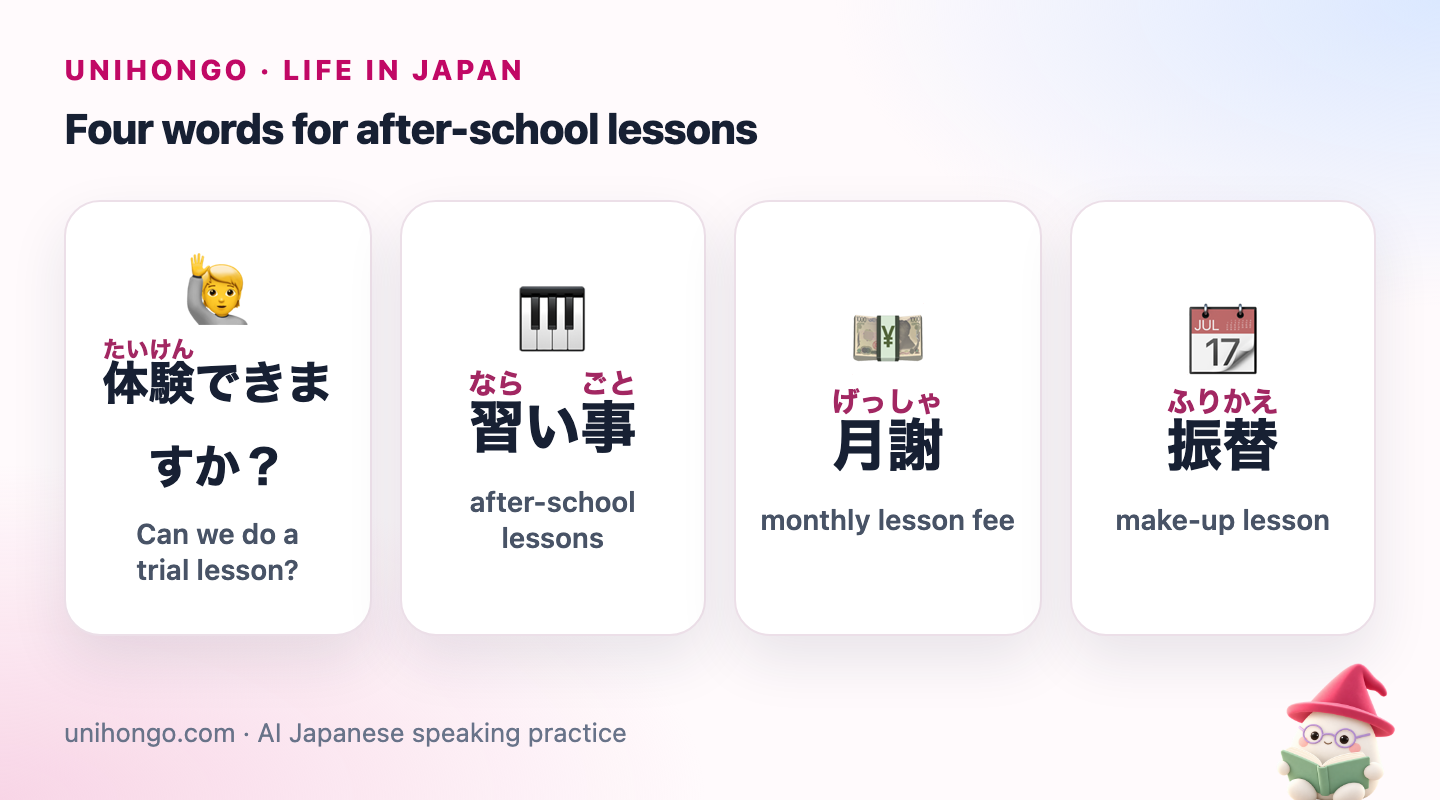
| Japanese | Romaji | Meaning |
|---|---|---|
| 体験できますか? | Taiken dekimasu ka? | Can we do a trial lesson? |
| 習い事 | naraigoto | after-school lessons |
| 月謝 | gessha | monthly lesson fee |
| 振替 | furikae | make-up lesson |
Common lessons and what they are called
Some lessons are loanwords, some are traditional words. Swimming schools usually say suimingu rather than suiei, and calligraphy for children is usually shūji rather than shodō.
| Japanese | Romaji | Meaning |
|---|---|---|
| スイミング | suimingu | swimming lessons |
| ピアノ | piano | piano |
| 英会話 | eikaiwa | English conversation |
| 習字 | shūji | calligraphy (school style) |
| そろばん | soroban | abacus |
| 体操 | taisō | gymnastics |
| プログラミング | puroguramingu | programming |
| 何か習い事をしていますか。 | Nanika naraigoto o shite imasu ka. | Does your child do any lessons? |
Many lessons have grades, kyū, and tests, kentei or shinkyū shiken. Swimming schools, abacus and calligraphy are famous for them, and children are proud to move up a level. Other parents often ask nan kyū, which level, in conversation.
Types of juku
Juku are private schools that teach school subjects outside school hours. They range from small neighbourhood classrooms to large chains with entrance exams of their own. The words below appear on almost every juku flyer.
| Word | Reading | Meaning |
|---|---|---|
| 進学塾 | shingaku juku | Exam-prep juku for school entrance exams |
| 補習塾 | hoshū juku | Catch-up juku for school lessons |
| 集団授業 | shūdan jugyō | Group classes |
| 個別指導 | kobetsu shidō | One-to-one or very small groups |
| 中学受験 | chūgaku juken | Entrance exams for private junior high schools |
| 入塾テスト | nyūjuku tesuto | Placement test before joining |
Public junior high schools in Japan do not usually require an entrance exam, so chūgaku juken is a choice some families make, often in big cities. Many more children go to juku in junior high school to prepare for high school entrance exams. Whether, when and which juku is a family decision, and opinions differ a lot.
Phoning to ask about a trial lesson
The enquiry call follows a fixed pattern: you say what you are calling about, give your child's grade, ask about a trial and the available days, then the staff ask for your details. Grade matters more than age in Japan, so know it: shōgaku sannensei is third grade of elementary school.
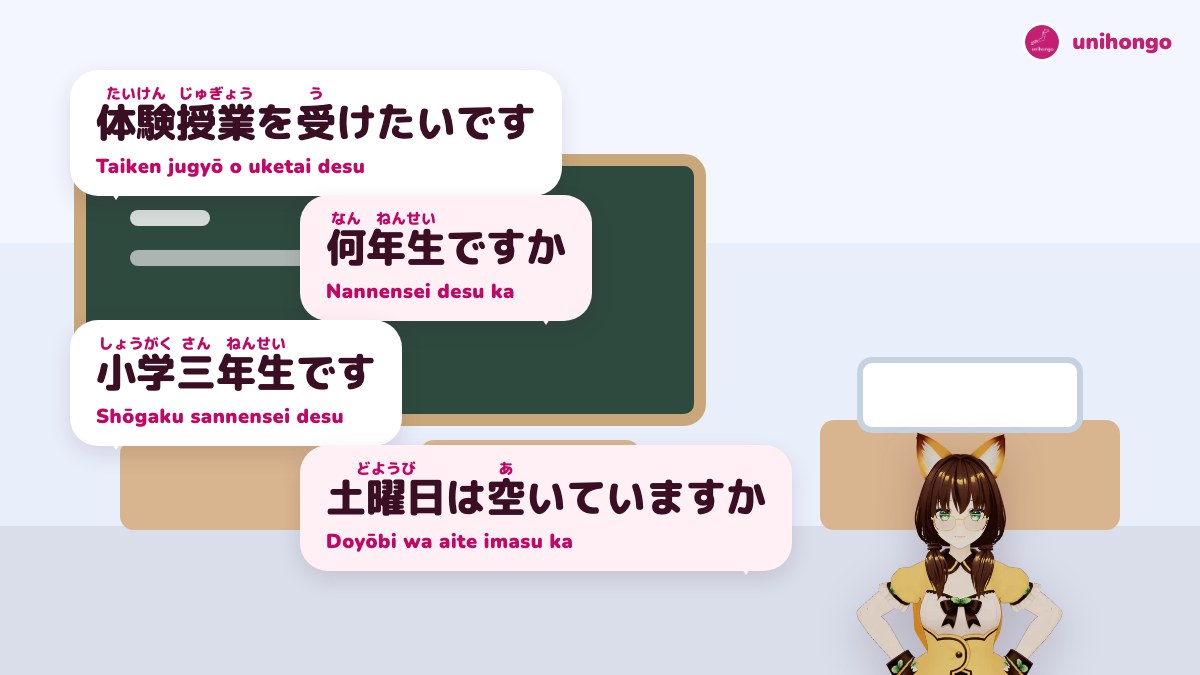
| Japanese | Romaji | Meaning |
|---|---|---|
| すみません、体験授業について伺いたいんですが。 | Sumimasen, taiken jugyō ni tsuite ukagaitai n desu ga. | Hello, I'd like to ask about a trial lesson. |
| 何年生ですか。 | Nannensei desu ka. | Staff: What grade is your child in? |
| 小学三年生です。 | Shōgaku sannensei desu. | Third grade of elementary school. |
| 初めてなんですが、大丈夫ですか。 | Hajimete nan desu ga, daijōbu desu ka. | She's a complete beginner. Is that OK? |
| 土曜日は空いていますか。 | Doyōbi wa aite imasu ka. | Do you have space on Saturdays? |
| 当日は何を持っていけばいいですか。 | Tōjitsu wa nani o motte ikeba ii desu ka. | What should we bring on the day? |
Fees, joining and the fee sheet
Before joining, ask for the fee sheet, ryōkinhyō, and read it carefully. Besides the monthly fee, many schools charge a joining fee, materials, an annual fee, uniforms or event costs. Payment is often by bank transfer each month.
| Japanese | Romaji | Meaning |
|---|---|---|
| 入会金 | nyūkaikin | joining fee |
| 教材費 | kyōzaihi | materials fee |
| 料金表をいただけますか。 | Ryōkinhyō o itadakemasu ka. | Could I have the fee sheet? |
| 月謝のほかに、かかる費用はありますか。 | Gessha no hoka ni, kakaru hiyō wa arimasu ka. | Are there any costs besides the monthly fee? |
| 兄弟割引はありますか。 | Kyōdai waribiki wa arimasu ka. | Is there a sibling discount? |
| 辞めるときは、いつまでに連絡すればいいですか。 | Yameru toki wa, itsu made ni renraku sureba ii desu ka. | If we quit, how much notice do we need to give? |
The last question is worth asking at the start. Many schools need notice by a set date of the previous month, and leaving without it can mean paying another month.
Absences, make-up lessons and pick-up
If your child is ill or has a school event, contact the school in advance; many use an app or web form. Make-up lessons, furikae, are common at swimming and some other schools, often within the same month and only if there is space. Ask the rules when you join.
| Japanese | Romaji | Meaning |
|---|---|---|
| 今日は熱があるので、お休みします。 | Kyō wa netsu ga aru node, oyasumi shimasu. | She has a fever, so she'll miss today. |
| 振替はできますか。 | Furikae wa dekimasu ka. | Can she take a make-up lesson? |
| 来週の水曜日に振り替えたいです。 | Raishū no suiyōbi ni furikaetai desu. | I'd like to move it to next Wednesday. |
| 今日は祖母が迎えに来ます。 | Kyō wa sobo ga mukae ni kimasu. | Her grandmother will pick her up today. |
Talking with the teacher or coach
Teachers at lesson schools are usually glad to talk briefly before or after class. Short questions about progress and practice at home are welcome; long conversations are better at a parents' meeting, mendan, which juku often hold before exams.
| Japanese | Romaji | Meaning |
|---|---|---|
| 最近、どうですか。 | Saikin, dō desu ka. | How has she been doing lately? |
| 家で何を練習したらいいですか。 | Ie de nani o renshū shitara ii desu ka. | What should she practise at home? |
| 本人はとても楽しんでいます。 | Honnin wa totemo tanoshinde imasu. | He's really enjoying it. |
| いつもありがとうございます。 | Itsumo arigatō gozaimasu. | Thank you for everything, as always. |
On the trial day: what to watch and ask
The trial lesson is as much for you as for your child. Arrive a little early, watch how the teacher speaks to the children, and ask your questions after the class, when staff usually have a few minutes. Many schools give you an application form, nyūkai mōshikomisho, at the end; you do not have to decide on the spot.
If your child does not enjoy it, a polite no is easy: thank the staff, say you will think about it at home, and leave. Schools are used to this, and nobody expects an explanation.
| Japanese | Romaji | Meaning |
|---|---|---|
| 一クラス何人ぐらいですか。 | Hito kurasu nannin gurai desu ka. | About how many children are in a class? |
| 先生は毎回同じですか。 | Sensei wa maikai onaji desu ka. | Is it the same teacher every time? |
| 見学はできますか。 | Kengaku wa dekimasu ka. | Can parents watch the lesson? |
| 家で相談してから決めます。 | Ie de sōdan shite kara kimemasu. | We'll talk it over at home before deciding. |
| 今日はありがとうございました。 | Kyō wa arigatō gozaimashita. | Thank you for today. |
Talking about lessons with other parents
Lessons are a favourite topic among parents, and other parents are the best source of honest reviews. Questions about which lessons a child does, how they like it and how they get there are friendly small talk. Questions about how much a family pays are more personal; many parents prefer not to discuss exact fees.
| Japanese | Romaji | Meaning |
|---|---|---|
| 何曜日に行ってるんですか。 | Nan'yōbi ni itteru n desu ka. | Which day does he go? |
| 送り迎えはどうしてますか。 | Okurimukae wa dō shite masu ka. | How do you handle drop-off and pick-up? |
| 先生、どうですか。 | Sensei, dō desu ka. | What's the teacher like? |
Practise the call before you pick up the phone
Write your enquiry script and paste it to Mocchi with /correct, adding who you are calling, such as a swimming school or a juku. Mocchi makes the Japanese natural and polite, explains forms such as ukagaitai, and can quiz you on the fee words with /quiz.
Phone calls are harder than face-to-face talk, so rehearse the spoken version too. In AI Sensei, ask Yamada-sensei to play the receptionist at a juku and to ask you the usual questions about grade, experience and preferred days. Ask Yamada-sensei to speak at a natural phone speed the second time.