
What furusato nōzei actually is
The scheme was created so that people in big cities could support the regions where they grew up, or any region they care about. You donate to a prefecture or municipality. In return, the donation minus a small fixed self-paid amount is deducted from your income tax and your resident tax, as long as you stay within your upper limit. Most municipalities send a thank-you gift, a henreihin, usually a local product. National rules cap the value of gifts at a share of the donation and require them to be local.
In practice, for someone who pays tax in Japan, a donation within the limit costs you the self-paid share, and you receive a gift. That is why the scheme is so popular. You can also donate without wanting a gift, for example to disaster recovery, and many municipalities let you choose how your money is used.
| Japanese | Romaji | Meaning |
|---|---|---|
| ふるさと納税をしてみよう。 | Furusato nōzei o shite miyō. | Let's try hometown tax donations. (casual) |
| 生まれた町じゃなくてもいいよ。 | Umareta machi ja nakute mo ii yo. | It doesn't have to be your hometown. (casual) |
| 寄附金の使い道を選べます。 | Kifukin no tsukaimichi o erabemasu. | You can choose how the donation is used. |
The four words to know first
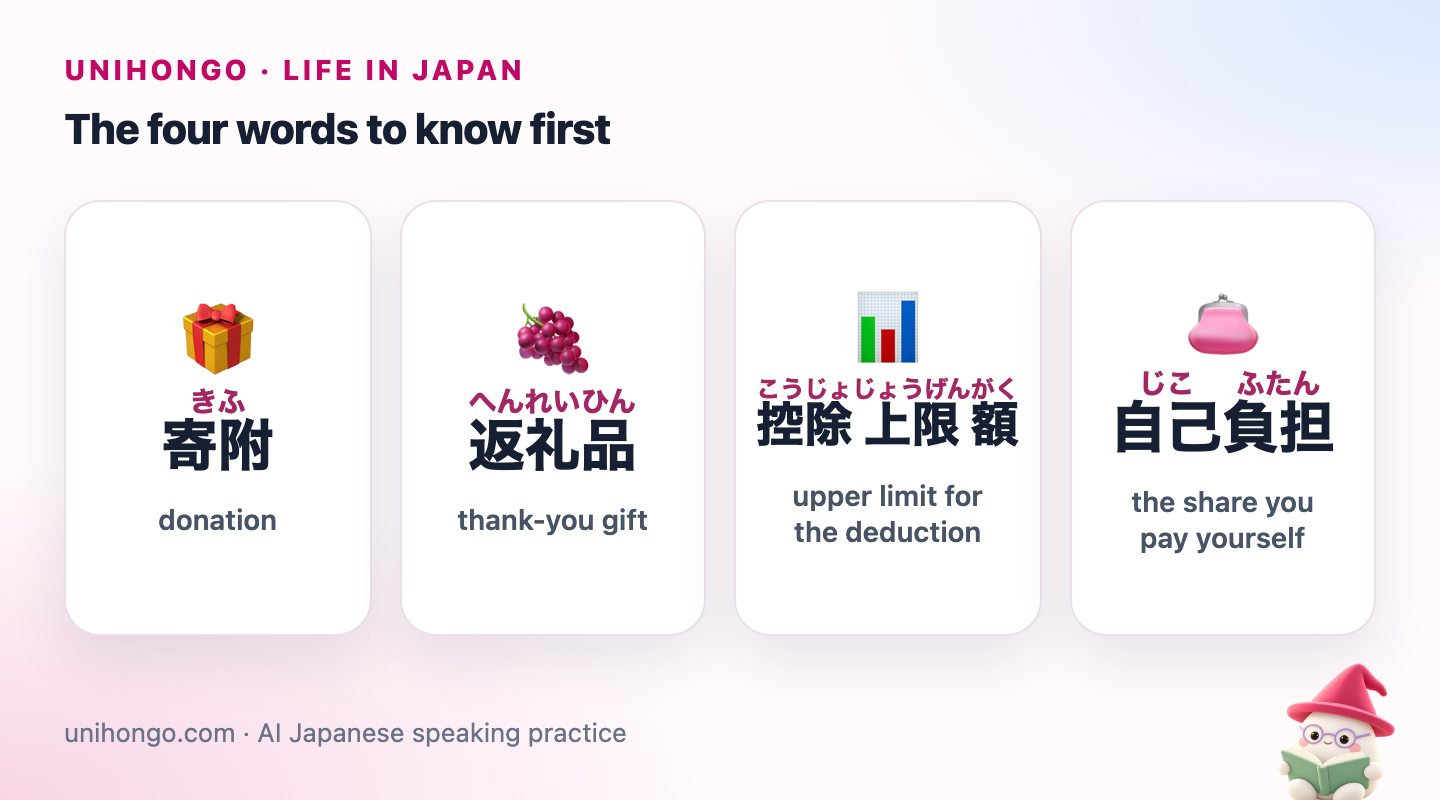
| Japanese | Romaji | Meaning |
|---|---|---|
| 寄附 | kifu | donation |
| 返礼品 | henreihin | thank-you gift |
| 控除上限額 | kōjo jōgengaku | upper limit for the deduction |
| 自己負担 | jiko futan | the share you pay yourself |
You will see both 寄附 and 寄付 for donation. They mean the same thing; municipalities often use 寄附 in official documents. The thank-you gift is also called orei no shina (お礼の品) on some sites.
Who benefits, and the upper limit
The deduction only helps if you pay tax in Japan. A student with no taxable income, a dependent spouse with no income, or someone who will leave Japan before next year's resident tax is charged gains little or nothing from the deduction. The donation still counts as a donation, but it is no longer close to free.
The upper limit depends on several things at once, so no single number fits everyone.
| Japanese | Romaji | Meaning |
|---|---|---|
| 上限額はいくらぐらいですか。 | Jōgengaku wa ikura gurai desu ka. | Roughly what is my upper limit? |
| 上限を超えた分は控除されません。 | Jōgen o koeta bun wa kōjo saremasen. | Anything above the limit is not deducted. |
| Factor | Why it matters |
|---|---|
| Annual income | Higher income usually means a higher limit |
| Family | A dependent spouse or children lower the limit |
| Other deductions | Housing loan, medical or insurance deductions change the calculation |
| How you claim | One-stop and a tax return reach the same total in most cases, split differently |
Use a simulator with your latest withholding slip (源泉徴収票) and stay below the estimate. If your income will change a lot this year, estimate with the lower figure. People whose situation is complex, such as the self-employed, can ask the tax office.
From choosing a gift to the receipt
| Japanese | Romaji | Meaning |
|---|---|---|
| 配送時期 | haisō jiki | delivery period |
| 冷凍でお届けします。 | Reitō de otodoke shimasu. | It will be delivered frozen. |
| 寄附金受領証明書 | kifukin juryō shōmeisho | donation receipt |
| 定期便 | teikibin | a gift delivered in several shipments |
- Choose a municipality and a gift on a portal site or the municipality's own site, and check the delivery period.
- Pay the donation, usually by card. The name and address must match your resident record, because the deduction is linked to you.
- Receive the gift, and separately the donation receipt, the kifukin juryō shōmeisho (寄附金受領証明書). Keep it.
- If you want the one-stop exception, ask for the application form when you donate, or download it, and return it with copies of your My Number and ID documents. Many municipalities accept it online.
- Next year, check that the deduction appears on your resident tax notice.
One-stop exception or tax return?
There are two ways to claim, and the right one depends on whether you file a tax return anyway.
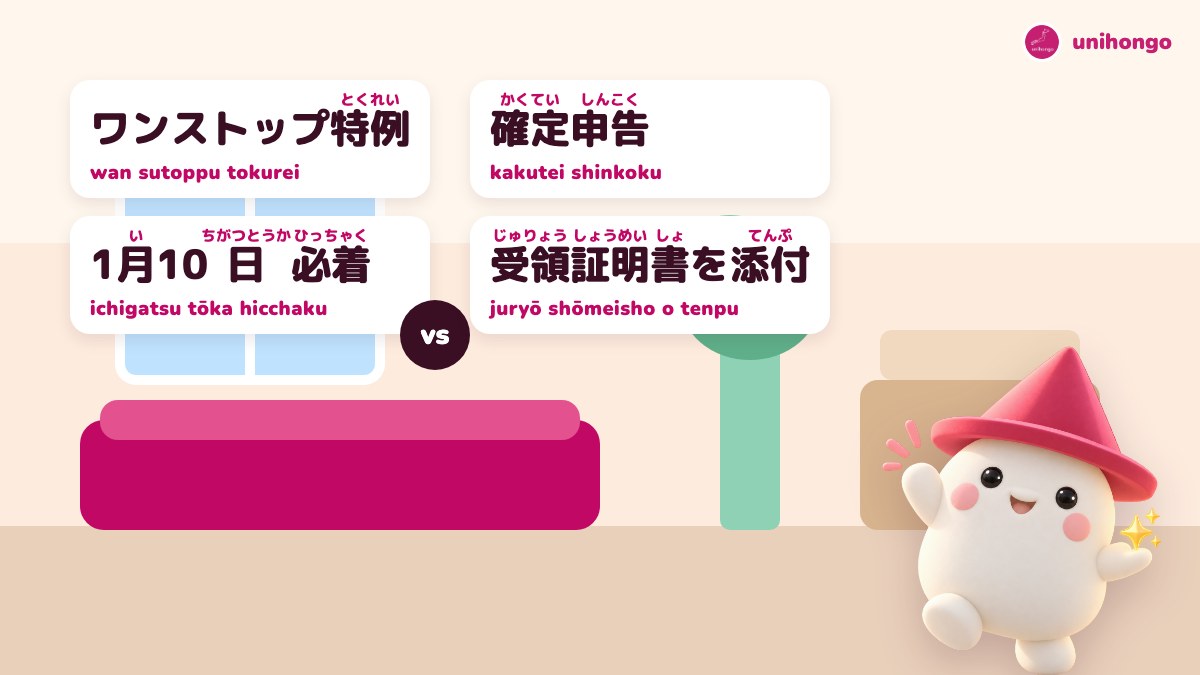
| Japanese | Romaji | Meaning |
|---|---|---|
| ワンストップ特例申請書 | wan sutoppu tokurei shinseisho | one-stop exception application form |
| 確定申告をするので、ワンストップは使えません。 | Kakutei shinkoku o suru node, wan sutoppu wa tsukaemasen. | I'm filing a return, so I can't use one-stop. |
| 住所が変わりました。変更届を出します。 | Jūsho ga kawarimashita. Henkō todoke o dashimasu. | My address changed. I'll send a change notice. |
| Point | One-stop exception | Tax return |
|---|---|---|
| Who | Salaried people who do not need to file a return | Anyone, and required for the self-employed |
| How many municipalities | Five or fewer | Any number |
| What you send | One form to each municipality | One return with all receipts |
| Deadline | Must arrive by 10 January of the next year | The normal tax return period |
| Where the deduction appears | All in next year's resident tax | Income tax refund plus resident tax |
Several donations to the same municipality count as one. If you file a tax return for any reason, for example a medical expense deduction, the one-stop applications are cancelled and every donation must go in the return. If you move after applying, send the municipality a change notice, also by 10 January.
Talking about it with a coworker
Furusato nōzei is a safe, friendly small-talk topic, especially in late autumn and December, when people rush to donate before the year ends. Note that the donation counts in the calendar year you pay it.
| Japanese | Romaji | Meaning |
|---|---|---|
| 今年のふるさと納税、もうした? | Kotoshi no furusato nōzei, mō shita? | Coworker: Have you done your furusato nōzei this year? (casual) |
| まだです。おすすめはありますか。 | Mada desu. Osusume wa arimasu ka. | You: Not yet. Any recommendations? |
| お米の定期便が便利だよ。 | Okome no teikibin ga benri da yo. | Coworker: Rice in regular deliveries is handy. |
| ワンストップの書類、忘れないでね。 | Wan sutoppu no shorui, wasurenaide ne. | Coworker: Don't forget the one-stop papers. |
| 一月十日までですよね。 | Ichigatsu tōka made desu yo ne. | You: It's by 10 January, right? |
Common mistakes
- Donating far above your limit because a gift looked good. The extra is a real donation with no deduction.
- Missing the 10 January deadline for one-stop forms, which then forces you to file a tax return.
- Using one-stop and then filing a tax return for medical expenses without listing the donations.
- Donating under a partner's name with your card, or with an address that differs from the resident record.
- Expecting a gift from your own municipality. Municipalities generally do not send gifts to their own residents.
- Donating in the year you leave Japan without checking whether you will still pay resident tax afterwards.
- Forgetting that the deduction appears a year later: check next year's resident tax notice, where the donation shows as a deduction, and ask the city if it is missing.
If you move or leave Japan
The deduction is attached to you through your resident record, so changes of address matter. If you used the one-stop exception and then move before the end of January, send each municipality a change notice, the shinsei jikō henkō todokede, by 10 January, so that the information reaches your new city. If you move later in the year, the deduction follows your resident tax to wherever you lived on 1 January.
Leaving Japan is the bigger risk. The one-stop deduction is taken entirely from next year's resident tax, and resident tax is charged by the city where you lived on 1 January. If you leave in, say, November and have moved out before 1 January, there is usually no resident tax to reduce, and the donation stays a donation. If you will still be registered on 1 January and pay that year's resident tax, the deduction applies. When in doubt, ask the tax section of your city office before donating.
| Japanese | Romaji | Meaning |
|---|---|---|
| 申請事項変更届出書 | shinsei jikō henkō todokedesho | change notice for the one-stop application |
| 引っ越したので、住所を変更したいです。 | Hikkoshita node, jūsho o henkō shitai desu. | I moved, so I'd like to change my address. |
| 来年の住民税から引かれますか。 | Rainen no jūminzei kara hikaremasu ka. | Will it be taken off next year's resident tax? |
| 年内に帰国する予定です。 | Nennai ni kikoku suru yotei desu. | I plan to leave Japan before the year ends. |
Learn the form words before December
The busy season is the end of the year, so learn the vocabulary early. Ask Mocchi something like "Make flashcards for the furusato nōzei form words and quiz me on them", and it builds cards with /create-flashcards and brings them back with /review-flashcards when they are due. If one word keeps slipping, Mocchi remembers it and returns to it.
For quick recognition practice, add those cards to Kotoba Stack in the games section, so that 控除, 寄附 and 申請書 become instant reads instead of puzzles.