
Four words that tell you what to do
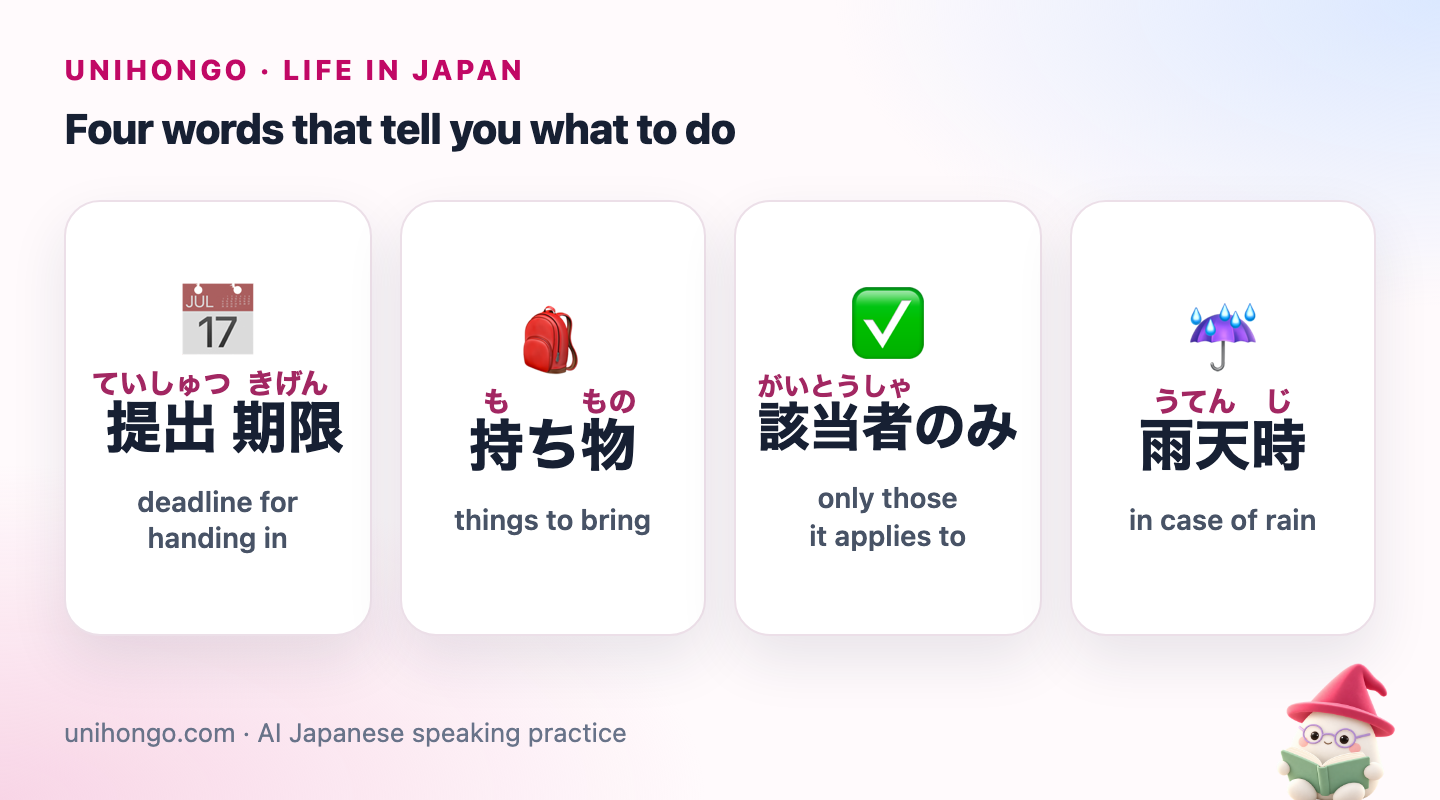
When a notice comes home, look for these four words before anything else. Mochimono tells you what to bring. Teishutsu kigen is the deadline for handing something in. Gaitōsha nomi means the instruction applies only to some families. Utenji tells you what happens if it rains, which matters for every outdoor event.
If none of the four appears and the title ends in dayori, the notice is probably for information only, and you can read it at leisure.
| Japanese | Romaji | Meaning |
|---|---|---|
| 提出期限 | teishutsu kigen | deadline for handing in |
| 持ち物 | mochimono | things to bring |
| 該当者のみ | gaitōsha nomi | only those it applies to |
| 雨天時 | utenji | in case of rain |
The kinds of notice that come home
The name of a notice tells you who wrote it and how urgent it is likely to be. Dayori is the form tayori, letter, takes after another word.
| Japanese | Romaji | Meaning |
|---|---|---|
| お知らせ | oshirase | notice, announcement |
| 〜について | ni tsuite | about, regarding |
| お願い | onegai | request |
| Name | Reading | From and about |
|---|---|---|
| 学校だより | gakkō dayori | Whole school: monthly plans, the principal's message |
| 学年だより | gakunen dayori | Grade: events, homework, items |
| 学級だより | gakkyū dayori | Class teacher: class news and requests |
| 保健だより | hoken dayori | School nurse: illnesses, health checks |
| 給食だより | kyūshoku dayori | School lunch: menu and nutrition |
| PTAだより | pītīē dayori | PTA: meetings, roles, events |
Single-issue notices usually have a title that starts with the event or the request, such as 運動会のお知らせ (notice about sports day) or 個人面談の日程について (about the individual meeting schedule). Those are the ones to read first.
The layout of a typical notice
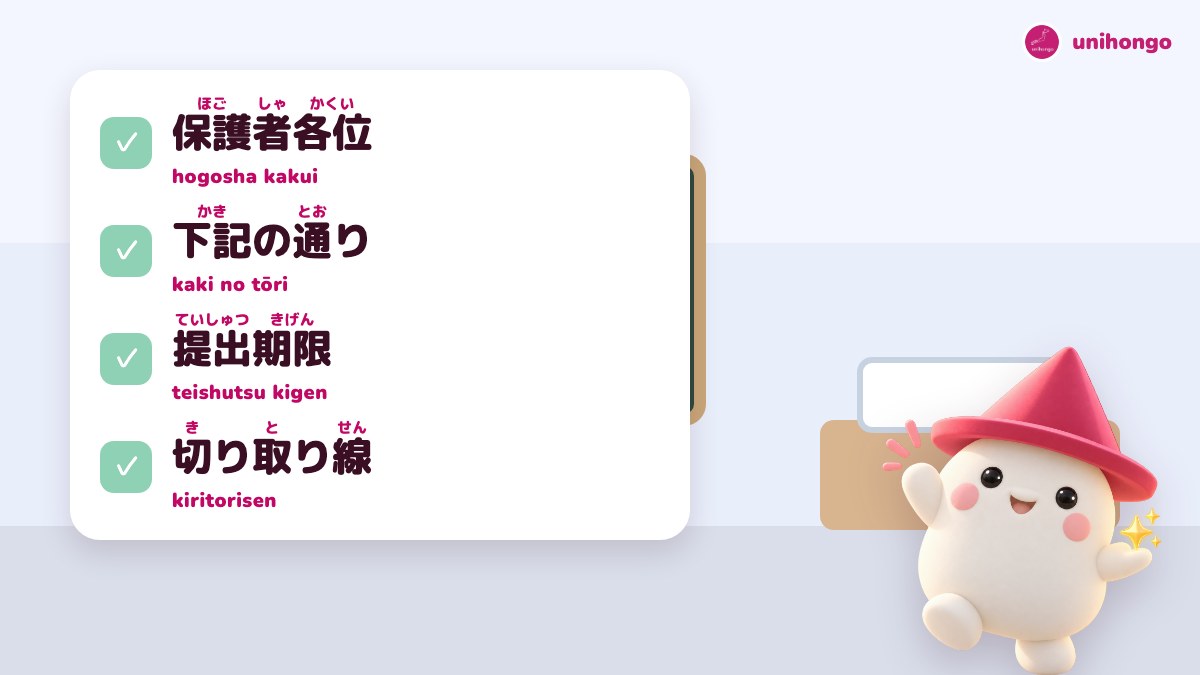
A formal notice has the date at the top right, often in the Japanese era: 令和8年 is 2026. Below it on the left is the addressee, hogosha kakui, to all parents and guardians, and on the right the sender, such as the principal. The title is centred. A short seasonal greeting follows, which you can skim. Then a sentence ending in kaki no tōri, as follows, leads to the word ki (記), and the details are listed below it, ending with ijō (以上), the end.
If there is a reply slip, it sits below a dotted line marked kiritorisen or キリトリ. Everything above that line stays at home; the part below goes back to school.
| Japanese | Romaji | Meaning |
|---|---|---|
| 保護者各位 | hogosha kakui | to all parents and guardians |
| 下記の通り | kaki no tōri | as follows (details below) |
| 記 | ki | details (heading of the list) |
| 以上 | ijō | end of the details |
| 切り取り線 | kiritorisen | cut along this line |
Set phrases and what they ask you to do
Notices use formal request forms with go or o in front of the verb, kudasai and itashimasu. Behind the politeness, each phrase asks for something specific. These are the ones you will meet every week.
| Japanese | Romaji | Meaning |
|---|---|---|
| ご記入の上、ご提出ください。 | Gokinyū no ue, goteishutsu kudasai. | Fill it in, then hand it in. |
| お子さんに持たせてください。 | Okosan ni motasete kudasai. | Send it with your child. |
| 各自ご用意ください。 | Kakuji goyōi kudasai. | Each family please prepare it. |
| ご確認ください。 | Gokakunin kudasai. | Please check. |
| ご協力をお願いいたします。 | Gokyōryoku o onegai itashimasu. | We ask for your cooperation. |
| ご不明な点は担任までお問い合わせください。 | Gofumei na ten wa tannin made otoiawase kudasai. | Ask the class teacher if anything is unclear. |
Motasete kudasai, often written omotase kudasai, is the one that catches foreign parents: it means let your child carry it to school, so the item or the form must go in the school bag. Gokyōryoku o onegai itashimasu often closes a request for help, such as volunteering or donating old towels, and usually there is no penalty for not helping, but it is noticed when many people do.
Dates, deadlines and money
Dates on notices are written with the day of the week in brackets: 11月6日(金), Friday 6 November. Made means by, so 6日(金)まで means by Friday the sixth. Money for trips, materials or the PTA is collected either in an envelope, shūkin, or by bank transfer, kōza furikae, which is withdrawn from your account on a set day, hikiotoshi-bi.
| Japanese | Romaji | Meaning |
|---|---|---|
| 十一月六日(金)までに | Jūichigatsu muika (kin) made ni | By Friday 6 November |
| 集金袋 | shūkin bukuro | cash collection envelope |
| おつりのないようにお願いします。 | Otsuri no nai yō ni onegai shimasu. | Please give the exact amount. |
| 口座振替 | kōza furikae | automatic bank transfer |
| 引き落とし日 | hikiotoshi bi | withdrawal date |
The PTA and the role selection meeting
The PTA is the parents and teachers' association. Membership is voluntary in principle, but schools differ a lot in how this works in practice. Most PTAs have officers, yakuin, and committees, iinkai, such as the newsletter committee (kōhō iin) or the safety committee. Roles are often decided in spring at a class meeting, sometimes by volunteering, sometimes by a points system, sometimes by drawing lots, kujibiki.
If your Japanese is still limited or your work hours are long, it is fine to say so and ask which roles would suit you. Many PTAs have small jobs that need little reading, such as helping at events.
| Japanese | Romaji | Meaning |
|---|---|---|
| 役員 | yakuin | PTA officer |
| 委員会 | iinkai | committee |
| くじ引き | kujibiki | drawing lots |
| 日本語の読み書きがまだ苦手なんですが… | Nihongo no yomikaki ga mada nigate nan desu ga... | My Japanese reading and writing is still weak... |
| 当日のお手伝いならできます。 | Tōjitsu no otetsudai nara dekimasu. | I can help on the day itself. |
| 平日は仕事なので、週末なら参加できます。 | Heijitsu wa shigoto na node, shūmatsu nara sanka dekimasu. | I work on weekdays, but I can join at weekends. |
Asking another parent or the teacher for help
Nobody expects you to read every notice perfectly. Asking a friendly parent is normal, and teachers are usually glad to explain. Point at the line and ask.
| Japanese | Romaji | Meaning |
|---|---|---|
| このプリント、何をすればいいですか。 | Kono purinto, nani o sureba ii desu ka. | What do I need to do for this handout? |
| ここの意味を教えていただけますか。 | Koko no imi o oshiete itadakemasu ka. | Could you tell me what this part means? |
| 返事は連絡帳でもいいですか。 | Henji wa renrakuchō demo ii desu ka. | Can I reply in the contact book? |
| うちは該当しますか。 | Uchi wa gaitō shimasu ka. | Does this apply to us? |
Mistakes with school notices
- Reading the seasonal greeting carefully and missing the deadline at the bottom.
- Treating gaitōsha nomi notices as optional for everyone, or as compulsory for everyone; check the condition.
- Keeping the reply slip at home. The part below the kiritorisen must go back to school.
- Confusing made and made ni: by the date, not until the date.
- Ignoring the school app. Many schools now send urgent changes, such as a cancelled event, only through the app or email.
A five-minute routine for each notice
Photograph the notice and type the line that matters into the chat with Mocchi, for example /explain 該当者のみ、11月6日(金)までに担任へご提出ください. Mocchi gives the readings, explains each part and tells you plainly what you have to do. Ask it to make flashcards of the set phrases you meet with /create-flashcards, and review them with /review-flashcards while you wait at the school gate.
When you need to speak about the notice, for example at an individual meeting, the Parent–Teacher Conference mission in AI Sensei lets you rehearse the conversation with a teacher first.