
Sports day in four words
Every undōkai has its cheer and its signature events. Ganbare is the imperative of ganbaru, to try hard, and it is what the whole schoolyard shouts all day. Tamaire is the ball toss, in which each team throws small beanbag balls into a basket on a tall pole. Tsunahiki is the tug of war, and tokyōsō is the short running race that every child runs.
You will see these words on the programme with the grade that takes part, for example 1年 玉入れ: first grade, ball toss.
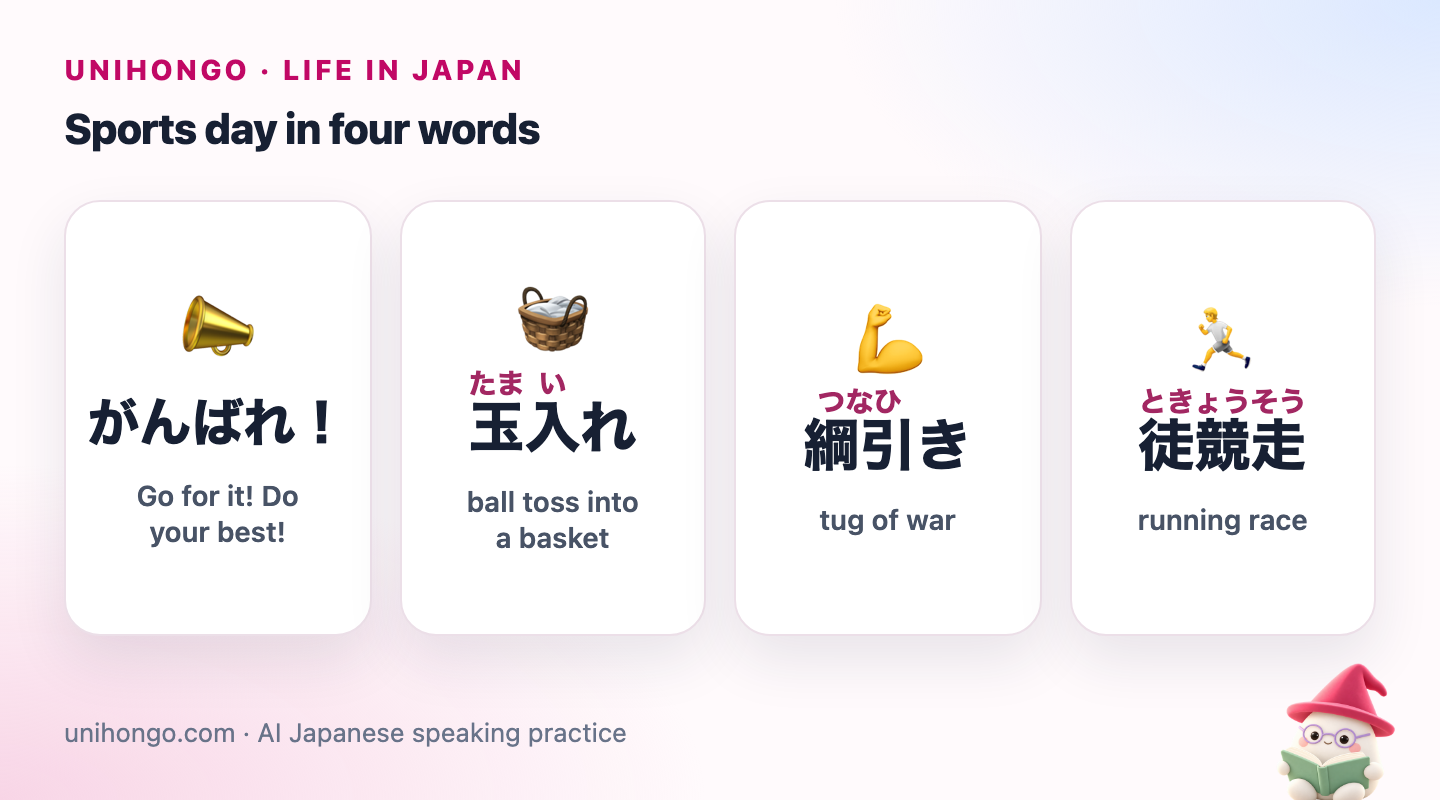
| Japanese | Romaji | Meaning |
|---|---|---|
| がんばれ! | Ganbare! | Go for it! Do your best! |
| 玉入れ | tamaire | ball toss into a basket |
| 綱引き | tsunahiki | tug of war |
| 徒競走 | tokyōsō | running race |
Red team, white team and the programme
Most schools divide the children into two teams, akagumi (red) and shirogumi (white), often wearing reversible red and white caps. Some schools use more colours. Points from each event go to a team score, and the winning team is announced at the closing ceremony.
The programme, puroguramu, lists the events in order. The day usually starts with the opening ceremony and warm-up exercises, often to the radio exercise music called rajio taisō, and ends with relays and the closing ceremony.
| Japanese | Romaji | Meaning |
|---|---|---|
| 赤組 | akagumi | red team |
| 白組 | shirogumi | white team |
| 開会式 | kaikaishiki | opening ceremony |
| 閉会式 | heikaishiki | closing ceremony |
| 応援団 | ōendan | cheering squad |
| うちの子は赤組です。 | Uchi no ko wa akagumi desu. | My child is on the red team. |
The events you are likely to see
Events differ by school and by grade. Younger children run short races and play games; older children dance, run relays and sometimes do group gymnastics. Some events involve parents too.
| Event | Reading | What happens |
|---|---|---|
| 玉入れ | tamaire | Throwing beanbags into a high basket |
| 綱引き | tsunahiki | Tug of war between teams |
| 大玉転がし | ōdama korogashi | Rolling a giant ball around the track |
| リレー | rirē | Relay race, often the finale |
| ダンス | dansu | Group dance, often by grade |
| 組体操 | kumitaisō | Group gymnastics; fewer schools do it now |
| 親子競技 | oyako kyōgi | An event for parents and children together |
If the programme lists hogosha kyōgi or oyako kyōgi, parents take part. Check whether you need to sign up in advance, and wear shoes you can run in.
Cheering from the side
Cheering is loud and friendly. Parents call their own child's name, but clapping for every child, especially the last runner in a race, is considered good manners. The cheers are short imperatives and exclamations.
| Japanese | Romaji | Meaning |
|---|---|---|
| ユキちゃん、がんばれー! | Yuki-chan, ganbarē! | Come on, Yuki! |
| いけー! | Ikē! | Go! |
| 速い! | Hayai! | So fast! |
| あと少し! | Ato sukoshi! | Almost there! |
| よくがんばったね! | Yoku ganbatta ne! | You did so well! (afterwards) |
| かっこよかったよ。 | Kakko yokatta yo. | You looked so cool. |
Reading the sports day notice
A few weeks before, a notice comes home with the date, the reserve day, the timetable and the rules for parents. These words appear on almost every sports day notice.
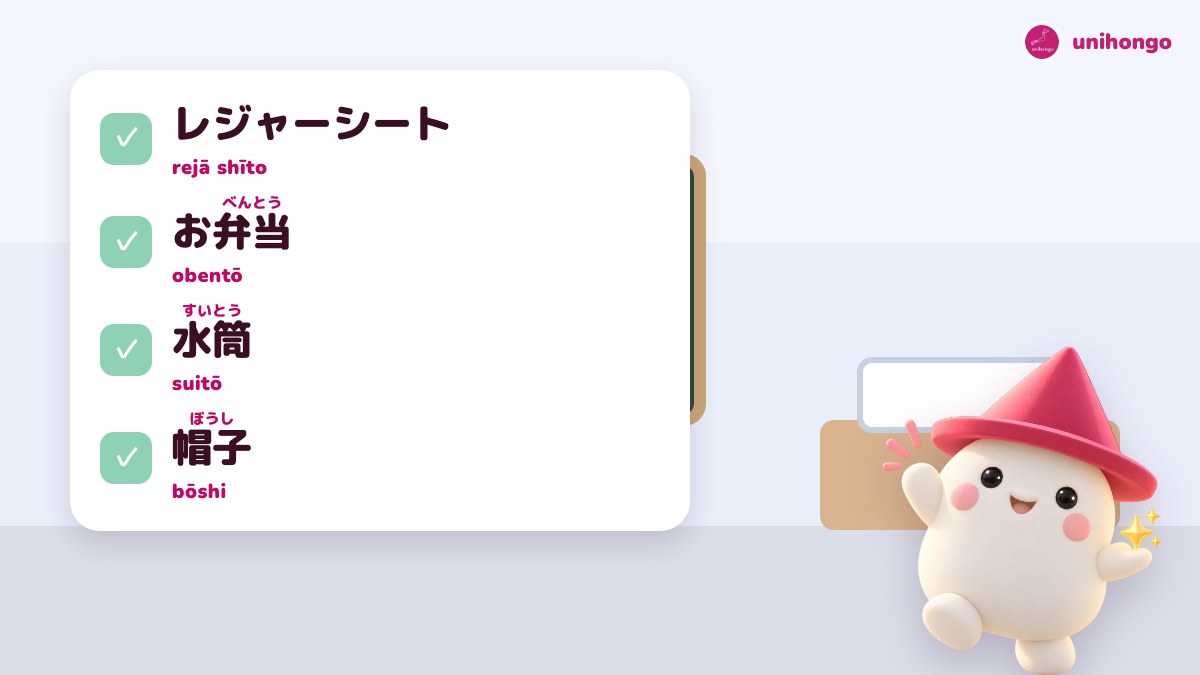
| Japanese | Romaji | Meaning |
|---|---|---|
| 雨天順延 | uten jun'en | postponed to the next day if it rains |
| 予備日 | yobibi | reserve day |
| 保護者席 | hogoshaseki | parents' area |
| 撮影禁止 | satsuei kinshi | no photography |
| 場所取りはご遠慮ください。 | Bashotori wa goenryo kudasai. | Please do not reserve spaces in advance. |
| 実施の有無はメールでお知らせします。 | Jisshi no umu wa mēru de oshirase shimasu. | We will email whether it goes ahead. |
Bashotori, reserving a spot early with a sheet, used to be a famous part of sports day, with parents queuing at dawn. Many schools now ban it or assign areas by grade. Goenryo kudasai is a polite way of saying please do not.
Parent etiquette on the day
| Japanese | Romaji | Meaning |
|---|---|---|
| すみません、ここ空いていますか。 | Sumimasen, koko aite imasu ka. | Excuse me, is this space free? |
| 見えますか。すみません、座りますね。 | Miemasu ka. Sumimasen, suwarimasu ne. | Can you see? Sorry, I'll sit down. |
| 何年生ですか。 | Nannensei desu ka. | Which year is your child in? |
- Stay in the parents' area and do not cross the track or the children's seating during events.
- Lower your camera and sit or crouch if people behind you cannot see; never stand on chairs.
- Do not take photos in areas marked satsuei kinshi, and avoid posting other children's faces online.
- Follow the school's rule on lunch, smoking, alcohol and parking; most schools ask parents to come on foot or by bicycle.
- Help tidy up chairs or tents at the end if the PTA asks; it is a good chance to meet other parents.
Mini dialogue: meeting a classmate's parent
| Japanese | Romaji | Meaning |
|---|---|---|
| おはようございます。いい天気になりましたね。 | Ohayō gozaimasu. Ii tenki ni narimashita ne. | You: Good morning. The weather turned out nice. |
| 本当に。昨日は雨で心配でした。 | Hontō ni. Kinō wa ame de shinpai deshita. | Parent: Yes. We were worried yesterday with the rain. |
| 次、二年生の玉入れですよね。 | Tsugi, ninensei no tamaire desu yo ne. | You: Next is the second-year ball toss, isn't it? |
| そうです。うちの子、白組なんです。 | Sō desu. Uchi no ko, shirogumi nan desu. | Parent: That's right. Ours is on the white team. |
| うちは赤組です。お互いがんばりましょう。 | Uchi wa akagumi desu. Otagai ganbarimashō. | You: Ours is red. Good luck to both of us. |
What the announcer and teachers say
Sports day runs on announcements, usually read by older pupils or teachers over loudspeakers. The language is formal and repetitive, so a few phrases unlock most of it. Listen for the event name, the grade and instructions to parents, such as moving to a viewing area or clearing the track.
| Japanese | Romaji | Meaning |
|---|---|---|
| ただいまより、運動会を始めます。 | Tadaima yori, undōkai o hajimemasu. | Announcer: Sports day now begins. |
| 次は、一年生による玉入れです。 | Tsugi wa, ichinensei ni yoru tamaire desu. | Announcer: Next is the ball toss by the first years. |
| 保護者の皆様はご移動をお願いします。 | Hogosha no minasama wa goidō o onegai shimasu. | Announcer: Parents, please move along. |
| ただいまの得点は、赤組百二十点です。 | Tadaima no tokuten wa, akagumi hyakunijutten desu. | Announcer: The current score is red team, 120 points. |
Ni yoru means by in the sense of performed by, a formal written-style phrase you hear in announcements and see on programmes. Tadaima yori, from now, is the classic opening of any formal event in Japan, not only sports day.
Nursery sports day and elementary sports day
If your child is at nursery, the undōkai is usually shorter and gentler: toddlers walk a short course, older children dance and run, and parents often join in an event with their child. Nursery sports days are frequently held on a weekend in autumn, sometimes in a local school gym or sports hall rather than outdoors.
At elementary school the day becomes more competitive, with team points, relays and practice for weeks beforehand. Many schools now keep the day to the morning, and some hold separate sessions for younger and older grades to reduce crowding. Whatever the format, the core vocabulary is the same.
| Japanese | Romaji | Meaning |
|---|---|---|
| 親子で参加する種目があります。 | Oyako de sanka suru shumoku ga arimasu. | There's an event for parents and children together. |
| 今年は午前中だけです。 | Kotoshi wa gozenchū dake desu. | This year it's mornings only. |
| 練習、がんばってるね。 | Renshū, ganbatteru ne. | You're working hard at practice. (to your child) |
Learn the programme before the day
Photograph your school's programme and type a few lines into the chat with Mocchi, for example /explain 3年 大玉転がし 9:40. Mocchi reads the line, gives the reading of each word and explains what the event involves. Ask it to make a short quiz of the event names, and it will bring back the ones you missed the next time you study.
For fast recall, play Vocabulary Dash on the games page with your own flashcards of the event words, so tamaire and tsunahiki come to you as quickly as the announcer says them.