
Four lines about your family's languages
Teachers, nursery staff, doctors and other parents will ask about your family's languages, often out of friendly curiosity. These four lines answer most of their questions. Replace eigo, English, with your own language: supeingo, Spanish, chūgokugo, Chinese, and so on.
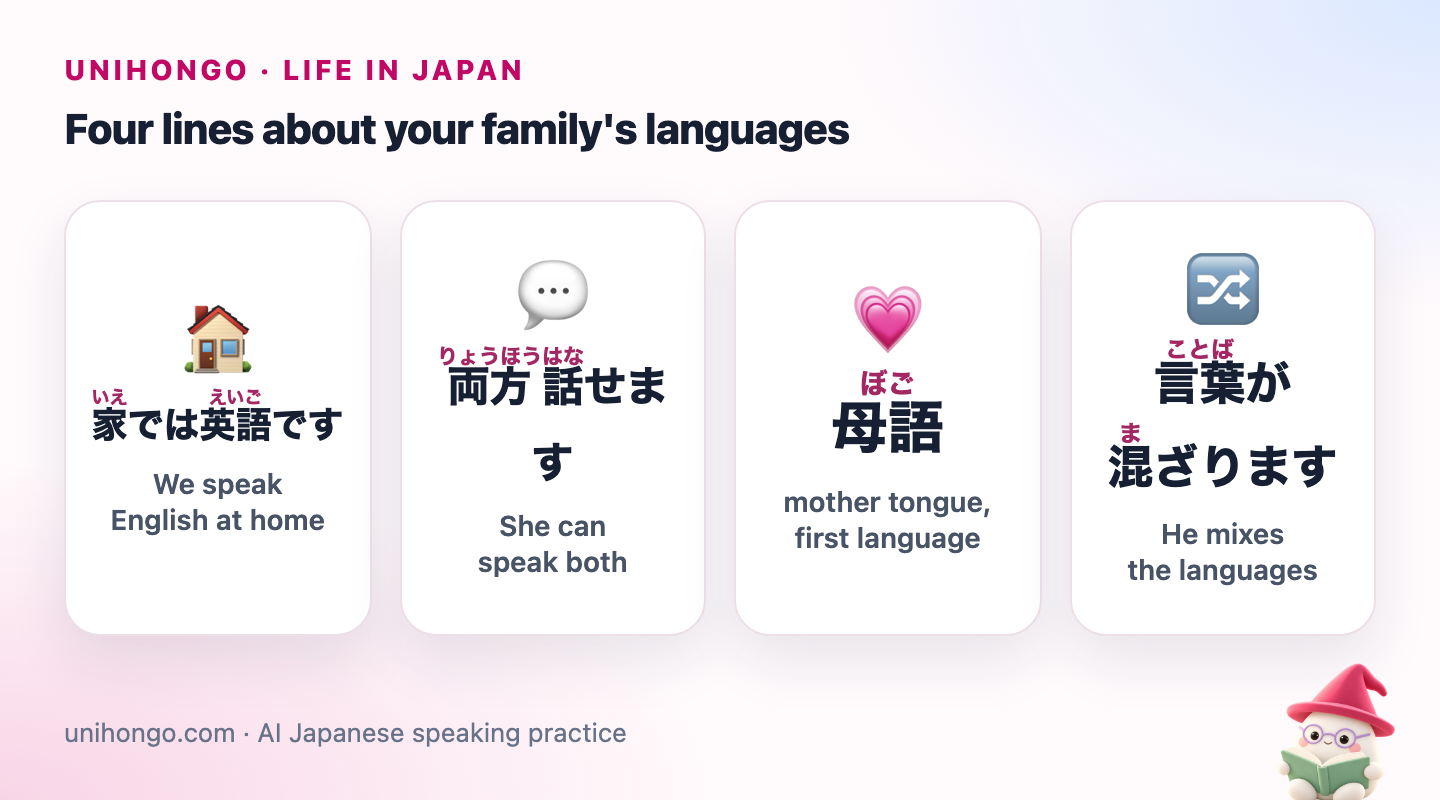
| Japanese | Romaji | Meaning |
|---|---|---|
| 家では英語です | Ie de wa eigo desu | We speak English at home |
| 両方話せます | Ryōhō hanasemasu | She can speak both |
| 母語 | bogo | mother tongue, first language |
| 言葉が混ざります | Kotoba ga mazarimasu | He mixes the languages |
Why Japanese usually takes over
Once a child starts nursery or school in Japan, most of their day happens in Japanese: friends, teachers, games, television, signs. Many parents notice that from around school age their child answers in Japanese even when spoken to in the home language, or prefers to speak Japanese with siblings. This is very common and does not mean the home language is lost; children often understand far more than they say.
The practical lesson many families draw is that the home language needs regular, enjoyable use that the child values: reading, songs, video calls with grandparents, trips, friends who speak it. Strict rules alone tend to work less well than reasons to use the language.
| Japanese | Romaji | Meaning |
|---|---|---|
| 家でも日本語で話したがります。 | Ie demo nihongo de hanashitagarimasu. | He wants to speak Japanese even at home. |
| 英語は分かるけど、日本語で答えます。 | Eigo wa wakaru kedo, nihongo de kotaemasu. | She understands English but answers in Japanese. |
| 兄弟同士は日本語です。 | Kyōdai dōshi wa nihongo desu. | The siblings speak Japanese to each other. |
Approaches many families use
There is no single correct method, and families often change approach as children grow. The table describes common options in neutral terms; mixing them is normal.
| Approach | How it works | Fits when |
|---|---|---|
| One parent, one language | Each parent speaks their own language | Parents speak different languages |
| Home language at home | Home language indoors, Japanese outside | Both parents share the home language |
| Time or place slots | Set times or activities in each language | Routines are easier than rules |
| Weekend or community classes | Heritage language school or playgroup | A community exists nearby |
Whatever you choose, consistency and enjoyment seem to matter more than the label. Reading aloud every night in the home language, even for ten minutes, is a habit many families keep for years.
Talking to nursery staff and teachers
Tell your child's nursery or school about your family's languages early. Teachers then understand why your child might mix words, take longer to answer, or know a word in only one language. Ask them to tell you if they notice anything, and offer to help with anything written in Japanese that you need explained.
| Japanese | Romaji | Meaning |
|---|---|---|
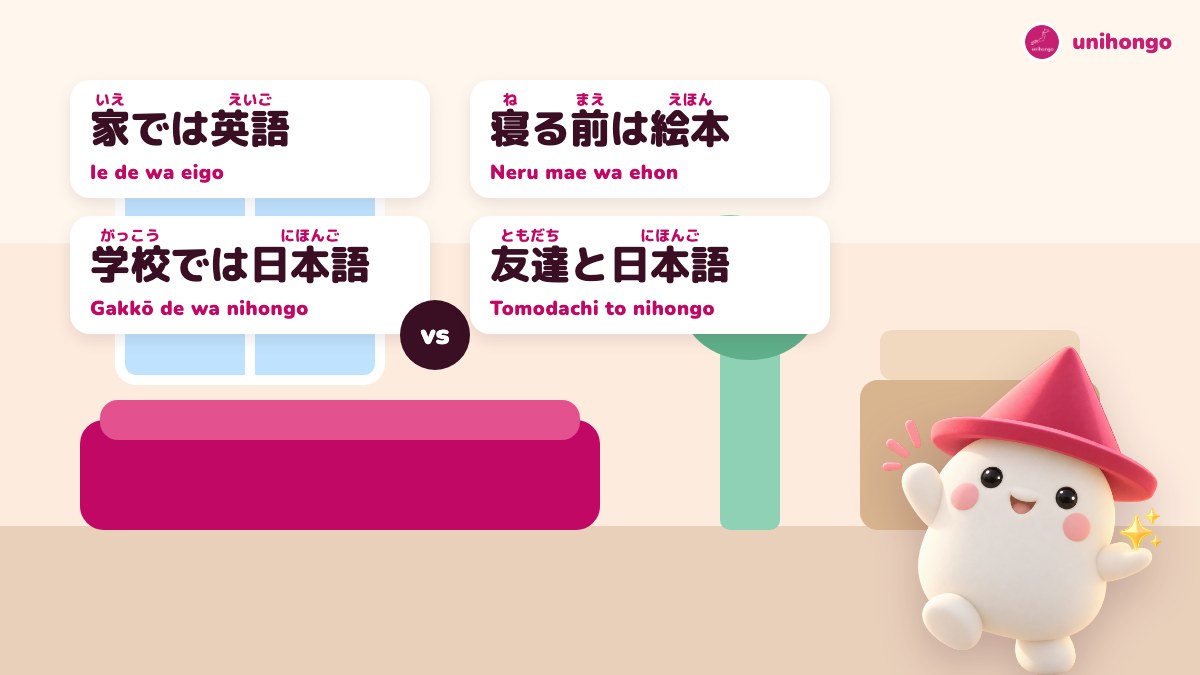
| 家では英語で話しています。 | Ie de wa eigo de hanashite imasu. | We speak English at home. |
| 日本語は保育園で覚えています。 | Nihongo wa hoikuen de oboete imasu. | He's learning Japanese at nursery. |
| 何か気になることがあれば教えてください。 | Nanika ki ni naru koto ga areba oshiete kudasai. | Please tell me if anything concerns you. |
| 私の日本語がまだ十分ではないので、 | Watashi no nihongo ga mada jūbun de wa nai node, | My own Japanese isn't strong enough yet, so |
| 大事なことは書いていただけると助かります。 | Daiji na koto wa kaite itadakeru to tasukarimasu. | it would help if important things were written down. |
Support at school and at the city office
If your child's Japanese is still developing, for example after moving to Japan, some cities and schools offer Japanese language support, nihongo shidō, through extra classes or visiting teachers. Some areas also have speech and language support classes, often called kotoba no kyōshitsu. Availability and names differ a great deal, so ask the school or the board of education.
Child health checks run by the city, nyūyōji kenshin, include questions about speech. If staff ask whether your child speaks yet, explain the languages at home; they can tell you whether a follow-up is useful.
| Japanese | Romaji | Meaning |
|---|---|---|
| 日本語指導 | nihongo shidō | Japanese language support at school |
| ことばの教室 | kotoba no kyōshitsu | speech and language support class |
| 言葉の発達が少し心配です。 | Kotoba no hattatsu ga sukoshi shinpai desu. | I'm a little worried about his speech development. |
| 二つの言葉を使っているからでしょうか。 | Futatsu no kotoba o tsukatte iru kara deshō ka. | Could it be because she uses two languages? |
Answering other parents' questions
Other parents often ask curious questions: which language you speak at home, whether your child is bilingual, how you teach it. Most mean well. Short, friendly answers keep the conversation easy, and you can redirect if a question feels too personal.
You may hear hāfu (ハーフ), half, for children with one Japanese and one non-Japanese parent. It is widely used and usually not meant unkindly, but some families prefer daburu (double), mikkusu (mixed) or simply the child's name. If you prefer something else, say so lightly.
| Japanese | Romaji | Meaning |
|---|---|---|
| おうちでは何語で話してるんですか。 | Ouchi de wa nanigo de hanashiteru n desu ka. | Parent: What language do you speak at home? |
| 私とは英語、夫とは日本語です。 | Watashi to wa eigo, otto to wa nihongo desu. | English with me, Japanese with my husband. |
| バイリンガルでいいですね。 | Bairingaru de ii desu ne. | Parent: How nice that she's bilingual. |
| いえいえ、英語は今がんばっているところです。 | Ieie, eigo wa ima ganbatte iru tokoro desu. | Oh no, she's still working on her English. |
Common worries and mistakes
- Expecting perfect balance. Most bilingual children have a stronger language, and it may change over time.
- Correcting every mixed sentence. Many families simply repeat the sentence back correctly instead.
- Dropping the home language when school starts. Many parents later wish they had kept a small daily routine.
- Not telling the school. Teachers can only help if they know the family's language situation.
- Neglecting your own Japanese. School notices, meetings and other parents will need it for years.
Practise the conversation with the teacher
Write a short explanation of your family's languages and send it to Mocchi with /correct, for example: 家では英語で話しています。日本語は学校で覚えています。何か気になることがあれば教えてください。 Mocchi makes it natural and polite, explains the grammar and keeps your family details in mind, so later practice fits your situation.
Then take it into a real conversation. The Parent–Teacher Conference mission in AI Sensei puts you in a meeting with your child's teacher; ask Haru-sensei to raise a question about your child's Japanese, and practise explaining your home language calmly and asking how the school can help.