
Four words for the clinic
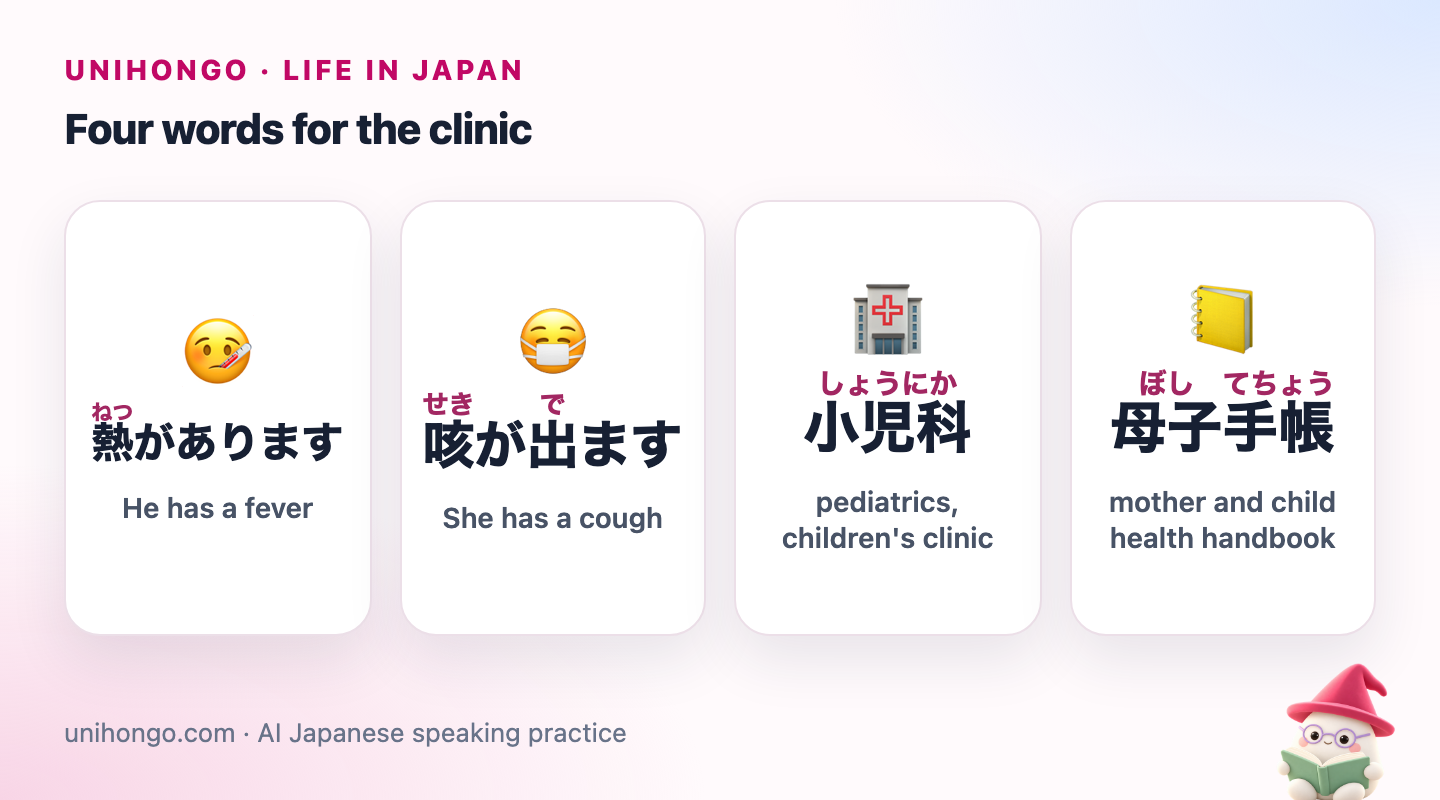
Before any phrase, learn the four words below. The first is the line you will say most often, the other three are the place, the symptom you will name second most often and the handbook that every vaccination is recorded in.
Shōnika is a pediatric department or clinic. In a town you will see the sign 小児科 on a clinic building, often next to 内科 (naika, internal medicine). Many family clinics see children too, but a pediatric clinic is used to small patients and nervous parents.
| Japanese | Romaji | Meaning |
|---|---|---|
| 熱があります | Netsu ga arimasu | He has a fever |
| 咳が出ます | Seki ga demasu | She has a cough |
| 小児科 | shōnika | pediatrics, children's clinic |
| 母子手帳 | boshi techō | mother and child health handbook |
Booking and reception
Many pediatric clinics use a web or phone booking system and give you a number, junban. Some ask you to phone before coming if your child has a fever, so that you can wait in a separate room. At the reception, uketsuke, you hand over the documents and receive a questionnaire, monshinhyō.
The documents differ, but the usual set is the health insurance card (hokenshō), or the My Number card registered for health insurance, the city's child medical expense certificate, whose name varies by city (for example kodomo iryōhi jukyūshashō), and the mother and child handbook, boshi techō, for vaccinations and checkups.
| Japanese | Romaji | Meaning |
|---|---|---|
| 初めてなんですが、予約できますか。 | Hajimete nan desu ga, yoyaku dekimasu ka. | It's our first visit. Can I book? |
| 熱があるんですが、そのまま行ってもいいですか。 | Netsu ga aru n desu ga, sono mama itte mo ii desu ka. | She has a fever. Can we just come in? |
| 保険証と医療証をお願いします。 | Hokenshō to iryōshō o onegai shimasu. | Staff: Insurance card and medical certificate, please. |
| 問診票にご記入ください。 | Monshinhyō ni gokinyū kudasai. | Staff: Please fill in the questionnaire. |
| 英語の問診票はありますか。 | Eigo no monshinhyō wa arimasu ka. | Do you have the questionnaire in English? |
Words on the questionnaire
The pediatric questionnaire asks the same things in almost every clinic. Circle or tick the words that apply and write numbers clearly. If you do not understand a line, leave it and ask; that is better than guessing.
| Japanese | Romaji | Meaning |
|---|---|---|
| 体温 | taion | body temperature |
| 鼻水 | hanamizu | runny nose |
| 嘔吐 | ōto | vomiting (written word) |
| 下痢 | geri | diarrhoea |
| 発疹 | hasshin | rash |
| 食欲 | shokuyoku | appetite |
| アレルギー | arerugī | allergy |
| 体重 | taijū | body weight |
Ōto is the written word for vomiting. In speech, parents and doctors usually say haku (to throw up), as in kesa nikai hakimashita, she threw up twice this morning. Weight matters because children's medicine is measured by weight, so know your child's recent weight in kilograms.
Describing the symptoms to the doctor
Japanese doctors usually ask in a fixed order: what the main problem is, since when, how high the fever went, whether the child is eating, drinking and sleeping, and whether anyone at home or at nursery is ill. Prepare short answers. Temperatures are read with do for the degree and bu for the decimal: 38.5 is sanjūhachi do go bu.
Words for mood and energy matter in pediatrics, because they help the doctor judge how ill the child is. Kigen ga warui means the child is cranky; guttari shite iru means floppy and listless, which doctors take seriously.
| Japanese | Romaji | Meaning |
|---|---|---|
| 昨日の夜から熱があります。 | Kinō no yoru kara netsu ga arimasu. | She's had a fever since last night. |
| 一番高いときで三十九度二分でした。 | Ichiban takai toki de sanjūkyū do ni bu deshita. | At its highest it was 39.2 degrees. |
| 夜中に咳がひどいです。 | Yonaka ni seki ga hidoi desu. | The cough is bad in the night. |
| 今朝、二回吐きました。 | Kesa, nikai hakimashita. | He threw up twice this morning. |
| あまり食べませんが、水は飲めます。 | Amari tabemasen ga, mizu wa nomemasu. | She's not eating much, but she can drink water. |
| 機嫌が悪いです。 | Kigen ga warui desu. | He's cranky. |
| ぐったりしています。 | Guttari shite imasu. | She's floppy and listless. |
| 保育園で胃腸炎がはやっています。 | Hoikuen de ichōen ga hayatte imasu. | A stomach bug is going around at nursery. |
Mini dialogue: in the examination room
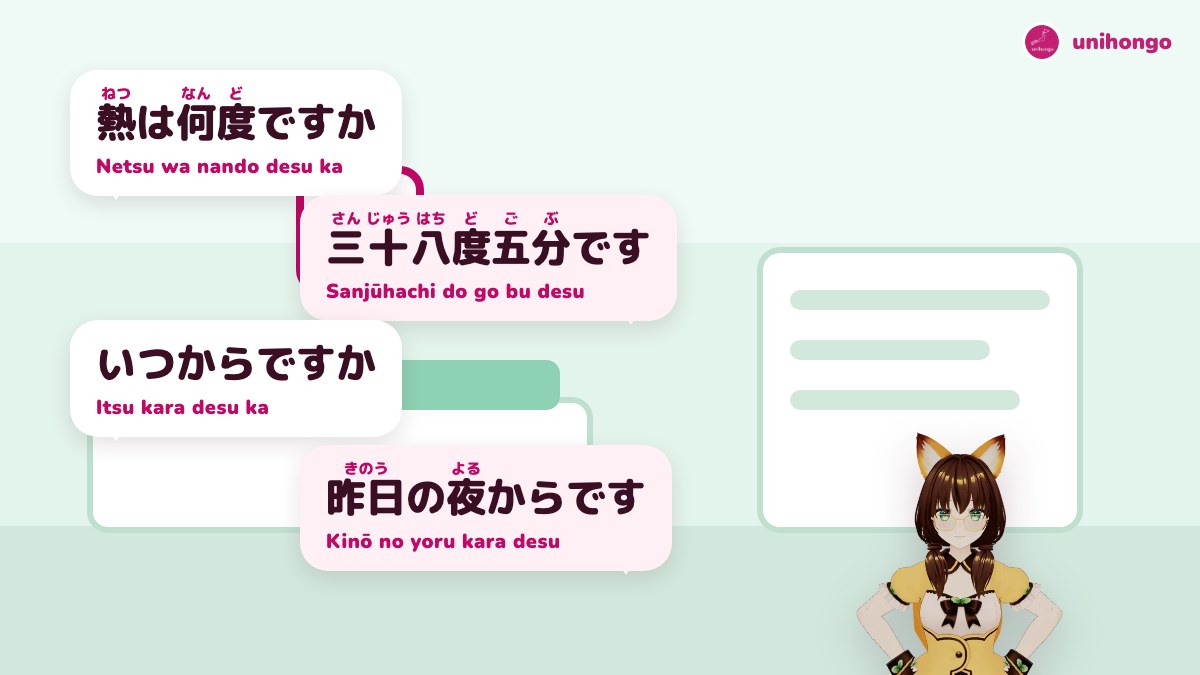
A short, typical exchange. The doctor speaks politely but quickly; it is fine to ask them to repeat or to speak more slowly.
| Japanese | Romaji | Meaning |
|---|---|---|
| 今日はどうされましたか。 | Kyō wa dō saremashita ka. | Doctor: What brings you in today? |
| 昨日の夜から熱があって、咳も出ます。 | Kinō no yoru kara netsu ga atte, seki mo demasu. | You: She's had a fever since last night, and a cough. |
| 熱は何度ですか。 | Netsu wa nando desu ka. | Doctor: How high is the fever? |
| 三十八度五分です。 | Sanjūhachi do go bu desu. | You: It's 38.5 degrees. |
| お水は飲めていますか。 | Omizu wa nomete imasu ka. | Doctor: Is she able to drink? |
| はい、少しずつ飲んでいます。 | Hai, sukoshi zutsu nonde imasu. | You: Yes, a little at a time. |
| お薬を出しておきますね。様子を見てください。 | Okusuri o dashite okimasu ne. Yōsu o mite kudasai. | Doctor: I'll prescribe some medicine. Keep an eye on her. |
| すみません、もう一度ゆっくりお願いします。 | Sumimasen, mō ichido yukkuri onegai shimasu. | You: Sorry, could you say that again slowly? |
Yōsu o mite kudasai, keep an eye on her, often comes with a condition: if the fever lasts more than a few days, or if something specific happens, come back. If you did not catch the condition, ask: dō nattara mata kitara ii desu ka, in what case should we come back?
Checkups, vaccinations and medicine
Not every visit is for illness. Infant checkups, nyūyōji kenshin, are run by the city at set ages, sometimes at a health centre and sometimes at a clinic. Vaccinations, yobō sesshu, are usually booked at a pediatric clinic, and the city sends the forms. Bring the boshi techō every time, because the clinic records each dose in it.
Children's medicine in Japan often comes as powder, konagusuri, which parents mix with a little water or food, or as syrup. Fever-reducing suppositories, zayaku, are common too. The pharmacist explains how to use them; ask if anything is unclear.
| Japanese | Romaji | Meaning |
|---|---|---|
| 予防接種の予約をしたいです。 | Yobō sesshu no yoyaku o shitai desu. | I'd like to book a vaccination. |
| 同時接種はできますか。 | Dōji sesshu wa dekimasu ka. | Can she have more than one vaccine at once? |
| 粉薬が苦手なんですが、シロップはありますか。 | Konagusuri ga nigate nan desu ga, shiroppu wa arimasu ka. | He hates powder medicine. Is there a syrup? |
| 座薬の使い方を教えてください。 | Zayaku no tsukaikata o oshiete kudasai. | Please show me how to use the suppository. |
Back to nursery or school
For some infectious illnesses, many nurseries and schools ask for a doctor's form before the child returns. Names differ: tōen kyokashō, ikensho or tōkō shōmeisho are common. Some facilities want a form filled in by the parent instead, tōen todoke. The list of illnesses and the rules are set locally, so ask the nursery or school which form they need, and ask the doctor for it at the visit.
| Japanese | Romaji | Meaning |
|---|---|---|
| 登園許可証を書いていただけますか。 | Tōen kyokashō o kaite itadakemasu ka. | Could you fill in the nursery return form? |
| いつから保育園に行けますか。 | Itsu kara hoikuen ni ikemasu ka. | From when can she go back to nursery? |
| 学校は休ませたほうがいいですか。 | Gakkō wa yasumaseta hō ga ii desu ka. | Should I keep him home from school? |
Say the symptoms before the night you need them
Write your own child's details in the chat with Mocchi, for example /correct 昨日の夜から熱があって、ご飯をあまり食べません, and ask for a natural version a doctor would understand. Mocchi corrects it, explains the grammar and can build flashcards of the symptom words with /create-flashcards.
Then rehearse the visit aloud. The Describe Symptoms at a Clinic mission in AI Sensei puts you in front of a doctor who asks follow-up questions; ask Haru-sensei to treat the patient as your child, and to slow down if you need it. The session report shows which symptom words you missed.