
Four lines every home repeats
Four sentences cover a surprising share of a day with a small child: tidying up, washing hands, brushing teeth and saying good night. Three of them are requests in the te-form, with or without the soft ending ne. The fourth is a fixed greeting.
The te-form alone is already a request in family speech. You do not need kudasai at home, and adding it can make you sound like a teacher or a shop assistant.
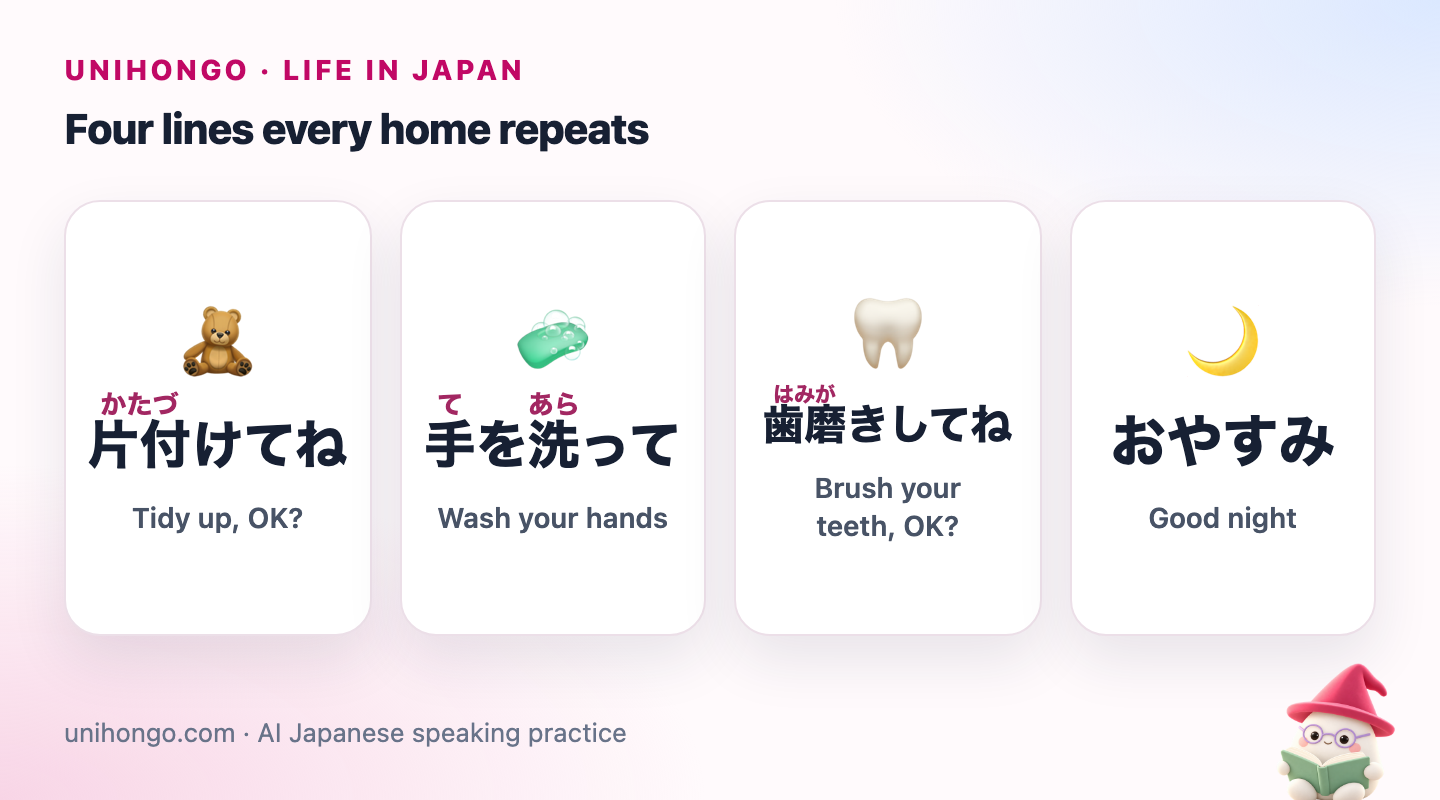
| Japanese | Romaji | Meaning |
|---|---|---|
| 片付けてね | Katazukete ne | Tidy up, OK? |
| 手を洗って | Te o aratte | Wash your hands |
| 歯磨きしてね | Hamigaki shite ne | Brush your teeth, OK? |
| おやすみ | Oyasumi | Good night |
The greeting pairs that frame the day
Japanese homes run on fixed pairs of greetings. Each one has a line for the person acting and a line for the person answering. Children learn them very early, and using them consistently is one of the easiest ways to give a child daily Japanese input.
| Japanese | Romaji | Meaning |
|---|---|---|
| おはよう | Ohayō | Good morning (casual) |
| いってきます | Itte kimasu | Child leaving: I'm off |
| いってらっしゃい | Itte rasshai | Parent: See you later |
| ただいま | Tadaima | Child coming home: I'm home |
| おかえり | Okaeri | Parent: Welcome back |
| いただきます | Itadakimasu | Before eating |
| ごちそうさまでした | Gochisōsama deshita | After eating |
Okaeri is the casual form of okaerinasai; both are used in families. Some families say gochisōsama without deshita. The point is that the reply is automatic: a child who says tadaima and hears nothing will often say it again, louder.
The firmness ladder: from shiyō ne to shinasai
The same request can be said in several ways, from an invitation to a command. Parents move up the ladder when they are ignored. Learning the ladder helps you sound natural and also helps you understand teachers and other parents.
| Japanese | Romaji | Meaning |
|---|---|---|
| 一緒に片付けようね。 | Issho ni katazukeyō ne. | Let's tidy up together. |
| おもちゃ、片付けて。 | Omocha, katazukete. | Tidy your toys away. |
| 早く片付けなさい。 | Hayaku katazukenasai. | Tidy up right now. |
| 走らないで。 | Hashiranaide. | Don't run. |
| それはダメ。 | Sore wa dame. | No, that's not allowed. |
| Form | Example | How it sounds |
|---|---|---|
| Let's (yō) | katazukeyō | Inviting, we do it together |
| Te-form + ne | katazukete ne | Gentle request |
| Plain te-form | katazukete | Normal request |
| Te-form + yo | katazukete yo | Mild complaint, why haven't you |
| Nasai | katazukenasai | Firm parent or teacher voice |
The morning rush
Mornings are when parents speak fastest. Most of the lines are short te-forms, plus questions that check readiness. Wasuremono nai, have you forgotten anything, is a classic last line at the door.
| Japanese | Romaji | Meaning |
|---|---|---|
| 起きて!朝だよ。 | Okite! Asa da yo. | Wake up! It's morning. |
| 着替えて。 | Kigaete. | Get dressed. |
| 早くして! | Hayaku shite! | Hurry up! |
| 靴はいて。 | Kutsu haite. | Put your shoes on. |
| 忘れ物ない? | Wasuremono nai? | Have you forgotten anything? |
| 帽子かぶった? | Bōshi kabutta? | Have you got your hat on? |
Japanese uses different verbs for wearing: haku for shoes and trousers, kabutta from kaburu for hats, kiru for tops. Children notice when a parent mixes them up, which can be a fun way to learn the difference together.
Coming home, bath and bed
The evening routine in many Japanese homes follows the same order: come home, wash hands and gargle, play, dinner, bath, teeth, bed. Announcements with yo, such as ofuro hairu yo, tell the child what is about to happen without making it an argument.
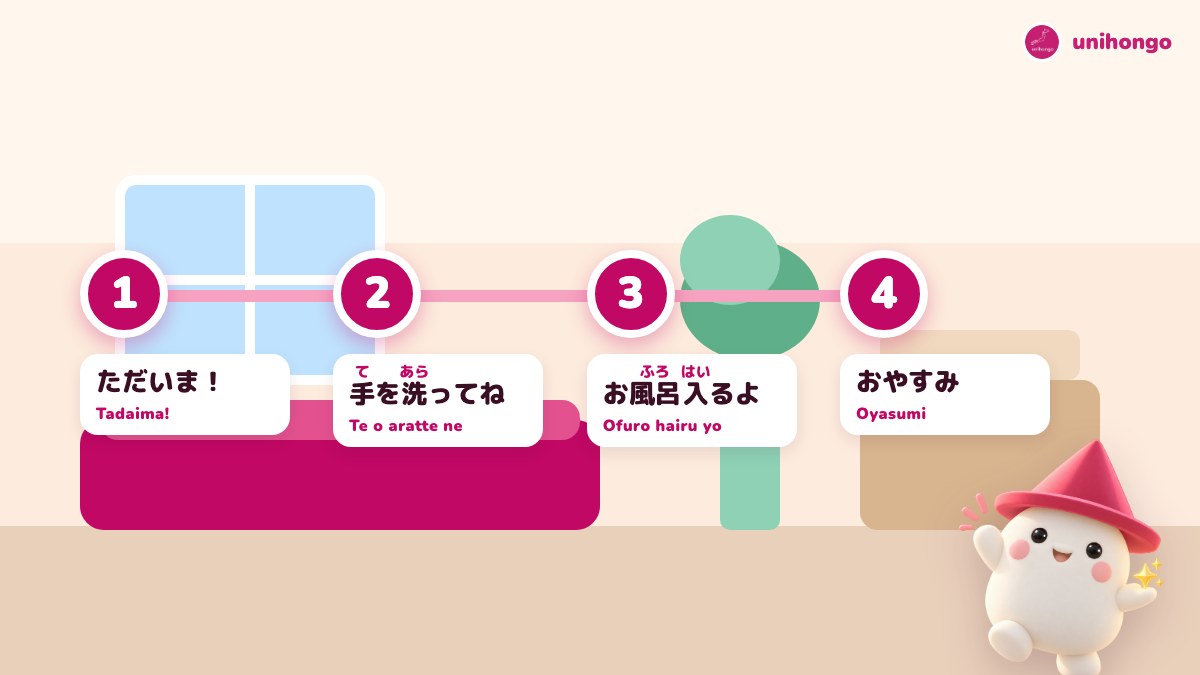
| Japanese | Romaji | Meaning |
|---|---|---|
| 手を洗って、うがいしてね。 | Te o aratte, ugai shite ne. | Wash your hands and gargle, OK? |
| ご飯できたよ。 | Gohan dekita yo. | Dinner's ready. |
| お風呂入るよ。 | Ofuro hairu yo. | Bath time. |
| パジャマ着て。 | Pajama kite. | Put your pyjamas on. |
| 電気消すよ。 | Denki kesu yo. | I'm turning the light off. |
| もう寝る時間だよ。 | Mō neru jikan da yo. | It's time for bed now. |
What children say back, and how parents answer
Real home talk is a two-way negotiation. Learn the child's side too, because you will hear these lines constantly. Hāi with a long vowel is the cheerful yes that teachers love; yada is the universal small-child no.
| Japanese | Romaji | Meaning |
|---|---|---|
| はーい! | Hāi! | Child: OK! (cheerful yes) |
| やだ! | Yada! | Child: No! Don't want to! |
| まだ遊びたい。 | Mada asobitai. | Child: I want to play more. |
| 見て見て! | Mite mite! | Child: Look, look! |
| じゃあ、あと五分ね。 | Jā, ato gofun ne. | Parent: OK, five more minutes. |
| 自分でやってみる? | Jibun de yatte miru? | Parent: Do you want to try it yourself? |
Offering a small choice often works better than repeating the order: ato gofun ne, five more minutes, or dotchi ni suru, which one will you choose. The child still does the task, but keeps some control.
Thanks and encouragement after the task
When the task is done, Japanese parents often thank the child rather than only praising them. Arigatō, tasukatta, thanks, that helped, treats the child as a contributor to the family. Short praise for the effort, such as jibun de dekita ne, you did it by yourself, is common too.
| Japanese | Romaji | Meaning |
|---|---|---|
| ありがとう、助かった! | Arigatō, tasukatta! | Thanks, that really helped! |
| 自分でできたね。 | Jibun de dekita ne. | You did it by yourself. |
| きれいになったね。 | Kirei ni natta ne. | It's all tidy now. |
Mistakes learners make at home
- Adding kudasai to every request. With your own child it sounds distant; use the te-form with ne.
- Using nasai all the time. It is the firm voice; if every sentence uses it, it loses its force and sounds harsh.
- Forgetting the reply in greeting pairs. If your child says tadaima, answer okaeri every time.
- Mixing up wearing verbs: kutsu o haku for shoes, bōshi o kaburu for a hat, fuku o kiru for clothes on the upper body.
- Translating word for word from your language. Japanese parents often announce what will happen, ofuro hairu yo, instead of asking do you want a bath.
Make your own home phrasebook
Write down the ten things you say most often to your child in your own language, then ask Mocchi to turn them into natural Japanese a parent would use, for example: Give me natural Japanese for these ten things I say to my four-year-old, gentle versions first. Mocchi explains each form and can make a card for every line with /create-flashcards, adding a photo you pick, so the deck looks like your own home.
Then play the deck in Flashcard Flip on the games page during a spare five minutes, and say each line aloud as it appears. A week later, use the lines at the real moments.