
April's new start in four words
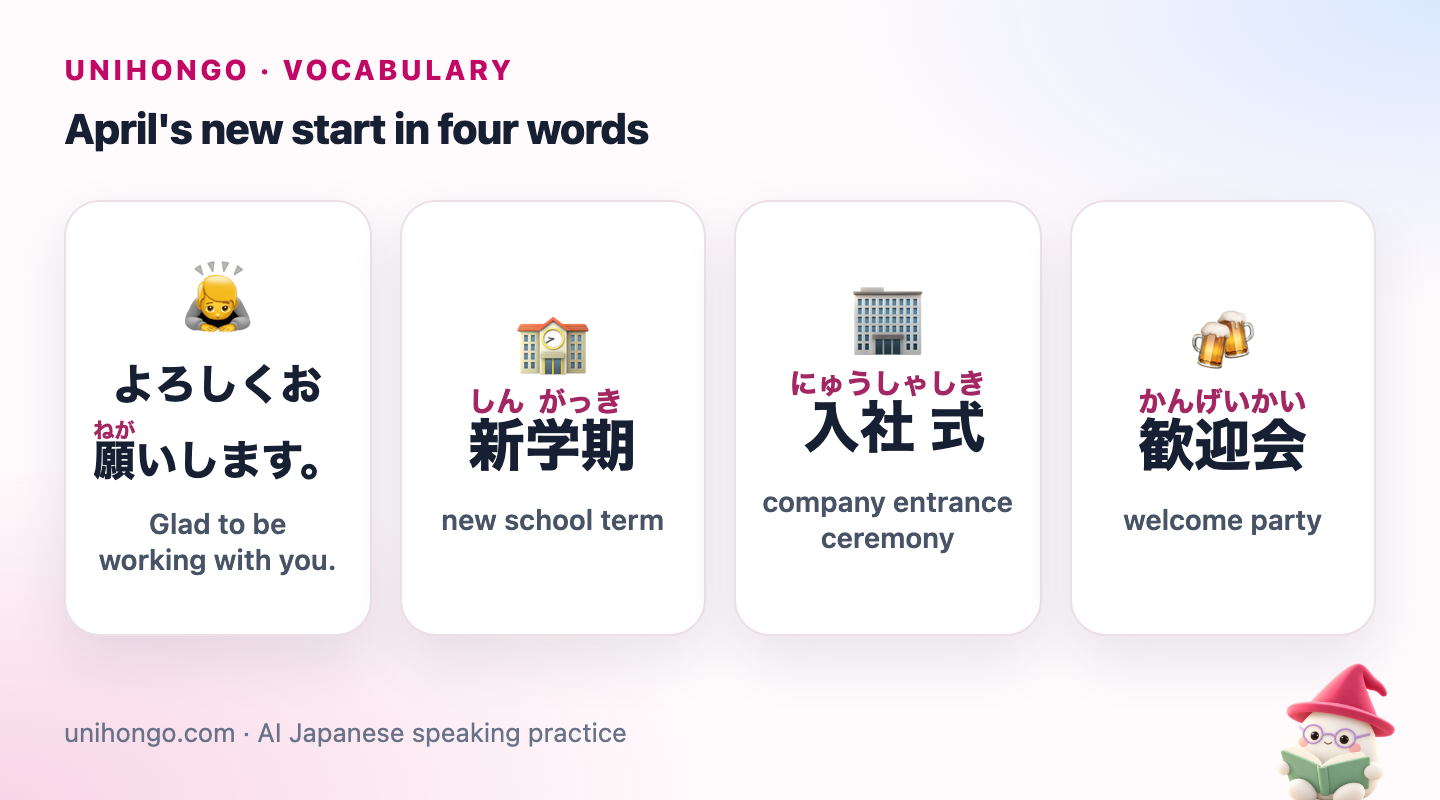
These four sum up the beginning of the Japanese year at school and at work. The first is the phrase everyone says in introductions; the others are the new term, the company ceremony and the party that welcomes newcomers.
| Japanese | Romaji | Meaning |
|---|---|---|
| よろしくお願いします。 | Yoroshiku onegai shimasu. | Glad to be working with you. |
| 新学期 | shingakki | new school term |
| 入社式 | nyūshashiki | company entrance ceremony |
| 歓迎会 | kangeikai | welcome party |
Yoroshiku onegai shimasu has no neat English equivalent. It asks for the other person's goodwill in the relationship that is starting, and it closes almost every introduction. In very formal settings, people say yoroshiku onegai itashimasu; among friends, just yoroshiku.
At school: new term, new class, new teacher
The Japanese school year has three terms in many schools, and the first begins in early April after the spring holiday. At the start of a new year, many schools change the class groupings, a kurasugae, so pupils find out who their new classmates and homeroom teacher, tannin, will be. The new class list is often posted on the first day, and everyone crowds round to find their name.
For first-years, the term starts with an entrance ceremony, nyūgakushiki. Children starting primary school often carry a brand-new randoseru, the sturdy backpack many families buy for the occasion.
| Japanese | Romaji | Meaning |
|---|---|---|
| 新学期が始まりました。 | Shingakki ga hajimarimashita. | The new term has started. |
| クラス替え、どうだった? | Kurasugae, dō datta? | How did the class change go? (casual) |
| また同じクラスだね! | Mata onaji kurasu da ne! | We're in the same class again! (casual) |
| 担任の先生は誰? | Tannin no sensei wa dare? | Who's your homeroom teacher? (casual) |
| 入学式 | nyūgakushiki | school entrance ceremony |
| ランドセル | randoseru | primary school backpack |
At university: clubs and new students
Universities fill with shinnyūsei, new students, in April, and clubs compete to recruit them. The campus is lined with stalls and flyers, and older students call out to first-years; this recruitment season is called shinkan, short for shinnyūsei kangei, welcoming new students. Clubs often hold free welcome events, and many students decide which circle or club to join in the first weeks.
| Japanese | Romaji | Meaning |
|---|---|---|
| 新入生 | shinnyūsei | new student, first-year |
| サークルに入りたいです。 | Sākuru ni hairitai desu. | I'd like to join a club. |
| 見学してもいいですか。 | Kengaku shite mo ii desu ka. | May I come and have a look? |
| 先輩 | senpai | someone senior to you |
| 後輩 | kōhai | someone junior to you |
Senpai and kōhai describe who joined first, not who is older. A thirty-year-old new member still calls a twenty-year-old who joined earlier senpai, and polite speech usually flows upward.
At work: the induction ceremony and training
Many Japanese companies hire new graduates as a group, and they all start on the same day in April. The year begins with the nyūshashiki, then training, kenshū, which can last from days to months depending on the company. After training, new employees are assigned to a department, haizoku. Existing employees may also change roles in April, because many companies make personnel moves, jinji idō, at the start of the fiscal year.
| Japanese | Romaji | Meaning |
|---|---|---|
| 新入社員 | shinnyū shain | new employee |
| 研修 | kenshū | training |
| 営業部に配属されました。 | Eigyōbu ni haizoku saremashita. | I've been assigned to the sales department. |
| 四月から異動になりました。 | Shigatsu kara idō ni narimashita. | I've been transferred from April. |
| 本日からお世話になります。 | Honjitsu kara osewa ni narimasu. | I'll be working with you from today. (formal) |
Your first week, step by step
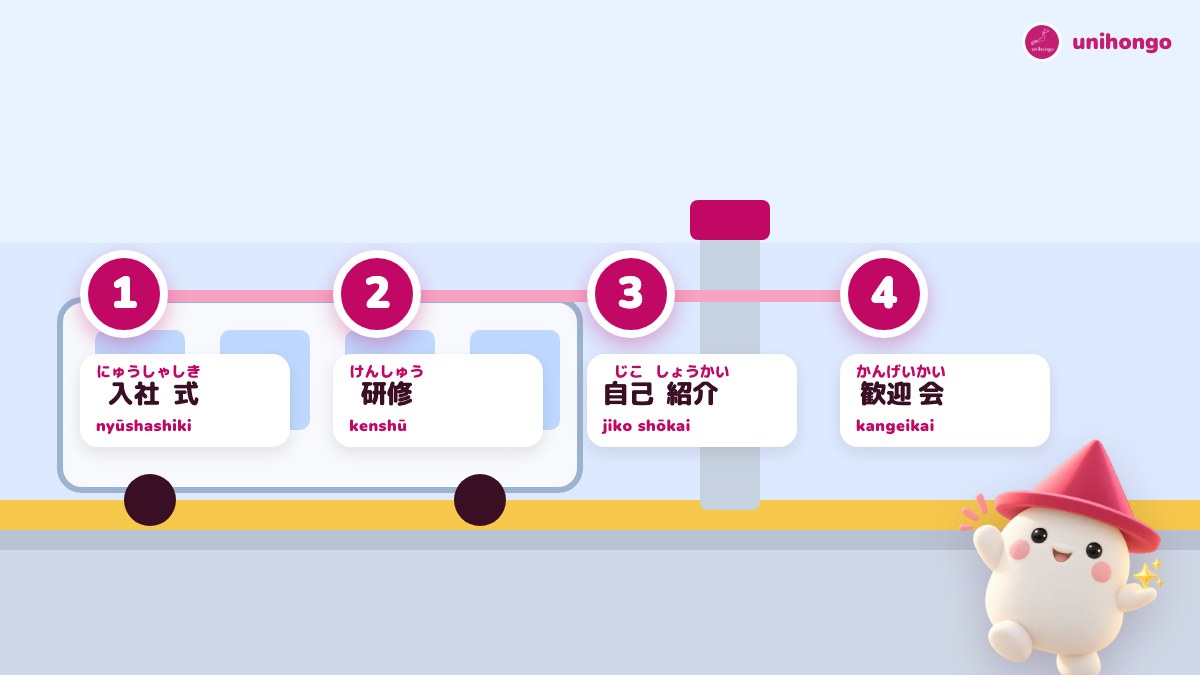
Whether you join a company, a school or a part-time job in April, the first week often follows a similar rhythm: a ceremony or first meeting, some kind of training or orientation, a round of introductions, and, a week or a few weeks later, a welcome party. Knowing what is coming makes it much easier to prepare the right sentence for each step.
| Japanese | Romaji | Meaning |
|---|---|---|
| はじめまして。ルーカスと申します。 | Hajimemashite. Rūkasu to mōshimasu. | Nice to meet you. My name is Lucas. (polite) |
| 前はカナダでエンジニアをしていました。 | Mae wa Kanada de enjinia o shite imashita. | I used to work as an engineer in Canada. |
| 至らない点もあるかと思いますが、 | Itaranai ten mo aru ka to omoimasu ga, | I'm sure I'll make mistakes, but... (formal) |
| 一日も早く慣れるよう頑張ります。 | Ichinichi mo hayaku nareru yō ganbarimasu. | I'll do my best to settle in as soon as I can. |
| どうぞよろしくお願いいたします。 | Dōzo yoroshiku onegai itashimasu. | I look forward to working with you all. (formal) |
These five lines make a complete formal introduction. In a relaxed office or a part-time job, the middle two can be dropped; a name, one fact and yoroshiku onegai shimasu is enough.
Mini dialogue: at the welcome party
| Japanese | Romaji | Meaning |
|---|---|---|
| では、新しいメンバーに乾杯! | Dewa, atarashii menbā ni kanpai! | Manager: Well then, a toast to our new members! |
| 乾杯! | Kanpai! | Everyone: Cheers! |
| 今日は私たちのために、ありがとうございます。 | Kyō wa watashitachi no tame ni, arigatō gozaimasu. | You: Thank you for doing this for us today. |
| わからないことがあったら、何でも聞いてね。 | Wakaranai koto ga attara, nan demo kiite ne. | Senior coworker: If there's anything you don't understand, just ask. |
| ありがとうございます。心強いです。 | Arigatō gozaimasu. Kokorozuyoi desu. | You: Thank you. That's reassuring. |
| お酒は飲めますか。 | Osake wa nomemasu ka. | Senior coworker: Do you drink? |
| あまり飲めないので、ウーロン茶にします。 | Amari nomenai node, ūroncha ni shimasu. | You: I can't drink much, so I'll have oolong tea. |
Amari nomenai node, I can't drink much, is a polite, face-saving way to decline alcohol. Nobody expects a longer explanation, and soft drinks are normal at welcome parties.
Common learner mistakes in April
- Saying yoroshiku onegai shimasu only at the end of a speech. You can also say it when handing over a document or asking for help in the first weeks.
- Calling someone senpai because they are older. Senpai means they joined before you.
- Using ganbarimasu without context. Ichinichi mo hayaku nareru yō ganbarimasu sounds complete; ganbarimasu alone can sound abrupt in a formal introduction.
- Thinking ohayō gozaimasu is only for mornings. In some workplaces, especially shift jobs, it is the greeting at the start of any shift, even in the afternoon.
- Using gogatsubyō as a joke about anyone tired in May. It is a common word, but some people take it seriously.
Polish your April introduction
Type your draft introduction into Mocchi and ask: /correct this self-introduction for my first day at a Japanese company, and give me a casual version for a club too. Mocchi fixes the Japanese, explains why osewa ni narimasu fits the office, and remembers your introduction for later practice.
Then say it out loud to AI Sensei. Choose Yamada-sensei, ask the Sensei to play your new manager at the welcome party, and practise introducing yourself, accepting a toast and politely declining a second drink. The session report afterwards lists your corrections and new phrases.