
Autumn in four words
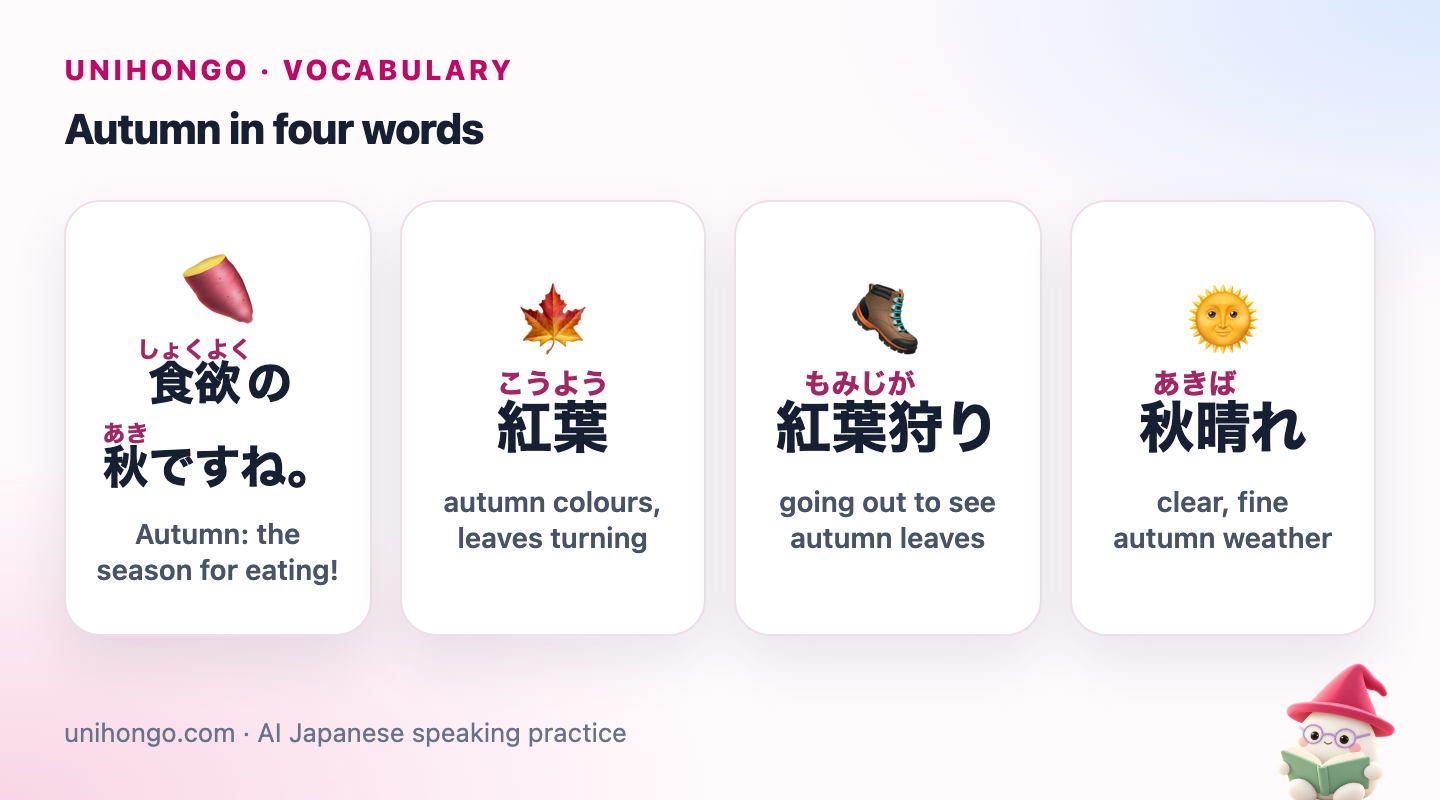
These four give you the core of Japanese autumn talk: a friendly phrase about food, the colours, the outing to see them and the clear weather that makes it all pleasant.
| Japanese | Romaji | Meaning |
|---|---|---|
| 食欲の秋ですね。 | Shokuyoku no aki desu ne. | Autumn: the season for eating! |
| 紅葉 | kōyō | autumn colours, leaves turning |
| 紅葉狩り | momijigari | going out to see autumn leaves |
| 秋晴れ | akibare | clear, fine autumn weather |
Notice that 紅葉 is read kōyō on its own here but momiji inside momijigari. The next section explains when each reading is used.
Kōyō or momiji? One kanji pair, two readings
紅葉 combines red, 紅, and leaf, 葉. Read kōyō, it is the general word for the turning of leaves, including yellow ginkgo and brown oak, and it is the word you see in forecasts: kōyō no migoro, the best time to see the colours. Read momiji, it usually means the red leaves of maples, or the maple tree itself, which can also be written もみじ or 椛. Yellow leaves have their own phrase, 黄葉, also read kōyō, but you mostly see it in writing.
| Japanese | Romaji | Meaning |
|---|---|---|
| 紅葉が始まりました。 | Kōyō ga hajimarimashita. | The leaves have started to turn. |
| 今が紅葉の見頃です。 | Ima ga kōyō no migoro desu. | Now is the best time to see the colours. |
| もみじが真っ赤ですね。 | Momiji ga makka desu ne. | The maples are bright red. |
| イチョウが黄色くなりました。 | Ichō ga kiiroku narimashita. | The ginkgo trees have turned yellow. |
| Reading | Main meaning | Typical use |
|---|---|---|
| kōyō | Leaves changing colour, red or yellow | News, forecasts, travel signs |
| momiji | Red maple leaves, the maple tree | Conversation, poems, sweets and place names |
| momijigari | An outing to see autumn leaves | Always read with momiji |
Why do you hunt leaves? The meaning of gari
Kari means hunting, and in compounds it often changes to gari. In momijigari it has the older sense of going out into nature to seek and enjoy something. Fruit picking uses the same pattern: ichigogari, strawberry picking, budōgari, grape picking, and mikangari, mandarin picking. In those cases you actually take something home. With leaves, you only take photos, and picking branches in parks and gardens is usually not allowed.
| Japanese | Romaji | Meaning |
|---|---|---|
| 週末、紅葉狩りに行きませんか。 | Shūmatsu, momijigari ni ikimasen ka. | Would you like to go leaf viewing this weekend? |
| ぶどう狩り | budōgari | grape picking |
| みかん狩り | mikangari | mandarin picking |
| 枝は折らないでください。 | Eda wa oranaide kudasai. | Please don't break off branches. (sign style) |
Autumn as the season of everything
Japanese has a set of no aki phrases that call autumn the season of some activity. They come from the comfortable weather and the harvest, and you hear them in shop campaigns, school newsletters and small talk. They are light clichés: saying watashi no dokusho no aki, my autumn of reading, is friendly and a little playful.
There is also a well-known traditional expression, ten takaku uma koyuru aki, the sky is high and the horses grow fat in autumn, describing clear skies and abundant harvests. It appears in writing and seasonal greetings more than in conversation.
| Japanese | Romaji | Meaning |
|---|---|---|
| 読書の秋 | dokusho no aki | autumn, the season for reading |
| スポーツの秋 | supōtsu no aki | autumn, the season for sport |
| 芸術の秋 | geijutsu no aki | autumn, the season for art |
| 食欲の秋で、つい食べすぎちゃう。 | Shokuyoku no aki de, tsui tabesugichau. | It's the season of appetite, I keep overeating. (casual) |
| 天高く馬肥ゆる秋 | Ten takaku uma koyuru aki | Clear high skies, a season of plenty (literary) |
Many schools hold their sports day, undōkai, and culture festival, bunkasai, in autumn, which is part of why supōtsu no aki and geijutsu no aki feel natural. Some schools hold sports day in spring instead.
Cool mornings and clear skies
Autumn weather talk has a clear arc. In September people still complain about the lingering heat, zansho. By October the air is dry and the sky is high and blue, akibare. In November mornings turn chilly, hadazamui, and people say the mornings and evenings are cold. Long autumn evenings, aki no yonaga, are traditionally linked with reading and quiet hobbies.
| Japanese | Romaji | Meaning |
|---|---|---|
| 今日は気持ちのいい秋晴れですね。 | Kyō wa kimochi no ii akibare desu ne. | It's a lovely clear autumn day today. |
| 朝晩は冷えますね。 | Asaban wa hiemasu ne. | It gets cold in the mornings and evenings. |
| ちょっと肌寒いですね。 | Chotto hadazamui desu ne. | It's a bit chilly. |
| 秋の夜長に本を読んでいます。 | Aki no yonaga ni hon o yonde imasu. | I'm reading through the long autumn evenings. |
| 急に涼しくなりましたね。 | Kyū ni suzushiku narimashita ne. | It's suddenly got cool, hasn't it? |
Maples, ginkgo and what lies on the path
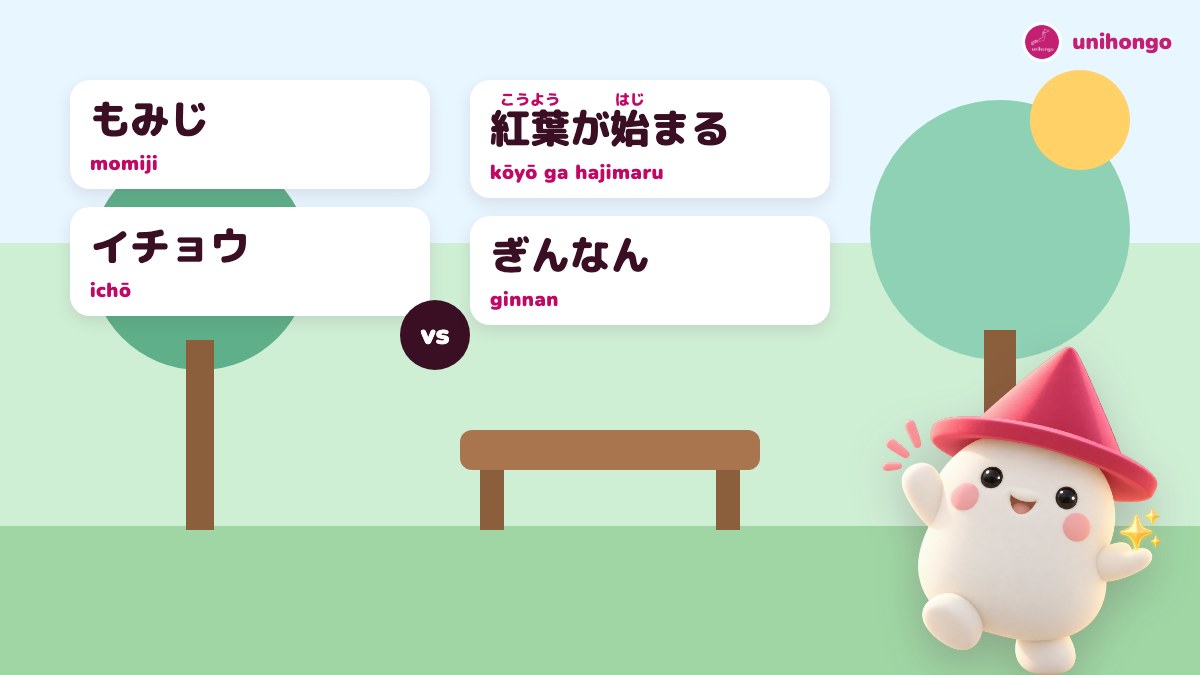
Two trees dominate autumn colour in Japanese towns. Maples, momiji or kaede, turn red in gardens and temple grounds, while ginkgo trees, ichō, turn bright yellow along streets and in parks. Ginkgo nuts, ginnan, fall in October and November and are roasted as a snack, but the fallen fruit has a strong smell that everyone comments on. Fallen leaves are ochiba, and sweeping them is a familiar autumn chore.
| Japanese | Romaji | Meaning |
|---|---|---|
| イチョウ並木 | ichō namiki | an avenue of ginkgo trees |
| ぎんなんの匂いがすごい。 | Ginnan no nioi ga sugoi. | The ginkgo nuts really smell. (casual) |
| 落ち葉を掃きます。 | Ochiba o hakimasu. | I'll sweep up the fallen leaves. |
| 落ち葉で滑らないように気をつけて。 | Ochiba de suberanai yō ni ki o tsukete. | Careful not to slip on the leaves. (casual) |
Mini dialogue: autumn plans with a friend
| Japanese | Romaji | Meaning |
|---|---|---|
| 最近、涼しくなったね。 | Saikin, suzushiku natta ne. | Friend: It's got cooler lately. |
| うん。そろそろ紅葉の季節だね。 | Un. Sorosoro kōyō no kisetsu da ne. | You: Yeah. It's nearly time for the autumn colours. |
| 来週、紅葉狩りに行かない? | Raishū, momijigari ni ikanai? | Friend: Want to go leaf viewing next week? |
| いいね。帰りに焼き芋も食べたい。 | Ii ne. Kaeri ni yakiimo mo tabetai. | You: Sounds good. I want roasted sweet potato on the way back too. |
| さすが、食欲の秋だね。 | Sasuga, shokuyoku no aki da ne. | Friend: Typical. It really is the season of appetite. |
Sasuga, as expected, is usually praise, but here it is gentle teasing. Tone and the no aki phrase make it clear it is a joke.
Common learner mistakes with autumn words
- Reading 紅葉狩り as kōyōgari. The compound is always momijigari.
- Using momiji for yellow ginkgo leaves. Momiji is red maple; ginkgo is ichō.
- Saying samui on a pleasantly cool day. Suzushii is the positive word; hadazamui is the slightly chilly one.
- Taking the no aki phrases too literally. They are friendly clichés, not real seasons for those activities.
- Using aki for September when it still feels like summer. People often say zansho ga kibishii, the late summer heat is fierce.
Learn autumn words while the leaves change
Ask Mocchi: explain when 紅葉 is read kōyō and when momiji, then give me five sentences to read. Mocchi explains the difference, lets you try each sentence, and remembers if you keep reading momijigari as kōyōgari, so it comes back in your next /review.
Then make a small deck with /create-flashcards, picking a photo for maple, ginkgo, fallen leaves and roasted sweet potato, and run it in Mocchi Flight on the games page. Seeing each word with its picture is a quick way to fix it in memory.