
How a New Year card is built
A typical nengajō has a greeting in large letters at the top or on the right, a few lines of thanks and good wishes, a personal handwritten note, and the date, often written as 令和九年 元旦 or simply 元旦 for 1 January. The greeting slot is where yojijukugo shine: four kanji, balanced and formal.
If you remember only one idiom for cards, make it this one. It is correct for every recipient.
| Japanese | Romaji | Meaning |
|---|---|---|
| 謹賀新年 | kinga shinnen | Respectful New Year greetings |
| 本年もよろしくお願いいたします。 | Honnen mo yoroshiku onegai itashimasu. | I look forward to your kind support this year too. (humble) |
Four idioms for the top of the card
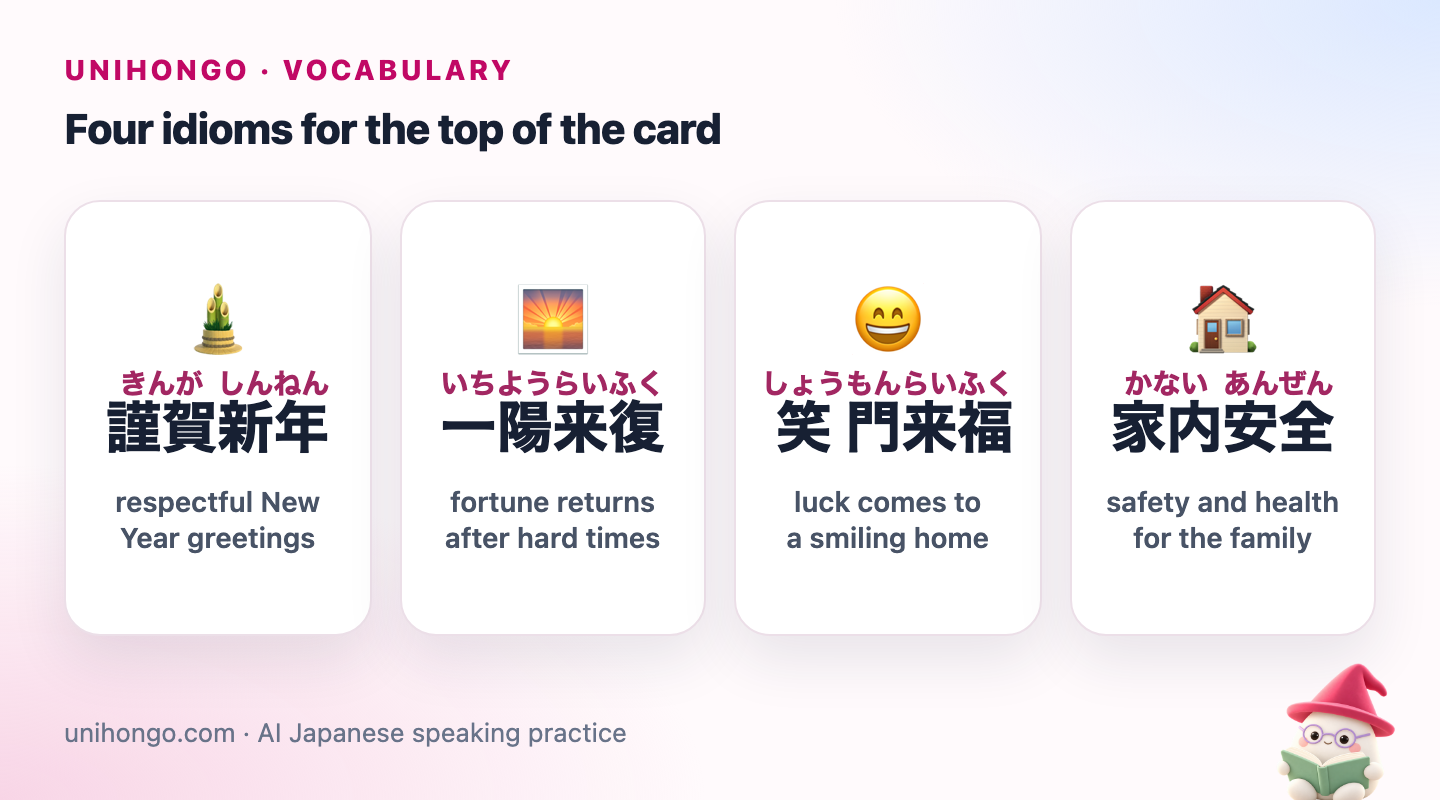
| Japanese | Romaji | Meaning |
|---|---|---|
| 謹賀新年 | kinga shinnen | respectful New Year greetings |
| 一陽来復 | ichiyō raifuku | fortune returns after hard times |
| 笑門来福 | shōmon raifuku | luck comes to a smiling home |
| 家内安全 | kanai anzen | safety and health for the family |
Only 謹賀新年 is a greeting. The other three are wishes, and they are often used as a design element on cards, on shrine charms or on decorations. 家内安全 is also a standard prayer request at shrines, so you will see it on ema plaques and charm packets.
一陽来復 is linked to the winter solstice in late December, when the days begin to lengthen again. Some shrines hand out charms with this name around the solstice, and the idiom works well on a card for someone who had a hard year, because it promises that brighter days are coming without mentioning the difficulties directly.
笑門来福 is the written form of a kotowaza that most Japanese know from childhood, 笑う門には福来たる, good fortune comes to the home where people laugh. It suits friends and families with children, and it fits the cheerful illustrations many people choose for their cards.
Who to send which greeting
Etiquette varies by family and company, but the following pattern is what most card guides suggest. When in doubt, choose the more respectful option.
| Greeting | Reading | Tone | Typical recipient |
|---|---|---|---|
| 謹賀新年 | kinga shinnen | Respectful | Anyone, including bosses, teachers and clients |
| 恭賀新年 | kyōga shinnen | Respectful | Anyone; a formal alternative |
| 謹んで新春のお慶びを申し上げます | tsutsushinde shinshun no oyorokobi o mōshiagemasu | Very respectful sentence | Clients, seniors, formal business cards |
| 迎春 / 賀正 | geishun / gashō | Short, casual | Friends, family, people your age |
| あけましておめでとう | akemashite omedetō | Warm, spoken style | Close friends (casual form) |
The 謹 in 謹賀新年 means respectfully, the same kanji as in 謹んで, which is why it is considered safe for superiors. 恭 in 恭賀新年 also means respectful.
Wish idioms for the message
After the greeting, many people add a wish. These idioms also appear on shrine charms, which is a nice link: you are wishing for the same things people pray for at the New Year shrine visit.
| Japanese | Romaji | Meaning |
|---|---|---|
| 無病息災 | mubyō sokusai | good health, free from illness |
| 皆様の無病息災をお祈りいたします。 | Minasama no mubyō sokusai o oinori itashimasu. | I pray for everyone's good health. (humble) |
| 商売繁盛 | shōbai hanjō | a thriving business |
| 貴社の商売繁盛をお祈り申し上げます。 | Kisha no shōbai hanjō o oinori mōshiagemasu. | I wish your company great prosperity. (business) |
| 千客万来 | senkyaku banrai | many customers coming |
| 開運招福 | kaiun shōfuku | better luck and good fortune |
| ご家族の家内安全をお祈りしています。 | Gokazoku no kanai anzen o oinori shite imasu. | I wish your family safety and health. |
Etiquette points card guides often mention
These are conventions, not laws, and younger people care about them less. Still, following them makes your card look well informed, especially to older recipients.
| Japanese | Romaji | Meaning |
|---|---|---|
| 昨年は大変お世話になりました。 | Sakunen wa taihen osewa ni narimashita. | Thank you for all your help last year. (polite) |
- Do not repeat the greeting: if the top says 謹賀新年, do not add あけましておめでとうございます below.
- Write 昨年 (sakunen, last year) instead of 去年, because 去 means to leave and is considered unlucky on a celebration card.
- 元旦 already means the morning of 1 January, so 一月一日元旦 is redundant; write 元旦 or 令和九年 元旦.
- If the recipient's family had a bereavement this year, they usually send a mourning postcard (喪中はがき) in advance, and you do not send them a New Year card.
- Add one handwritten line, even on printed cards.
Model cards for three recipients
| Japanese | Romaji | Meaning |
|---|---|---|
| 謹賀新年 | kinga shinnen | To a teacher: Respectful New Year greetings |
| 昨年は大変お世話になりました。本年もご指導のほどよろしくお願いいたします。 | Sakunen wa taihen osewa ni narimashita. Honnen mo goshidō no hodo yoroshiku onegai itashimasu. | To a teacher: Thank you for last year. I hope you will keep guiding me this year. |
| 笑門来福 | shōmon raifuku | To a friend: May luck come to your smiling home |
| 今年もたくさん笑おうね。また飲みに行こう! | Kotoshi mo takusan waraō ne. Mata nomi ni ikō! | To a friend: Let's laugh a lot this year too. Let's go for drinks again! (casual) |
| 家内安全 | kanai anzen | To a family: Safety and health for your household |
| 皆様にとって素敵な一年になりますように。 | Minasama ni totte suteki na ichinen ni narimasu yō ni. | To a family: I hope this will be a wonderful year for you all. |
Mistakes on cards
Handwriting is another point people notice. You do not need beautiful calligraphy, but write the idiom slowly and clearly, with balanced kanji. Many people practise the greeting a few times on scrap paper before writing the real cards. If your handwriting is unsteady, a printed greeting with a short handwritten personal line is perfectly acceptable and very common.
- Writing 謹賀新年 and あけましておめでとう together at the top.
- Sending 迎春 to your manager. It is understood, but many people consider it too casual for a superior.
- Writing 去年 instead of 昨年 in the message.
- Choosing a business wish such as 商売繁盛 for a friend's family card.
- Mixing up 笑門来福 with the kotowaza it comes from, 笑う門には福来たる. The idiom is the short written form; in speech people quote the kotowaza.
Timing, late cards and digital greetings
Japan Post accepts New Year cards from mid-December, and cards posted by around 25 December are usually delivered on 1 January. Cards posted later still arrive, just a few days into the new year. If you receive a card from someone you did not write to, it is common to reply quickly, and early January is fine.
If you miss the New Year period entirely, many people send a 寒中見舞い, a midwinter greeting card, instead. The New Year period, matsu no uchi, usually ends on 7 January, though in some regions it lasts until 15 January, so customs vary. A midwinter card does not use 謹賀新年; it starts with 寒中お見舞い申し上げます.
Many younger people now send greetings by message apps instead of postcards, and the tone is far more casual. Friends often exchange the slang abbreviations あけおめ and ことよろ, short for the New Year greeting and for please treat me well this year too. These are fine among friends of your age but should never appear on a card to a teacher or a client, where the four-character idioms in this post remain the safe choice.
| Japanese | Romaji | Meaning |
|---|---|---|
| 寒中お見舞い申し上げます。 | Kanchū omimai mōshiagemasu. | Midwinter greetings to you. (formal card) |
| あけおめ!ことよろ! | Akeome! Kotoyoro! | Happy New Year! Be good to me this year! (slang, friends only) |
| 年賀状、もう書いた? | Nengajō, mō kaita? | Have you written your New Year cards yet? (casual) |
Draft, check and memorise your card
Write a first draft for each recipient and paste it into the chat with /correct. Mocchi checks the politeness level, flags doubled greetings or 去年, and suggests a warmer handwritten line. If you ask for a plan, Mocchi can add a short card-writing task to your study plan for late December.
To remember the idioms themselves, make five flashcards with /create-flashcards, picking a photo for each wish, and review them in the Quick Flip game a few times before you start writing.