
Golden Week in four phrases
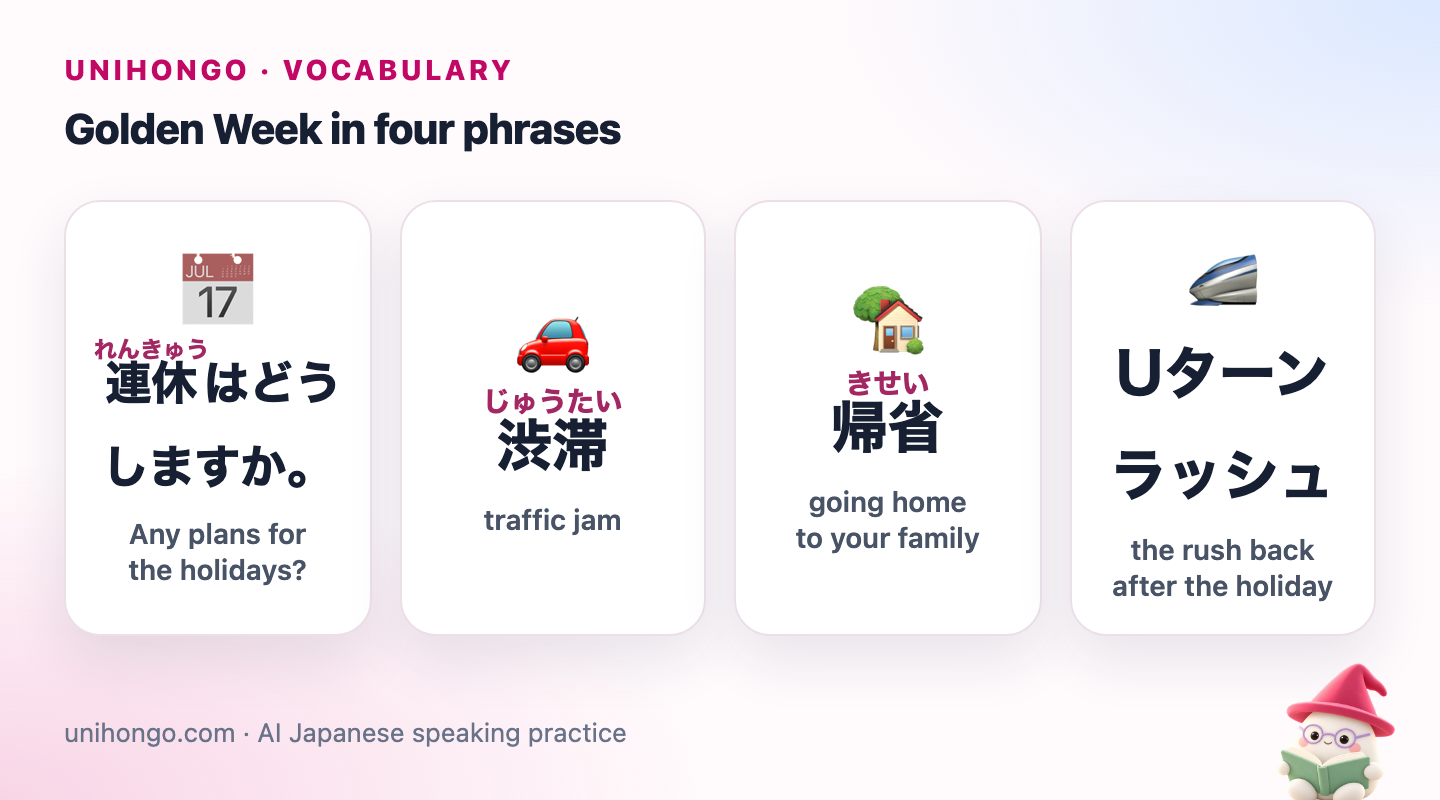
Most Golden Week conversations rotate around these four. The question opens the topic in April; the other three are the things people end up talking about: traffic, going home and the rush back at the end.
| Japanese | Romaji | Meaning |
|---|---|---|
| 連休はどうしますか。 | Renkyū wa dō shimasu ka. | Any plans for the holidays? |
| 渋滞 | jūtai | traffic jam |
| 帰省 | kisei | going home to your family |
| Uターンラッシュ | yūtān rasshu | the rush back after the holiday |
Dō shimasu ka, how will you do it, is softer and more open than doko ni ikimasu ka, where are you going, because it lets the other person answer that they are staying home without feeling odd.
The four holidays and the calendar
The dates of the four holidays are fixed. What changes each year is how they fall around the weekend, which decides how long the break is. When a holiday falls on a Sunday, the next working day becomes a substitute holiday, furikae kyūjitsu. When holidays are separated by working days, the pattern is called tobiishi renkyū, stepping-stone holidays.
| Japanese | Romaji | Meaning |
|---|---|---|
| 今年のゴールデンウィークは何連休ですか。 | Kotoshi no gōruden wīku wa nanrenkyū desu ka. | How many days off in a row do you get this Golden Week? |
| 五連休です。 | Gorenkyū desu. | Five days in a row. |
| 三十日に有給を取ります。 | Sanjūnichi ni yūkyū o torimasu. | I'm taking paid leave on the 30th. |
| 今年は飛び石連休ですね。 | Kotoshi wa tobiishi renkyū desu ne. | This year the holidays are scattered. |
| カレンダー通りに休みます。 | Karendā dōri ni yasumimasu. | I'm off on the calendar holidays only. |
| Date | Holiday | Reading |
|---|---|---|
| 29 April | Shōwa Day (昭和の日) | Shōwa no Hi |
| 3 May | Constitution Memorial Day (憲法記念日) | Kenpō Kinenbi |
| 4 May | Greenery Day (みどりの日) | Midori no Hi |
| 5 May | Children's Day (こどもの日) | Kodomo no Hi |
In 2027, 29 April is a Thursday and 1 to 5 May runs from Saturday to Wednesday, so many people get five days off in a row, and more if they take 30 April too.
Talking about plans before the break
In the second half of April, coworkers, classmates and hairdressers all ask about your plans. Short, honest answers are fine. Staying home is a perfectly normal answer, and many people avoid travelling precisely because of the crowds.
| Japanese | Romaji | Meaning |
|---|---|---|
| ゴールデンウィークの予定は? | Gōruden wīku no yotei wa? | Any plans for Golden Week? (casual) |
| 家族と温泉に行きます。 | Kazoku to onsen ni ikimasu. | I'm going to a hot spring with my family. |
| 実家に帰ります。 | Jikka ni kaerimasu. | I'm going back to my parents' place. |
| 混むので、家でゆっくりします。 | Komu node, ie de yukkuri shimasu. | It gets crowded, so I'll take it easy at home. |
| まだ決めていません。 | Mada kimete imasen. | I haven't decided yet. |
| いいですね。楽しんできてください。 | Ii desu ne. Tanoshinde kite kudasai. | Sounds great. Have a good time. |
Traffic jams, full trains and crowds
Golden Week news has its own vocabulary. Expressway operators publish jūtai yosoku, traffic jam forecasts, and reporters give the length of the queue in kilometres. Rail companies report how full the trains are, and on peak days reserved seats on popular routes sell out early, so people queue for unreserved cars. For crowds in stations, shops and sights, the word is konzatsu, not jūtai.
| Japanese | Romaji | Meaning |
|---|---|---|
| 高速道路で三十キロの渋滞です。 | Kōsoku dōro de sanjukkiro no jūtai desu. | There's a thirty-kilometre jam on the expressway. |
| 指定席はもう満席です。 | Shiteiseki wa mō manseki desu. | Station staff: The reserved seats are already full. |
| 自由席は何号車ですか。 | Jiyūseki wa nangōsha desu ka. | Which cars are unreserved? |
| 駅がすごく混雑していました。 | Eki ga sugoku konzatsu shite imashita. | The station was terribly crowded. |
| どこも人でいっぱいだった。 | Doko mo hito de ippai datta. | Everywhere was packed with people. (casual) |
| 渋滞にはまっちゃった。 | Jūtai ni hamatchatta. | I got stuck in a jam. (casual) |
Going home and coming back
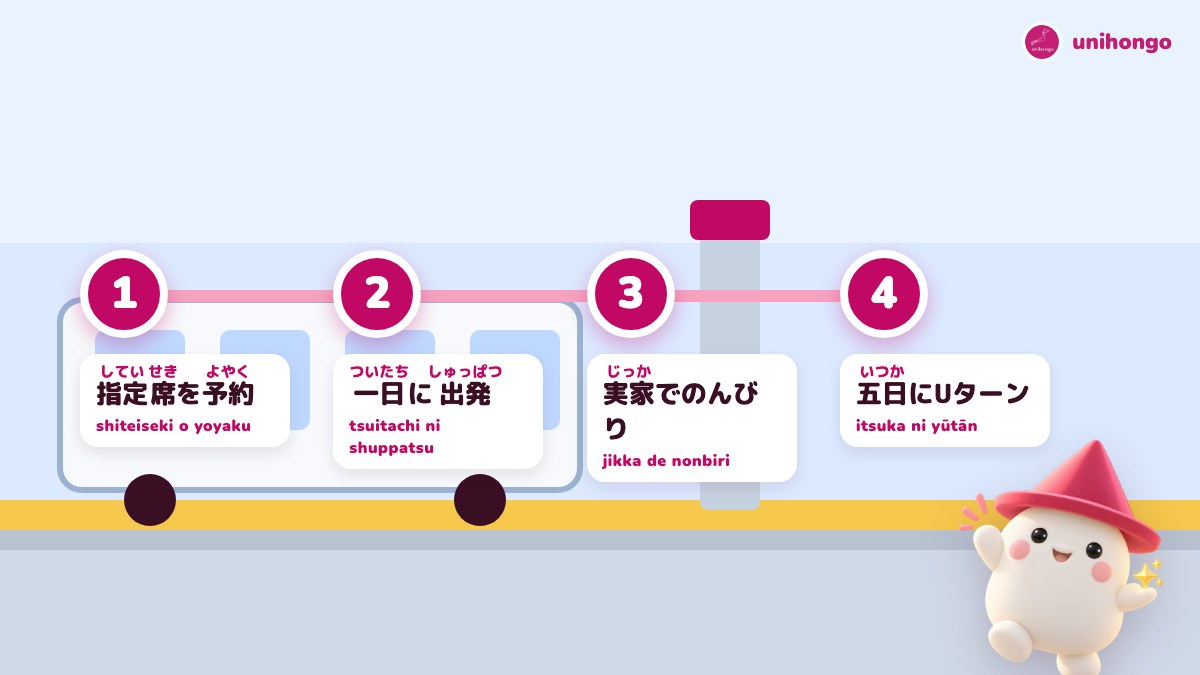
For many people, Golden Week means kisei: a trip back to the family home, the jikka, especially if they moved to a big city for work. The news calls the outward peak the kisei rasshu and the return peak, usually on the last day or two, the U-tān rasshu. A simple plan is to book early, travel off-peak if you can and expect the last day to be busy everywhere.
| Japanese | Romaji | Meaning |
|---|---|---|
| 早めに指定席を予約しました。 | Hayame ni shiteiseki o yoyaku shimashita. | I booked reserved seats early. |
| 一日に出発します。 | Tsuitachi ni shuppatsu shimasu. | I'm leaving on the 1st. |
| 実家でのんびりしました。 | Jikka de nonbiri shimashita. | I took it easy at my parents' place. |
| 五日はUターンラッシュで大変でした。 | Itsuka wa yūtān rasshu de taihen deshita. | The 5th was awful with everyone heading back. |
| 一日ずらして帰ります。 | Ichinichi zurashite kaerimasu. | I'll go back a day later to avoid the rush. |
Dates in May have special readings for the first ten days. Tsuitachi is the 1st, futsuka the 2nd, mikka the 3rd, yokka the 4th and itsuka the 5th, so Golden Week is good practice for them.
Mini dialogue: back at work after the holidays
| Japanese | Romaji | Meaning |
|---|---|---|
| おはようございます。連休、どうでした? | Ohayō gozaimasu. Renkyū, dō deshita? | Coworker: Morning. How were the holidays? |
| 実家に帰省していました。 | Jikka ni kisei shite imashita. | You: I went back to my family home. |
| いいですね。混んでいませんでしたか。 | Ii desu ne. Konde imasen deshita ka. | Coworker: Nice. Wasn't it crowded? |
| 帰りの新幹線は満席でした。 | Kaeri no shinkansen wa manseki deshita. | You: The bullet train back was full. |
| これ、地元のお菓子です。よかったらどうぞ。 | Kore, jimoto no okashi desu. Yokattara dōzo. | You: These are sweets from my hometown. Please help yourselves. |
| わあ、ありがとうございます。いただきます。 | Wā, arigatō gozaimasu. Itadakimasu. | Coworker: Oh, thank you. I'll have one. |
Bringing a box of individually wrapped sweets for your team after a trip is a common workplace habit, though it differs from office to office. Yokattara dōzo, please have some if you like, is the light, polite way to offer them.
Common learner mistakes with Golden Week words
- Using jūtai for a crowded station. Jūtai is for traffic; people in a station are konzatsu or simply komu.
- Saying kisei about a trip to anywhere you like. Kisei means going home to your family or hometown.
- Saying Golden Week in English to non-Japanese friends and expecting them to know it. It is a Japanese term.
- Saying renkyū for a single day off. A renkyū is at least two consecutive days, usually three or more.
- Reading 5日 as gonichi. For dates, the 5th is itsuka; gonichikan means five days in length.
Rehearse the holiday conversations
First ask Mocchi: help me say my Golden Week plans in Japanese, then check my sentences. Mocchi corrects them, explains the date readings like tsuitachi and itsuka, and keeps track of the ones you get wrong for your next /review.
Then take the hardest part, buying tickets in a busy week, to AI Sensei. Choose Sakura-sensei, ask the Sensei to play the ticket office clerk on a peak day when the reserved seats are full, and practise asking for unreserved cars, another train or a different date. The session report afterwards lists the corrections and the new words.