
Spring in four words
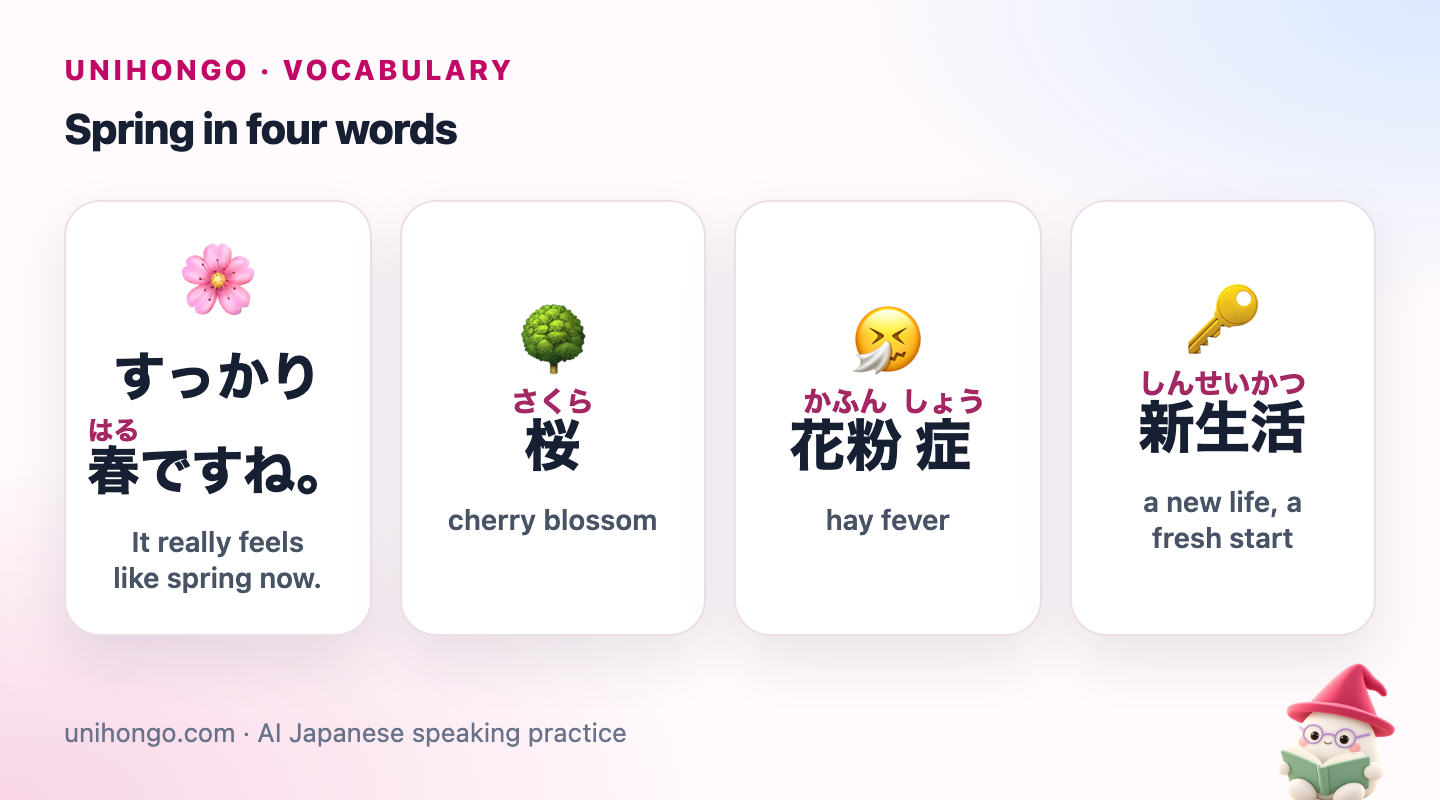
If you learn only four things to say about spring, make them these. The first is a complete small-talk sentence you can use with almost anyone from March onwards. The other three are the words that headline the season in Japan: the blossoms, the pollen and the fresh start.
| Japanese | Romaji | Meaning |
|---|---|---|
| すっかり春ですね。 | Sukkari haru desu ne. | It really feels like spring now. |
| 桜 | sakura | cherry blossom |
| 花粉症 | kafunshō | hay fever |
| 新生活 | shinseikatsu | a new life, a fresh start |
Sukkari means completely or thoroughly, and it pairs naturally with seasons and changes: sukkari samuku narimashita ne, it has really got cold. The ne at the end invites the listener to agree, which is exactly what weather talk is for.
Weather words for late winter and early spring
Japanese has several words for the uneven weeks when winter turns into spring. You will hear them in forecasts and in conversation, and using one correctly sounds surprisingly fluent.
| Japanese | Romaji | Meaning |
|---|---|---|
| 今日は暖かいですね。 | Kyō wa atatakai desu ne. | It's warm today, isn't it? |
| 昨日、春一番が吹いたそうです。 | Kinō, haru ichiban ga fuita sō desu. | Apparently the first spring gale blew yesterday. |
| まさに三寒四温ですね。 | Masa ni sankan shion desu ne. | Cold one day, warm the next, just like they say. |
| 花冷えで、また寒くなりました。 | Hanabie de, mata samuku narimashita. | It's turned cold again during blossom time. |
| ぽかぽかして気持ちいいね。 | Pokapoka shite kimochi ii ne. | It's lovely and warm. (casual) |
| Word | Reading | What it describes |
|---|---|---|
| 春一番 | haru ichiban | The first strong, warm southerly wind of the year, announced by forecasters in some regions |
| 三寒四温 | sankan shion | A run of cold days followed by warmer ones, often said of late winter and early spring |
| 花冷え | hanabie | A cold snap while the cherry trees are in bloom |
| 春雨 | harusame | Soft spring rain; also the name of thin glass noodles |
| ぽかぽか | pokapoka | Pleasantly warm, like sunshine on your back |
Hay fever: the spring topic everyone shares
From around February to April, cedar pollen (sugi kafun, スギ花粉) fills the air in much of Japan, followed by cypress pollen (hinoki, ヒノキ). Timing and severity vary by region and year, but pollen forecasts sit next to the weather on the news, and many people wear masks and carry tissues. If you sneeze at work in March, someone may well ask whether you have kafunshō.
The structure is simple: name the body part, then what it does. Me ga kayui is my eyes itch, hana ga muzumuzu suru is my nose tickles. These sentences are also what you would say at a pharmacy, where allergy medicine is sold over the counter.
| Japanese | Romaji | Meaning |
|---|---|---|
| 花粉症なんです。 | Kafunshō nan desu. | I have hay fever. |
| 今日は花粉がひどいですね。 | Kyō wa kafun ga hidoi desu ne. | The pollen is bad today. |
| 目がかゆくて、くしゃみが止まりません。 | Me ga kayukute, kushami ga tomarimasen. | My eyes itch and I can't stop sneezing. |
| 鼻水が止まらない。 | Hanamizu ga tomaranai. | My nose won't stop running. (casual) |
| 花粉症の薬はありますか。 | Kafunshō no kusuri wa arimasu ka. | Do you have hay fever medicine? (at a pharmacy) |
| マスクをしています。 | Masuku o shite imasu. | I'm wearing a mask. |
Notice that a mask is something you suru, do, not kiru, wear. Glasses take kakeru and hats take kaburu, and the pollen-proof glasses sold in spring are kafun yō megane.
A fresh start: school, work and moving
The Japanese school and business year starts in April, so March is full of endings and April of beginnings. Graduation, sotsugyō (卒業), comes in March; school entrance, nyūgaku (入学), and joining a company, nyūsha (入社), come in early April. Many people move house in these weeks, so rental agents and removal companies are busy and shops advertise shinseikatsu sales.
| Japanese | Romaji | Meaning |
|---|---|---|
| 卒業おめでとう! | Sotsugyō omedetō! | Congratulations on graduating! (casual) |
| ご入学おめでとうございます。 | Gonyūgaku omedetō gozaimasu. | Congratulations on starting school. (polite) |
| 四月から新生活が始まります。 | Shigatsu kara shinseikatsu ga hajimarimasu. | My new life starts in April. |
| 春から一人暮らしをします。 | Haru kara hitorigurashi o shimasu. | I'll be living on my own from spring. |
| 引っ越しの準備で忙しいです。 | Hikkoshi no junbi de isogashii desu. | I'm busy getting ready to move. |
Flowers and food besides sakura
Cherry blossoms get the headlines, but people also mention the plum blossoms that come before them, the yellow rapeseed fields, and the foods that appear in supermarkets and sweet shops only in spring. Any of these makes a good conversation starter that is a little less predictable than sakura.
| Japanese | Romaji | Meaning |
|---|---|---|
| 梅の花 | ume no hana | plum blossom, often in February and March |
| 菜の花 | nanohana | rapeseed blossom; the shoots are also eaten |
| たけのこ | takenoko | bamboo shoots |
| 山菜 | sansai | wild mountain vegetables |
| 桜餅 | sakuramochi | pink rice cake wrapped in a salted cherry leaf |
| うぐいすの声が聞こえますね。 | Uguisu no koe ga kikoemasu ne. | You can hear the bush warbler, can't you? |
The bush warbler, uguisu, is the bird of early spring in Japanese poems and greetings, and its song is often written hōhokekyo. If someone points it out, a simple ā, haru desu ne is the perfect reply.
On a spring walk: what you see and what you say
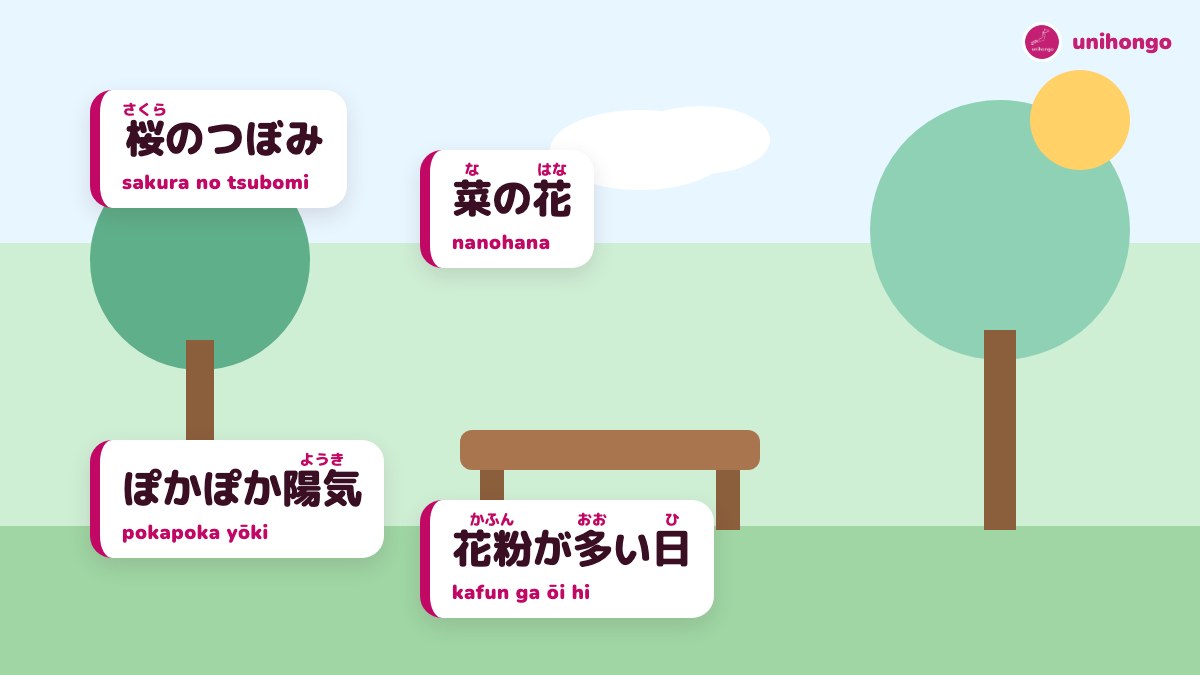
A walk through a local park in March is the best place to use these words. Before the full bloom, people talk about the buds and the forecast; on a sunny day they comment on the warmth; on a windy day, the pollen. You do not need long sentences: a noun, an adjective and ne will carry most of the conversation.
| Japanese | Romaji | Meaning |
|---|---|---|
| つぼみがふくらんできましたね。 | Tsubomi ga fukurande kimashita ne. | The buds are starting to swell. |
| 来週あたり咲きそうですね。 | Raishū atari sakisō desu ne. | Looks like they'll bloom around next week. |
| もう五分咲きですね。 | Mō gobuzaki desu ne. | They're already half open. |
| 今日はぽかぽか陽気ですね。 | Kyō wa pokapoka yōki desu ne. | It's lovely warm weather today. |
| 風が強くて、花粉が飛んでいますね。 | Kaze ga tsuyokute, kafun ga tonde imasu ne. | It's windy and the pollen is flying. |
Mini dialogue: spring small talk with a coworker
| Japanese | Romaji | Meaning |
|---|---|---|
| 最近、暖かくなりましたね。 | Saikin, atatakaku narimashita ne. | Coworker: It's got warmer lately, hasn't it? |
| そうですね。でも、花粉がつらくて。 | Sō desu ne. Demo, kafun ga tsurakute. | You: It has. But the pollen is getting to me. |
| あ、花粉症ですか。私もです。 | A, kafunshō desu ka. Watashi mo desu. | Coworker: Oh, do you have hay fever? Me too. |
| 目がかゆくて、仕事に集中できません。 | Me ga kayukute, shigoto ni shūchū dekimasen. | You: My eyes itch so much I can't focus on work. |
| 駅前の薬局の薬、よく効きますよ。 | Ekimae no yakkyoku no kusuri, yoku kikimasu yo. | Coworker: The medicine at the pharmacy by the station works well. |
| 本当ですか。帰りに寄ってみます。 | Hontō desu ka. Kaeri ni yotte mimasu. | You: Really? I'll stop by on the way home. |
The unfinished sentence kafun ga tsurakute, the pollen is hard and..., is very natural. Japanese speakers often leave the rest unsaid and let the listener fill it in with sympathy.
Common learner mistakes with spring words
- Writing 温かい for warm weather. Weather and rooms use 暖かい; food, drinks and warm hearts use 温かい. Both are read atatakai.
- Saying sakura ga sakimasu to describe trees already in bloom. Sakimasu is will bloom; for blossoms out now, say saite imasu, and for full bloom, mankai desu.
- Saying kafunshō ga arimasu. It is understood, but kafunshō nan desu or kafunshō desu is what people normally say.
- Saying shinseikatsu about any small change. It fits a real new chapter, such as a new job, school or home, not a new hobby.
- Using haru for early February because the old calendar says spring begins then. In conversation, people still call February winter.
Keep a spring word diary
Vocabulary tied to real weather sticks best. Each day this spring, type a two-line diary entry to Mocchi, for example: write my spring diary with me, today was windy and my eyes itched. Mocchi corrects the Japanese, explains why 暖かい and not 温かい, and keeps track of the words you keep getting wrong, so a later /quiz picks up where you left off.
Then make a small deck with /create-flashcards for the ten words you use most, and play them in Flashcard Flip on the games page during the commute. Hearing and seeing the same words in a game is a quick way to make them automatic.