
The questions you will hear about your morning
Mornings come up in small talk with a host family, at a language exchange and with coworkers who arrive at the same time as you. The question is almost always one of these four. The first three are polite; the last is how a friend asks, with the particles dropped and shite iru shortened to shiteru.
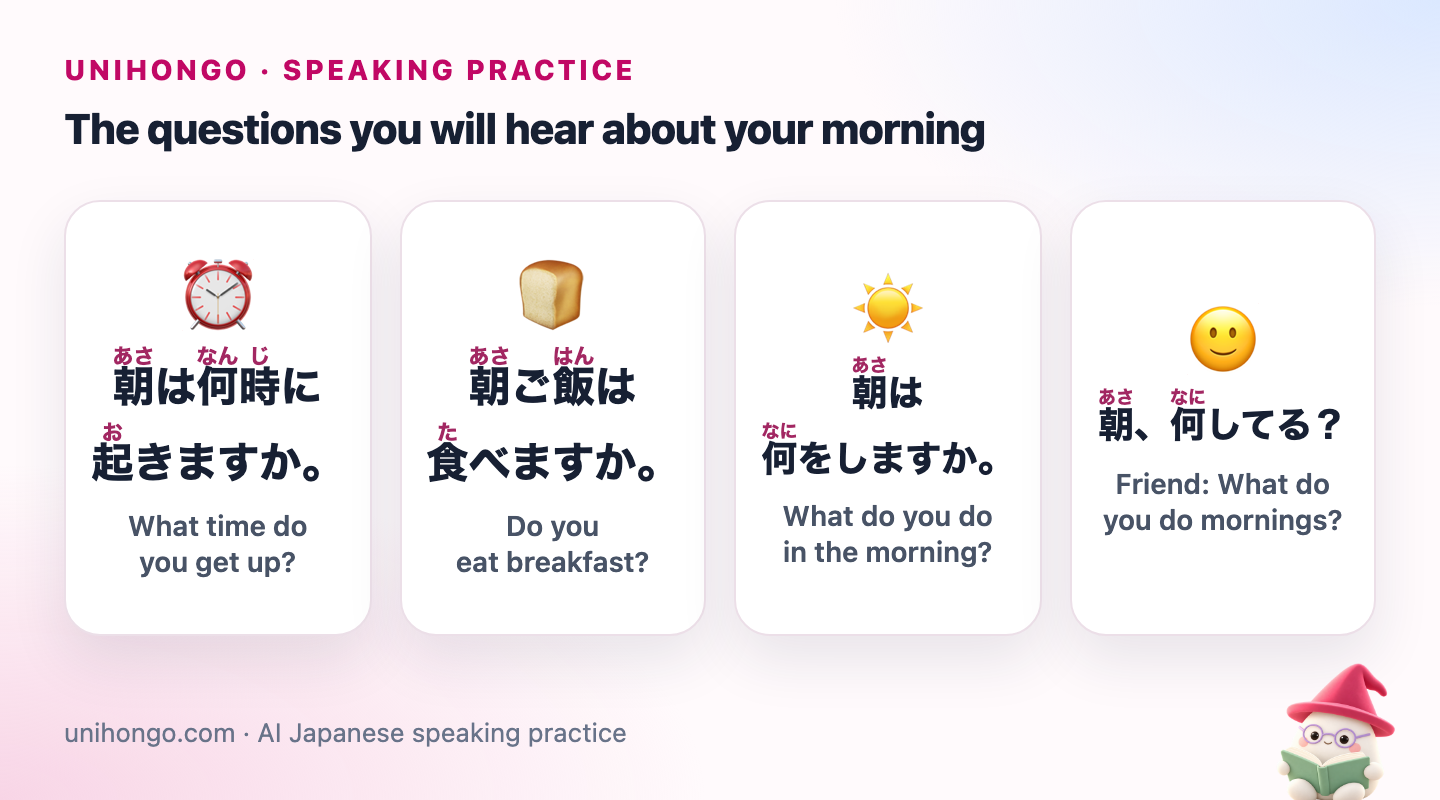
| Japanese | Romaji | Meaning |
|---|---|---|
| 朝は何時に起きますか。 | Asa wa nanji ni okimasu ka. | What time do you get up? |
| 朝ご飯は食べますか。 | Asagohan wa tabemasu ka. | Do you eat breakfast? |
| 朝は何をしますか。 | Asa wa nani o shimasu ka. | What do you do in the morning? |
| 朝、何してる? | Asa, nani shiteru? | Friend: What do you do mornings? |
Model answer 1: three sentences, no connectors
At the very start, three plain sentences are a complete and perfectly natural answer. Each one has a time or a verb and nothing else. Notice that the time comes before the object: maiasa shichiji ni okimasu, not okimasu shichiji ni.
| Japanese | Romaji | Meaning |
|---|---|---|
| 毎朝七時に起きます。 | Maiasa shichiji ni okimasu. | You: I get up at seven every morning. |
| コーヒーを飲みます。 | Kōhī o nomimasu. | You: I drink coffee. |
| 八時に家を出ます。 | Hachiji ni ie o demasu. | You: I leave the house at eight. |
If you can only remember one verb, make it okimasu, to get up. A wake-up time alone already answers the most common question, and the listener will usually supply the next one.
Model answer 2: the same morning in order
The second level adds the order words. Mazu opens the list, sorekara or tsugi ni carries the middle, saigo ni closes it. One ~te kara, after doing, in the middle shows that you can link two actions inside one sentence, which is the grammar this topic is really about.
| Japanese | Romaji | Meaning |
|---|---|---|
| まず、シャワーを浴びます。 | Mazu, shawā o abimasu. | You: First, I take a shower. |
| それから、朝ご飯を食べます。 | Sorekara, asagohan o tabemasu. | You: Then I eat breakfast. |
| 歯を磨いてから、服を着ます。 | Ha o migaite kara, fuku o kimasu. | You: After brushing my teeth, I get dressed. |
| 最後に、電車で会社に行きます。 | Saigo ni, densha de kaisha ni ikimasu. | You: Finally, I take the train to work. |
Shawā o abiru, literally to pour a shower over yourself, is the set phrase; shawā o suru is understood but sounds like a learner. Fuku o kiru covers tops and whole outfits; trousers and shoes take haku, but nobody expects you to split the outfit when describing a morning.
Model answer 3: habits, frequency and honesty
An intermediate answer tells the listener how often, admits a bad habit and separates weekdays from weekends. The grammar is ~te shimau for something you do without meaning to, tama ni shika ~nai for only occasionally, and ~ koto mo arimasu for there are times when. The honesty is what makes people laugh and keep asking.
| Japanese | Romaji | Meaning |
|---|---|---|
| 平日はだいたい六時半に起きます。 | Heijitsu wa daitai rokuji han ni okimasu. | You: On weekdays I get up at about half past six. |
| 起きてすぐにスマホを見てしまいます。 | Okite sugu ni sumaho o mite shimaimasu. | You: Right after waking up, I end up looking at my phone. |
| 朝ご飯はたまにしか食べません。 | Asagohan wa tama ni shika tabemasen. | You: I only occasionally eat breakfast. |
| 週末は昼まで寝ていることもあります。 | Shūmatsu wa hiru made nete iru koto mo arimasu. | You: On weekends I sometimes sleep until noon. |
The grammar this topic needs: ni, no particle, and the order words
Two rules carry almost every morning sentence. First, the particle after a time expression: clock times and dates take ni, relative words take nothing. Second, the connectors that order the steps. The table shows the particle rule; the phrase rows after it show each connector in a sentence you could say tomorrow.
| Japanese | Romaji | Meaning |
|---|---|---|
| まず、顔を洗います。 | Mazu, kao o araimasu. | First, I wash my face. |
| 次に、コーヒーをいれます。 | Tsugi ni, kōhī o iremasu. | Next, I make coffee. |
| その後、ニュースを見ます。 | Sono ato, nyūsu o mimasu. | After that, I watch the news. |
| 出かける前に、ゴミを出します。 | Dekakeru mae ni, gomi o dashimasu. | Before going out, I take out the rubbish. |
| 最後に、鍵をかけます。 | Saigo ni, kagi o kakemasu. | Last, I lock the door. |
| Time expression | Particle | Example in romaji |
|---|---|---|
| Clock time: seven o'clock, half past six | ni | shichiji ni okimasu |
| Every morning, every day: maiasa, mainichi | none | maiasa okimasu |
| Morning, evening, today: asa, yoru, kyō | none, or wa for contrast | asa wa kōhī o nomimasu |
| Weekdays, weekends: heijitsu, shūmatsu | wa to contrast the two | heijitsu wa hayai desu, shūmatsu wa osoi desu |
| Around a time: shichiji goro | ni optional | shichiji goro okimasu |
Mae ni, before, takes the dictionary form of the verb even when the whole sentence is polite: dekakeru mae ni. Kōhī o ireru is the verb for making coffee or tea; tsukuru is understood but ireru is what people say.
Follow-up questions and natural reactions
Once you have answered, the conversation lives or dies on the follow-ups. A Japanese listener will react to a time first, hayai desu ne or osoi desu ne, then ask about breakfast or the commute. These are the lines you will hear and the lines you can use when the question comes back to you. The last one, asagata or yorugata, is a favourite small-talk question in Japan and a good one to ask back.
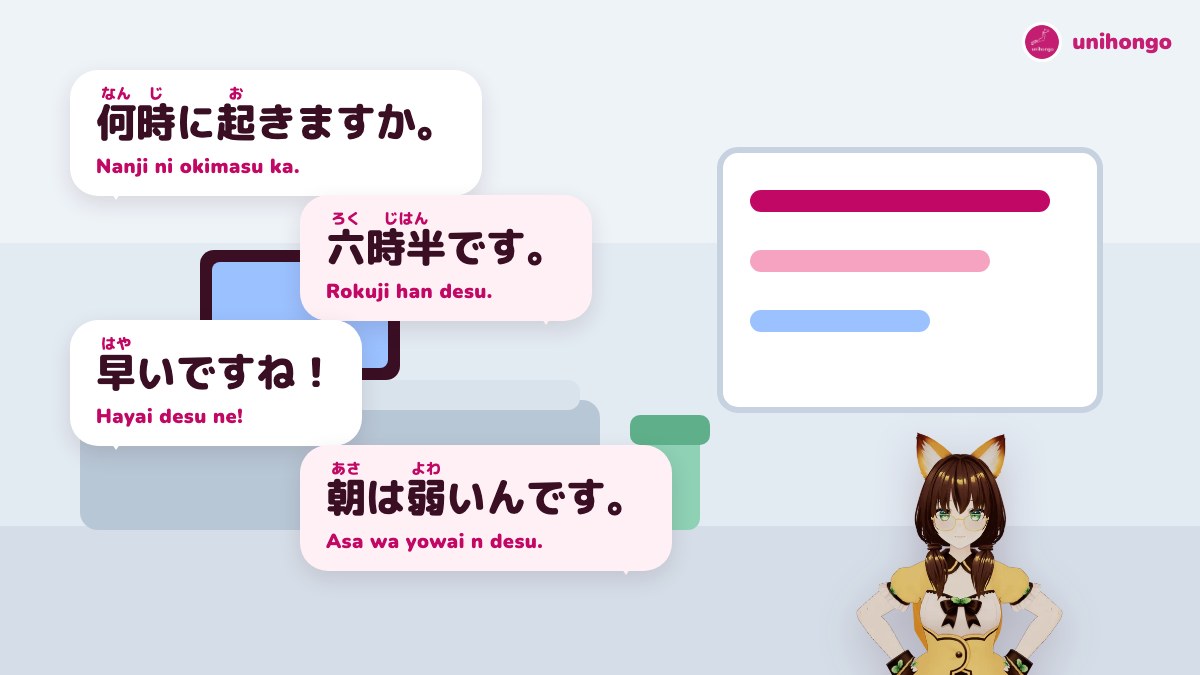
| Japanese | Romaji | Meaning |
|---|---|---|
| 早いですね! | Hayai desu ne! | Coworker: That's early! |
| 朝ご飯は何を食べますか。 | Asagohan wa nani o tabemasu ka. | Coworker: What do you eat for breakfast? |
| 朝は弱いんです。 | Asa wa yowai n desu. | You: I'm not a morning person. |
| へえ、健康的ですね。 | Hee, kenkōteki desu ne. | Coworker: Oh, that's healthy. |
| 私も! | Watashi mo! | You: Me too! (casual) |
| 朝型ですか、夜型ですか。 | Asagata desu ka, yorugata desu ka. | You: Are you a morning type or a night type? |
Hee with a rising tone shows mild surprise and interest; it is the single most useful reaction sound for this topic. Sō nan desu ka works the same way in polite conversation.
Mistakes and register notes
- Putting ni after maiasa or asa. Maiasa ni okimasu sounds wrong to a native ear; drop the particle, or use wa when you are contrasting morning with evening.
- Using sorekara in every sentence. One sorekara is fine; four in a row sound like a list read aloud. Mix in tsugi ni, sono ato and ~te kara, or just start a new sentence.
- Saying asagohan o tabemasu when you mean a habit you do not have. If you skip breakfast, say asagohan wa tabemasen, with wa, because the topic is now being contrasted.
- Translating I get ready as junbi shimasu alone. It is correct but vague; Japanese speakers usually name the step, shitaku o suru for getting dressed and ready, or kigaeru for changing clothes.
- Answering a casual asa nani shiteru? in full polite form. Among friends, reply in the plain form: shichiji ni okite, kōhī nonde, hachiji ni deru. With a teacher, host parent or coworker, stay with masu.
Make your own morning the daily drill
The morning is the easiest routine to practise because you can describe it while it happens. Say each step aloud in Japanese as you do it, mazu kao o arau, sorekara kōhī o ireru, and the connectors attach themselves to real actions instead of a word list.
When you want it checked, paste your six sentences into Mocchi, Unihongo's study assistant, with /correct and ask it to keep the meaning but make the order words sound natural; Mocchi keeps track of the particle mistakes you repeat, so a /quiz a few days later will test exactly those. Then let someone ask you the question for real: in AI Sensei, pick Haru-sensei, ask Haru-sensei to play a coworker meeting you at the office coffee machine and to ask about your morning, with one follow-up question each time. The session report afterwards lists which connectors you used and which sentences needed a fix. A free account at unihongo.com/login is all you need to try both tonight.
Your turn: five prompts to answer aloud
- Asa wa nanji ni okimasu ka. Answer with a time and one thing you do straight after.
- Asagohan wa nani o tabemasu ka. If you skip it, say so with wa and a reason.
- Describe your morning in four steps using mazu, tsugi ni, ~te kara and saigo ni, each once.
- Heijitsu to shūmatsu wa dō chigaimasu ka. Contrast the two with wa.
- Asagata desu ka, yorugata desu ka. Say which one you are and give one piece of evidence.