
The questions you will hear about your city
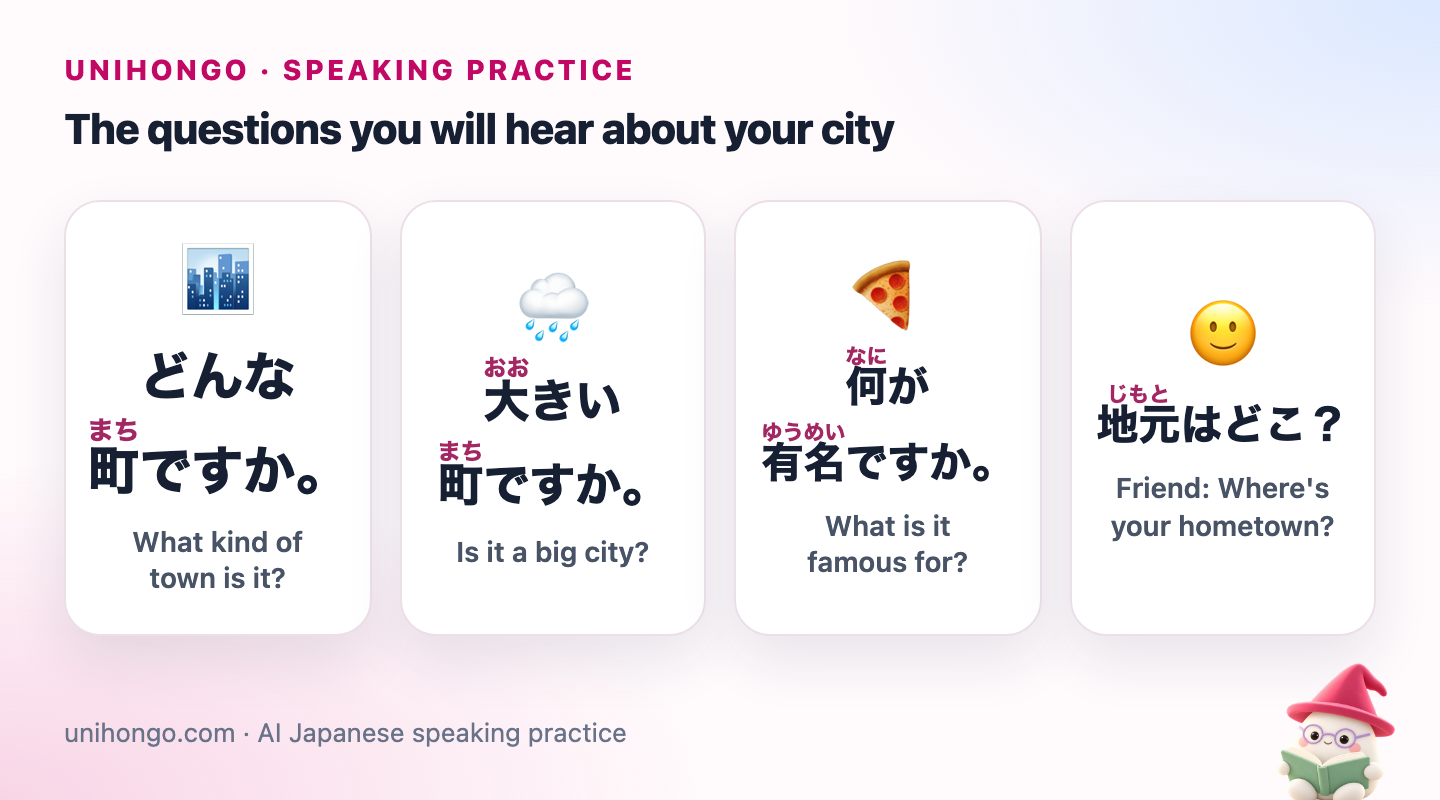
After doko kara kimashita ka and your country, the next question is one of these. Donna machi desu ka is the open one and the most common. The others ask about size and fame. The last is the casual version a friend uses, with jimoto, hometown, which is the word Japanese people use for their own home area and will happily use for yours.
| Japanese | Romaji | Meaning |
|---|---|---|
| どんな町ですか。 | Donna machi desu ka. | What kind of town is it? |
| 大きい町ですか。 | Ōkii machi desu ka. | Is it a big city? |
| 何が有名ですか。 | Nani ga yūmei desu ka. | What is it famous for? |
| 地元はどこ? | Jimoto wa doko? | Friend: Where's your hometown? |
Model answer 1: name, size, famous for
Three sentences answer donna machi desu ka completely at the beginner level. The example city is Melbourne; swap in your own. Say the name slowly in katakana pronunciation if it has a known Japanese form, and otherwise just say it clearly in your own language.
| Japanese | Romaji | Meaning |
|---|---|---|
| 私の町はメルボルンです。 | Watashi no machi wa Meruborun desu. | You: My city is Melbourne. |
| 大きい町です。 | Ōkii machi desu. | You: It's a big city. |
| コーヒーが有名です。 | Kōhī ga yūmei desu. | You: It's famous for coffee. |
Both X ga yūmei desu and X de yūmei desu are heard. With the city as the topic, machi wa kōhī de yūmei desu is the textbook form; on its own, kōhī ga yūmei desu, coffee is famous, is what people actually say.
Model answer 2: where, how many people, what the weather does
The second level locates the city with ni aru, gives a population with gurai, and uses ga (but) to contrast summer and winter. The last sentence uses the kute join to describe the city and its people in one breath. The weather comparison with Tokyo is the first comparison, and yori does the work.
| Japanese | Romaji | Meaning |
|---|---|---|
| オーストラリアの南にある町で、人口は五百万人ぐらいです。 | Ōsutoraria no minami ni aru machi de, jinkō wa gohyakuman nin gurai desu. | You: It's a city in the south of Australia with a population of about five million. |
| 夏は暑いですが、冬は東京より暖かいです。 | Natsu wa atsui desu ga, fuyu wa Tōkyō yori atatakai desu. | You: Summers are hot, but winters are milder than Tokyo's. |
| カフェが多くて、週末はみんな外で過ごします。 | Kafe ga ōkute, shūmatsu wa minna soto de sugoshimasu. | You: There are lots of cafés, and everyone spends the weekend outdoors. |
Jinkō wa ~ nin desu is the population sentence; nin is the counter for people. The number itself is the hard part: five million is gohyakuman, five hundred ten-thousands. If you are not sure of your city's figure, say daitai, roughly, and round it.
Model answer 3: compared with Tokyo
An intermediate answer compares openly. Ni kuraberu to, compared with, opens the sentence, node gives a reason, and to iwarete imasu, it is said that, lets you pass on a local saying without claiming it as fact. The last line balances praise with a complaint, which is how Japanese speakers talk about their own towns too.
| Japanese | Romaji | Meaning |
|---|---|---|
| 東京に比べると、ずっとのんびりしています。 | Tōkyō ni kuraberu to, zutto nonbiri shite imasu. | You: Compared with Tokyo, it's much more laid-back. |
| 電車は少ないので、車かトラムで移動する人が多いです。 | Densha wa sukunai node, kuruma ka toramu de idō suru hito ga ōi desu. | You: There are few trains, so many people get around by car or tram. |
| 一日に四つの季節があると言われています。 | Ichinichi ni yottsu no kisetsu ga aru to iwarete imasu. | You: People say it has four seasons in one day. |
| 住みやすいですが、家賃は高いです。 | Sumiyasui desu ga, yachin wa takai desu. | You: It's a nice place to live, but rent is expensive. |
The grammar this topic needs: comparing two cities
Comparison grammar is the engine of this conversation, because every description of your city will be heard against the listener's picture of Japan. The table gives the four patterns in order of usefulness, and the phrase rows show each in a sentence. Note that yori puts the smaller or lesser thing second, which is the opposite of English word order.
| Japanese | Romaji | Meaning |
|---|---|---|
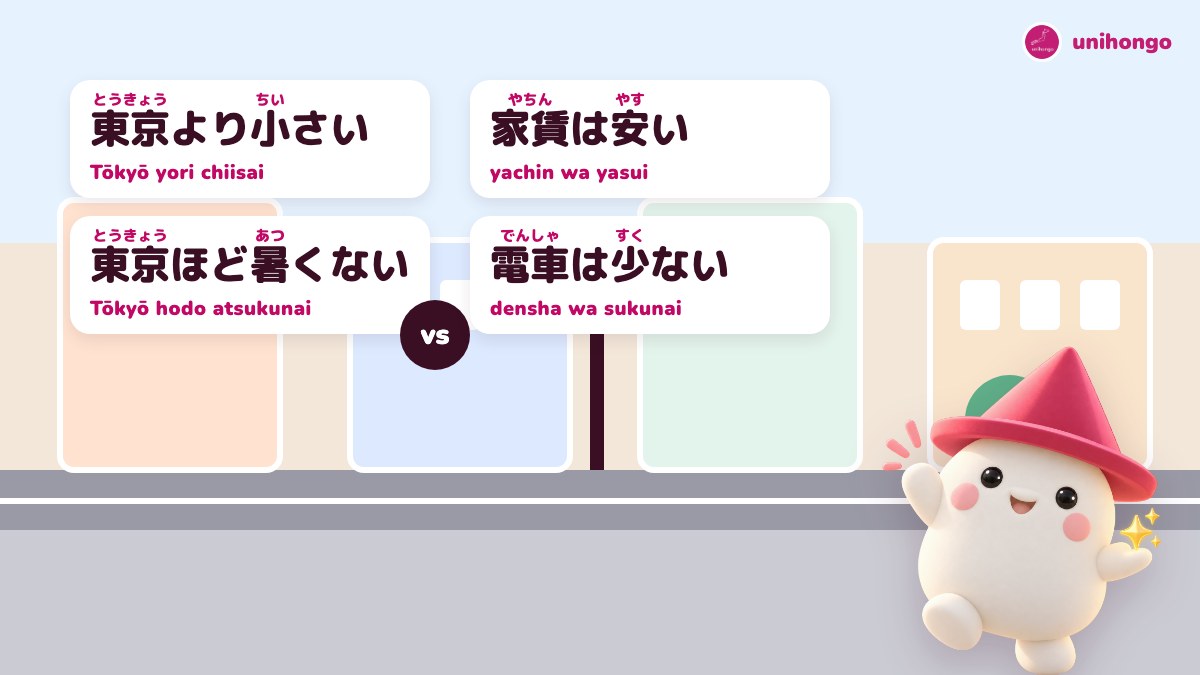
| 東京より小さいです。 | Tōkyō yori chiisai desu. | It's smaller than Tokyo. |
| 東京ほど人が多くないです。 | Tōkyō hodo hito ga ōkunai desu. | It's not as crowded as Tokyo. |
| 大阪と同じくらいの大きさです。 | Ōsaka to onaji kurai no ōkisa desu. | It's about the same size as Osaka. |
| 日本と違って、店は早く閉まります。 | Nihon to chigatte, mise wa hayaku shimarimasu. | Unlike Japan, shops close early. |
| 物価は日本と同じくらいです。 | Bukka wa Nihon to onaji kurai desu. | Prices are about the same as in Japan. |
| Pattern | Meaning | Example in romaji |
|---|---|---|
| A wa B yori + adjective | A is more ~ than B | Meruborun wa Tōkyō yori chiisai desu |
| A wa B hodo + negative adjective | A is not as ~ as B | Tōkyō hodo hito ga ōkunai desu |
| B ni kuraberu to, A wa ~ | compared with B, A is ~ | Tōkyō ni kuraberu to, shizuka desu |
| A wa B to onaji kurai ~ | A is about as ~ as B | Ōsaka to onaji kurai no ōkisa desu |
| B to chigatte, A wa ~ | unlike B, A ~ | Nihon to chigatte, mise wa hayaku shimarimasu |
Ōkisa is the noun form of ōkii, size. Adjective + sa makes a noun for many i-adjectives: takasa (height), hirosa (area), samusa (coldness), all useful for a city.
Famous for, things to do, and the weather
Three small topics fill out the description. What the city is famous for uses de yūmei desu. What there is to do uses ga arimasu and the potential form, oyogemasu, you can swim. Weather is a sentence with wa for each season. Pick two or three lines; nobody expects a tourist brochure.
| Japanese | Romaji | Meaning |
|---|---|---|
| ワインで有名です。 | Wain de yūmei desu. | It's famous for wine. |
| 古い建物がたくさんあります。 | Furui tatemono ga takusan arimasu. | There are lots of old buildings. |
| 海が近いので、夏は泳げます。 | Umi ga chikai node, natsu wa oyogemasu. | The sea is close, so you can swim in summer. |
| 夜景がきれいです。 | Yakei ga kirei desu. | The night view is beautiful. |
| 冬は雪がよく降ります。 | Fuyu wa yuki ga yoku furimasu. | It snows a lot in winter. |
| 観光客はあまり来ません。 | Kankōkyaku wa amari kimasen. | Not many tourists come. |
Amari + negative, not very, is the polite way to say your city is not a tourist spot. It leaves room for the listener to say sore ga ii desu ne, that's the nice part.
Follow-up questions and the reactions you will hear
A Japanese listener will ask about population, snow, food and whether they could visit. The exchange below is a lunch conversation between you and a coworker. The reaction hee, Nihon to zenzen chigaimasu ne, it's completely different from Japan, is not a criticism; it is the standard expression of interest, and the right reply is sō desu ne followed by one more detail.
| Japanese | Romaji | Meaning |
|---|---|---|
| 人口はどのくらいですか。 | Jinkō wa dono kurai desu ka. | Coworker: What's the population? |
| 冬は雪が降りますか。 | Fuyu wa yuki ga furimasu ka. | Coworker: Does it snow in winter? |
| 何を食べたらいいですか。 | Nani o tabetara ii desu ka. | Coworker: What should I eat there? |
| へえ、日本と全然違いますね。 | Hee, Nihon to zenzen chigaimasu ne. | Coworker: Oh, it's completely different from Japan. |
| そうですね。でも、人は親切ですよ。 | Sō desu ne. Demo, hito wa shinsetsu desu yo. | You: It is. But the people are friendly. |
| 行ってみたいです! | Itte mitai desu! | Coworker: I'd like to visit! |
When someone says itte mitai desu, the warm reply is zehi kite kudasai, please do come, or annai shimasu yo, I'll show you around. It is a polite formula more than a real invitation, so do not start planning dates.
Mistakes and register notes
- Reversing yori: Tōkyō wa watashi no machi yori chiisai desu says Tokyo is smaller than my city. The thing after yori is the one being compared against.
- Saying toshi in conversation. Watashi no toshi wa sounds translated; say watashi no machi or jimoto.
- Counting population in thousands. Gosen sen nin does not exist; five million is gohyakuman nin. Learn man, ten thousand, and build from there.
- Claiming yūmei for something only locals know. If outsiders have not heard of it, say jimoto de wa yūmei desu, it's famous locally, or jimoto no hito wa minna shitte imasu.
- Talking only in praise. Japanese speakers describe their own towns with a mix of pride and complaint, and a single ~ desu ga, yachin wa takai desu makes you sound like one of them.
Build your city description in a week
Your city is a topic you will be asked about for as long as you speak Japanese, so it pays to get a good version down once. Give Mocchi, Unihongo's study assistant, the facts in English, population, climate, one famous thing, one difference from Japan, and ask it to help you write five Japanese sentences and then correct your own attempt; the request below does exactly that. Mocchi remembers where you are from, so later speaking prompts and quizzes will refer to it.
After the written version is right, say it in AI Sensei: pick Yamada-sensei, ask Yamada-sensei to play a coworker at lunch who has never left Japan and keeps asking how your city compares, and ask Yamada-sensei to react to each answer. The report at the end shows which comparison patterns you reached for. You can open a free account at unihongo.com/login and do the written half first.
Your turn: describe your city aloud
- Donna machi desu ka. Answer with location, size and one famous thing.
- Jinkō wa dono kurai desu ka. Say the number in man, with gurai.
- Fuyu wa dō desu ka. One weather sentence with wa, plus a comparison with yori.
- Nihon to dō chigaimasu ka. Two differences: one with to chigatte, one with hodo ~nai.
- Ii tokoro wa nan desu ka. One good point, then one complaint with desu ga.