
What 3D City is
3D City is a model of Tokyo that opens in your web browser. You choose a character, and you walk: across the Shibuya crossing, past the Hachiko statue, into the station. The streets are full of people. Some of them work in the shops and offices, and some are just walking by. You can talk to all of them, and they answer you out loud in Japanese.
There is no script to read from. You say what you need in your own words, the person replies the way a real barista or bank clerk would, and the conversation goes where you take it. If you say something unclear, they ask you again. It is the closest thing to a day in Tokyo that fits into ten minutes at your desk.
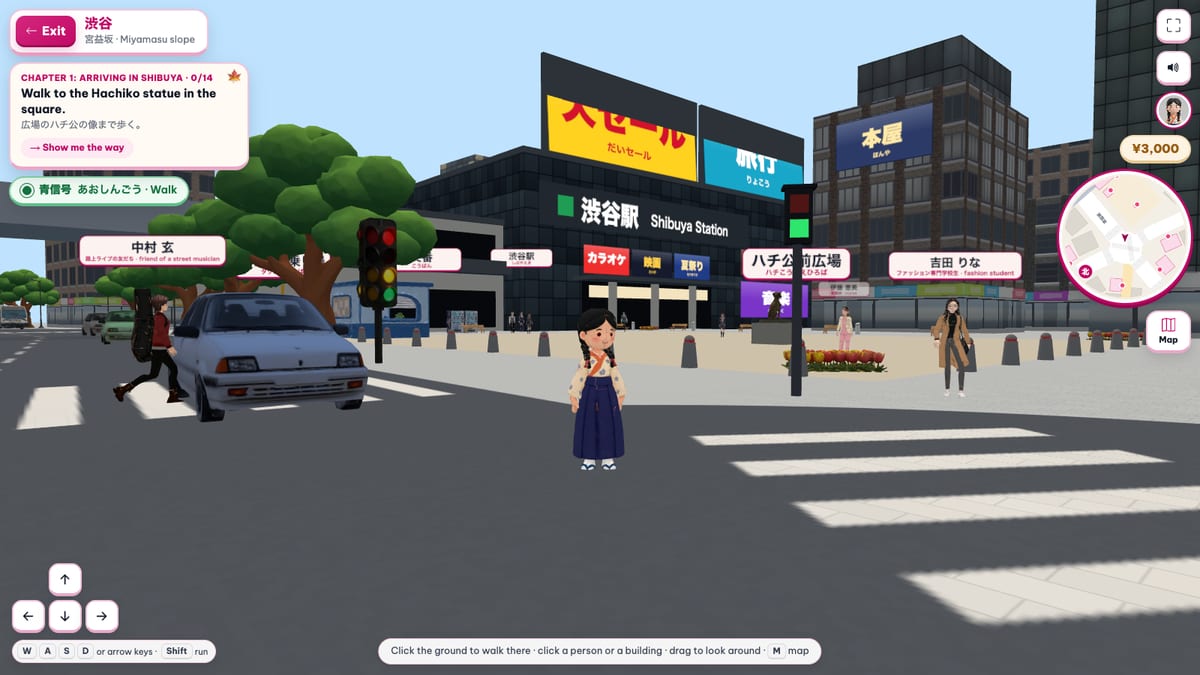
Your first walk: ten minutes in Shibuya
The city has a story with three chapters, one for each district. The first chapter begins in Shibuya and is made for a first visit. It takes you to three people, and each of them teaches you one thing every traveller needs.
| Stop | Who you meet | What you practise |
|---|---|---|
| The Hachiko statue | A friendly local waiting for a friend | Saying hello, asking how someone is, giving your name |
| The police box | A police officer | Stopping someone politely and asking the way |
| Shibuya Station | The station attendant | Buying a ticket, asking the price and the platform |
| The convenience store | The clerk at the register | Answering quick questions about a bag and how you pay |
| The café | The barista | Ordering a drink, choosing a size, for here or to go |
The first three stops are enough for one visit. The city always shows your next step, and Show me the way leads you there. The chapter then continues to the convenience store, the café, a ramen shop, a bookshop, the pharmacy and the supermarket, so Shibuya alone gives you about a week of short sessions.
Eight lines for your first walk
These are the lines the first three conversations are built on. Say them out loud before you start. You do not need to remember them perfectly: in the city, Ask Sensei shows you a line you can use whenever you are stuck. But the conversation feels very different when the first sentence is already in your mouth.
| Japanese | Romaji | Meaning |
|---|---|---|
| こんにちは。はじめまして。 | Konnichiwa. Hajimemashite. | Hello. Nice to meet you. |
| お元気ですか。 | Ogenki desu ka. | How are you? |
| すみません、ちょっといいですか。 | Sumimasen, chotto ii desu ka. | Excuse me, do you have a moment? |
| 駅はどこですか。 | Eki wa doko desu ka. | Where is the station? |
| まっすぐ行って、右ですね。 | Massugu itte, migi desu ne. | Straight on, then right, correct? |
| 横浜までの切符をください。 | Yokohama made no kippu o kudasai. | A ticket to Yokohama, please. |
| いくらですか。 | Ikura desu ka. | How much is it? |
| 何番線ですか。 | Nanbansen desu ka. | Which platform is it? |
What a conversation looks like
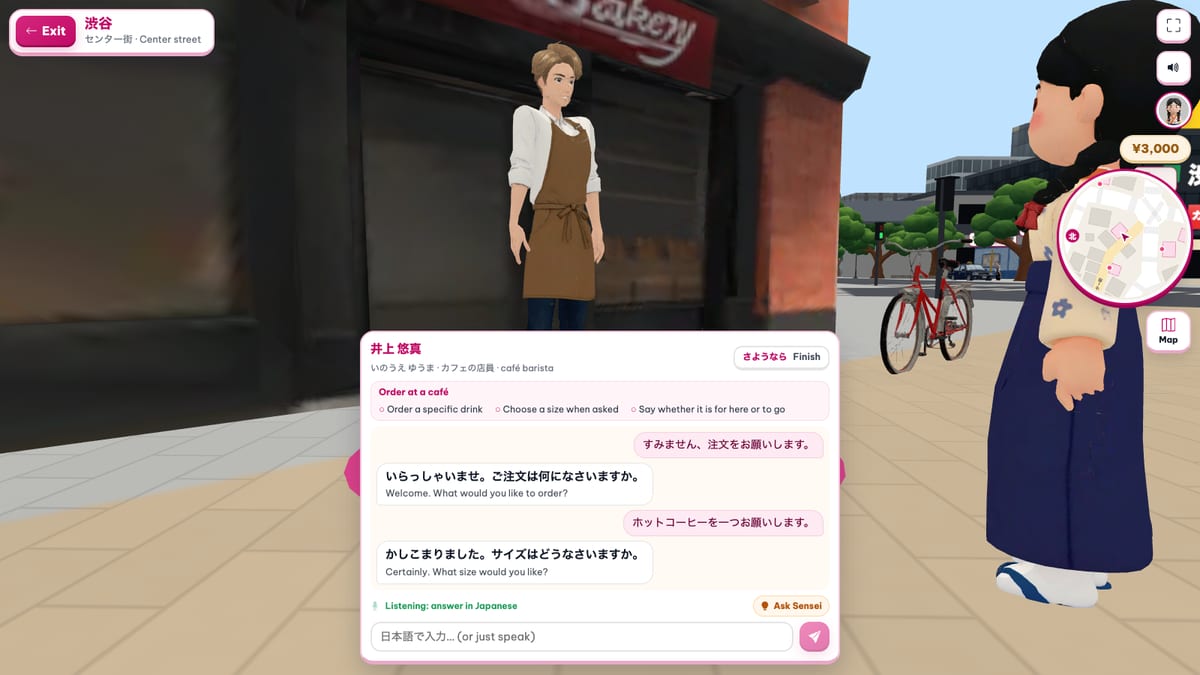
Walk up to someone who works in a place and you see the conversations they offer, each marked with its level. Choose one and the situation appears with three small goals: at the café, for example, order a specific drink, choose a size when asked, and say whether it is for here or to go. Then you speak first, as you would in real life.
| Japanese | Romaji | Meaning |
|---|---|---|
| すみません、注文をお願いします。 | Sumimasen, chūmon o onegai shimasu. | Excuse me, I would like to order. |
| ホットコーヒーをください。 | Hotto kōhī o kudasai. | A hot coffee, please. |
| Mサイズでお願いします。 | Emu saizu de onegai shimasu. | Medium size, please. |
| 持ち帰りです。 | Mochikaeri desu. | It is to go. |
| 袋はいりません。 | Fukuro wa irimasen. | I do not need a bag. |
| カードでお願いします。 | Kādo de onegai shimasu. | By card, please. |
You can speak into your microphone or type your answer in Japanese. The person answers out loud in their own voice, and a translation appears under every reply, so you never lose the thread. Nobody is waiting behind you, and nobody switches to English when you hesitate. That is the part real life cannot give you: time.
The feedback after each conversation
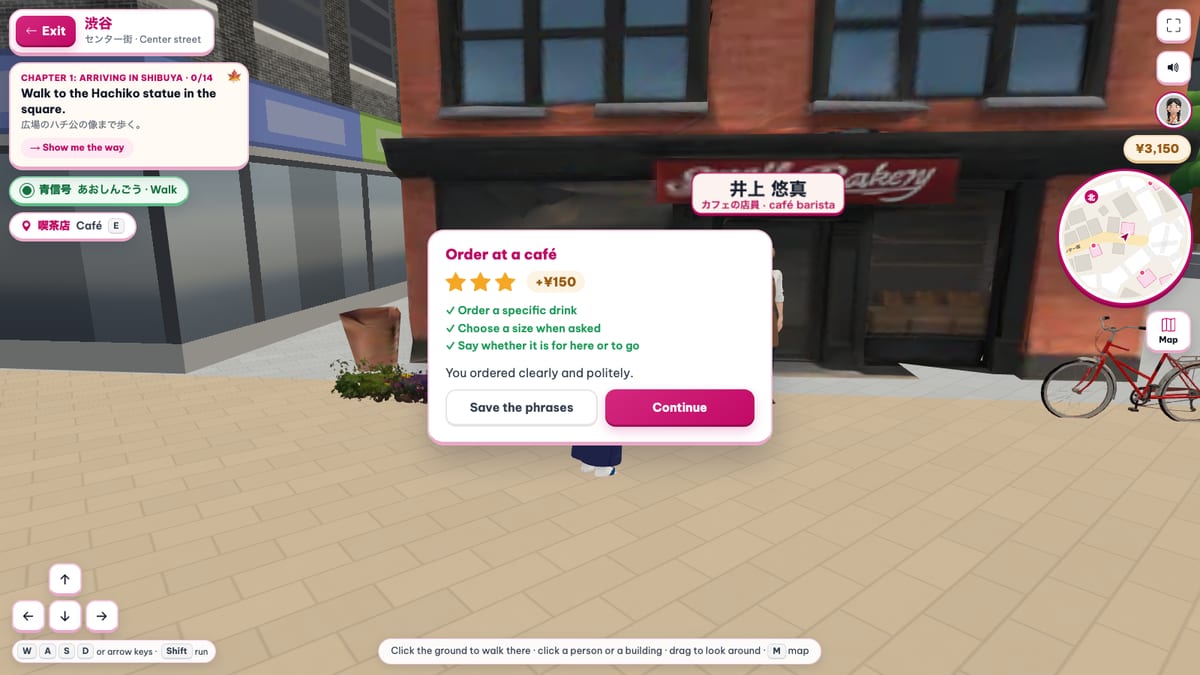
When you finish, Sensei looks at the whole conversation and tells you how it went. You see which of the three goals you reached, one sentence about what you did well, and the one correction that matters most. A conversation earns up to three stars, and good ones also earn yen, which you spend on the train, the bus or a taxi to the next district.
This is where the learning happens. Read the correction, then start the same conversation again and use it. The second attempt is almost always better, and the phrase you fixed is the one you will remember. You can also save the phrases of a conversation to your phrasebook and come back to them later.
Three districts, three kinds of Japanese
Each district is a different part of life in Japan, so each one trains a different kind of Japanese. Start where your own goal is: a trip, a move to Japan, or work.
| Japanese | Romaji | Meaning |
|---|---|---|
| 住所を登録したいです。 | Jūsho o tōroku shitai desu. | I would like to register my address. (ward office) |
| 口座を開きたいです。 | Kōza o hirakitai desu. | I would like to open an account. (bank) |
| 頭が痛くて、気持ち悪いです。 | Atama ga itakute, kimochi warui desu. | My head hurts and I feel sick. (clinic) |
| とりあえず、ビールをください。 | Toriaezu, bīru o kudasai. | To start, a beer, please. (izakaya) |
| 明日、京都まで行きたいです。 | Ashita, Kyōto made ikitai desu. | I want to go to Kyoto tomorrow. (ticket office) |
| 窓側の席をお願いします。 | Madogawa no seki o onegai shimasu. | A window seat, please. (ticket office) |
| 予約している田中です。 | Yoyaku shite iru Tanaka desu. | I have a booking. My name is Tanaka. (hotel) |
| District | What it is about | Places you can visit | Conversations |
|---|---|---|---|
| Shibuya | Daily life and travel basics | Café, ramen shop, convenience store, pharmacy, bookshop, post office, police box, station | 56 |
| Shinjuku | Living in Japan | Ward office, bank, clinic, dentist, estate agent, hair salon, gym, office, izakaya | 68 |
| Tokyo Station | Travel and business | Shinkansen ticket office, boxed lunch shop, hotel, travel agent, office tower, terrace restaurant | 71 |
You travel between the districts by train, bus or taxi, and even the ride is practice: the bus driver and the taxi driver have conversations of their own. If you are moving to Japan, Shinjuku is the district to spend time in. The ward office, the bank and the clinic are the three places where new residents most often wish they had practised first.
Learn words from the street
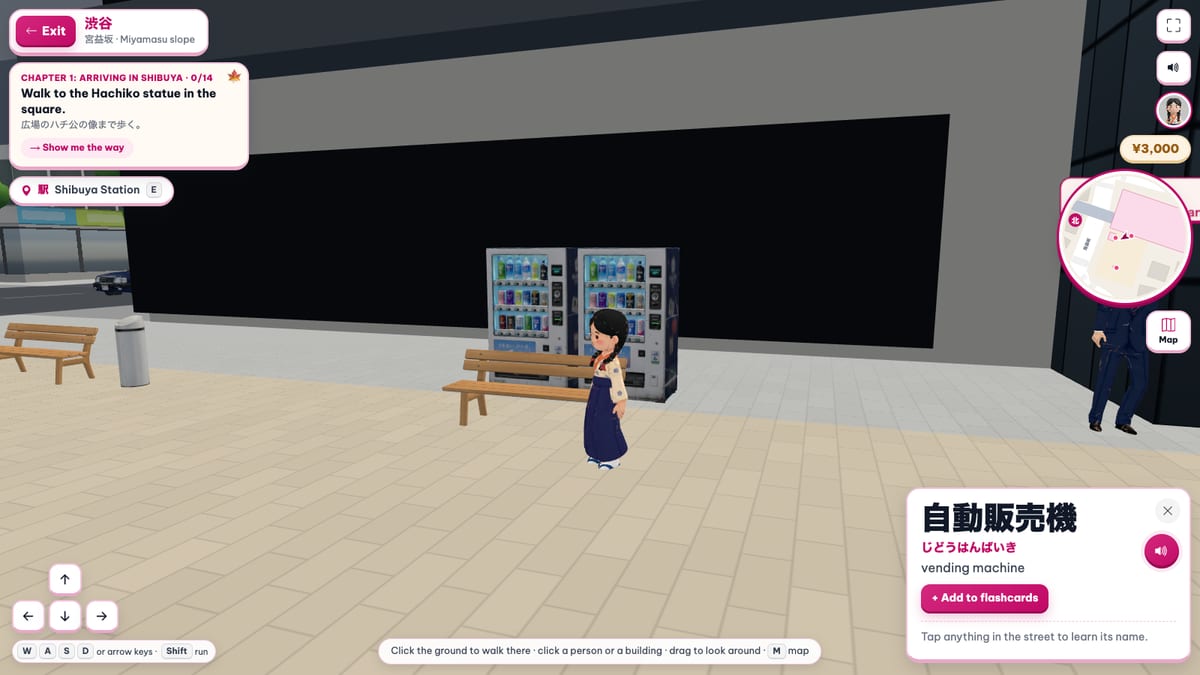
Not everything in the city is a conversation. Tap a vending machine, a post box, a traffic light or a shop sign, and a card shows the Japanese word, how to read it and what it means. You can listen to it and add it to your Unihongo flashcards with one more tap.
The people walking by are there for small talk. Stop an office worker on a break or a retiree with his dog, and the city suggests easy things to talk about: the weather, food, work, plans for the weekend. Or choose Talk about anything and lead the conversation yourself. It is practice at the hardest skill of all: keeping a friendly conversation going.
How to use 3D City at your level
The same city works from your first week of Japanese to an advanced level, because every place offers conversations at several levels. What changes is how you use it.
| Your level | Where to start | How to practise |
|---|---|---|
| Beginner | Shibuya: the statue, the police box, the café | Say the model lines first, use Ask Sensei freely, repeat each conversation until you reach all three goals |
| Elementary | Shibuya shops, then the Shinjuku bank and clinic | Try the conversation before you look at any hint, then read the correction and do it once more |
| Intermediate | Shinjuku and Tokyo Station | Choose problems, not routines: the wrong order, the lost card, the changed ticket |
| Advanced | The office, the hotel and the terrace restaurant | Practise polite and business Japanese, and finish each visit with small talk with a passer-by |
Whatever your level, keep the sessions short. One walk, one or two conversations and one new phrase is a complete session. It is better to come back tomorrow than to do an hour today.
What 3D City does not do yet
It is a new feature, and it is better to know its limits before you start. 3D City runs on a laptop or a desktop computer, not on a phone. To speak with your microphone you need Chrome, Edge or Safari; in other browsers you can walk, read, listen and type. The people are AI characters, so they are patient and always available, but they are not a replacement for talking with real people: they are the practice that makes those conversations easier.
Walking around, reading signs and learning words are free. Talking with the people uses the same speaking time as AI Sensei, so a Free account can try one short conversation and a paid plan is needed for daily practice. The city has six districts today, in Tokyo, Kyoto and Osaka, and more will be added.