
What actually happens, step by step
A first conversation with a Japanese speaker almost always follows the same shape, whether it happens at a language exchange, a party, a hostel kitchen or a shop counter when the clerk notices you are studying. Knowing the shape takes away most of the fear, because you can prepare each step and you will recognise where you are.
| Stage | What usually happens | Your job |
|---|---|---|
| Opening | A greeting, often with a small bow or nod | Greet back and say hajimemashite |
| Names | You exchange names; they may ask how to say yours | Say your name slowly, then yoroshiku onegai shimasu |
| Where from | Dochira kara desu ka, where are you from? | Country plus kara kimashita |
| Why Japanese | Curiosity about why you study, how long, whether it is hard | One or two short reasons; honesty beats grammar |
| Small talk | The weather, food, something nearby | Listening sounds and one question back |
| Ending | Someone signals time is up | A thank-you line and a goodbye that fits |
The whole thing might last two minutes. That is not a failure; two minutes is the length of a normal first conversation in any language. The second conversation will be longer, and that is where the real learning begins.
The six lines that carry the whole exchange
You do not need a hundred phrases for a first conversation. You need six that you can say without thinking, so that your attention is free for listening. All of them are polite, so they work with a stranger, a classmate's parent or a shopkeeper. Learn them as sounds, not as grammar.
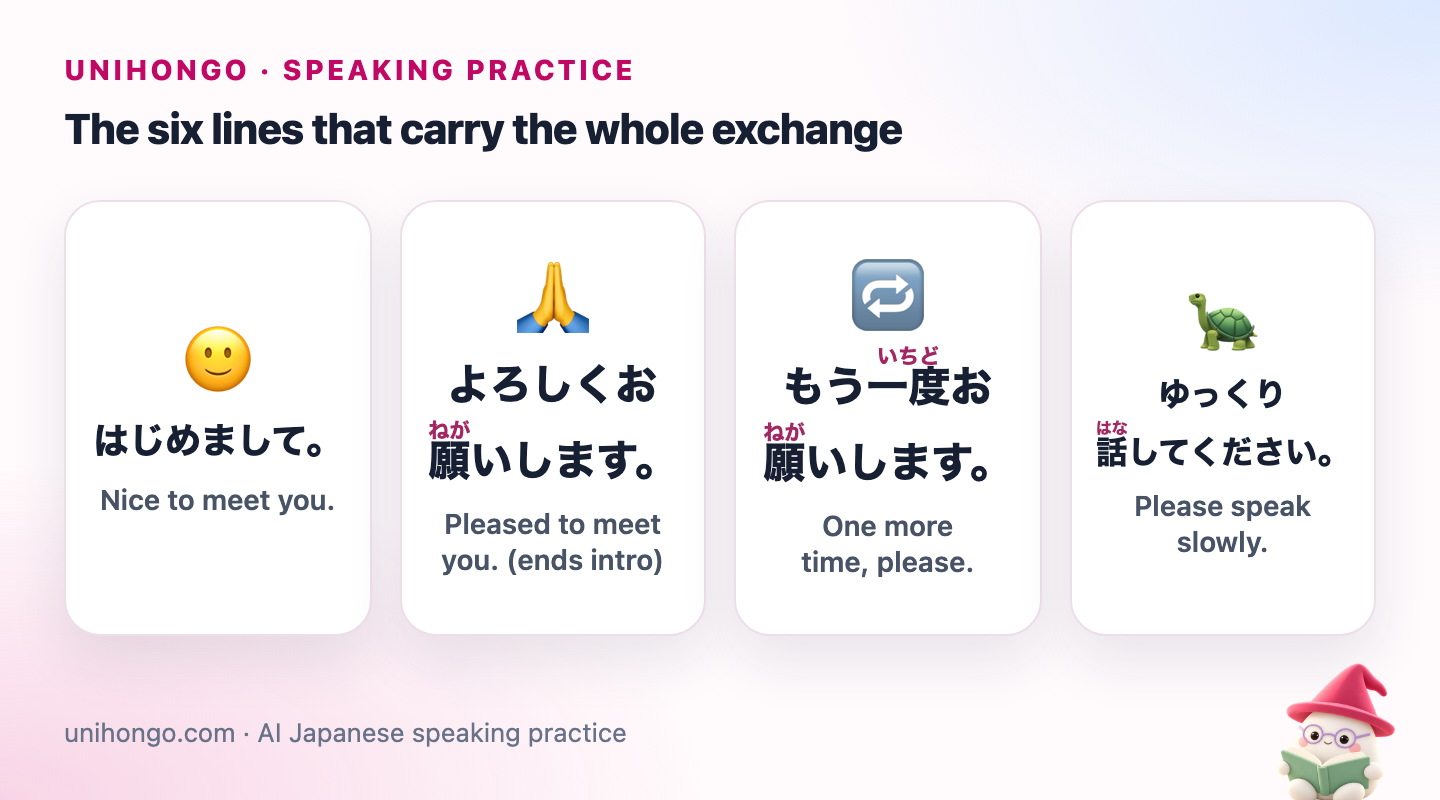
| Japanese | Romaji | Meaning |
|---|---|---|
| はじめまして。 | Hajimemashite. | Nice to meet you. |
| よろしくお願いします。 | Yoroshiku onegai shimasu. | Pleased to meet you. (ends intro) |
| もう一度お願いします。 | Mō ichido onegai shimasu. | One more time, please. |
| ゆっくり話してください。 | Yukkuri hanashite kudasai. | Please speak slowly. |
| アンナです。アメリカから来ました。 | Anna desu. Amerika kara kimashita. | I'm Anna. I'm from the United States. |
| 日本語を勉強しています。 | Nihongo o benkyō shite imasu. | I'm studying Japanese. |
What you will hear back
The questions in a first conversation are predictable, which is good news: you can prepare answers in advance. Most Japanese speakers ask the same three or four things of any learner, usually in polite form. If a question comes too fast, it is almost certainly one of these.
| Japanese | Romaji | Meaning |
|---|---|---|
| お名前は? | Onamae wa? | Your name? (polite, shortened) |
| どちらからですか。 | Dochira kara desu ka. | Where are you from? |
| 日本語、勉強してるんですか。 | Nihongo, benkyō shiteru n desu ka. | Oh, you're studying Japanese? |
| どのくらい勉強していますか。 | Dono kurai benkyō shite imasu ka. | How long have you been studying? |
| 日本語、上手ですね。 | Nihongo, jōzu desu ne. | Your Japanese is good. |
| いえいえ、まだまだです。 | Ieie, madamada desu. | You: Oh no, I've a long way to go. (modest reply) |
You will hear nihongo jōzu desu ne after your very first sentence. It is a kindness and a conversation opener, not an assessment, and the expected reply is modest: ieie, madamada desu. Answering with a confident thank-you is not wrong, but the modest reply sounds more natural and often makes the other person smile.
For how long you have studied, a number plus a time unit plus desu is enough: sankagetsu desu (three months), ichinen desu (one year). Nobody expects a full sentence.
Aizuchi: the sounds that keep it going
Japanese conversation runs on aizuchi, the short sounds a listener makes to show they are following. English speakers nod silently; Japanese speakers say something every few seconds. If you stay silent while listening, a Japanese speaker may think you are lost or uninterested, and will stop. If you use a few aizuchi, the conversation keeps going even when you only understand half of it.
| Japanese | Romaji | Meaning |
|---|---|---|
| はい。 | Hai. | Yes / I'm listening. (not always agreement) |
| そうですか。 | Sō desu ka. | I see. (falling tone) |
| そうなんですね。 | Sō nan desu ne. | Oh, is that so. (warm, polite) |
| なるほど。 | Naruhodo. | That makes sense. |
| へえ! | Hē! | Oh really! (surprise, casual-ish) |
| 本当ですか。 | Hontō desu ka. | Really? |
| いいですね。 | Ii desu ne. | That's nice. |
Two cautions. First, hai while listening means I hear you, not I agree, so do not be surprised when someone says hai through a story and then disagrees. Second, overusing a single aizuchi sounds mechanical; rotate two or three. Sō desu ka with a falling tone and a nod is the safest, and sō nan desu ne adds warmth.
When you don't understand
At some point you will lose the thread. This is the moment learners fear most, and it is also the moment that goes best when you have a plan. The plan is: say a repair line immediately, before the silence grows, and point at the exact problem if you can. Japanese speakers are used to rephrasing for each other and will do it gladly.
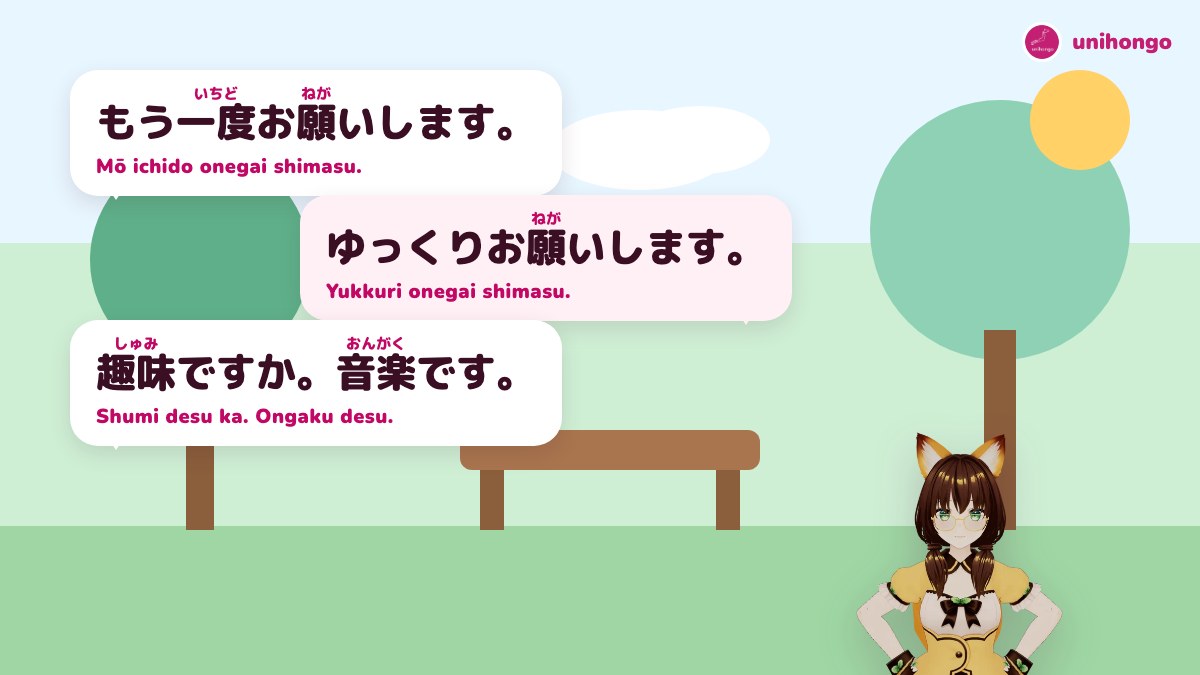
| Japanese | Romaji | Meaning |
|---|---|---|
| すみません、もう一度お願いします。 | Sumimasen, mō ichido onegai shimasu. | Sorry, one more time please. |
| ちょっと分かりませんでした。 | Chotto wakarimasen deshita. | I didn't quite catch that. |
| 「しゅみ」って何ですか。 | 'Shumi' tte nan desu ka. | What does 'shumi' mean? |
| 英語で何と言いますか。 | Eigo de nan to iimasu ka. | How do you say it in English? |
| ゆっくりお願いします。 | Yukkuri onegai shimasu. | Slowly, please. |
| 趣味ですか。音楽です。 | Shumi desu ka. Ongaku desu. | Hobbies? Music. |
The tte in shumi tte nan desu ka is a casual quoting particle, and the whole line is the standard way to ask what a word means. Repeating the word you heard, even badly, helps enormously: the other person knows exactly which part to explain. Also notice the last row: repeating the question word with desu ka and then answering in one word is a perfectly good move when a full sentence will not come.
How to end it well
Endings matter more than you think, because the last thing you say is what the other person remembers. A conversation in Japanese is normally closed in two moves: a signal that time is up, then a thank-you and a goodbye. Pick the goodbye by setting: ja, mata with a peer, shitsurei shimasu when the other person is older, a teacher or a shop owner.
| Japanese | Romaji | Meaning |
|---|---|---|
| そろそろ行きます。 | Sorosoro ikimasu. | I should get going. |
| 話せて楽しかったです。 | Hanasete tanoshikatta desu. | It was fun talking with you. |
| また話しましょう。 | Mata hanashimashō. | Let's talk again. |
| じゃあ、また。 | Jā, mata. | See you. (casual-polite) |
| 失礼します。 | Shitsurei shimasu. | Excuse me, goodbye. (formal) |
| ありがとうございました。 | Arigatō gozaimashita. | Thank you. (for what just happened) |
Arigatō gozaimashita, in the past form, thanks someone for something that is now finished, so it is the right form at the end of a conversation, a lesson or a meal. The present form arigatō gozaimasu is for something being given right now.
A model first conversation, line by line
Here is the whole thing in one piece, at a language exchange table. Read the English first, then cover it and read only the Japanese. Everything is polite form.
| Japanese | Romaji | Meaning |
|---|---|---|
| こんにちは。はじめまして。 | Konnichiwa. Hajimemashite. | You: Hello. Nice to meet you. |
| はじめまして。ゆきです。 | Hajimemashite. Yuki desu. | Yuki: Nice to meet you. I'm Yuki. |
| アンナです。よろしくお願いします。 | Anna desu. Yoroshiku onegai shimasu. | You: I'm Anna. Pleased to meet you. |
| アンナさんはどちらからですか。 | Anna-san wa dochira kara desu ka. | Yuki: Where are you from, Anna? |
| カナダから来ました。 | Kanada kara kimashita. | You: I'm from Canada. |
| へえ、カナダですか。日本語、上手ですね。 | Hē, Kanada desu ka. Nihongo, jōzu desu ne. | Yuki: Oh, Canada. Your Japanese is good. |
| いえいえ、まだまだです。半年勉強しています。 | Ieie, madamada desu. Hantoshi benkyō shite imasu. | You: Not at all. I've studied for half a year. |
| どうして日本語を勉強しているんですか。 | Dōshite nihongo o benkyō shite iru n desu ka. | Yuki: Why are you studying Japanese? |
| すみません、もう一度お願いします。 | Sumimasen, mō ichido onegai shimasu. | You: Sorry, one more time please. |
| どうして、日本語、勉強? | Dōshite, nihongo, benkyō? | Yuki: Why... Japanese... study? (slowed down) |
| ああ。アニメが好きです。それから、旅行。 | Ā. Anime ga suki desu. Sorekara, ryokō. | You: Ah. I like anime. And travel. |
| いいですね。私も旅行が好きです。 | Ii desu ne. Watashi mo ryokō ga suki desu. | Yuki: Nice. I like travel too. |
| そうなんですね。あ、そろそろ行きます。話せて楽しかったです。 | Sō nan desu ne. A, sorosoro ikimasu. Hanasete tanoshikatta desu. | You: Oh, I see. Ah, I should go. It was fun talking. |
| こちらこそ。また話しましょう。 | Kochira koso. Mata hanashimashō. | Yuki: Likewise. Let's talk again. |
Notice what Anna did not do: she never produced a long sentence, she asked for a repeat once and got a simplified question back, and she answered with fragments. That is what a successful first conversation looks like. Kochira koso (likewise, the pleasure is mine) is the natural reply to a thank-you line and worth stealing for your own use.
How it feels, honestly
Expect your heart rate to go up, your prepared lines to come out in the wrong order, and at least one moment of complete blankness where a word you know perfectly well refuses to appear. Expect the other person to speak faster than any audio you have practised with, and to use a word you have never heard in the second sentence. All of this is normal and none of it is a sign that you are not ready.
Also expect the good part: the small jolt when you understand a question without translating, and the moment the other person laughs at something you said on purpose. Most learners walk away from their first conversation slightly embarrassed and strangely elated, and want to do it again within a day. That wish is the real result. Write down the one word or question you missed, look it up that evening, and it will not stop you next time.
- Saying hajimemashite to someone you have met before. It is only for a genuine first meeting; after that, konnichiwa is enough.
- Translating in your head while the other person is still talking, so you miss the second half. Aizuchi first, understanding second.
- Answering a yes-no question with a full sentence you cannot finish. Hai or iie plus a nod is a complete answer.
- Going silent when you lose the thread. The silence is what feels awkward, not the repair line.
- Using casual forms you learned from anime with a stranger. Polite form is never wrong in a first conversation.
Rehearse the first one before it happens
The easiest way to make the real conversation feel like the second one is to have the first one somewhere safe. Start by typing to Mocchi, Unihongo's study assistant: ask it to play a Japanese student at a language exchange, keep every question short, and tell you afterwards which of your replies were unnatural. Because Mocchi keeps track of your level and the points you keep missing, you can come back the next day and ask it to quiz you on exactly those lines with /quiz.
Then take the same script into speech. In AI Sensei's 3D classroom, choose Haru-sensei, set the greetings topic, and ask the Sensei to play someone you have just met and to speak slowly. Use the repair line on purpose at least once so that it feels normal before you need it. The session report afterwards lists what you said well and the corrections, which is more than most real first conversations give you. A free account at unihongo.com/login is all you need to try both tonight.