
Choosing an episode you can actually hear
The first episode without subtitles should be chosen for listenability, not for love. Three things make an episode easy: an everyday setting, speech that is not shouted over music, and a plot you already know. The last one matters most. When you have seen the episode with subtitles, your brain already holds the story, so every half-caught line has somewhere to land. You are not guessing what is happening; you are matching sounds to events you remember.
This rules out a lot. Battle episodes are full of technique names and screaming. Fantasy series invent vocabulary. Comedies that rely on fast wordplay are hard even for intermediate learners. A quiet episode about a club meeting, a part-time job, a cooking scene or a family dinner is the sweet spot, and short episodes are better than long ones.
| Japanese | Romaji | Meaning |
|---|---|---|
| 字幕なしで見てみる。 | Jimaku nashi de mite miru. | Try watching without subtitles. |
| Pick this | Avoid this for now | Why |
|---|---|---|
| An episode you have seen | A new episode | Known plot gives you context for free |
| Slice of life, school, daily life | Battle, fantasy, historical | Everyday words versus invented or rare ones |
| Calm scenes with pauses | Fast comedy and shouting | You need gaps to process what you heard |
| Around twenty minutes | A film | Three passes of a film is a whole weekend |
Twenty words to learn before you press play
Slice-of-life dialogue leans on a small set of household words and reactions. If you know these twenty as sounds, you will hear them clearly in the stream, and each one you catch gives you an anchor for the lines around it. Learn the casual forms, because that is how characters say them to friends and family.
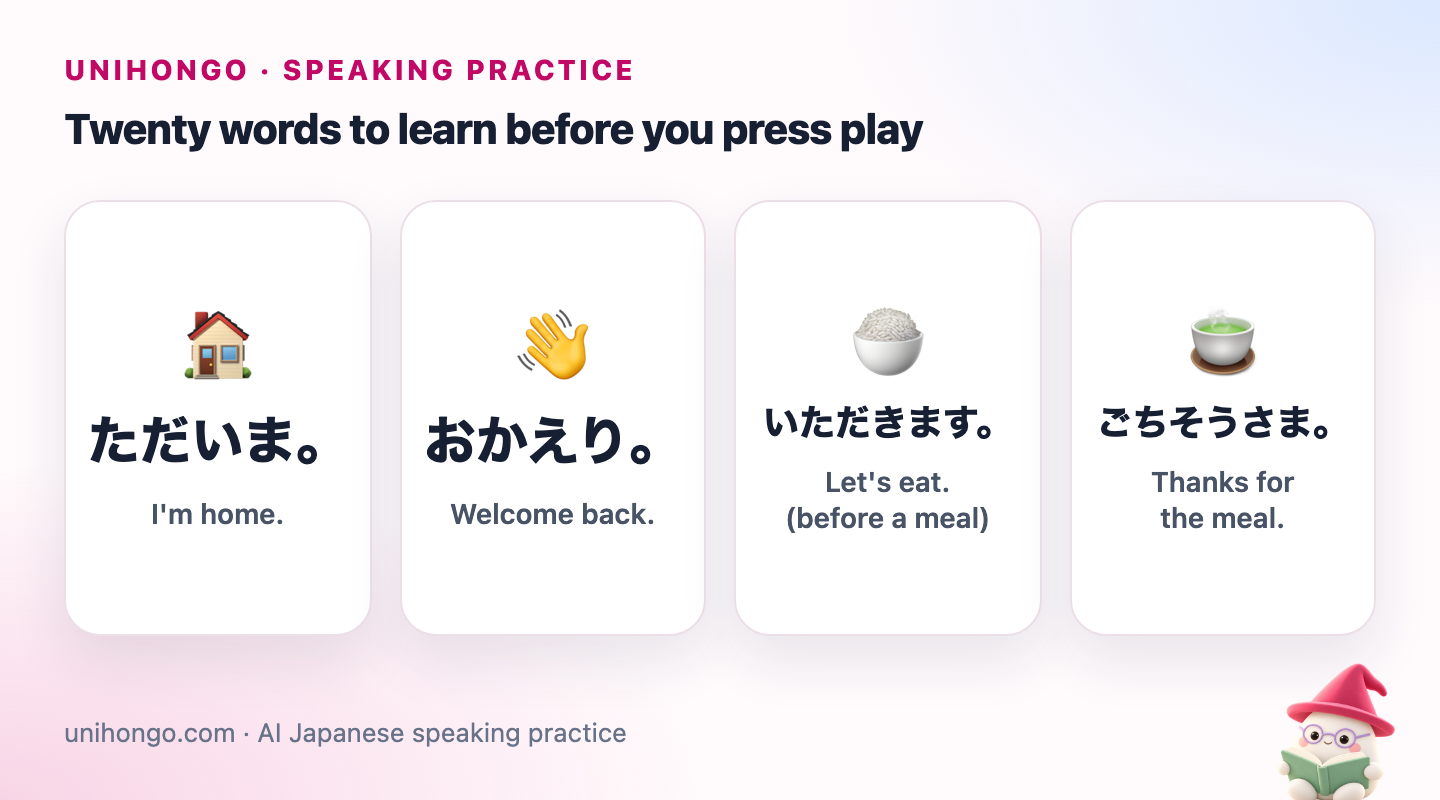
| Japanese | Romaji | Meaning |
|---|---|---|
| ただいま。 | Tadaima. | I'm home. |
| おかえり。 | Okaeri. | Welcome back. |
| いただきます。 | Itadakimasu. | Let's eat. (before a meal) |
| ごちそうさま。 | Gochisōsama. | Thanks for the meal. |
| 行ってきます。 | Ittekimasu. | I'm off. (leaving home) |
| 行ってらっしゃい。 | Itterasshai. | See you later. (to someone leaving) |
| おはよう。 | Ohayō. | Morning. (casual) |
| おやすみ。 | Oyasumi. | Good night. (casual) |
| 大丈夫? | Daijōbu? | You okay? |
| ちょっと待って。 | Chotto matte. | Wait a sec. |
| 何それ。 | Nani sore. | What's that? / What is that supposed to be? |
| まじで? | Maji de? | Seriously? (slang) |
| うそ! | Uso! | No way! (literally: a lie) |
| やばい。 | Yabai. | Uh-oh / amazing. (slang, context decides) |
| すごい。 | Sugoi. | Wow / great. |
| 分かった。 | Wakatta. | Got it. |
| 分かんない。 | Wakannai. | No idea. (contracted wakaranai) |
| 行こう。 | Ikō. | Let's go. |
| 帰ろう。 | Kaerō. | Let's go home. |
| お腹すいた。 | Onaka suita. | I'm hungry. |
The three-pass method
One pass is a test. Three passes are a lesson. Each pass has a single job, and you are not allowed to do the other jobs during it. The whole routine takes about an hour for a twenty-minute episode, and you can split it across two evenings.
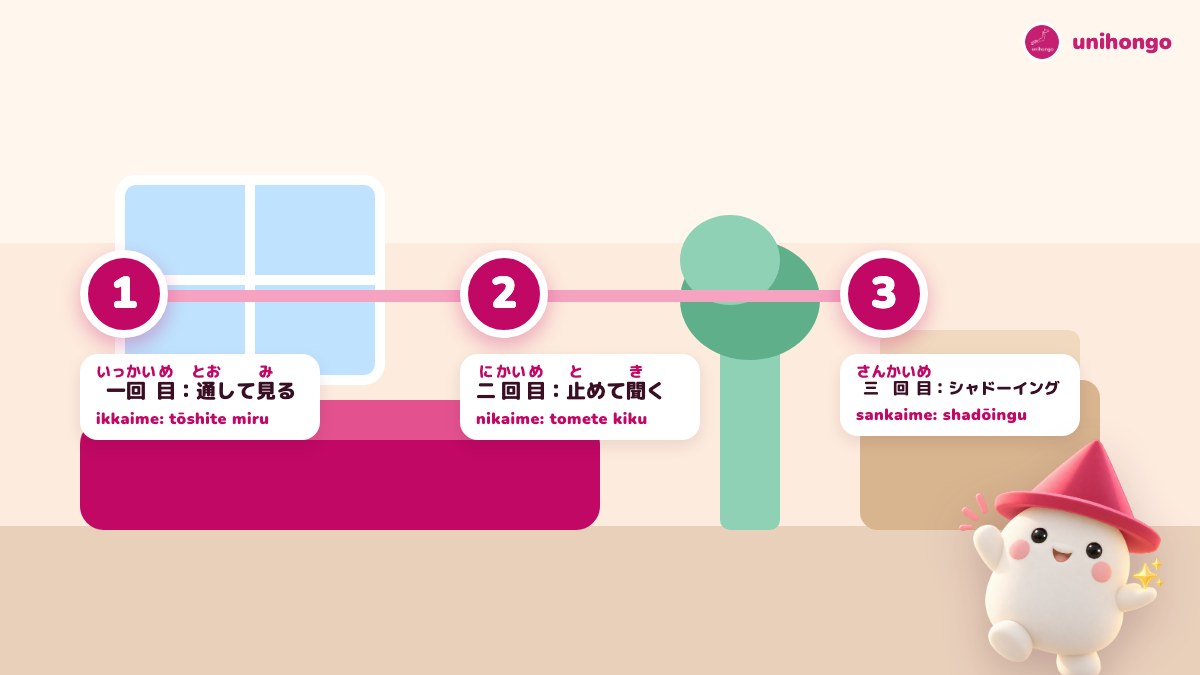
| Pass | What you do | What you are allowed to feel |
|---|---|---|
| 1. Straight through | No pausing, no notes. Follow the story through pictures, tone and the words you catch | Lost for stretches; that is expected |
| 2. Pause and catch | Pause after any line you half-heard. Say it back. Write the words you recognised | Slow and tiring; stop after ten minutes if needed |
| 3. Shadow one scene | Pick thirty seconds. Play, pause, repeat each line aloud, three times through | Clumsy; your mouth lags behind your ears |
| Optional 4. Check | Japanese subtitles on. Compare what you heard with what was said | Relief, and a few surprises |
The second pass is where learning happens, and the rule is to say the line back before you look anything up. The order matters: hear, repeat, then confirm. Learners who look up every line on the first pass usually never finish the episode.
Why anime Japanese sounds different from your textbook
The words are not the real barrier; the shapes are. Casual spoken Japanese shortens verbs and drops particles, and every anime character except the stiff one speaks this way. Once you can recognise the common contractions, lines that sounded like noise turn out to be built from words you already know.
| Japanese | Romaji | Meaning |
|---|---|---|
| 食べてる。 | Tabeteru. | I'm eating. (te iru → teru) |
| 食べちゃった。 | Tabechatta. | I ate it all / oops, I ate it. (te shimatta → chatta) |
| 行かなきゃ。 | Ikanakya. | Gotta go. (nakereba → nakya) |
| いいじゃん。 | Ii jan. | That's fine, isn't it? (ja nai → jan) |
| 何してんの? | Nani shiten no? | What are you doing? (shite iru no → shiten no) |
| 行くんだ。 | Iku n da. | I'm going, you see. (no da → n da) |
| これ、食べる? | Kore, taberu? | Want this? (particle o dropped) |
| 学校、行く? | Gakkō, iku? | Going to school? (particle ni dropped) |
Two more things to listen for. Sentence-final particles carry attitude: ne seeks agreement, yo asserts, na is a casual ne used more by men, and no softens a question. And some characters stretch or clip vowels for personality, so a slow, drawling line and a snappy one can be the same sentence. If a character speaks in a rough, deliberately rude style, do not copy their forms; you are listening to them, not borrowing from them.
What following forty percent feels like
Here is the honest version. In the first pass you will catch greetings, names and reactions, and lose the sentences in between. Minutes will pass in which you understand nothing but still know what is happening, because the pictures are doing the storytelling. Around the middle you will suddenly understand a whole exchange and feel a jolt. Then a character will explain something and you will lose it again.
That is forty percent, and it is enough to enjoy the episode. The frustration peaks around minute six, when the novelty has worn off and the fatigue has started. Push through to the end of the first pass without pausing; the second pass is where you convert frustration into words. By the third pass of the same episode, most learners understand noticeably more, which is the proof that this works: the same twenty minutes, heard three times, teaches more than three different episodes heard once.
- Do not stop to look up words during the first pass; you will never reach the end.
- Do not switch to a harder episode because the first one felt easy with subtitles. Without them it will not be.
- Do not measure success in words understood. Measure it in whether you could follow the scene.
- Do not copy rough or anime-only speech into real conversations; keep it for recognition.
After the episode: turn what you heard into something you can use
An episode leaves you with a handful of lines you heard clearly and a longer list you half-heard. The clear ones are worth keeping; the half-heard ones are worth checking. Pick five lines, write down what you think they were, and compare with Japanese subtitles or a transcript if the series has one. Then sort them: which lines could you say to a friend, which only to family, and which belong to that one character and nobody else.
The last sort is the important one. A line like ittekimasu is used in every Japanese home. A line delivered in a swaggering, rough register might be a joke between best friends and an insult anywhere else. Learning the difference early is what keeps anime from giving you bad habits, and it is a better use of your time than learning another hundred words.
| Japanese | Romaji | Meaning |
|---|---|---|
| この言い方、友達に使える? | Kono iikata, tomodachi ni tsukaeru? | Can I use this phrasing with a friend? |
| 丁寧に言うとどうなる? | Teinei ni iu to dō naru? | What is the polite version? |
| アニメだけの言い方? | Anime dake no iikata? | Is this an anime-only way of speaking? |
A way to check the lines you caught
The step most learners skip is checking, because it needs someone who can read the line and say whether it is normal Japanese. This is what Mocchi, Unihongo's study assistant, is good at. Paste a line you caught with /explain and it breaks the sentence into its parts, expands the contractions, and tells you the register, so you learn whether tabechatta is something you can say at work. Because it remembers which contractions you keep missing, a later /quiz can target exactly those shapes.
For the twenty words, Listen & Pick in Unihongo's games is a quick way to make them automatic: you hear a word and pick it before the next episode. Signing in at unihongo.com/login gives you the chat and the quick games on a free account, which is enough for the whole three-pass routine.
- Type /explain and paste one line per message, so each explanation stays short.
- Ask: is this casual, polite or rough, and who would say it?
- Ask Mocchi to add the five lines you caught to tonight's review.
- Play Listen & Pick for five minutes before the next episode.