
What a booking call looks like, step by step
A reservation call in Japan is a form filled in by voice. The staff member needs the same five facts every time, and they ask for them in nearly the same order at an izakaya, a ramen shop that takes bookings and a hair salon. Once you know the order, every question they ask is one you expected, and the call stops being a conversation and becomes a checklist.
| Japanese | Romaji | Meaning |
|---|---|---|
| 予約をお願いします。 | Yoyaku o onegai shimasu. | I'd like to make a reservation. |
| Step | What happens | Your line |
|---|---|---|
| They answer | The shop name and a thank-you for calling | Anō, yoyaku o shitai no desu ga |
| When | They ask the date and time | Ashita no shichiji ni |
| How many | They ask the number of people | Nimei desu |
| Name | They ask your name, sometimes the reading | Sumisu to mōshimasu, then syllable by syllable |
| Number | They ask a contact number | Digits in groups joined by no |
| Confirm | They read everything back | Hai, onegai shimasu |
| End | They thank you and wait for you to go | Yoroshiku onegai shimasu. Shitsurei shimasu |
Two things differ from a call in English. The staff read the whole booking back at the end, slowly, and expect a hai after it. And the caller ends the call: say shitsurei shimasu, wait a beat, and hang up. Shops may wait for you to hang up first, so a silence at the end is not a problem.
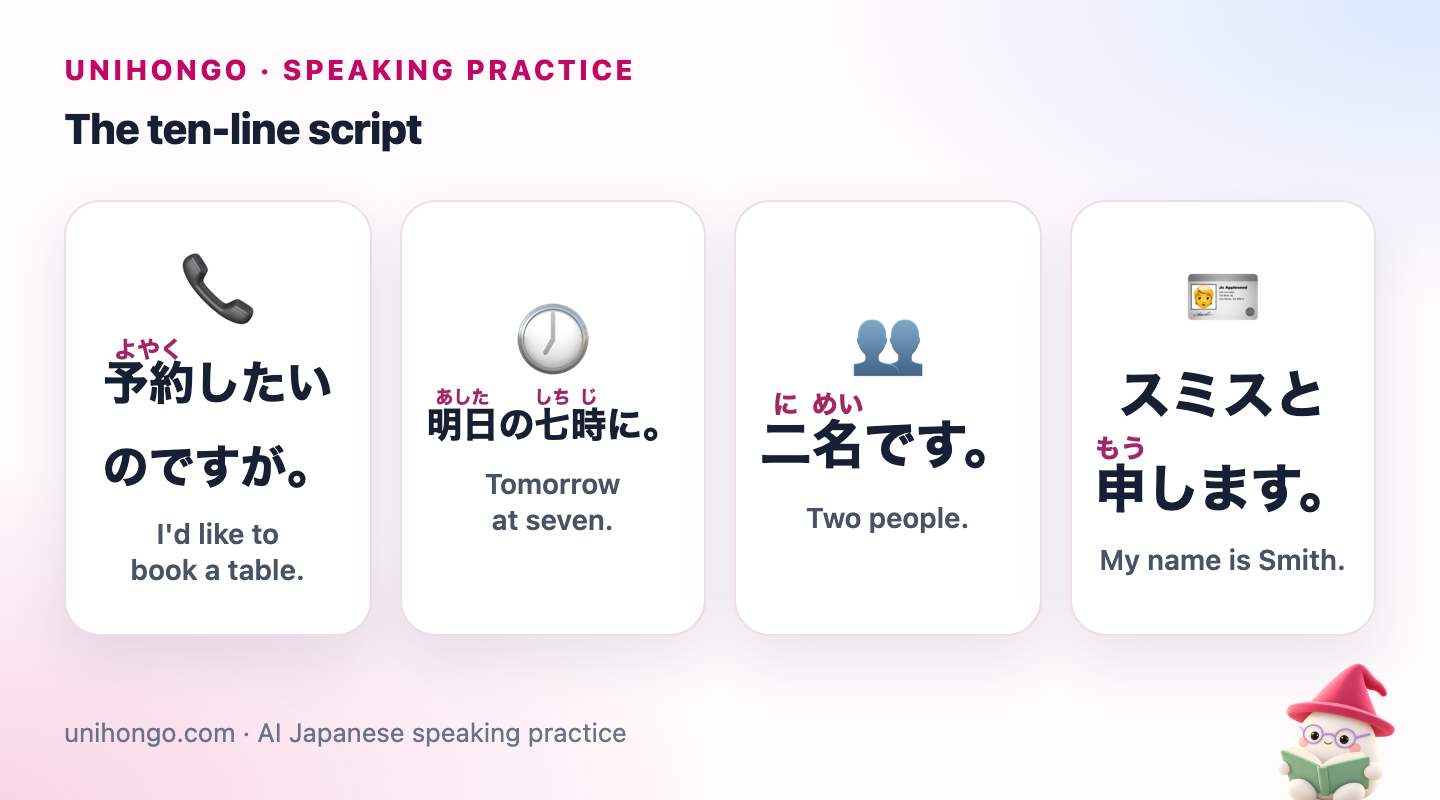
The ten-line script
These are your lines, in the order you will need them. Lines one to six make the booking; seven and eight are the repair lines; nine and ten close the call. All are polite form, because the person on the line is a stranger at work. Replace the date, time, number of people and name with your own, and keep the card in front of you while you dial.
| Japanese | Romaji | Meaning |
|---|---|---|
| 予約したいのですが。 | Yoyaku shitai no desu ga. | I'd like to book a table. |
| 明日の七時に。 | Ashita no shichiji ni. | Tomorrow at seven. |
| 二名です。 | Nimei desu. | Two people. |
| スミスと申します。 | Sumisu to mōshimasu. | My name is Smith. |
| 電話番号は、090の1234の5678です。 | Denwa bangō wa, zero kyū zero no ichi ni san yon no go roku nana hachi desu. | My number is 090-1234-5678. |
| はい、お願いします。 | Hai, onegai shimasu. | Yes, please. (after the read-back) |
| すみません、もう一度お願いします。 | Sumimasen, mō ichido onegai shimasu. | Sorry, one more time please. |
| ゆっくりお願いします。 | Yukkuri onegai shimasu. | Slowly, please. |
| よろしくお願いします。 | Yoroshiku onegai shimasu. | Thank you in advance. (closing) |
| 失礼します。 | Shitsurei shimasu. | Goodbye. (ending a call politely) |
Yoyaku shitai no desu ga trails off on ga, which is deliberate: it hands the turn to the staff, who then ask the questions. Learners who try to say the whole booking in one sentence, date, time, people and name together, make the call harder, not easier. Give one fact, wait for the next question.
What the shop will say back
Staff on the phone use the service register, which is more honorific than anything you will say yourself. You do not need to produce it, only to recognise which of the five questions you are being asked. Here are the lines in the order they tend to come, with the reply each one wants.
| Japanese | Romaji | Meaning |
|---|---|---|
| お電話ありがとうございます。さくらでございます。 | Odenwa arigatō gozaimasu. Sakura de gozaimasu. | Staff: Thank you for calling. This is Sakura. |
| ご予約ですね。ありがとうございます。 | Goyoyaku desu ne. Arigatō gozaimasu. | Staff: A reservation, I see. Thank you. |
| いつがよろしいですか。 | Itsu ga yoroshii desu ka. | Staff: When would you like? |
| 何名様ですか。 | Nanmei-sama desu ka. | Staff: How many people? |
| お名前をお願いします。 | Onamae o onegai shimasu. | Staff: Your name, please. |
| お電話番号をお願いします。 | Odenwa bangō o onegai shimasu. | Staff: Your phone number, please. |
| 少々お待ちください。 | Shōshō omachi kudasai. | Staff: One moment, please. |
| 明日七時、二名様、スミス様ですね。 | Ashita shichiji, nimei-sama, Sumisu-sama desu ne. | Staff: Tomorrow at seven, two, Mr Smith, correct? |
| お待ちしております。 | Omachi shite orimasu. | Staff: We look forward to seeing you. |
Shōshō omachi kudasai means they are checking the book; say hai and wait, even through twenty seconds of hold music. The read-back line near the end is the one that matters: listen only for your date, your time and your number, and say hai, onegai shimasu if all three are right. If one is wrong, say the correct one with the pattern in the next section.
Numbers, times and names on the phone
The details are where phone calls go wrong, because a mishearing costs you a table. Japanese speakers have their own habits for making numbers and names survive a bad line, and borrowing them makes you sound prepared. Seven is nana rather than shichi, because shichi sounds like ichi (one). Four is yon rather than shi. Zero is zero. A phone number is read digit by digit in its written groups, with no between the groups. Minutes past the hour use fun or pun, and half past is han.
| Japanese | Romaji | Meaning |
|---|---|---|
| 七時 | shichiji | seven o'clock (the hour keeps shichi) |
| 七時半 | shichiji han | half past seven |
| 午後六時 | gogo rokuji | six in the evening |
| なな | nana | seven, when reading digits |
| よん | yon | four, when reading digits |
| 二名 | nimei | two people (on the phone, to a shop) |
| 四名 | yonmei | four people |
| 明後日 | asatte | the day after tomorrow |
| 今週の金曜日 | konshū no kin'yōbi | this Friday |
| 十一月三日 | jūichigatsu mikka | 3 November |
| スミスです。ス、ミ、ス。 | Sumisu desu. Su, mi, su. | Smith. Su, mi, su. (spelling it out) |
| カタカナで、アンナです。 | Katakana de, Anna desu. | In katakana, it's Anna. |
A foreign name is spelled out syllable by syllable in katakana, not letter by letter in English; the staff are writing it in katakana anyway. If the shop asks for the reading of your name, that is what they want. Dates with the small irregular readings, tsuitachi for the 1st, futsuka for the 2nd, mikka for the 3rd and so on up to the 10th, are worth checking before you dial if your date is one of them.
Asking them to repeat, and checking you heard right
On the phone you cannot show confusion with your face, so you have to say it, and you have to say it fast, before the staff member moves on. The repair lines from a face-to-face conversation all work here, with one addition that is specific to the phone: odenwa ga tōi yō desu, literally the phone seems far, which politely blames the line. The other essential move is confirming back: repeat the detail you heard and add desu ne, and the staff member will say hai or correct you.
| Japanese | Romaji | Meaning |
|---|---|---|
| すみません、お電話が遠いようです。 | Sumimasen, odenwa ga tōi yō desu. | Sorry, the line seems bad. (I can't hear well) |
| もう一度お願いできますか。 | Mō ichido onegai dekimasu ka. | Could you say that once more? |
| 七時ですね。 | Shichiji desu ne. | Seven o'clock, right? (confirming) |
| すみません、聞き取れませんでした。 | Sumimasen, kikitoremasen deshita. | Sorry, I didn't catch that. |
| ゆっくりお願いできますか。 | Yukkuri onegai dekimasu ka. | Could you speak slowly? |
| 六時ではなく、七時です。 | Rokuji dewa naku, shichiji desu. | Not six, seven. (correcting a detail) |
| はい、合っています。 | Hai, atte imasu. | Yes, that's correct. |
Dekimasu ka at the end of a request is a shade softer than onegai shimasu alone and suits the phone, where you are asking a stranger for extra effort. Use the correction line only when the read-back is wrong; a quiet hai when it is right is the normal rhythm.
When the answer is no
Sometimes the time is full, the shop is closed that day, or they do not take bookings for small groups. Staff will not say no bluntly; they wrap it in mōshiwake gozaimasen (we are very sorry) and often offer an alternative in the same breath. The call then becomes a small negotiation, and three lines handle all of it: ask for another time, accept it, or thank them and withdraw.
| Japanese | Romaji | Meaning |
|---|---|---|
| 申し訳ございません、その時間は満席です。 | Mōshiwake gozaimasen, sono jikan wa manseki desu. | Staff: We're very sorry, that time is full. |
| 六時でしたら空いております。 | Rokuji deshitara aite orimasu. | Staff: Six o'clock is available. |
| では、六時でお願いします。 | Dewa, rokuji de onegai shimasu. | Then six o'clock, please. |
| 他の時間はありますか。 | Hoka no jikan wa arimasu ka. | Is there another time? |
| 分かりました。また電話します。 | Wakarimashita. Mata denwa shimasu. | I understand. I'll call again. |
| ありがとうございました。失礼します。 | Arigatō gozaimashita. Shitsurei shimasu. | Thank you. Goodbye. |
Manseki (full) and aite orimasu (we have space, humble) are the two words to listen for. If you hear manseki, wait: an alternative usually follows. If you cannot take the alternative, withdraw with wakarimashita and a thank-you; there is no need to explain why.
A model first call
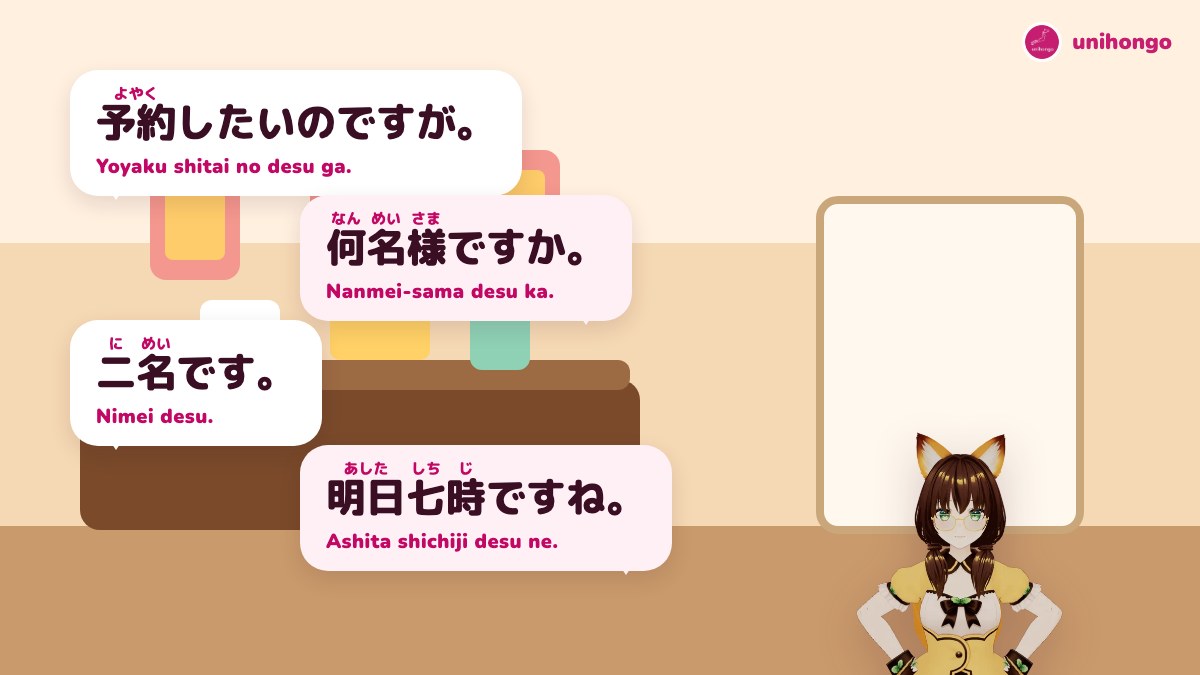
The whole call, as it might go at a small izakaya. Your lines come from the script above; the staff lines are the ones you have just read. Say it aloud with the phone against your ear.
| Japanese | Romaji | Meaning |
|---|---|---|
| お電話ありがとうございます。居酒屋さくらでございます。 | Odenwa arigatō gozaimasu. Izakaya Sakura de gozaimasu. | Staff: Thank you for calling, Izakaya Sakura. |
| あのう、予約したいのですが。 | Anō, yoyaku shitai no desu ga. | You: Um, I'd like to make a reservation. |
| ありがとうございます。いつがよろしいですか。 | Arigatō gozaimasu. Itsu ga yoroshii desu ka. | Staff: Thank you. When would you like? |
| 明日の七時にお願いします。 | Ashita no shichiji ni onegai shimasu. | You: Tomorrow at seven, please. |
| 明日の七時ですね。何名様ですか。 | Ashita no shichiji desu ne. Nanmei-sama desu ka. | Staff: Tomorrow at seven. How many? |
| 二名です。 | Nimei desu. | You: Two. |
| お名前をお願いします。 | Onamae o onegai shimasu. | Staff: Your name, please. |
| スミスと申します。ス、ミ、ス、です。 | Sumisu to mōshimasu. Su, mi, su, desu. | You: Smith. Su, mi, su. |
| スミス様ですね。お電話番号をお願いします。 | Sumisu-sama desu ne. Odenwa bangō o onegai shimasu. | Staff: Mr Smith. And a phone number? |
| 090の1234の5678です。 | Zero kyū zero no ichi ni san yon no go roku nana hachi desu. | You: 090-1234-5678. |
| ありがとうございます。明日七時、二名様、スミス様でお取りしました。 | Arigatō gozaimasu. Ashita shichiji, nimei-sama, Sumisu-sama de otori shimashita. | Staff: Booked: tomorrow at seven, two, Mr Smith. |
| はい、よろしくお願いします。 | Hai, yoroshiku onegai shimasu. | You: Yes, thank you. |
| お待ちしております。 | Omachi shite orimasu. | Staff: We look forward to seeing you. |
| 失礼します。 | Shitsurei shimasu. | You: Goodbye. |
Fourteen lines, seven of them yours, none longer than six words. Otori shimashita is the humble form of took, meaning the booking is made. If you want to ask something in the same call, a last order time or whether cards are accepted, slip it in before the goodbye with a sore kara (and also); but for a first call, booking only is a fine ambition.
How the first call honestly feels
Dialling is the hardest part; many learners hold the phone for a full minute before pressing call. Then the shop answers in a rush of honorifics that you half expected and still cannot parse, and the only thing that saves you is that your first line does not depend on theirs. Once you have said anō, yoyaku shitai no desu ga, the staff member takes over, and the call becomes the checklist you prepared. The read-back at the end feels like a test you suddenly know the answers to.
The second call, a week later, is almost boring, which is the point. Phone calls reward exact repetition more than any other speaking situation, because the other side is reading from the same script every time. Three bookings in, you will be adding questions of your own.
- Giving every detail in one breath. One fact per turn; let them ask.
- Saying shichi and shi for seven and four. On the phone, nana and yon.
- Spelling your name in English letters. Syllables in katakana are what the staff write down.
- Staying silent through the read-back. It is waiting for your hai.
- Hanging up right after yoroshiku onegai shimasu. Add shitsurei shimasu, then a beat.
- Calling at the busiest hour. Mid-afternoon calls get a calmer, slower staff member.
Make the call to a Sensei before you make it to a shop
The mission Reserve a Restaurant by Phone in AI Sensei is this call without the dial tone. Choose Yamada-sensei, ask Yamada-sensei to play the restaurant, and Yamada-sensei will take the booking at a normal speed, read it back and, if you ask, make the first time slot full so that you practise accepting another. The report afterwards shows which numbers and which repair lines came out cleanly. Do it with the script in front of you the first time and without it the second.
Before the voice version, Mocchi, Unihongo's study assistant, can check your card: paste your ten lines with your own date, name and number and use /correct, and ask it to write your name in katakana syllables the way a shop will hear them. It keeps track of what you asked, so the next booking's card takes a minute. Everything here runs on a free account; sign in at unihongo.com/login and the mission is one click from the home page.