
Choosing a title you can actually read
The single most important decision is furigana. A manga with furigana on every kanji, which publishers call sōrubi, lets you read every word by sound and look it up. Without furigana you are stuck at every kanji you do not know, which for a beginner is most of them. Manga serialised in magazines for younger readers generally has full furigana; manga for adult readers often has none or only partial furigana. Policies differ by publisher and even by series, so look at a sample page, not the genre label.
After furigana, choose by setting. A school or daily-life story uses the words you are learning anyway. A story you already know from the anime is the easiest of all, because you know who is talking and roughly what they are saying before you read the bubble. Chapter one of many series is available as a free sample in official apps and on publisher sites, so you can try before buying.
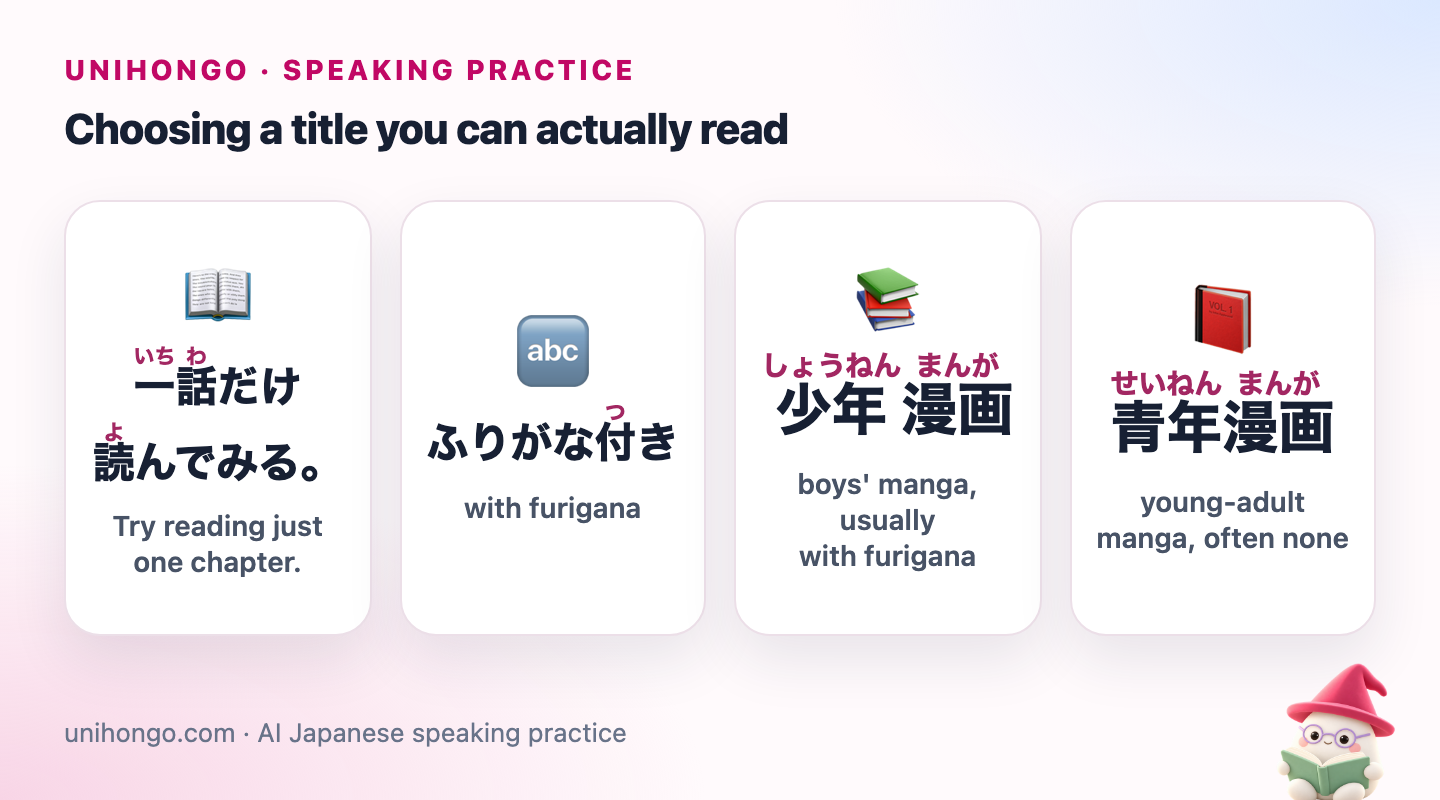
| Japanese | Romaji | Meaning |
|---|---|---|
| 一話だけ読んでみる。 | Ichiwa dake yonde miru. | Try reading just one chapter. |
| ふりがな付き | furigana tsuki | with furigana |
| 少年漫画 | shōnen manga | boys' manga, usually with furigana |
| 青年漫画 | seinen manga | young-adult manga, often none |
| 総ルビ | sōrubi | furigana on every kanji |
| 試し読み | tameshiyomi | free sample pages |
The words of a manga page
Before you read, learn the names of the things you are looking at. They come up in every discussion about manga, in reading apps and in the questions you will ask about a page. Reading order on a Japanese page runs right to left and top to bottom, panel by panel and bubble by bubble; if a page confuses you, follow the characters' eyes and the tails of the bubbles.
| Japanese | Romaji | Meaning |
|---|---|---|
| コマ | koma | panel |
| 吹き出し | fukidashi | speech bubble |
| 擬音語 | giongo | sound-effect word |
| 見開き | mihiraki | two-page spread |
| 第一話 | daiichiwa | chapter one |
| 単行本 | tankōbon | collected volume |
| 右から左へ読む。 | Migi kara hidari e yomu. | Read from right to left. |
Thought bubbles with a cloudy outline are the character's inner voice and are often more casual than their speech. Narration boxes, usually square, use the written register with da and de aru rather than desu, so do not copy them as spoken Japanese.
Sound effects you will meet on page one
The letters outside the bubbles are not decoration. Manga sound effects describe sounds, movements and states, and a handful of them appear in nearly every series. Learn these as vocabulary with a feeling attached, not as noises to skip. Many also exist in spoken Japanese: a friend can say dokidoki shita about a job interview.
| Japanese | Romaji | Meaning |
|---|---|---|
| ドキドキ | dokidoki | heart pounding (nerves or excitement) |
| シーン | shīn | silence |
| ガーン | gān | shock, dismay |
| ニヤニヤ | niyaniya | grinning smugly |
| バタン | batan | a door slamming |
| ザワザワ | zawazawa | a crowd murmuring |
| キラキラ | kirakira | sparkling |
| ハッ | ha | a sharp intake of breath, realisation |
The casual shapes inside the bubbles
Manga characters talk the way friends talk, and casual Japanese shortens almost everything. The verb endings you learned as te imasu and te shimaimashita appear as teru and chatta, and whole sentences end in a particle and a question mark. You do not need to produce these forms yet; you need to recognise them so that you can find the dictionary word underneath.
| Japanese | Romaji | Meaning |
|---|---|---|
| 何してるの? | Nani shiteru no? | What are you doing? (shite iru → shiteru) |
| 忘れちゃった。 | Wasurechatta. | I forgot. (te shimatta → chatta) |
| もう帰らなきゃ。 | Mō kaeranakya. | I have to go home now. (nakereba → nakya) |
| いいじゃん。 | Ii jan. | It's fine, isn't it? (ja nai → jan) |
| そうなんだ。 | Sō nan da. | Oh, I see. (no da → n da) |
| 知らない。 | Shiranai. | No idea. (plain negative) |
| 行くってば! | Iku tte ba! | I said I'm going! (impatient) |
| マジかよ。 | Maji ka yo. | Seriously? (rough, mostly male speech) |
The last row is the kind of line to recognise and not reuse: ka yo is blunt, and in real life it belongs to close friends joking, if at all. A fair rule for the first chapter is that anything ending in yo, zo, ze or ka yo is being said by a character with attitude, and your own version should end in desu or ne until you know better.
The seven-day plan for one chapter
A twenty-page chapter at fifteen minutes a day. The plan front-loads the easy parts so that by the time you reach the hard bubbles you already know the story.
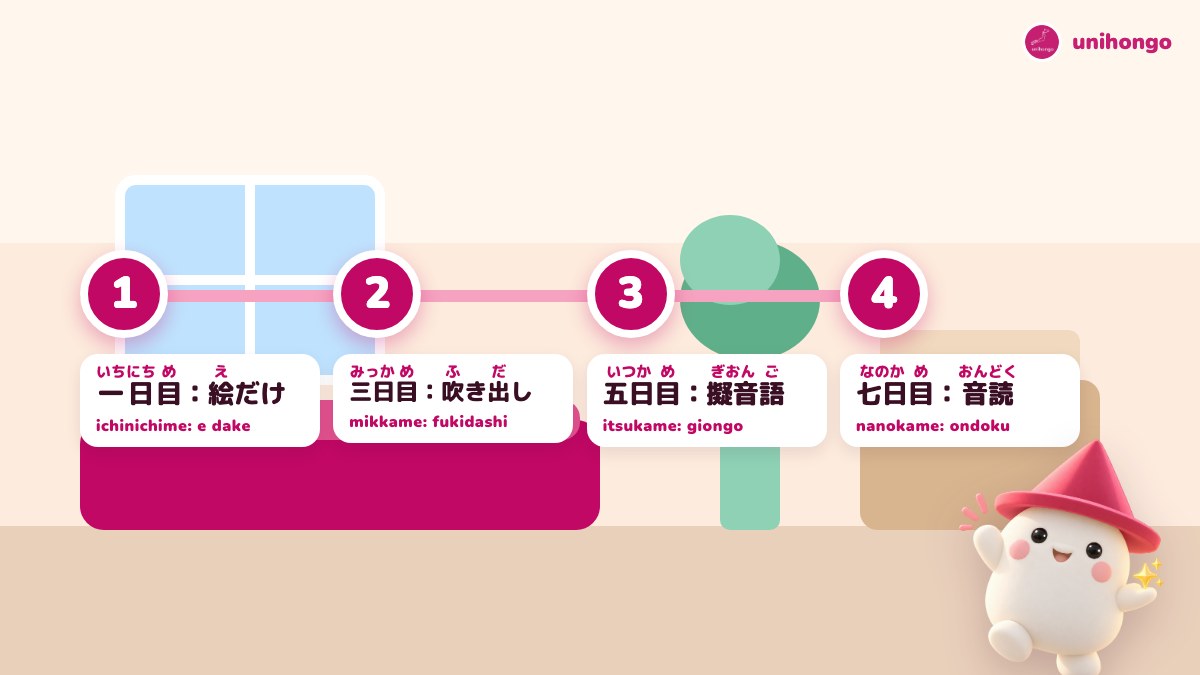
| Day | Pages | Job |
|---|---|---|
| 1 | All | Pictures only. Work out the story from faces, settings and panel order. Write a one-line guess in English |
| 2 | 1 to 5 | Read every bubble aloud by furigana. Look up at most three words a page. Mark lines you cannot parse |
| 3 | 6 to 10 | Same. Note every contracted form you meet and its dictionary shape |
| 4 | 11 to 15 | Same. Photograph three panels with lines you want to keep |
| 5 | 16 to 20 | Same. Now read the sound effects too |
| 6 | Marked lines | Go back only to the lines you marked. Ask for help with any still unclear |
| 7 | All | Read the whole chapter aloud in one sitting. Compare with your day-one guess |
The day-one guess is not a gimmick. Comparing it with day seven shows you exactly how much the words added to the pictures, which is usually more than beginners expect and the best motivation for chapter two.
What to do with a bubble you cannot parse
Some bubbles will not give in. The usual causes are a contraction you have not met, a word split across two bubbles, a dialect, or a joke that depends on a kanji pun. The rule is to spend no more than one minute, then mark the bubble and move on; it will either make sense from the next page or it will go on your day-six list. Do not let one bubble end the session.
| Japanese | Romaji | Meaning |
|---|---|---|
| 読み方 | yomikata | the reading of a word |
| 意味 | imi | meaning |
| 辞書で調べる | jisho de shiraberu | look it up in a dictionary |
| 飛ばす | tobasu | skip it |
| この台詞、どういう意味? | Kono serifu, dō iu imi? | What does this line mean? |
| 誰が言ってるの? | Dare ga itteru no? | Who is saying this? |
- Look up by the furigana reading, not by drawing the kanji; it is faster and you learn the sound.
- Check who is speaking first. Half of all confusing bubbles are clear once you know the speaker.
- A word that ends mid-bubble and continues in the next bubble is one word; read the pair together.
- If the furigana itself looks odd, it may be a deliberate reading the author chose for effect; take the kanji's normal meaning.
How the first chapter honestly feels
Day one feels like cheating, because you understand the story without reading. Day two is slow and a little demoralising: five pages in fifteen minutes, with every bubble a small puzzle. By day four the characters have repeated their favourite phrases often enough that you read them without thinking, and the pace nearly doubles. Day seven is the reward. Reading the chapter aloud in one go, with the story in your head and the shapes now familiar, is the first time most learners feel that Japanese text is theirs.
You will also discover that you cannot say most of what you read. That is normal; recognition runs ahead of production. The lines you photographed on day four are the bridge: those are the ones to turn into speech.
Someone to ask on day six
The day-six list of unclear bubbles is where a helper matters. Paste a line to Mocchi, Unihongo's study assistant, with /explain and it breaks the bubble into words, expands the contraction, names the register and says whether the line is something you could use yourself. Because it keeps track of the forms you keep asking about, by chapter three it will be quizzing you on chatta and nakya before you ask.
The three photographed panels become flashcards with /create-flashcards, and Flashcard Flip in the games section drills them with the picture attached, so the line stays tied to the scene. Everything here works on a free account at unihongo.com/login, which is all you need for chapter one.