
The whole visit, step by step
Every café and small restaurant visit in Japan has the same skeleton. The details change, counter or table, pay first or pay after, but the order of events does not, so you can prepare one line for each stage and know where you are at every moment.
| Stage | What happens | Your line |
|---|---|---|
| Door | Irasshaimase, then how many people | Hitori desu / futari desu |
| Seat | Shown to a table or told to sit anywhere | Hai, a nod, arigatō gozaimasu |
| Water and menu | Water and a menu arrive; sometimes a hot towel | Nothing needed; take your time |
| Call | You call the staff or press a button | Sumimasen |
| Order | Okimari desu ka, have you decided? | Point: kore o onegai shimasu |
| Confirm | The order is read back and confirmed | Hai. Ijō desu |
| Finish | Plates cleared; the bill slip is on the table | Gochisōsama deshita |
| Pay | At the register by the door in most small shops | Okaikei onegai shimasu |
Irasshaimase is shouted at everyone and expects no answer; a small nod is the whole etiquette. Learners who try to reply to it with a greeting are the ones who feel flustered before they have sat down.
The eight phrases that carry the order
Eight phrases cover the visit. All are polite form and work equally at a café counter, a ramen shop with table service and a family restaurant. Say them in order ten times and the order becomes a routine rather than a series of decisions.
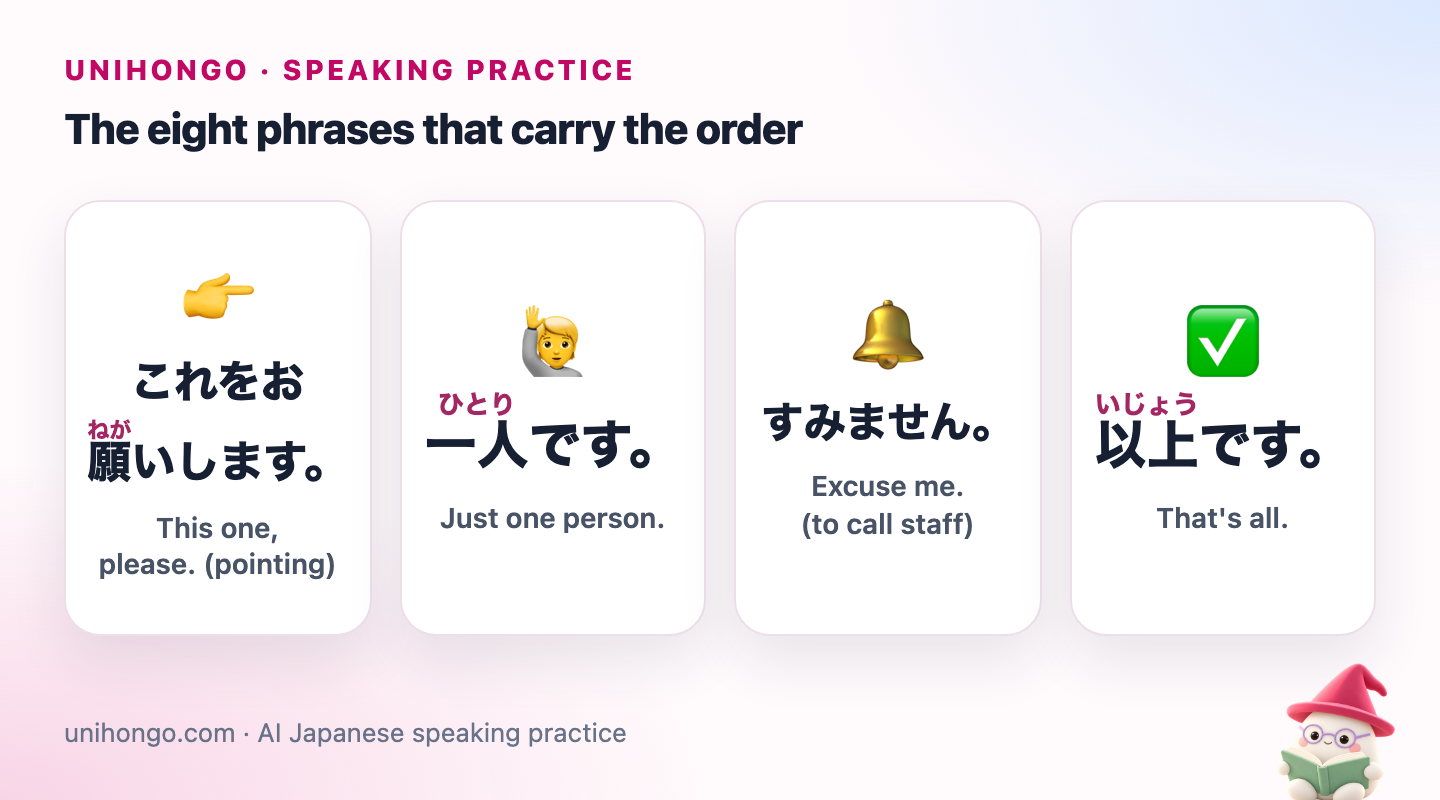
| Japanese | Romaji | Meaning |
|---|---|---|
| これをお願いします。 | Kore o onegai shimasu. | This one, please. (pointing) |
| 一人です。 | Hitori desu. | Just one person. |
| すみません。 | Sumimasen. | Excuse me. (to call staff) |
| 以上です。 | Ijō desu. | That's all. |
| おすすめは何ですか。 | Osusume wa nan desu ka. | What do you recommend? |
| お水をください。 | Omizu o kudasai. | Water, please. |
| ごちそうさまでした。 | Gochisōsama deshita. | Thank you for the meal. |
| お会計お願いします。 | Okaikei onegai shimasu. | The bill, please. |
Kore o onegai shimasu and kore o kudasai are both fine; onegai shimasu is a shade softer. For two of something, add futatsu before onegai shimasu: kore o futatsu onegai shimasu. If you order two different things, say the first, pause for the nod, then to (and) and the second.
What the staff will say back
Staff speech is polite set phrases, delivered fast and often while walking away. They sound nothing like your textbook because they use honorific vocabulary: okimari for decided, omeshiagari for eat, yoroshii for good. You do not need to produce any of it, only to recognise which question you are being asked. Here are the lines, in the order you will hear them, with the simplest correct reply.
| Japanese | Romaji | Meaning |
|---|---|---|
| いらっしゃいませ。 | Irasshaimase. | Staff: Welcome. (no reply needed) |
| 何名様ですか。 | Nanmei-sama desu ka. | Staff: How many people? |
| お好きな席へどうぞ。 | Osuki na seki e dōzo. | Staff: Sit wherever you like. |
| ご注文はお決まりですか。 | Gochūmon wa okimari desu ka. | Staff: Have you decided? |
| お決まりになりましたらお呼びください。 | Okimari ni narimashitara oyobi kudasai. | Staff: Call me when you've decided. |
| ご注文は以上でよろしいですか。 | Gochūmon wa ijō de yoroshii desu ka. | Staff: Is that everything? |
| お飲み物はいかがですか。 | Onomimono wa ikaga desu ka. | Staff: Would you like a drink? |
| 店内でお召し上がりですか。 | Tennai de omeshiagari desu ka. | Staff: Eating in? (cafés, fast food) |
| お支払いはどうなさいますか。 | Oshiharai wa dō nasaimasu ka. | Staff: How will you pay? |
Replies: a number for the first question, hai for the fourth and sixth, kekkō desu (I'm fine) or a drink for the seventh, hai for eating in or mochikaeri de (takeaway) for the eighth, and kādo de or genkin de for the last. If you hear a question that is none of these, it is usually about a size, a set or a loyalty card, and futsū de (regular) or daijōbu desu (I'm fine without) answers most of them.
Café counter or restaurant table
The two most common first orders happen in different shapes. At a chain café you order and pay at the counter, then wait for your name or number; at a small restaurant you sit, call, order, eat and pay at the register. Knowing which shape you are in tells you when to speak.
| Point | Café counter | Restaurant table |
|---|---|---|
| Where you order | Standing at the counter, menu on the wall | Seated, menu in hand or on the table |
| When you pay | Immediately, before the drink | After eating, usually at the register |
| Extra questions | Size, hot or iced, eat in or takeaway | Set or single, drink, rice size |
| Calling staff | Not needed | Sumimasen, or a call button on the table |
| Where the food comes | Pick-up counter when called | Brought to the table |
Ramen shops and some casual places add a third shape: a ticket machine by the door where you buy the meal first and hand the ticket over. If you see a machine with buttons and pictures as you enter, that is the order; no speaking needed beyond a thank-you.
When you freeze
The freeze usually happens at the confirmation question, when the staff read back your order with words you did not say and end with yoroshii desu ka. Or at a question you did not expect: a size, a set menu, a loyalty card. The fix is the same every time: do not try to understand the whole sentence. Say the repair line, or point, or answer the most likely question with hai. Staff deal with unclear customers all day and have their own repair moves, usually a slower repeat and a gesture at the menu.
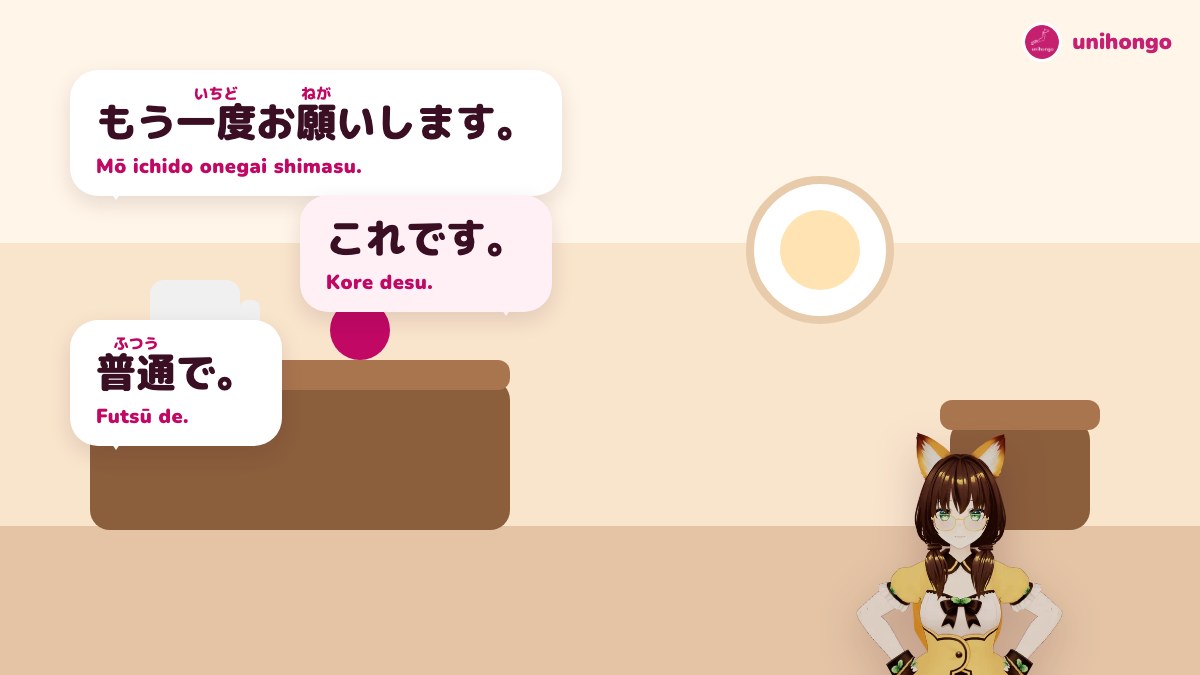
| Japanese | Romaji | Meaning |
|---|---|---|
| すみません、もう一度お願いします。 | Sumimasen, mō ichido onegai shimasu. | Sorry, one more time please. |
| ゆっくりお願いします。 | Yukkuri onegai shimasu. | Slowly, please. |
| これです。 | Kore desu. | This one. (pointing) |
| 普通で。 | Futsū de. | Regular, please. (size, spice) |
| 大丈夫です。 | Daijōbu desu. | I'm fine, no thank you. (declining) |
| 英語のメニューはありますか。 | Eigo no menyū wa arimasu ka. | Is there an English menu? |
| ちょっと待ってください。 | Chotto matte kudasai. | One moment, please. (still deciding) |
Daijōbu desu is the polite no for an upsell: a bag, a loyalty card, a bigger size. It confuses learners because it looks like yes; the tone and a small hand wave make it clearly a decline. If a question is a genuine choice you cannot follow, pointing at the first option is always acceptable.
Paying and leaving
Paying is the stage learners under-prepare, because it comes after the relief of having eaten. In many cafés and small restaurants you pick up the bill slip from the table, go to the register by the door and pay there; at others staff bring the bill to the table. Money or card goes in the small tray, not into the cashier's hand, and your change comes back on the same tray. Tipping does not exist, and leaving coins behind causes staff to run after you.
| Japanese | Romaji | Meaning |
|---|---|---|
| お会計お願いします。 | Okaikei onegai shimasu. | The bill, please. |
| レジでお願いします。 | Reji de onegai shimasu. | Staff: At the register, please. |
| カードで。 | Kādo de. | By card. |
| 現金で。 | Genkin de. | In cash. |
| 別々でお願いします。 | Betsubetsu de onegai shimasu. | Separately, please. (two people) |
| 一緒でお願いします。 | Issho de onegai shimasu. | Together, please. |
| ごちそうさまでした。 | Gochisōsama deshita. | Thank you for the meal. (leaving) |
A model first order at a small restaurant
| Japanese | Romaji | Meaning |
|---|---|---|
| いらっしゃいませ。何名様ですか。 | Irasshaimase. Nanmei-sama desu ka. | Staff: Welcome. How many? |
| 一人です。 | Hitori desu. | You: One. |
| こちらへどうぞ。 | Kochira e dōzo. | Staff: This way, please. |
| すみません。 | Sumimasen. | You: Excuse me. (after reading the menu) |
| はい、ご注文はお決まりですか。 | Hai, gochūmon wa okimari desu ka. | Staff: Yes, have you decided? |
| これをお願いします。 | Kore o onegai shimasu. | You: This one, please. (pointing) |
| しょうが焼き定食ですね。お飲み物はいかがですか。 | Shōgayaki teishoku desu ne. Onomimono wa ikaga desu ka. | Staff: The ginger pork set. Any drinks? |
| 大丈夫です。以上です。 | Daijōbu desu. Ijō desu. | You: I'm fine. That's all. |
| かしこまりました。 | Kashikomarimashita. | Staff: Certainly. |
| ごちそうさまでした。お会計お願いします。 | Gochisōsama deshita. Okaikei onegai shimasu. | You: Thank you for the meal. The bill, please. |
| ありがとうございました。 | Arigatō gozaimashita. | Staff: Thank you very much. |
Eleven lines, five of them yours, and you never had to produce a sentence longer than four words. The staff line in the middle, reading your order back, is the one you could not have predicted; the point and the hai carried you through it. Kashikomarimashita is the service-register certainly and needs no reply.
How it feels, and the mistakes to skip
Honestly: the first irasshaimase makes you jump, the menu is more Japanese than you hoped, and the read-back of your order sounds like a different language. Then the food arrives, exactly what you pointed at, and you realise the transaction worked. Most learners remember their first order more fondly than their first conversation, because the outcome is on the table in front of them.
- Replying to irasshaimase. A nod is enough; staff are not starting a conversation.
- Saying the dish name from the English menu with English stress. Point, and say kore.
- Answering a size question with hai. Hai confirms nothing; say futsū de or point at the size.
- Waiting at the table for the bill when the slip is already there. Look for the register near the door.
- Handing cash directly to the cashier. Use the tray; it is not rudeness, just the custom.
- Skipping gochisōsama deshita. It is the one line that turns a transaction into a pleasant exchange.
Run the order once before the real café
The mission called Order at a Café in AI Sensei is this exact visit: the Sensei plays the clerk, asks the size and hot-or-iced questions at normal speed, and reads your order back for confirmation. Choose Hana-sensei, ask Hana-sensei to speak slowly the first time and at full speed the second, and use the repair line on purpose once so that it is already in your mouth. The session report then shows which of your eight phrases came out cleanly and which need another run.
Before that, a text rehearsal is useful: Mocchi, Unihongo's study assistant, can play the staff in the chat and explain any of the honorific set phrases you did not catch, and it remembers which ones tripped you so that the next rehearsal starts there. You can begin with a free account at unihongo.com/login this evening and order for real tomorrow.