
Before you start: what a first lesson is for
A first lesson is a diagnosis and a handshake. The teacher wants to learn three things: what you can do now, what you want to be able to do, and how much time you have. You want to learn one thing: whether this teacher's pace, warmth and explanations suit you. Nothing is graded. A teacher who sees a nervous beginner slows down and simplifies, so the worst thing you can do is pretend to understand more than you do.
This is as true of an AI teacher as of a human one. An AI teacher that already knows your level from earlier study will skip some of the checking; a human teacher asks. Either way the lesson is built around answers you give in the first ten minutes, so those answers are worth preparing.
| Japanese | Romaji | Meaning |
|---|---|---|
| 目標は会話です。 | Mokuhyō wa kaiwa desu. | My goal is conversation. |
Introduce yourself and say what you want
The self-introduction in a first lesson is the one place where hajimemashite and yoroshiku onegai shimasu are exactly right. Keep it to four lines, then add your goal, your time and your weak point. A teacher who hears those three things in simple, correct Japanese can plan your next ten lessons; a teacher who hears a long apology in English cannot.
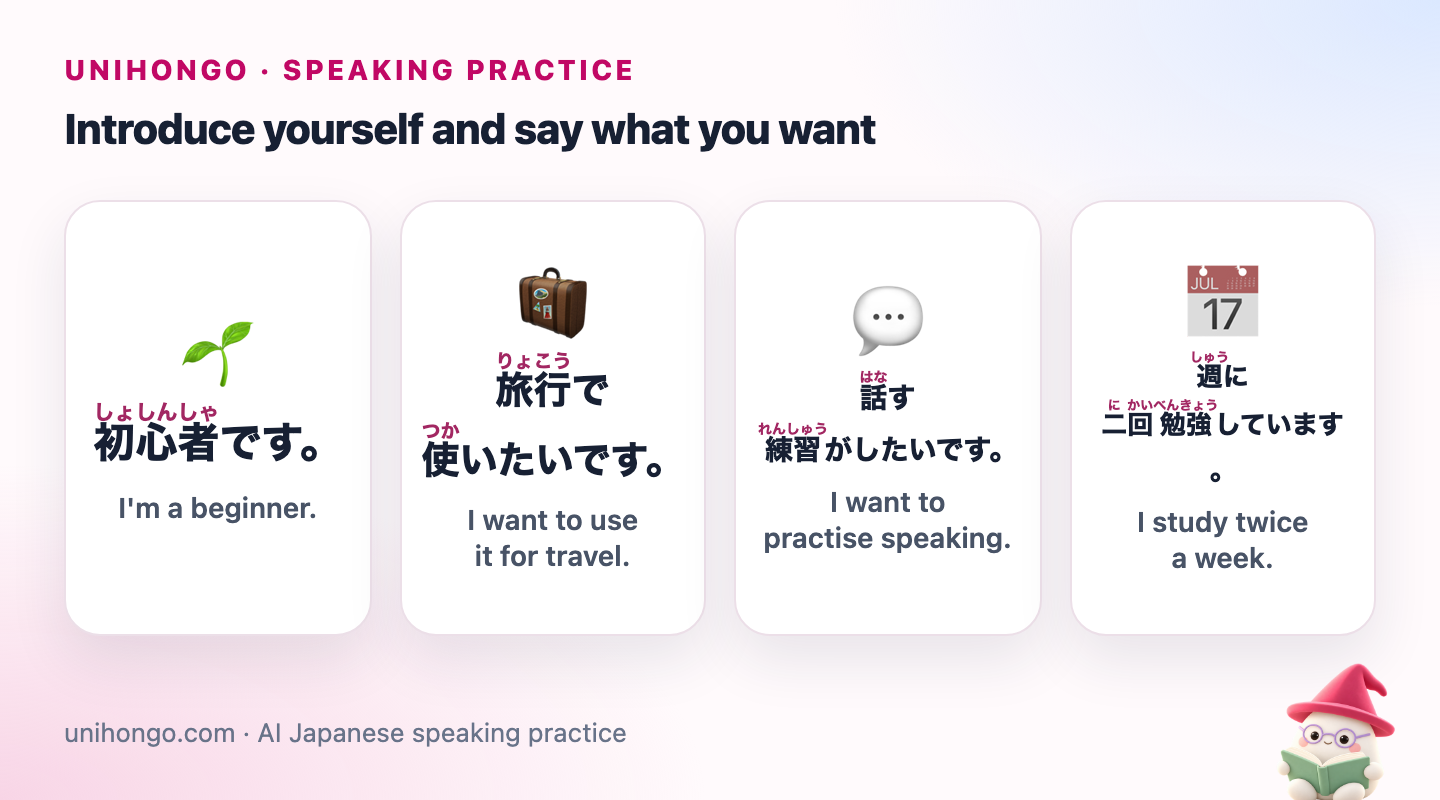
| Japanese | Romaji | Meaning |
|---|---|---|
| 初心者です。 | Shoshinsha desu. | I'm a beginner. |
| 旅行で使いたいです。 | Ryokō de tsukaitai desu. | I want to use it for travel. |
| 話す練習がしたいです。 | Hanasu renshū ga shitai desu. | I want to practise speaking. |
| 週に二回勉強しています。 | Shū ni nikai benkyō shite imasu. | I study twice a week. |
| はじめまして。マリアです。ブラジルから来ました。 | Hajimemashite. Maria desu. Burajiru kara kimashita. | Nice to meet you. I'm Maria, from Brazil. |
| 半年、独学で勉強しました。 | Hantoshi, dokugaku de benkyō shimashita. | I studied on my own for half a year. |
| 聞き取りが苦手です。 | Kikitori ga nigate desu. | Listening is my weak point. |
| 漢字はまだ読めません。 | Kanji wa mada yomemasen. | I can't read kanji yet. |
| 日本語能力試験のN5を受けたいです。 | Nihongo nōryoku shiken no enu go o uketai desu. | I want to take JLPT N5. |
| よろしくお願いします。 | Yoroshiku onegai shimasu. | I look forward to working with you. |
Nigate, weak at, is kinder to yourself than dame (hopeless) and is the word teachers use. Dokugaku, self-study, tells the teacher a lot: expect good reading, uneven speaking, and gaps in the order things were learned. If you have used an app or a textbook, naming it helps too; teachers know what each one leaves out.
The first lesson, minute by minute
Timings vary by teacher, school and whether the lesson is online, but the sequence rarely does. Here is a typical hour, and where each of your prepared pieces goes.
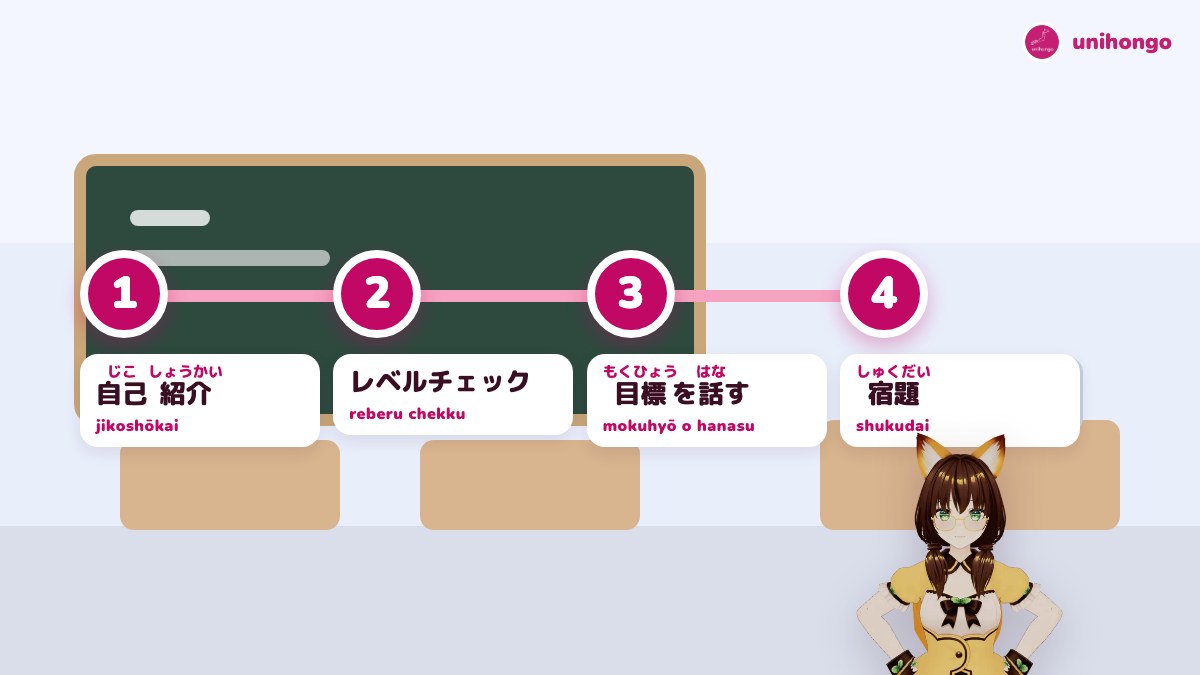
| Part | What the teacher does | What you do |
|---|---|---|
| Greetings | Hajimemashite, a little small talk about the weather or your day | Your four-line introduction |
| Level check | Simple questions, perhaps a short text or a picture to describe | Answer what you can; wakarimasen for the rest |
| Goals and time | Asks why Japanese, by when, how often | Goal sentence, study time, weak point |
| A taste of teaching | One grammar point or one situation, such as ordering | Steering lines: slower, again, what does it mean |
| Homework | Something small to practise | Write it down; ask if unclear |
| Next time | Proposes a day and what to cover | Confirm; say arigatō gozaimashita |
The picture-description or short-text part of a level check is where learners panic. The teacher is listening for which structures you reach for, not for a correct answer, so a fragment is useful data. Three nouns and a verb tell them more than silence.
What the level check is listening for
A level check through conversation looks casual and is quietly systematic. The teacher asks a question in the past tense to see whether you can answer in it, asks a why question to see whether you can give a reason with kara, and adds one slightly harder word to see what you do when you miss it. None of this is a trap; it tells them which textbook chapter you are standing in. Here are the questions you are most likely to hear and a simple way to answer each.
| Japanese | Romaji | Meaning |
|---|---|---|
| 日本語の勉強はどのくらいですか。 | Nihongo no benkyō wa dono kurai desu ka. | Teacher: How long have you studied Japanese? |
| 三か月ぐらいです。 | Sankagetsu gurai desu. | You: About three months. |
| 昨日は何をしましたか。 | Kinō wa nani o shimashita ka. | Teacher: What did you do yesterday? |
| 仕事でした。それから、日本語を勉強しました。 | Shigoto deshita. Sorekara, nihongo o benkyō shimashita. | You: I worked. Then I studied Japanese. |
| どうして日本語を勉強していますか。 | Dōshite nihongo o benkyō shite imasu ka. | Teacher: Why are you studying Japanese? |
| 来年、日本に行くからです。 | Rainen, Nihon ni iku kara desu. | You: Because I'm going to Japan next year. |
| この絵を見て、話してください。 | Kono e o mite, hanashite kudasai. | Teacher: Look at this picture and talk about it. |
| 女の人がコーヒーを飲んでいます。 | Onna no hito ga kōhī o nonde imasu. | You: A woman is drinking coffee. |
| 分かりません。 | Wakarimasen. | You: I don't know. (a fine answer) |
Kara desu, because, is the structure teachers hope to hear in the why answer, and it is worth preparing. If a question is beyond you, wakarimasen is a complete, correct answer and ends the probe; the teacher moves one step easier. Guessing wildly gives them less information than an honest wakarimasen.
Steering the lesson: slower, again, explain
The phrases that improve a first lesson most are not vocabulary; they are the ones that control the pace. Teachers want you to use them, because a learner who says mō sukoshi yukkuri is giving them the information they need, and a silent learner is not. Learn them as reflexes, say them early, and say them without apology.
| Japanese | Romaji | Meaning |
|---|---|---|
| もう少しゆっくりお願いします。 | Mō sukoshi yukkuri onegai shimasu. | A little slower, please. |
| もう一度言ってください。 | Mō ichido itte kudasai. | Please say that again. |
| それはどういう意味ですか。 | Sore wa dō iu imi desu ka. | What does that mean? |
| 英語で説明してもらえますか。 | Eigo de setsumei shite moraemasu ka. | Could you explain in English? |
| 例文をお願いします。 | Reibun o onegai shimasu. | An example sentence, please. |
| ちょっと待ってください。メモします。 | Chotto matte kudasai. Memo shimasu. | One moment, I'll write that down. |
| 日本語だけでお願いします。 | Nihongo dake de onegai shimasu. | Japanese only, please. (if you want immersion) |
| もう少し難しくても大丈夫です。 | Mō sukoshi muzukashikute mo daijōbu desu. | It's fine to make it a little harder. |
| もう少し簡単なものをお願いします。 | Mō sukoshi kantan na mono o onegai shimasu. | Something a little easier, please. |
The last two lines are for the end of the taste-of-teaching part, when the teacher asks how it felt. Saying muzukashikatta desu (it was hard) is useful; saying which direction to adjust is more useful. With an AI teacher the same lines work as instructions: ask it to speak more slowly or to make the lesson harder and it does so at once.
What the teacher will say
Classroom Japanese is a small, fixed vocabulary, and teachers use it in every lesson. Learn it once and the instructions stop being noise. Most of it is polite requests with kudasai, plus a few words of praise and correction that you will hear hundreds of times.
| Japanese | Romaji | Meaning |
|---|---|---|
| では、始めましょう。 | Dewa, hajimemashō. | Teacher: Right, let's begin. |
| 繰り返してください。 | Kurikaeshite kudasai. | Teacher: Please repeat. |
| もう一回。 | Mō ikkai. | Teacher: Once more. |
| いいですね。 | Ii desu ne. | Teacher: Good. |
| 惜しい! | Oshii! | Teacher: Close! (nearly right) |
| 読んでください。 | Yonde kudasai. | Teacher: Please read. |
| 質問はありますか。 | Shitsumon wa arimasu ka. | Teacher: Any questions? |
| これは宿題です。 | Kore wa shukudai desu. | Teacher: This is homework. |
| 次は来週の火曜日ですね。 | Tsugi wa raishū no kayōbi desu ne. | Teacher: Next is Tuesday next week, yes? |
| お疲れさまでした。 | Otsukaresama deshita. | Teacher: Well done, that's all for today. |
Oshii is the word to hope for: it means you were nearly right and the teacher is about to tell you the one thing to fix. Otsukaresama deshita closes a lesson the way it closes a day at work, and the natural reply is arigatō gozaimashita, past tense, for the lesson now finished.
Human teacher or AI teacher: what differs in the first hour
The two kinds of first lesson share a shape and differ in texture. Neither is better for everyone; many learners pair a human lesson every week or two with AI conversation practice in between. What matters for the first lesson is knowing what each one will and will not do.
| Point | Human teacher | AI teacher |
|---|---|---|
| Level check | Through conversation and judgement; may use a short test | Through conversation; may already know your level from earlier study |
| Pace | Adjusts as they read your face; ask if it is still fast | Changes the moment you ask; no social cost to asking twice |
| Goals | Discussed; you may need to steer the plan | Stated once, then used to shape later sessions |
| Correction | Chosen carefully so as not to overwhelm | Collected in a written report after the session |
| Booking | A set time, a set day | Whenever you have fifteen quiet minutes |
| What it cannot do | Be there at 11 pm on a whim | Notice you are tired or guess what you meant to say |
A fair way to use both: have the human first lesson to get a judgement about your pronunciation and habits, and use an AI teacher to rehearse the self-introduction and the steering lines before it, so that the human hour is spent on teaching rather than on nerves.
How it feels, honestly, and what to avoid
The first ten minutes feel like being quizzed, even by the kindest teacher, because they are. Your prepared introduction comes out faster than you practised it, and the first question you did not prepare for produces a blank. Then the teacher says something slowly, you understand it, and the room changes. By the taste-of-teaching part most learners are enjoying themselves, and the homework at the end feels like a gift rather than a chore.
Afterwards you will remember two things: a word the teacher said that you want to look up, and a sentence you said wrong. Both are the point. A first lesson that leaves you with a clear next step and a teacher you want to see again has done its job, whatever your level turned out to be.
- Over-preparing a speech. A four-line introduction and a goal is enough; the rest is conversation.
- Nodding through sentences you did not understand. The teacher then plans the next lesson too high.
- Apologising for being a beginner. The lesson exists because you are one.
- Asking for English for everything. Try the Japanese explanation once, then ask.
- Leaving without the homework written down. Ask shukudai wa nan desu ka if it was not clear.
Prepare the evening before, and have a trial run
The best first lesson is the second one you have had. Mocchi, Unihongo's study assistant, can give you the first: tell it your level, your goal and how often you can study, ask it to play a teacher starting a first lesson, and answer its questions in the chat. It corrects your introduction, explains any classroom word you missed, and then, if you ask with /plan, builds a 60-day study path around what you told it, so the goal you state to your teacher is already a plan with daily steps. The speaking steps of that plan open AI Sensei, where Haru-sensei can run a spoken version of the same first lesson and hand you a report of strengths and corrections at the end.
A free account at unihongo.com/login is enough to have that rehearsal tonight, before anything is booked.