
How the first casual chat usually goes
A first casual conversation rarely starts casual. It starts in the polite forms you both used on the day you met, and at some point, often in the first ten minutes of a second or third meeting, one of you suggests relaxing. From there it is messy on both sides: plain forms, then a desu by habit, then a laugh about it. Knowing this shape stops you from treating the mixed phase as failure.
| Japanese | Romaji | Meaning |
|---|---|---|
| タメ口でいい? | Tameguchi de ii? | Can we talk casually? |
| Stage | What happens | What you do |
|---|---|---|
| Polite warm-up | Greetings and small talk in desu and masu | Stay polite; match them |
| The invitation | One of you proposes casual speech | Say ii yo, or ask tameguchi de ii? |
| The messy switch | Endings drop, then come back by habit | Laugh, keep going |
| Stories | Questions about days off, hobbies, recent things | Ask what they do, react, ask more |
| Your turn | They ask about you | A short story in plain past tense |
| Next time | Someone mentions a place or a plan | Kondo, issho ni ikanai? |
Tameguchi is the word Japanese speakers use for talking as equals, without honorifics. Asking tameguchi de ii? is itself a casual sentence, so it only works with someone your age or at a setting like a language exchange where equality is assumed. With a senior, a boss or a friend's parent, the answer to the question is already no, and you do not ask.
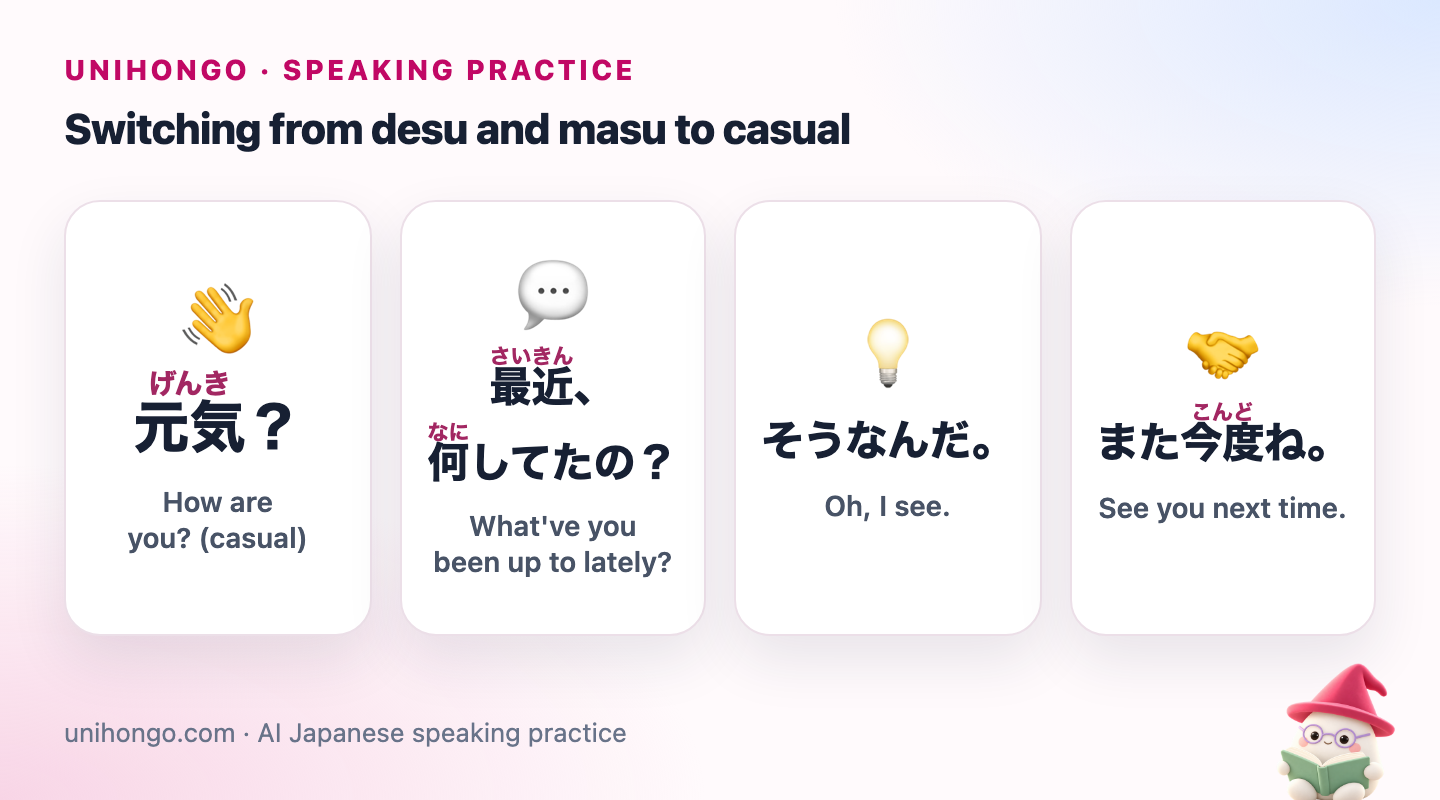
Switching from desu and masu to casual
The whole switch is a matter of sentence endings, and a learner who changes only those sounds casual immediately. Drop desu, turn masu verbs into their dictionary form, let questions rise in tone instead of ending in ka, and replace ja arimasen with ja nai. That is the first week's worth. Casual vocabulary, softer particles and the plain past can come later, one at a time.
| Japanese | Romaji | Meaning |
|---|---|---|
| 元気? | Genki? | How are you? (casual) |
| 最近、何してたの? | Saikin, nani shiteta no? | What've you been up to lately? |
| そうなんだ。 | Sō nan da. | Oh, I see. |
| また今度ね。 | Mata kondo ne. | See you next time. |
| いいよ、タメ口で。 | Ii yo, tameguchi de. | Friend: Sure, casual is fine. |
| じゃあ、そうする。 | Jā, sō suru. | You: Okay, I'll do that. |
| 学生? | Gakusei? | Are you a student? (just a rising noun) |
| 学生じゃない。会社員。 | Gakusei ja nai. Kaishain. | Not a student. Office worker. |
| Polite | Casual | What changed |
|---|---|---|
| Gakusei desu | Gakusei | Desu dropped (da is optional) |
| Ikimasu | Iku | Masu verb to dictionary form |
| Ikimasu ka | Iku? | Ka replaced by rising tone |
| Ikimashita | Itta | Past masu to plain past |
| Ja arimasen | Ja nai | Negative copula |
| Tabete imasu | Tabeteru | Te iru shortened to teru |
Notice what did not change: sumimasen, arigatō, the names with san. Casual speech is not the same as dropping courtesy, and most Japanese friends keep thanking and apologising to each other all day in casual form. The thing to drop is the grammar, not the manners.
Questions that invite a story
A polite first meeting runs on facts: where from, what job, how long in Japan. A friendship runs on stories, and stories come from questions about what people do and like, not what they are. Build the question from a question word, nani, doko, nande, itsu, and end it with a casual no, which softens it and makes it sound genuinely curious. Then wait. Silence after a question is not awkward in Japanese; it is the other person thinking.
| Japanese | Romaji | Meaning |
|---|---|---|
| 休みの日、何してるの? | Yasumi no hi, nani shiteru no? | What do you do on your days off? |
| 最近ハマってることある? | Saikin hamatteru koto aru? | Anything you're into lately? |
| 出身、どこ? | Shusshin, doko? | Where are you from originally? |
| それ、どういうこと? | Sore, dō iu koto? | What do you mean by that? |
| なんで日本語始めたの? | Nande nihongo hajimeta no? | Friend: Why did you start Japanese? |
| 一番好きなアニメ、何? | Ichiban suki na anime, nani? | What's your favourite anime? |
| 週末、どうだった? | Shūmatsu, dō datta? | How was your weekend? |
| それ、いつから? | Sore, itsu kara? | Since when? |
Hamaru, to be hooked on something, is the word friends use for hobbies and obsessions, and saikin hamatteru koto aru? is a better opener than shumi wa nan desu ka, which sounds like a form. Sore, dō iu koto? is your best friend when a story loses you: it asks for a rephrase without admitting you lost the thread.
Reacting like a friend
Casual conversation has its own set of listening sounds, and they are what make a Japanese speaker feel they are talking to a friend rather than to a learner. Sō desu ka becomes sō nan da; hontō desu ka becomes maji de or uso. Overdo any one and it sounds like a comedy sketch, so rotate three or four. A few are marked by age or gender, and the notes below say so.
| Japanese | Romaji | Meaning |
|---|---|---|
| へえ、そうなんだ。 | Hē, sō nan da. | Oh, really? I see. |
| まじで? | Maji de? | Seriously? (casual, any gender) |
| うそ! | Uso! | No way! |
| いいなあ。 | Ii nā. | Lucky you / I'm envious. |
| わかる。 | Wakaru. | I know, right. |
| それな。 | Sore na. | Exactly. (youth slang) |
| すごいね。 | Sugoi ne. | That's great. |
| 大変だったね。 | Taihen datta ne. | That sounds rough. |
| で、どうなったの? | De, dō natta no? | And then what happened? |
Wakaru, said with a nod, is one of the most friend-making words in Japanese: it means I get it, I feel the same. Sore na is current slang among younger speakers and will date you if you are not young. De, dō natta no? is the line that asks for the end of the story, and a friend who asks it is a friend who was listening.
A small story of your own
At some point they will ask what you did at the weekend, and a casual answer is a short story in plain past tense: what, where, one thing that went wrong, how it ended. Three or four sentences are plenty. Casual storytelling uses te-form chains with chatte for the small disasters, meccha for very, and kekkyoku for how it turned out, and it leaves subjects and particles out wherever the meaning survives.
| Japanese | Romaji | Meaning |
|---|---|---|
| 昨日、ラーメン食べに行った。 | Kinō, rāmen tabe ni itta. | Yesterday I went for ramen. |
| めっちゃ美味しかった。 | Meccha oishikatta. | It was really good. |
| でも、道に迷っちゃって。 | Demo, michi ni mayocchatte. | But I got lost on the way. |
| 結局、三十分歩いた。 | Kekkyoku, sanjuppun aruita. | In the end I walked for half an hour. |
| まあ、楽しかったけど。 | Mā, tanoshikatta kedo. | Well, it was fun though. |
| 今度一緒に行こうよ。 | Kondo issho ni ikō yo. | Let's go together next time. |
Meccha began as Kansai speech and is now casual everywhere, especially among younger people; in Tokyo you will also hear chō. Kedo trailing off at the end of a sentence is a casual softener, like the English though, and friends use it constantly. A story told this way, even with mistakes, sounds like a person talking, not a textbook exercise.
Plans for next time
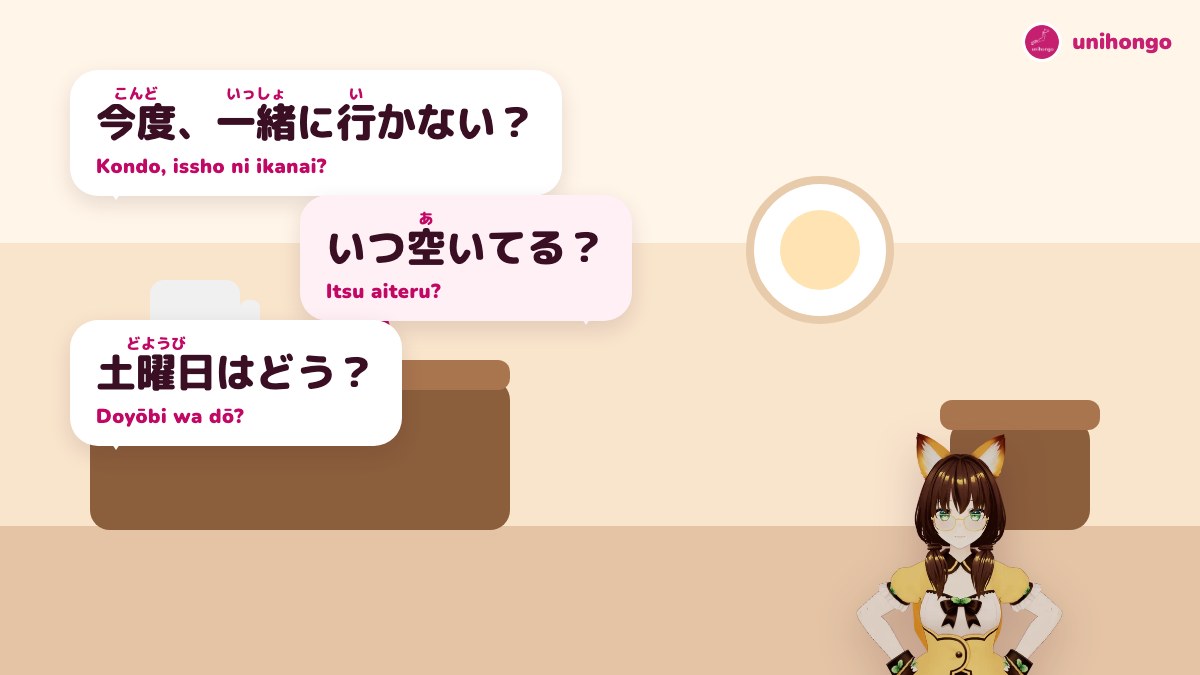
The difference between a pleasant chat and a friendship is whether a second meeting is set. In casual Japanese the invitation is a negative question, ikanai? (won't you go?), which sounds softer than ikō (let's go) and gives the other person room to decline. Add kondo (next time, sometime) to keep it loose, then narrow it to a day if they sound keen. Contact details are exchanged by messaging app, and the natural line for that is a casual suggestion rather than a request.
| Japanese | Romaji | Meaning |
|---|---|---|
| 今度、一緒に行かない? | Kondo, issho ni ikanai? | You: Want to go together sometime? |
| 行きたい!いつ空いてる? | Ikitai! Itsu aiteru? | Friend: I'd love to! When are you free? |
| 土曜日はどう? | Doyōbi wa dō? | You: How about Saturday? |
| 土曜日、いいよ。 | Doyōbi, ii yo. | Friend: Saturday works. |
| LINE交換しようか。 | Rain kōkan shiyō ka. | You: Shall we swap LINE? |
| じゃあ、また連絡するね。 | Jā, mata renraku suru ne. | Friend: Okay, I'll message you. |
| うん、楽しみにしてる。 | Un, tanoshimi ni shiteru. | You: Yeah, looking forward to it. |
Tanoshimi ni shiteru, I'm looking forward to it, is the casual version of tanoshimi ni shite imasu, and it is the warmest way to end. Un is the casual hai; use it with a nod. If the other person answers an invitation with kondo ne (sometime, yeah) and no day, that can be a soft decline; let it go and try again another time.
Register notes and the mistakes that sound rude
Casual Japanese has levels inside it. The forms in this post are the friendly middle: plain verbs, soft particles, no honorifics. Below that is the rough speech of anime heroes and tired men in bars, and that is the layer learners accidentally borrow. A few rules keep you in the middle.
- Going casual with someone older or senior before they do. Age and seniority still shape speech between friends; many pairs stay polite in one direction for years.
- Using omae or kimi for you. Use the person's name, or no pronoun at all. Anata to a friend sounds stiff or oddly intimate.
- Ending sentences in zo, ze or ka yo. These are rough, mostly male and often confrontational; ne, yo and no are the friendly endings.
- Switching to casual with your friend's friends automatically. New person, polite start, until invited.
- Dropping sumimasen and arigatō along with desu. Courtesy words stay.
- Apologising for every mixed sentence. Nobody is counting, and a desu that slips out is normal.
How it feels, honestly
The first time you say a plain-form sentence to a Japanese person's face, it feels rude. It is not; it is what they asked for, and the small smile you get in return is relief, because polite speech is tiring for them too. For the next half hour you will mix forms, catch yourself, and mix them again. Your friend will do a bit of the same, because they are adjusting their speed and vocabulary for you.
What surprises most learners is how much faster casual conversation moves, and how much more of it is reaction rather than content. You will say wakaru and sō nan da more than any sentence with a verb in it, and that is fine. The sign that it went well is not grammatical: it is that you have a day and a place written down for next time.
Practise going casual without the awkwardness
The switch is easier to rehearse than to improvise. Tell Mocchi, Unihongo's study assistant, that you want to chat about your weekend in casual Japanese, and ask it to note every place you drift back into desu or masu, then explain the plain form you should have used. Because it keeps track of the endings you keep missing, the next chat starts with a reminder. For a message to a friend, /correct with the note casual, same age makes sure the register matches.
Then say it out loud. In AI Sensei, Ibuki-sensei can play a classmate: pick the hobbies topic, ask to switch to casual speech from the start, and tell a weekend story with one small disaster in it. The session report shows which plain forms came out right and which sentences still ended in desu. Signing in with a free account at unihongo.com/login opens both the chat and the classroom.