
The four ways you will be asked
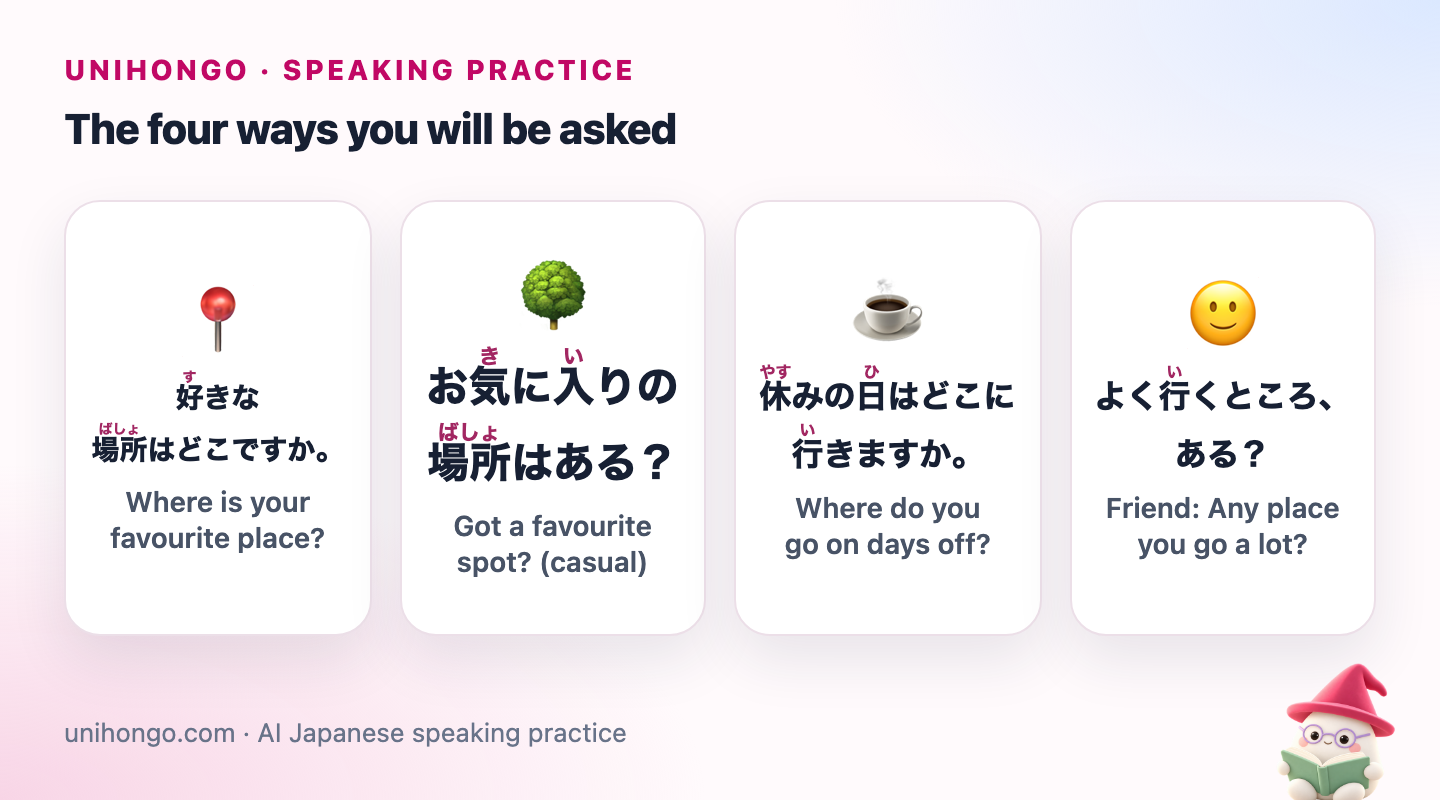
The question comes in polite and casual shapes, and it is often indirect: not where is your favourite place but where do you go on days off. All four below mean roughly the same thing, and recognising them is half the work. The last one is how a friend asks, with the verb in plain form and the particle dropped.
| Japanese | Romaji | Meaning |
|---|---|---|
| 好きな場所はどこですか。 | Suki na basho wa doko desu ka. | Where is your favourite place? |
| お気に入りの場所はある? | Okiniiri no basho wa aru? | Got a favourite spot? (casual) |
| 休みの日はどこに行きますか。 | Yasumi no hi wa doko ni ikimasu ka. | Where do you go on days off? |
| よく行くところ、ある? | Yoku iku tokoro, aru? | Friend: Any place you go a lot? |
Model answer 1: name it, describe it, say how often
Three sentences make a complete beginner answer. The first names the place with the pattern X wa Y desu, the second gives two adjectives joined by de, and the third says how often you go. Even at this level, two adjectives sound much better than one.
| Japanese | Romaji | Meaning |
|---|---|---|
| 私の好きな場所は海です。 | Watashi no suki na basho wa umi desu. | You: My favourite place is the sea. |
| 静かで、きれいです。 | Shizuka de, kirei desu. | You: It's quiet and beautiful. |
| 週末によく行きます。 | Shūmatsu ni yoku ikimasu. | You: I often go at weekends. |
If the place has a name, say it: suki na basho wa Yoyogi kōen desu. Japanese speakers do not expect you to translate place names, and a foreign name said clearly is fine.
Model answer 2: what is there and what you do
The second level sets the scene with aru (there is, for things) and says what you do there with ~nagara, while doing. The last sentence gives the reason with node, which is the sentence the listener was waiting for. Notice ōkute, the kute form of ōi, many: an i-adjective drops the final i and takes kute to join the next description.
| Japanese | Romaji | Meaning |
|---|---|---|
| 家の近くに小さい公園があります。 | Ie no chikaku ni chiisai kōen ga arimasu. | You: There's a small park near my house. |
| 木が多くて、朝は人が少ないです。 | Ki ga ōkute, asa wa hito ga sukunai desu. | You: There are lots of trees and few people in the morning. |
| そこでコーヒーを飲みながら本を読みます。 | Soko de kōhī o nominagara hon o yomimasu. | You: I read there while drinking coffee. |
| 一人になれるので、好きです。 | Hitori ni nareru node, suki desu. | You: I like it because I can be alone there. |
Hitori ni nareru, can become alone, is the natural way to say you can have time to yourself. Hitori de iru koto ga dekiru is grammatical but heavy.
Model answer 3: a place with a history
An intermediate answer tells a small story: how long you have been going, who knows you there, and what the place does for you. The grammar is ~te iru for a habit that continues (kayotte imasu, I have been going), ~te kureru for something someone kindly does for you, and n desu yo ne to share a feeling and invite agreement.
| Japanese | Romaji | Meaning |
|---|---|---|
| 一番好きなのは、駅の裏にある古い喫茶店です。 | Ichiban suki na no wa, eki no ura ni aru furui kissaten desu. | You: The one I like best is an old coffee shop behind the station. |
| 学生の頃から通っています。 | Gakusei no koro kara kayotte imasu. | You: I've been going there since I was a student. |
| マスターが覚えていてくれて、いつものを出してくれます。 | Masutā ga oboete ite kurete, itsumo no o dashite kuremasu. | You: The owner remembers me and brings my usual. |
| 落ち着くんですよね。 | Ochitsuku n desu yo ne. | You: It just puts me at ease, you know. |
The grammar this topic needs: joining descriptions and giving reasons
Describing a place means stringing adjectives together, and Japanese does that with the te-form of the adjective. The rule depends on the adjective type, and the table lays it out. After that, the phrase rows show the three ways to give your reason: kara, node, and shi for stacking several reasons at once.
| Japanese | Romaji | Meaning |
|---|---|---|
| 広くて明るいです。 | Hirokute akarui desu. | It's spacious and bright. |
| 静かで落ち着きます。 | Shizuka de ochitsukimasu. | It's quiet and calming. |
| 景色がいいから好きです。 | Keshiki ga ii kara suki desu. | I like it because the view is nice. |
| 家から近いので、よく行きます。 | Ie kara chikai node, yoku ikimasu. | It's close to home, so I go often. |
| 近いし、安いし、おいしいです。 | Chikai shi, yasui shi, oishii desu. | It's close, it's cheap, and the food's good. |
| Type | How to join | Example in romaji |
|---|---|---|
| i-adjective: hiroi (spacious), akarui (bright) | drop the final i, add kute | hirokute akarui |
| na-adjective: shizuka (quiet), kirei (pretty) | add de | shizuka de kirei |
| noun: kōen (park), kissaten (coffee shop) | add de | furui kissaten de, masutā ga yasashii |
| ii (good) | irregular: yokute | keshiki ga yokute shizuka |
Shi lists reasons and implies there are more: chikai shi, yasui shi, and so on. It is a very natural way to sound enthusiastic without a long sentence. Keep the plain form before it: chikai shi, not chikai desu shi, in everyday speech.
Inviting someone to your place
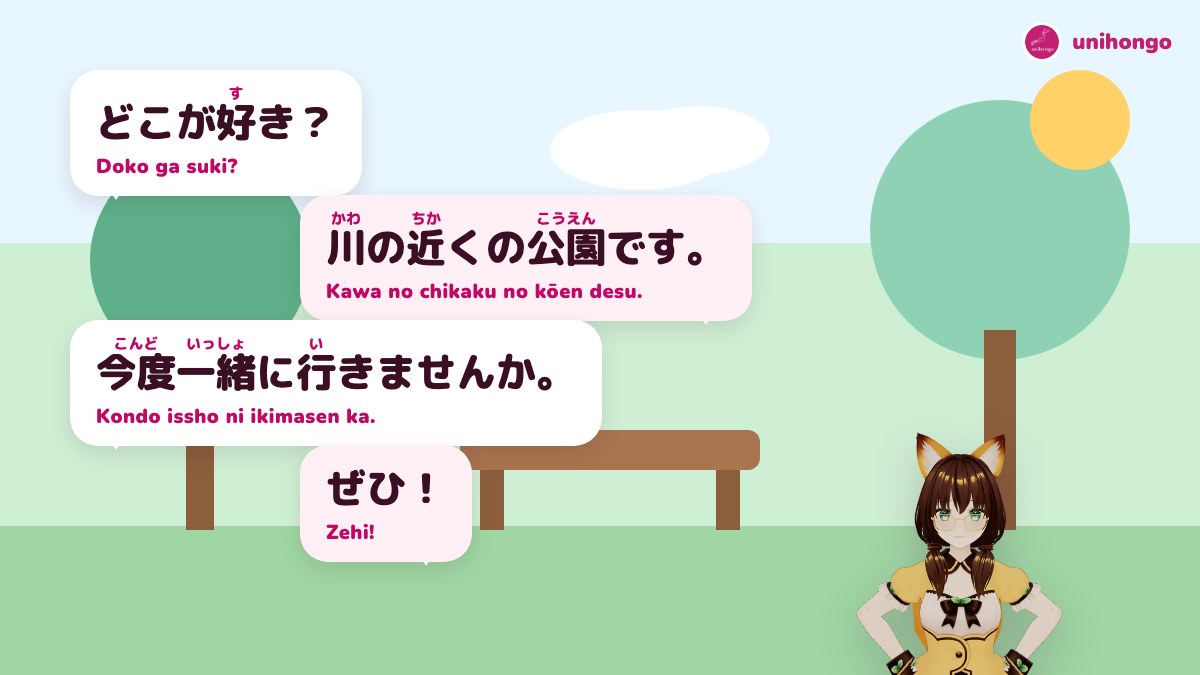
Describing a place you love almost always ends in an invitation, and the invitation is where many learners stop. The polite form is a negative question, ikimasen ka, which sounds softer than ikimashō ka. If the answer is yes, offer a day and promise to show them around. If it is a soft no, chotto, let it go lightly with mata kondo, another time.
| Japanese | Romaji | Meaning |
|---|---|---|
| 今度一緒に行きませんか。 | Kondo issho ni ikimasen ka. | You: Would you like to go together sometime? |
| いいですね。ぜひ。 | Ii desu ne. Zehi. | Friend: Sounds great. I'd love to. |
| 土曜日はどうですか。 | Doyōbi wa dō desu ka. | You: How about Saturday? |
| 案内しますよ。 | Annai shimasu yo. | You: I'll show you around. |
| 連れて行ってください。 | Tsurete itte kudasai. | Friend: Please take me there. |
| その日はちょっと…。また今度。 | Sono hi wa chotto… Mata kondo. | Friend: That day's a bit… Another time. (soft no) |
Zehi, by all means, is the warm yes. Chotto with a trailing voice is the standard soft refusal; it does not need a reason, and pressing for one is a mistake. Reply with wakarimashita, mata kondo, understood, another time.
Follow-up questions and reactions you will hear
After your answer, a Japanese listener will usually ask why, how long, or whether they can come. Learn the questions so you can both answer them and ask them back; asking the same question back, with wa, is the simplest way to keep a conversation balanced.
| Japanese | Romaji | Meaning |
|---|---|---|
| どうしてそこが好きなんですか。 | Dōshite soko ga suki nan desu ka. | Friend: Why do you like it there? |
| どのくらい通っていますか。 | Dono kurai kayotte imasu ka. | Friend: How long have you been going? |
| いいですね、行ってみたいです。 | Ii desu ne, itte mitai desu. | Friend: Nice, I'd like to go there. |
| 私も好きです。 | Watashi mo suki desu. | You: I like it too. |
| へえ、知らなかった。 | Hee, shiranakatta. | Friend: Oh, I didn't know that one. (casual) |
| あなたの好きな場所はどこですか。 | Anata no suki na basho wa doko desu ka. | You: And your favourite place? |
Mistakes and register notes
- Doubling the topic: suki na basho wa umi ga suki desu. Choose one frame: suki na basho wa umi desu, or umi ga suki desu.
- Joining adjectives with to: shizuka to kirei. To joins nouns, not adjectives; use shizuka de kirei.
- Using imasu for a building or a view. Imasu is for people and animals; a park, a café and a bench take arimasu. Hito ga imasu, kōen ga arimasu.
- Ending the reason with desu kara in casual talk. Kirei desu kara is a formal register; with friends say kirei da kara, and in polite conversation kirei na node sounds smoother.
- Inviting with ikimashō ka when you mean a first invitation. Ikimashō ka sounds like you are already going and asking about timing; ikimasen ka is the invitation itself.
A short way to practise this with your real place
The best material is a place you can picture. Open a photo of it on your phone and describe what you see for one minute, then add the reason and the invitation. If you want the description checked, send it to Mocchi, Unihongo's study assistant, with /correct and ask it to turn your two or three plain sentences into one joined with kute, de and node; it also keeps a note of which join you keep getting wrong, so the next /review comes back to it.
For the invitation, which only works out loud, open AI Sensei, choose Sakura-sensei and ask Sakura-sensei to play a new friend who asks where you like to go on days off, then accepts or gently declines your invitation. Practise both outcomes. Anyone can sign up free at unihongo.com/login and start with the description tonight.
Your turn: prompts to answer aloud
- Suki na basho wa doko desu ka. Name it and give two joined adjectives.
- Soko ni nani ga arimasu ka. Describe two things that are there with arimasu or imasu.
- Soko de nani o shimasu ka. Use ~nagara once.
- Dōshite suki nan desu ka. Give two reasons with shi.
- Invite the listener with ikimasen ka and suggest a day.