
The line you will say and the questions you will hear
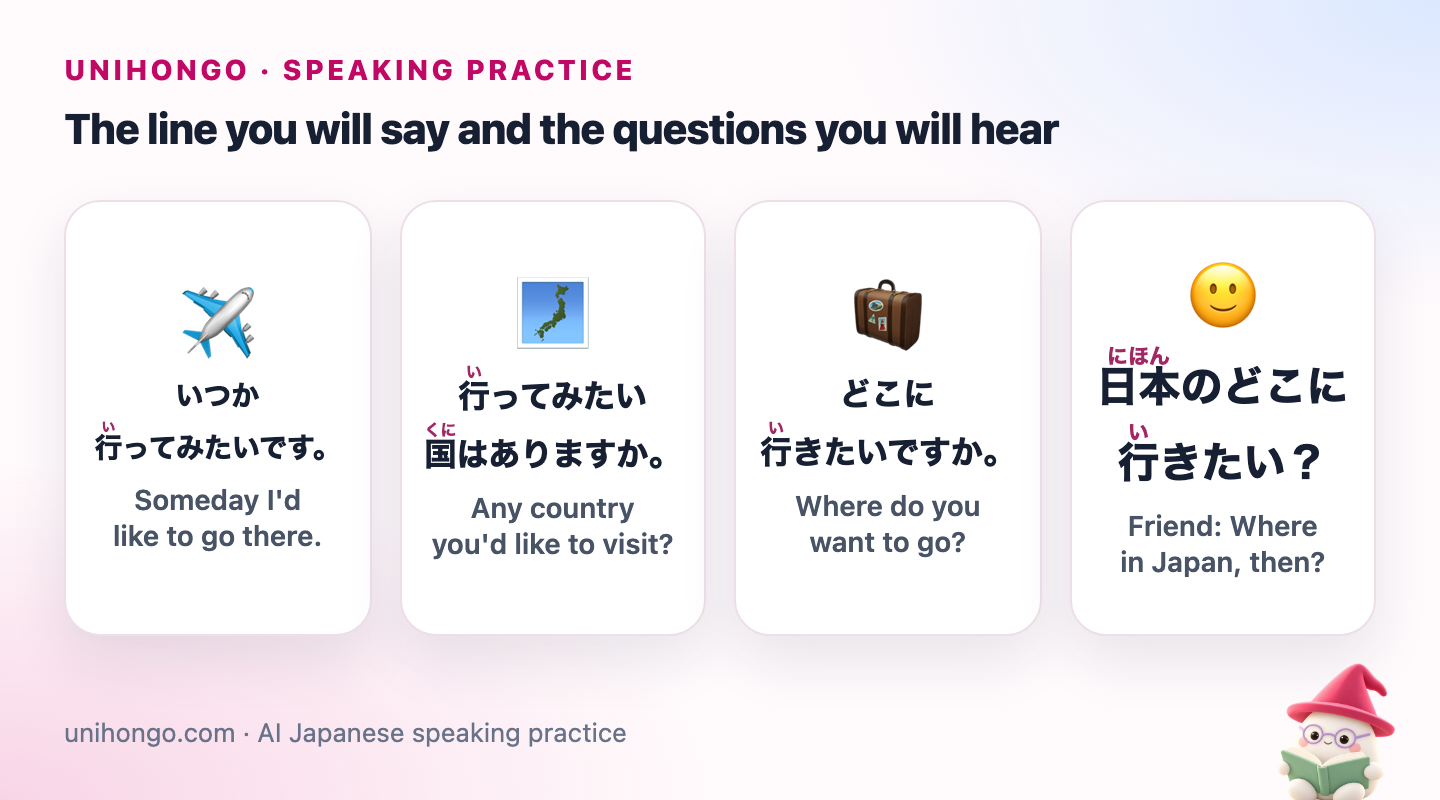
The whole topic hangs on one sentence: itsuka itte mitai desu, someday I'd like to go there. Learn it first; everything else is decoration. Then learn the three shapes of the question, two polite and one casual, so you recognise it when it arrives in the middle of a conversation about holidays or the weather.
| Japanese | Romaji | Meaning |
|---|---|---|
| いつか行ってみたいです。 | Itsuka itte mitai desu. | Someday I'd like to go there. |
| 行ってみたい国はありますか。 | Itte mitai kuni wa arimasu ka. | Any country you'd like to visit? |
| どこに行きたいですか。 | Doko ni ikitai desu ka. | Where do you want to go? |
| 日本のどこに行きたい? | Nihon no doko ni ikitai? | Friend: Where in Japan, then? |
Model answer 1: place, reason, one thing to do
At the first level you need a place with ni ikitai desu, a reason that ends in kara desu, and one verb in -tai form for what you want to do there. Three sentences, and each one is a pattern you can reuse for any destination on earth.
| Japanese | Romaji | Meaning |
|---|---|---|
| いつか沖縄に行きたいです。 | Itsuka Okinawa ni ikitai desu. | You: Someday I want to go to Okinawa. |
| 海がきれいだからです。 | Umi ga kirei da kara desu. | You: Because the sea is beautiful. |
| 泳ぎたいです。 | Oyogitai desu. | You: I want to swim. |
Kara desu at the end of a sentence answers a why question on its own. Kirei is a na-adjective despite its final i, so it takes da before kara: kirei da kara, not kirei kara.
Model answer 2: a trip with a season and a worry
The second level joins two actions with the -te form (itte, mite mitai), admits a problem with ga (but), and adds a time and a length. Ichido wa, at least once, is the small word that makes the wish sound sincere.
| Japanese | Romaji | Meaning |
|---|---|---|
| 北海道に行って、雪祭りを見てみたいです。 | Hokkaidō ni itte, yukimatsuri o mite mitai desu. | You: I'd like to go to Hokkaido and see the snow festival. |
| 寒いのは苦手ですが、一度は見たいです。 | Samui no wa nigate desu ga, ichido wa mitai desu. | You: I'm not good with cold, but I want to see it at least once. |
| おいしい海鮮も食べたいです。 | Oishii kaisen mo tabetai desu. | You: I also want to eat delicious seafood. |
| 冬に一週間ぐらい行きたいです。 | Fuyu ni isshūkan gurai ikitai desu. | You: I'd like to go for about a week in winter. |
Samui no wa turns the adjective into a noun phrase, the cold, which is what nigate needs. Gurai after a length of time means about and is the usual way to say roughly a week.
Model answer 3: the dream with conditions
An intermediate answer starts with a condition, okane to jikan ga attara, if I had the money and the time, which is exactly how Japanese speakers introduce a dream they do not expect to come true soon. It then uses -te mitai for an experience, -tai to omotte imasu for a softer long-standing wish, and closes with a self-deprecating kedo ne, though.
| Japanese | Romaji | Meaning |
|---|---|---|
| お金と時間があったら、イタリアを一か月かけて回りたいです。 | Okane to jikan ga attara, Itaria o ikkagetsu kakete mawaritai desu. | You: If I had the money and time, I'd like to spend a month travelling around Italy. |
| 小さい町に泊まって、地元の人と話してみたいんです。 | Chiisai machi ni tomatte, jimoto no hito to hanashite mitai n desu. | You: I'd like to stay in small towns and try talking with local people. |
| 昔から料理が好きで、本場のパスタを習いたいと思っています。 | Mukashi kara ryōri ga suki de, honba no pasuta o naraitai to omotte imasu. | You: I've always liked cooking, and I'm thinking I'd like to learn real pasta there. |
| まだ夢ですけどね。 | Mada yume desu kedo ne. | You: It's still just a dream, though. |
The grammar this topic needs: the want-to family
Four patterns translate as I want to go, and the choice tells the listener how real the trip is. The table orders them from pure wish to firm plan. Below it, the phrase rows give each one in a sentence, plus two time words that set the mood: itsuka for someday and rainen koso for next year for sure.
| Japanese | Romaji | Meaning |
|---|---|---|
| 行きたいです。 | Ikitai desu. | I want to go. |
| 行ってみたいです。 | Itte mitai desu. | I'd like to go and see. |
| 行きたいと思っています。 | Ikitai to omotte imasu. | I'm thinking I'd like to go. |
| 行くつもりです。 | Iku tsumori desu. | I intend to go. |
| 来年こそ行きます。 | Rainen koso ikimasu. | Next year I'm going for sure. |
| Pattern | Feels like | Use it when |
|---|---|---|
| ikitai desu | I want to go | a plain wish, any time |
| itte mitai desu | I'd like to go and see what it's like | you have never been; the default for a dream trip |
| ikitai to omotte imasu | I've been thinking I'd like to go | a wish you hold over time; softer and more adult |
| ikō to omotte imasu | I'm thinking of going | you are leaning toward actually doing it |
| iku tsumori desu | I intend to go | a decision, even without a date |
| iku yotei desu | I'm scheduled to go | dates or tickets exist |
Koso adds emphasis to the word before it, so rainen koso means this time, next year, really. People say it about trips they have postponed, usually with a laugh.
Places and reasons you can borrow
A reason makes a wish worth hearing. The two most useful reason shapes are ~ ni kyōmi ga aru node, because I'm interested in, and a plain ~ kara. Below are reasons tied to real places in Japan that learners most often name; swap in your own.
| Japanese | Romaji | Meaning |
|---|---|---|
| 歴史に興味があるので、京都に行きたいです。 | Rekishi ni kyōmi ga aru node, Kyōto ni ikitai desu. | I'm interested in history, so I want to go to Kyoto. |
| 温泉に入ってみたいです。 | Onsen ni haitte mitai desu. | I'd like to try a hot spring. |
| 富士山に登ってみたいです。 | Fujisan ni nobotte mitai desu. | I'd like to try climbing Mt Fuji. |
| 桜の季節に行きたいです。 | Sakura no kisetsu ni ikitai desu. | I want to go in cherry blossom season. |
| 田舎の静かなところに泊まりたいです。 | Inaka no shizuka na tokoro ni tomaritai desu. | I want to stay somewhere quiet in the countryside. |
| 本場の寿司を食べてみたいです。 | Honba no sushi o tabete mitai desu. | I'd like to try sushi where it comes from. |
Onsen ni hairu, to enter a hot spring, is the verb for bathing in one. Yama ni noboru takes ni, so Fujisan ni noboru; o is also heard, but ni is the safe choice.
Follow-up questions and the reactions you will get
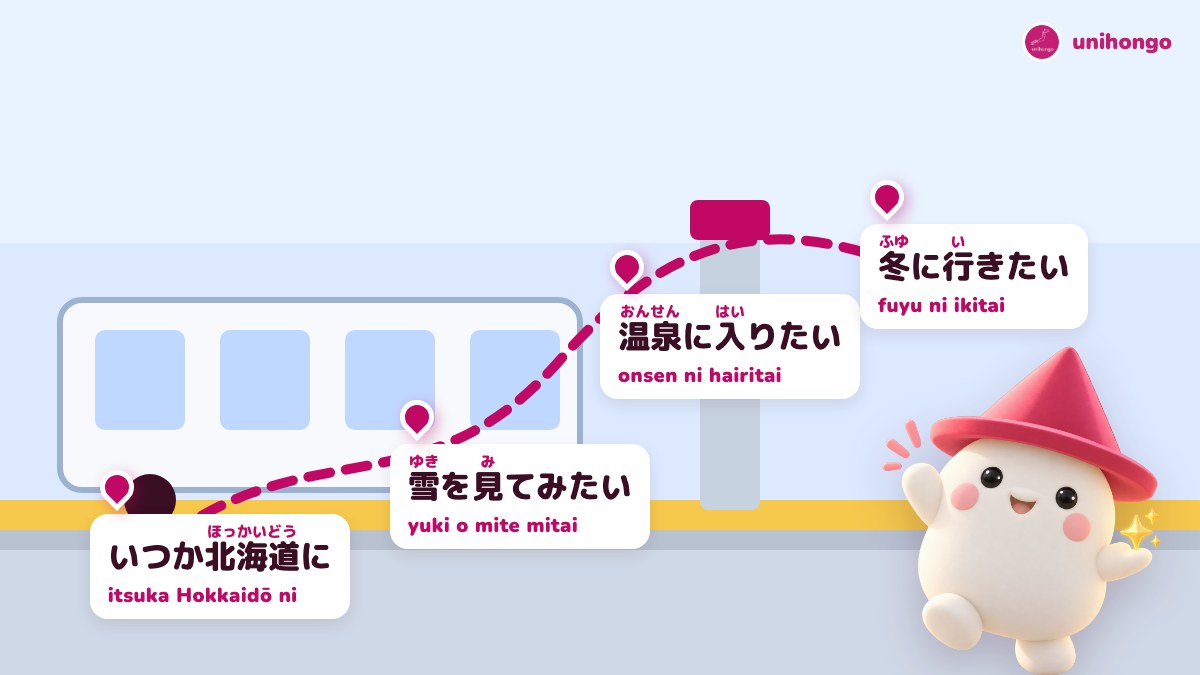
A Japanese listener will almost always ask whether you have been, who you would go with, and then offer a recommendation; dream-trip talk tends to turn into advice. The lines below are the exchange at a café between you and a Japanese friend. The one to practise most is the reply to itta koto ga arimasu ka, because the negative, itta koto ga nai, trips up the mouth.
| Japanese | Romaji | Meaning |
|---|---|---|
| 行ったことがありますか。 | Itta koto ga arimasu ka. | Friend: Have you been there? |
| まだ行ったことがないんです。 | Mada itta koto ga nai n desu. | You: I haven't been yet. |
| 誰と行きたいですか。 | Dare to ikitai desu ka. | Friend: Who do you want to go with? |
| いいですね!私も行きたい。 | Ii desu ne! Watashi mo ikitai. | Friend: Nice! I want to go too. |
| 絶対行ったほうがいいですよ。 | Zettai itta hō ga ii desu yo. | Friend: You should definitely go. |
| おすすめの季節はありますか。 | Osusume no kisetsu wa arimasu ka. | You: Is there a season you recommend? |
~ta hō ga ii desu, you had better, is advice, and Japanese friends give it freely about travel. Receive it with sō nan desu ka, jā, kangaete mimasu, I see, then I'll think about it.
Mistakes and register notes
- Using -tai about other people: tomodachi wa Nihon ni ikitai desu. Say ikitagatte imasu, or ikitai to itte imashita, said they want to go.
- Saying ikitai desu to a boss or a client about something you are asking for. In a request, soften it: ikitai to omotte imasu, or ikitai no desu ga.
- Mixing itsu and itsuka. Itsu is when, a question word; itsuka is someday. Itsuka ikimasu ka sounds like are you going someday?, which is odd; the question is itsu ikimasu ka.
- Translating my dream is to go as yume wa ikitai desu. Yume needs a noun: yume wa Nihon ni iku koto desu.
- Forgetting da before kara after a na-adjective or a noun: kirei kara, Kyōto kara. Say kirei da kara, Kyōto da kara.
Turn the dream into speaking practice
A dream trip is a topic you can talk about for years, so it is worth getting the grammar right once. Start with Mocchi, Unihongo's study assistant: ask it to /explain the difference between ikitai, itte mitai and ikitai to omotte imasu with your own destination in the examples, then give it your four sentences with /correct. Because Mocchi keeps notes on your goals and interests, the place you name will come back later in review questions and speaking suggestions.
Then say it to someone. In AI Sensei, choose Ibuki-sensei and ask Ibuki-sensei to play a Japanese friend who has travelled a lot, who asks where you would go, whether you have been, and who you would go with, and then recommends a season. Ask him to speak slowly the first time. The session report afterwards shows the want-to forms you used and the ones you avoided. A free account at unihongo.com/login gets you into both.
Your turn: say your dream trip aloud
- Itte mitai kuni wa arimasu ka. Name one country or region with itsuka and itte mitai.
- Dōshite desu ka. Give a reason with ni kyōmi ga aru node.
- Soko de nani o shite mitai desu ka. Three things, each with -te mitai.
- Itsu, dono kurai ikitai desu ka. A season and a length with gurai.
- Okane to jikan ga attara, dō shimasu ka. Finish the condition with your biggest wish.