
What the first song night looks like
The room, the drinks and the time plan are the easy part. The part that matters for your first song is the sequence inside the room: someone grabs the tablet, songs go into a queue, the screen announces each one, and your song arrives sooner than you expected. Friends will ask what you are putting in, cheer when the intro starts, and read your score out loud at the end. Knowing the sequence lets you prepare the one moment that is actually hard: the three minutes with the microphone.
| Japanese | Romaji | Meaning |
|---|---|---|
| 歌ってみます。 | Utatte mimasu. | I'll give it a go. |
| Moment | What happens | What you do |
|---|---|---|
| Queue | Someone searches songs on the tablet and adds them | Add your song early so you are not asked on the spot |
| Intro | The screen shows the title and the first lyrics in colour | Take the mic, say utatte mimasu, breathe |
| Verse | Lyrics scroll; the colour change shows the timing | Read the furigana, follow the colour, do not stop |
| Chorus | Friends join in on a famous chorus | Sing louder; the group hides mistakes |
| Score | The machine shows a number if scoring is on | Laugh, say madamada, pass the mic |
Choosing a song you can finish
The best first song is not your favourite song; it is the slowest song you know by heart. The melody you already carry in your head will keep the words coming when your reading falls behind, and a slow tempo gives your eyes time to find the furigana. A well-known classic that everyone in the room recognises, such as the 1960s song Ue o muite arukō (known abroad as Sukiyaki), has the extra advantage that friends sing with you. Many learners also do well with the opening theme of an anime they have watched fifty times.
Avoid, for now, songs with a rap section, long English passages (switching scripts mid-line is surprisingly hard), very high keys, and anything where the chorus repeats a word fast. If a song is slightly too high or low, karaoke machines let you shift the key; asking a friend to lower it by two is completely normal.
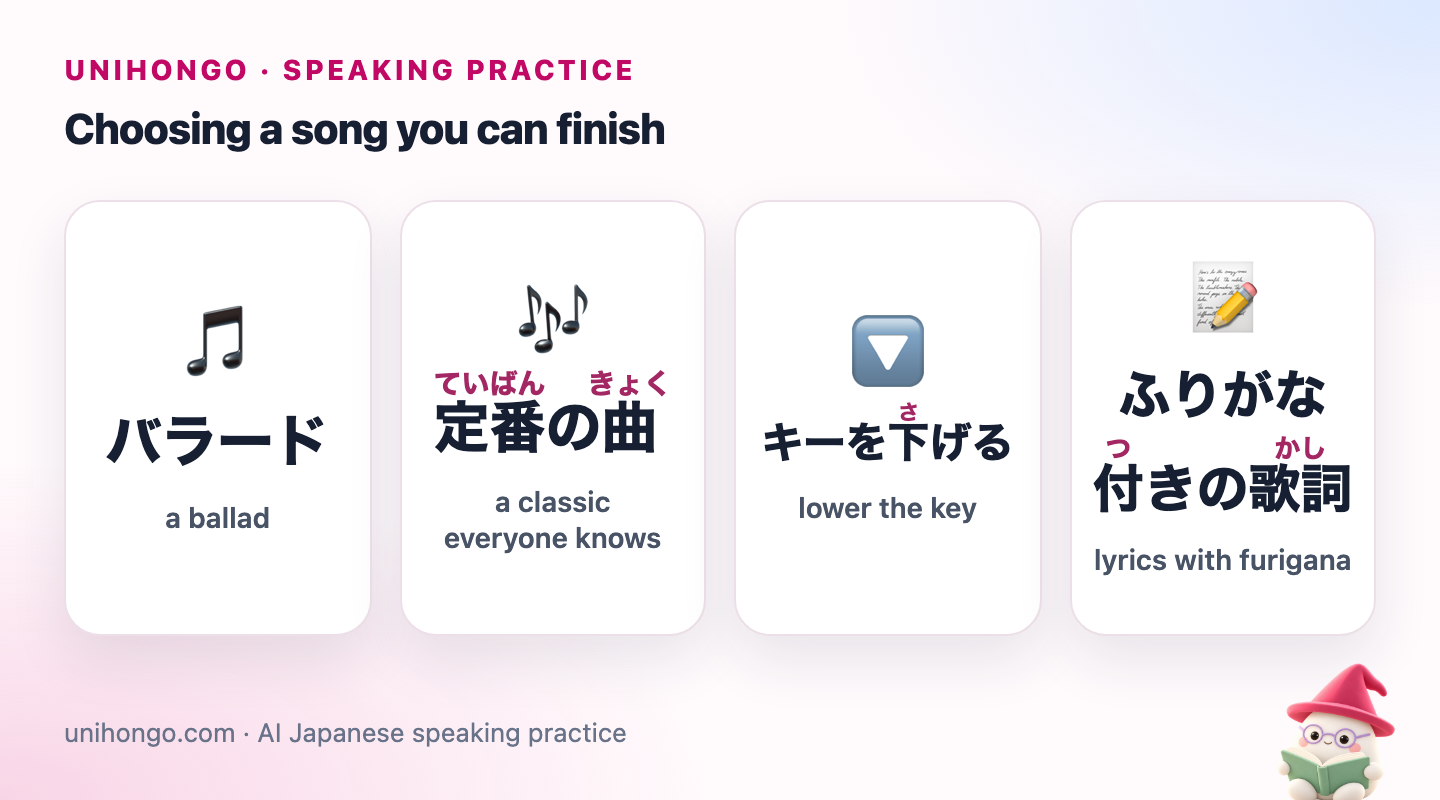
| Japanese | Romaji | Meaning |
|---|---|---|
| バラード | barādo | a ballad |
| 定番の曲 | teiban no kyoku | a classic everyone knows |
| キーを下げる | kī o sageru | lower the key |
| ふりがな付きの歌詞 | furigana tsuki no kashi | lyrics with furigana |
| ゆっくりな曲がいいです。 | Yukkuri na kyoku ga ii desu. | A slow song would be good. |
| この曲、知ってる? | Kono kyoku, shitteru? | Do you know this song? (casual) |
Reading the lyrics on the screen
Karaoke screens show the lyrics a line or two at a time, with the text changing colour at the moment each syllable should be sung. Most systems add furigana above kanji, but it is small, and how it is shown differs by machine and song. Treat the screen as a prompt: if you have read the lyrics with furigana at home, the screen reminds you of the next line rather than teaching it to you on the spot.
Learn the structure words too. Japanese songs are discussed in terms of the verse, the chorus (sabi) and the instrumental break (kansō), and friends will say things like here comes the sabi. During the kansō you can breathe, drink and find your place again.
| Japanese | Romaji | Meaning |
|---|---|---|
| 歌詞 | kashi | lyrics |
| サビ | sabi | the chorus, the hook |
| 間奏 | kansō | instrumental break |
| 色が変わる | iro ga kawaru | the colour changes (timing cue) |
| 歌詞が速い! | Kashi ga hayai! | The lyrics are fast! |
| 見えない。 | Mienai. | I can't see it. (screen too far) |
Rhythm: why long vowels keep you in time
Learners fall behind in Japanese songs for one reason: they count syllables the English way. Japanese counts in kana beats, called mora, and song melodies are written to those beats. A long vowel is two beats, a small tsu is a silent beat, and n is a beat of its own. Once you count this way, the notes and the words line up and you stop running out of sound in the middle of a line.
| Japanese | Romaji | Meaning |
|---|---|---|
| 東京 | Tōkyō | 4 beats: to-o-kyo-o |
| 本当 | hontō | 3 beats: ho-n-to-o |
| きっと | kitto | 3 beats: ki-(hold)-to |
| ありがとう | arigatō | 5 beats: a-ri-ga-to-o |
| 会いたい | aitai | 4 beats: a-i-ta-i |
| ずっと | zutto | 3 beats: zu-(hold)-to |
| 空 | sora | 2 beats: so-ra |
| 夢 | yume | 2 beats: yu-me |
Clap these eight words before you sing. In a song, the held vowel of arigatō often sits on a long note, and the small tsu of zutto lands exactly on a rest. Singers also stretch or bend vowels for expression, so a word may be sung on more notes than it has beats; follow the colour change and the melody rather than fighting it.
Song vocabulary is its own register. Kimi (you), boku (I) and aitai (I want to see you) are everywhere in lyrics and rarer in everyday polite speech; learn them for singing and keep them out of your office vocabulary.
What friends say in the room
The room is a conversation as much as a concert, and the lines are predictable. Most are casual, because karaoke is for friends; with colleagues after work the same lines appear in polite form. Learn the questions so that you can answer, and the praise so that you can reply with something other than a nod.
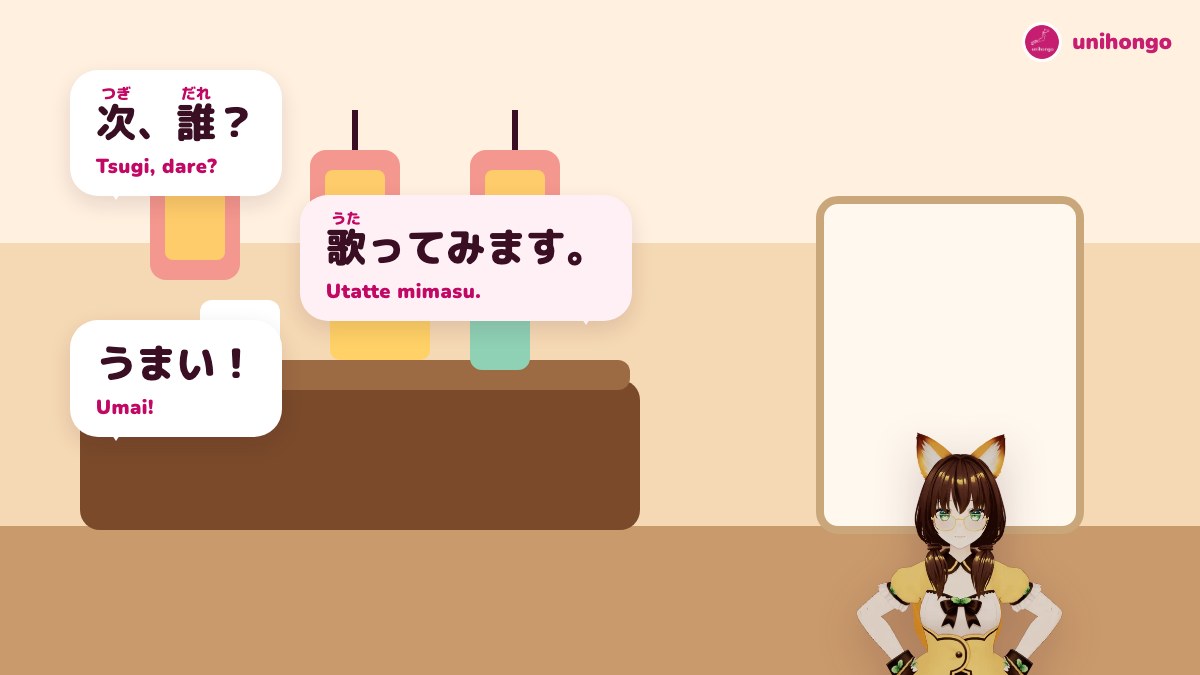
| Japanese | Romaji | Meaning |
|---|---|---|
| 次、誰? | Tsugi, dare? | Friend: Who's next? |
| 何歌う? | Nani utau? | Friend: What are you singing? |
| じゃあ、歌ってみます。 | Jā, utatte mimasu. | You: Okay, I'll give it a go. |
| 一緒に歌おう! | Issho ni utaō! | Friend: Let's sing it together! |
| うまい! | Umai! | Friend: Nice singing! |
| いやいや、まだまだです。 | Iyaiya, madamada desu. | You: Oh no, I've a long way to go. |
| 九十点!すごい! | Kyūjitten! Sugoi! | Friend: Ninety points! Amazing! |
| もう一曲! | Mō ikkyoku! | Friend: One more song! |
| キー、下げようか? | Kī, sageyō ka? | Friend: Shall I lower the key? |
Umai is the universal shout. It is the same word as delicious, which confuses learners; in a karaoke room it means skilful. If someone says jōzu desu ne, the same modest reply works. And a mō ikkyoku is an invitation, not a demand; sing one more or hand the mic on with tsugi, dōzo (next, go ahead).
When it goes wrong mid-song
You will lose the lyrics at least once: a line scrolls faster than you can read, you hit a kanji with no furigana, or the key is wrong and you stop singing to laugh. None of this is a disaster, and there are standard moves. Hum through to the chorus and rejoin there. Skip a line and pick up at the colour change. Say a short word to the room and keep going. Friends will fill the gap by singing along, which is the point of a famous song.
| Japanese | Romaji | Meaning |
|---|---|---|
| あ、間違えた。 | A, machigaeta. | Oops, I messed up. |
| 速すぎる! | Hayasugiru! | Too fast! |
| ここ、読めない。 | Koko, yomenai. | I can't read this bit. |
| サビだけ一緒に歌って。 | Sabi dake issho ni utatte. | Sing just the chorus with me. |
| 最初からもう一回いい? | Saisho kara mō ikkai ii? | Can I start again from the top? |
- Do not stop the song. A stopped song is awkward; a hummed verse is funny.
- Do not apologise after every line. One gomen is plenty.
- If you cannot read the screen from the sofa, stand nearer; nobody minds.
- If you really cannot continue, hand the mic to the person who knows the song and say tsuzuki onegai (please carry on).
How the first song honestly feels
The intro is the worst part: the room goes quiet, your name is on the screen and you suddenly cannot remember how the song starts. Then the first line passes and your body remembers the melody. The verses feel like reading an exam aloud while running; the chorus feels like relief, because everyone joins in. You will finish behind the beat in two places, miss one line entirely, and still get to the end. The score will be lower than the friend who sings every week and higher than you feared.
Then something good happens. The second time you sing the same song, a week later, it is easy. Rhythm and reading speed improve faster through one song repeated than through ten songs attempted, and a learner who owns three karaoke songs has three minutes of Japanese they can produce fluently at full speed, which is more than many classroom learners can say.
Rehearse the rhythm and the room
Two parts of the night can be practised at home. The rhythm is a pronunciation problem, and Unihongo's pronunciation coach has drills focused on exactly the two things songs punish: long vowels and the small tsu. Listen to a line slowed down, record yourself, and the rhythm score shows whether you held the vowel for its full beat. Ten minutes of this before the night changes how you hear the lyrics.
The room is a conversation problem, and AI Sensei can play it. Choose Sakura-sensei, set the karaoke topic, and ask Sakura-sensei to be a friend who asks what you will sing, cheers you on and teases you about the score; then ask Sakura-sensei to switch to polite speech so that you are ready for a work outing too. Your free account at unihongo.com/login covers the coach and the classroom, and Mocchi can first pull out the ten words in your song that you should know before you sing it.