

The title and three words for a chef's life
The biography is titled 料理人・山口春子, Chef Haruko Yamaguchi. In Japanese titles like this, the job comes first and a small dot (・) separates it from the name. Learn the title and these three phrases; they mark the three stages of her career.
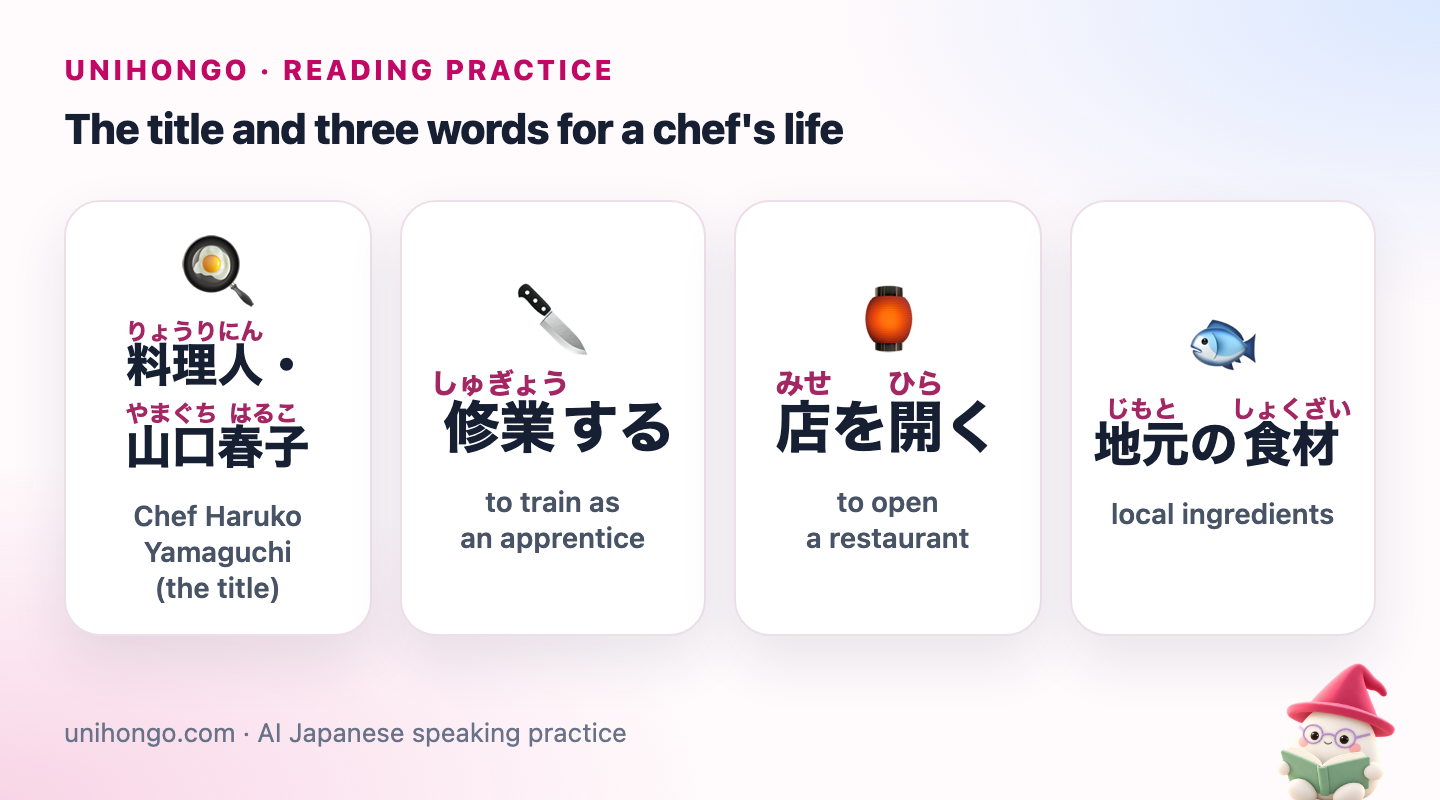
| Japanese | Romaji | Meaning |
|---|---|---|
| 料理人・山口春子 | Ryōrinin Yamaguchi Haruko | Chef Haruko Yamaguchi (the title) |
| 修業する | shugyō suru | to train as an apprentice |
| 店を開く | mise o hiraku | to open a restaurant |
| 地元の食材 | jimoto no shokuzai | local ingredients |
The biography, part 1: childhood and training
The biography is in plain past form. As you read, note every time phrase: 子どものころ, 十歳で, 高校を卒業すると, 最初の三年間. They are the skeleton of the story.
| Japanese | Romaji | Meaning |
|---|---|---|
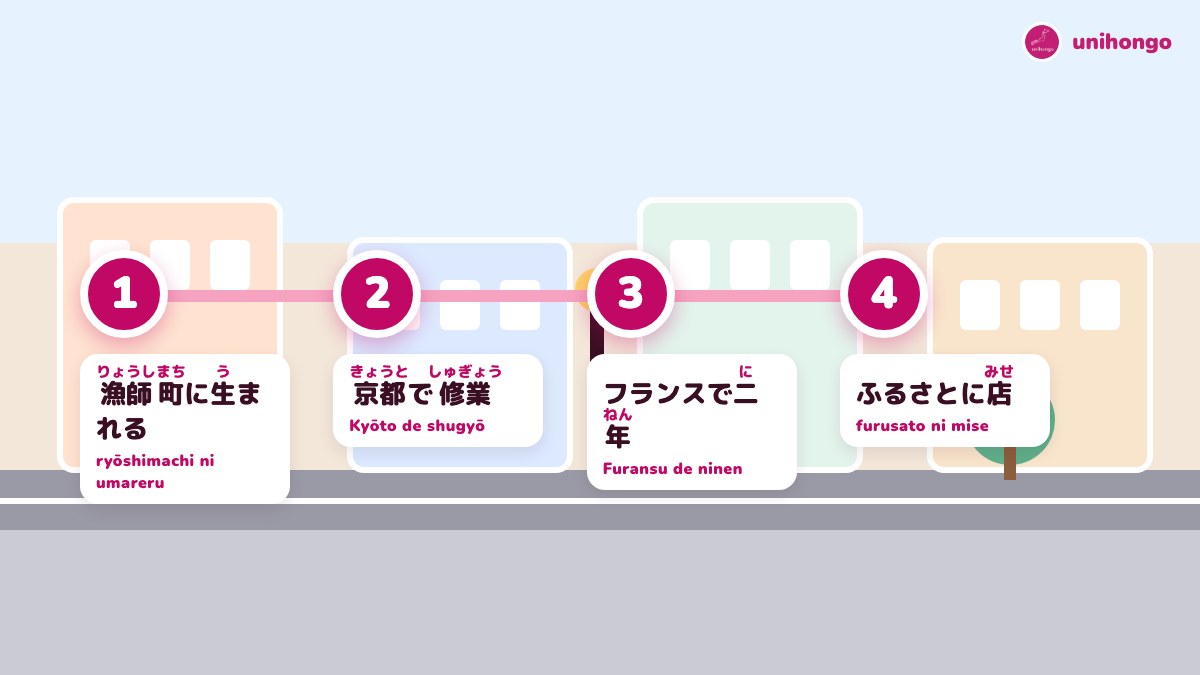
| 山口春子は、海の近くの小さな漁師町で生まれた。 | Yamaguchi Haruko wa, umi no chikaku no chiisana ryōshimachi de umareta. | Haruko Yamaguchi was born in a small fishing town by the sea. |
| 父は漁師で、母は港の近くで小さな食堂をやっていた。 | Chichi wa ryōshi de, haha wa minato no chikaku de chiisana shokudō o yatte ita. | Her father was a fisherman, and her mother ran a small eatery near the harbour. |
| 子どものころから母の手伝いをし、十歳で魚をさばけるようになったという。 | Kodomo no koro kara haha no tetsudai o shi, jussai de sakana o sabakeru yō ni natta to iu. | She helped her mother from childhood and, it is said, could fillet a fish by the age of ten. |
| 高校を卒業すると、京都の料亭で修業を始めた。 | Kōkō o sotsugyō suru to, Kyōto no ryōtei de shugyō o hajimeta. | After finishing high school, she began training at a traditional restaurant in Kyoto. |
| 修業は厳しく、最初の三年間は皿洗いと掃除ばかりだった。 | Shugyō wa kibishiku, saisho no sannenkan wa saraarai to sōji bakari datta. | The training was hard, and for the first three years she did nothing but wash dishes and clean. |
| 親方によく叱られたが、一度もやめようとは思わなかったそうだ。 | Oyakata ni yoku shikarareta ga, ichido mo yameyō to wa omowanakatta sō da. | She was often scolded by the head chef, but she says she never once thought of quitting. |
| 二十八歳のとき、フランスに渡り、二年間レストランで働いた。 | Nijūhassai no toki, Furansu ni watari, ninenkan resutoran de hataraita. | At twenty-eight she moved to France and worked in a restaurant for two years. |
| そこで、和食とフランス料理の共通点に気づいた。 | Soko de, washoku to Furansu ryōri no kyōtsūten ni kizuita. | There she noticed what Japanese and French cooking have in common. |
The biography, part 2: her own restaurant
The second half follows Haruko home. Look for the reason her menu changes every day and for the sentence that sums up her philosophy.
| Japanese | Romaji | Meaning |
|---|---|---|
| 本人の話によると、どちらの料理も素材を生かすことを何より大切にしているという。 | Honnin no hanashi ni yoru to, dochira no ryōri mo sozai o ikasu koto o nani yori taisetsu ni shite iru to iu. | In her own words, both cuisines value bringing out the best in the ingredients above all. |
| 帰国後、ふるさとの町に戻り、小さな店を開いた。 | Kikokugo, furusato no machi ni modori, chiisana mise o hiraita. | After returning to Japan, she went back to her hometown and opened a small restaurant. |
| メニューは毎朝、港でその日にとれた魚を見てから決める。 | Menyū wa maiasa, minato de sono hi ni toreta sakana o mite kara kimeru. | Every morning she decides the menu after seeing the fish caught that day at the harbour. |
| 店は雑誌で紹介され、今では遠くから来る客も多い。 | Mise wa zasshi de shōkai sare, ima de wa tōku kara kuru kyaku mo ōi. | The restaurant was featured in magazines, and now many customers come from far away. |
| 予約は三か月先までいっぱいらしい。 | Yoyaku wa sankagetsu saki made ippai rashii. | Apparently it is fully booked for the next three months. |
| 最近は、地元の高校生に料理を教える活動も続けている。 | Saikin wa, jimoto no kōkōsei ni ryōri o oshieru katsudō mo tsuzukete iru. | Recently she has also been teaching cooking to local high school students. |
| 「いい魚があれば、料理は半分できている」というのが彼女の口ぐせだ。 | Ii sakana ga areba, ryōri wa hanbun dekite iru to iu no ga kanojo no kuchiguse da. | With good fish, the dish is half done, is something she often says. |
Vocabulary notes
Many of these words belong to the world of food and work. A few, such as 口ぐせ and 共通点, are useful in any biography or self-introduction.
| Japanese | Romaji | Meaning |
|---|---|---|
| 漁師町 | ryōshimachi | fishing town |
| 食堂 | shokudō | simple eatery, canteen |
| 魚をさばく | sakana o sabaku | to fillet (prepare) a fish |
| 料亭 | ryōtei | traditional high-class Japanese restaurant |
| 親方 | oyakata | master, head chef (of apprentices) |
| 叱る | shikaru | to scold |
| 共通点 | kyōtsūten | something in common |
| 素材を生かす | sozai o ikasu | to bring out the best in ingredients |
| 帰国後 | kikokugo | after returning to one's country |
| 活動 | katsudō | activity, work (for a cause) |
| 口ぐせ | kuchiguse | a favourite saying, a habit of speech |
やっていた in sentence 2 is the casual verb やる meaning to run a shop or business. In formal writing you would see 営んでいた (itonande ita), but やる is common even in written biographies of ordinary people.
Grammar notes: telling a life story at N3
1. Reporting endings: という, そうだ and らしい. The writer was not there when Haruko was ten, so the story is marked with という (it is said). Her feelings during training are reported with そうだ (she says). The booking situation gets らしい (apparently), information the writer has heard but not checked.
2. 〜ようになる: a new ability or habit. さばけるようになった means she became able to fillet fish. Use the potential form plus ようになる for skills you gained over time.
3. The passive for things that happened to her: 親方に叱られた (was scolded by the head chef) and 雑誌で紹介され (was featured in magazines). The second uses the joining form 紹介され, a written way to link two sentences.
4. 〜ば for a general truth: いい魚があれば (if there is good fish). Her favourite saying is a rule, not a one-time condition, and ば is the natural form for rules and proverbs.
| Japanese | Romaji | Meaning |
|---|---|---|
| その寺は、八百年前に建てられたという。 | Sono tera wa, happyakunen mae ni taterareta to iu. | Pattern 1: That temple is said to have been built eight hundred years ago. |
| 日本に来て、納豆が食べられるようになった。 | Nihon ni kite, nattō ga taberareru yō ni natta. | Pattern 2: Since coming to Japan, I've become able to eat natto. |
| 子どものころ、よく母に叱られた。 | Kodomo no koro, yoku haha ni shikarareta. | Pattern 3: As a child, I was often scolded by my mother. |
| 春になれば、桜が咲く。 | Haru ni nareba, sakura ga saku. | Pattern 4: When spring comes, the cherry blossoms bloom. |
Time phrases that move a life story forward
A biography is held together by time phrases. The text uses several, and the same ones appear in self-introductions, job interviews and speeches about someone's career. Learn them as a set and you can tell any life story in order.
| Japanese | Romaji | Meaning |
|---|---|---|
| 子どものころから | kodomo no koro kara | since childhood |
| 大学を卒業すると | daigaku o sotsugyō suru to | on graduating from university |
| 三十歳のとき | sanjussai no toki | at the age of thirty |
| 帰国後 | kikokugo | after returning home (to one's country) |
| それ以来 | sore irai | ever since then |
〜すると in 卒業すると describes one event followed immediately by the next, which is why biographies use it for turning points. それ以来 (ever since) is not in the text, but it is the natural phrase to add if you want to say that something has continued from a turning point until now, such as それ以来、毎朝港へ行っている.
Comprehension questions
Answer in short polite sentences. Question 1 needs 〜ようになりました.
- Question 1: What could Haruko do by the age of ten?
- Question 2: What did she notice in France?
- Question 3: How does she decide the menu?
| Japanese | Romaji | Meaning |
|---|---|---|
| 魚をさばけるようになりました。 | Sakana o sabakeru yō ni narimashita. | Answer 1: She became able to fillet fish. |
| 和食とフランス料理の共通点です。 | Washoku to Furansu ryōri no kyōtsūten desu. | Answer 2: What Japanese and French cooking have in common. |
| 毎朝、港でその日にとれた魚を見てから決めます。 | Maiasa, minato de sono hi ni toreta sakana o mite kara kimemasu. | Answer 3: Every morning, after seeing the day's catch at the harbour. |
Read it aloud like an introduction
Biographies are often read aloud: to introduce a speaker, in a documentary narration or at an award ceremony. Read this one in a clear, steady voice.
- Read the text silently and underline every time phrase and every age.
- Read part 1 aloud, slowing down at each age: 十歳 (jussai), 二十八歳 (nijūhassai).
- Read part 2 aloud a little warmer, as if you admired her.
- Practise the reporting endings until they sound natural: 〜たという, 〜たそうだ, 〜らしい.
- Close the text and introduce Haruko in five sentences, as if she were about to walk on stage.
Write a short life story of your own
Mocchi is useful twice here. First, paste sentence 9, the one that combines によると, 生かす and という, after /explain to see how the writer separates her words from the narration. Second, write a seven-sentence biography of someone you admire and send it with /correct; Mocchi keeps note of the forms you mix up, such as そうだ and らしい, and returns to them in later reviews.
To practise telling a life story aloud, open AI Sensei and ask Haru-sensei to play a magazine interviewer. Answer his questions as if you were Haruko: where you grew up, how training felt and why you went home.