

Four notice words to spot first
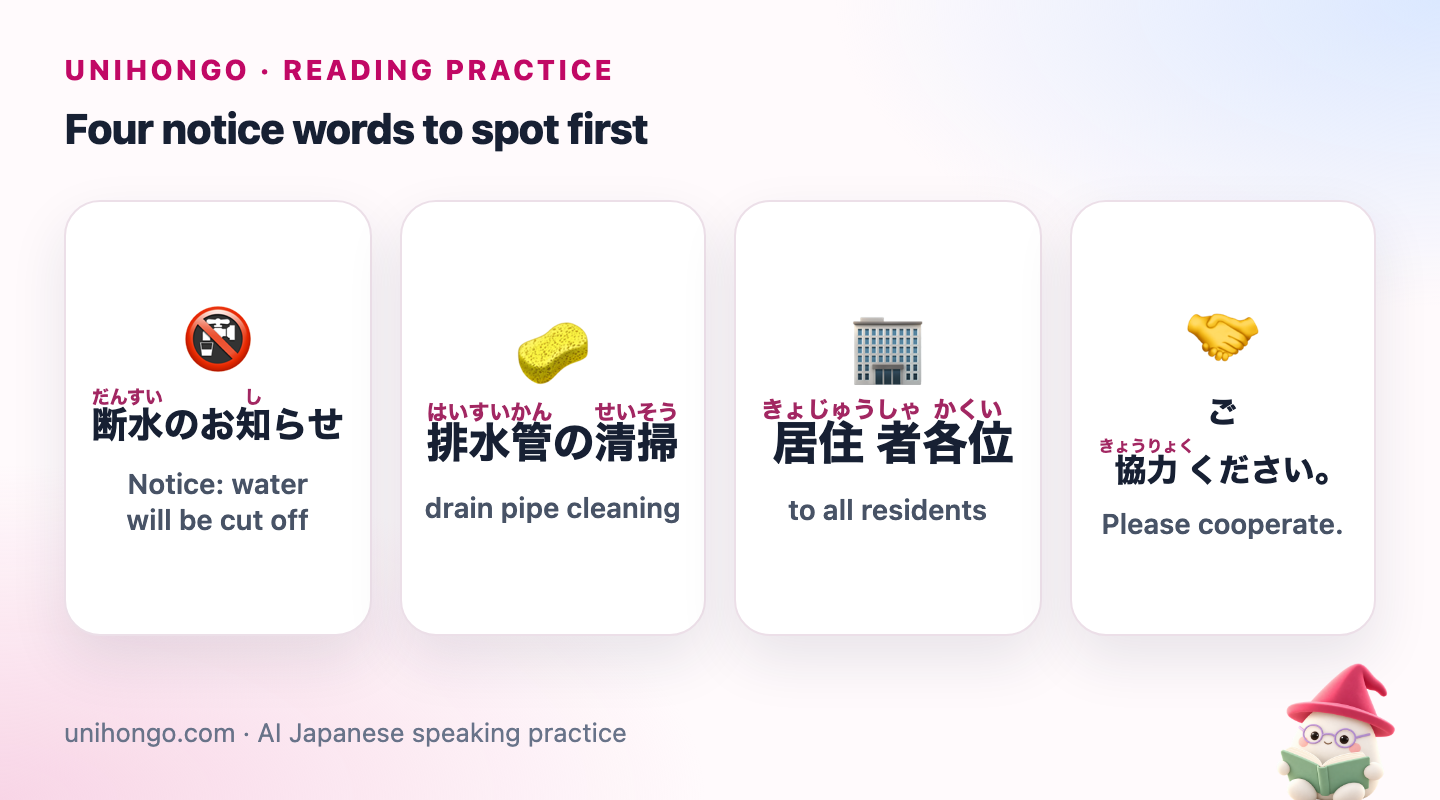
Before you read the full text, learn the four expressions that tell you what kind of notice this is and who it is for. You will see them on notices in almost any building.
| Japanese | Romaji | Meaning |
|---|---|---|
| 断水のお知らせ | Dansui no oshirase | Notice: water will be cut off |
| 排水管の清掃 | haisuikan no seisō | drain pipe cleaning |
| 居住者各位 | kyojūsha kakui | to all residents |
| ご協力ください。 | Gokyōryoku kudasai. | Please cooperate. |
The notice, part 1: the water cut
The first half of the notice announces the water outage. Find the date, the time and what you cannot use.
| Japanese | Romaji | Meaning |
|---|---|---|
| 居住者各位 | Kyojūsha kakui | To all residents |
| 断水および排水管清掃のお知らせ | Dansui oyobi haisuikan seisō no oshirase | Notice of water outage and drain pipe cleaning |
| いつもご協力いただき、ありがとうございます。 | Itsumo gokyōryoku itadaki, arigatō gozaimasu. | Thank you for your continued cooperation. |
| このたび、給水設備の点検を行うため、下記のとおり断水いたします。 | Kono tabi, kyūsui setsubi no tenken o okonau tame, kaki no tōri dansui itashimasu. | The water supply will be cut off as below so that the water equipment can be inspected. |
| 日時:十一月十二日(木)午前十時~午後三時 | Nichiji: jūichigatsu jūninichi (moku) gozen jūji kara gogo sanji | Date and time: Thursday 12 November, 10 a.m. to 3 p.m. |
| 断水中は、水道、トイレ、洗濯機などが使えません。 | Dansui-chū wa, suidō, toire, sentakuki nado ga tsukaemasen. | During the outage, you cannot use the taps, toilet, washing machine and so on. |
| トイレの水は、事前にバケツなどにためておけば、流すことができます。 | Toire no mizu wa, jizen ni baketsu nado ni tamete okeba, nagasu koto ga dekimasu. | If you store water in a bucket or similar beforehand, you can flush the toilet. |
| 断水が終わった後は、しばらく水が濁ることがあります。 | Dansui ga owatta ato wa, shibaraku mizu ga nigoru koto ga arimasu. | After the outage, the water may be cloudy for a while. |
The notice, part 2: the drain cleaning
The second half is about a different day and asks more of you. Look for what you must do before the workers come, and the deadline if the date does not suit you.
| Japanese | Romaji | Meaning |
|---|---|---|
| また、十一月十九日(木)には、各部屋の排水管の清掃が行われます。 | Mata, jūichigatsu jūkunichi (moku) ni wa, kaku heya no haisuikan no seisō ga okonawaremasu. | Also, on Thursday 19 November, the drain pipes in every flat will be cleaned. |
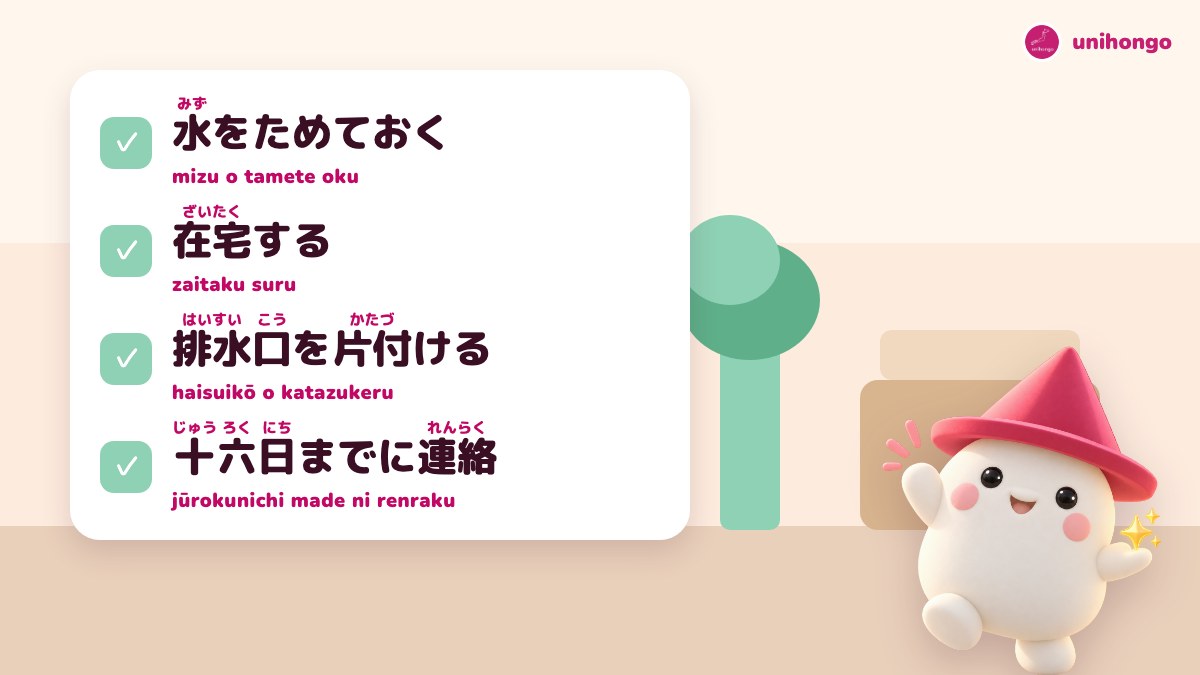
| 作業員が部屋に入りますので、ご在宅をお願いいたします。 | Sagyōin ga heya ni hairimasu node, gozaitaku o onegai itashimasu. | Workers will enter each flat, so please be at home. |
| 台所、浴室、洗面所の排水口の周りの物は、片付けておいてください。 | Daidokoro, yokushitsu, senmenjo no haisuikō no mawari no mono wa, katazukete oite kudasai. | Please clear away anything around the drains in the kitchen, bathroom and washroom. |
| 作業の時間は、部屋番号によって異なります。 | Sagyō no jikan wa, heya bangō ni yotte kotonarimasu. | The time of the work depends on your flat number. |
| 詳しい時間は、一階の掲示板に貼り出されます。 | Kuwashii jikan wa, ikkai no keijiban ni haridasaremasu. | The exact times will be posted on the bulletin board on the ground floor. |
| ご都合が悪い場合は、十一月十六日までに管理会社へご連絡ください。 | Gotsugō ga warui baai wa, jūichigatsu jūrokunichi made ni kanri gaisha e gorenraku kudasai. | If the date is inconvenient, please contact the management company by 16 November. |
| ご不便をおかけしますが、ご理解とご協力をお願いいたします。 | Gofuben o okake shimasu ga, gorikai to gokyōryoku o onegai itashimasu. | We apologise for the inconvenience and ask for your understanding and cooperation. |
| みどり管理株式会社 | Midori Kanri Kabushiki-gaisha | Midori Management Co., Ltd. |
Vocabulary notes
Building notices use formal kanji words where speech would use simpler ones. The gloss gives the everyday meaning, and the note below shows a few spoken equivalents.
| Japanese | Romaji | Meaning |
|---|---|---|
| 断水 | dansui | water outage, water cut |
| 給水設備 | kyūsui setsubi | water supply equipment |
| 点検 | tenken | inspection, check |
| 下記のとおり | kaki no tōri | as stated below |
| 日時 | nichiji | date and time |
| 濁る | nigoru | to become cloudy, muddy |
| 作業員 | sagyōin | worker, technician |
| 在宅 | zaitaku | being at home |
| 排水口 | haisuikō | drain (opening) |
| 掲示板 | keijiban | bulletin board, notice board |
| 管理会社 | kanri gaisha | management company |
In speech, a neighbour would say 水が止まる instead of 断水する, 家にいる instead of 在宅, and 片付ける stays the same. Recognising both versions lets you read the notice and then talk about it.
Grammar notes: the patterns behind the formal tone
1. 〜ておけば and 〜ておいてください: preparing in advance. ためておけば means if you store it beforehand, and 片付けておいてください asks you to clear things before the workers arrive.
2. The passive for scheduled work: 清掃が行われます (cleaning will be carried out) and 掲示板に貼り出されます (will be posted). The notice cares about the work, not about who does it, so the passive is the natural choice.
3. 〜場合は: in the case that. ご都合が悪い場合は is more formal than 都合が悪かったら and is standard in notices, contracts and instructions.
4. 〜によって異なる: varies depending on. 部屋番号によって異なります means it depends on the flat number. When you see this, look for the detailed list somewhere else, here the bulletin board.
| Japanese | Romaji | Meaning |
|---|---|---|
| 明日の分も、今日買っておけば安心です。 | Ashita no bun mo, kyō katte okeba anshin desu. | Pattern 1: If you buy tomorrow's share today too, you won't need to worry. |
| 来週、エレベーターの点検が行われます。 | Raishū, erebētā no tenken ga okonawaremasu. | Pattern 2: The lift will be inspected next week. |
| 鍵をなくした場合は、すぐにご連絡ください。 | Kagi o nakushita baai wa, sugu ni gorenraku kudasai. | Pattern 3: If you lose your key, please contact us immediately. |
| ごみの日は、地域によって異なります。 | Gomi no hi wa, chiiki ni yotte kotonarimasu. | Pattern 4: Rubbish collection days vary by area. |
| 管理人さんによると、一部屋三十分くらいらしいですよ。 | Kanrinin san ni yoru to, hitoheya sanjuppun kurai rashii desu yo. | Neighbour: According to the caretaker, it takes about thirty minutes a flat. |
Neighbours often pass on notice information in casual speech with によると and らしい, as in the last example. That is how the formal notice turns into everyday conversation in the lift.
Other notices you will find in your mailbox
Once you can read this notice, most others follow the same pattern with different nouns. These titles are common in Japanese apartment buildings, though what is required varies by building, so always read the details.
| Japanese | Romaji | Meaning |
|---|---|---|
| 停電のお知らせ | Teiden no oshirase | Notice of a power cut |
| 消防設備点検のお知らせ | Shōbō setsubi tenken no oshirase | Notice of a fire equipment inspection |
| 外壁工事のお知らせ | Gaiheki kōji no oshirase | Notice of exterior wall work |
| 騒音についてのお願い | Sōon ni tsuite no onegai | A request about noise |
- A title ending in お知らせ is information; one ending in お願い is a request, often a polite complaint about noise, rubbish or bicycles.
- A fire equipment inspection often needs someone to let the technicians in to check the smoke alarm, much like the drain cleaning here.
- If a notice mentions 入室 (entering your room), check the date carefully and contact the management company if you cannot be there.
Comprehension questions
Answer in polite Japanese. These are the questions a busy resident really needs answered.
- Question 1: What can't you use during the water outage?
- Question 2: What do you need to do on 19 November?
- Question 3: What should you do if 19 November is inconvenient?
| Japanese | Romaji | Meaning |
|---|---|---|
| 水道、トイレ、洗濯機などが使えません。 | Suidō, toire, sentakuki nado ga tsukaemasen. | Answer 1: The taps, toilet, washing machine and so on. |
| 家にいて、排水口の周りの物を片付けておきます。 | Ie ni ite, haisuikō no mawari no mono o katazukete okimasu. | Answer 2: Stay at home and clear things away from the drains. |
| 十一月十六日までに管理会社に連絡します。 | Jūichigatsu jūrokunichi made ni kanri gaisha ni renraku shimasu. | Answer 3: Contact the management company by 16 November. |
A short routine for reading it aloud
Formal notices are rarely read aloud, but doing so helps the set phrases stick, and you will need them when you phone the management company.
- Read the date line aloud: the dates, days of the week and times. Dates are the part learners most often misread.
- Read the formulas aloud three times each: いつもご協力いただき, ご不便をおかけしますが, ご理解とご協力をお願いいたします.
- Read part 2 at a calm, even speed, as if you were reading it to a neighbour.
- Practise the tricky readings: 十九日 (jūkunichi), 十六日 (jūrokunichi), 浴室 (yokushitsu) and 掲示板 (keijiban).
- Say what the notice asks in three casual sentences, starting with 来週、水が止まるんだって.
Handle the next notice on your own
Next time a notice lands in your mailbox, type the hardest line into Mocchi after /explain. Mocchi separates the formal formula from the actual instruction and tells you what, if anything, you need to do. If notices are a regular headache, ask Mocchi to add a few notice words to your study plan; it keeps track of them and brings them back in short reviews.
When you need to call the management company to change the date, rehearse first. In AI Sensei, ask Yamada-sensei to play the person at the management office, explain that you cannot be at home on the 19th and ask for another time.