

The question and three key words
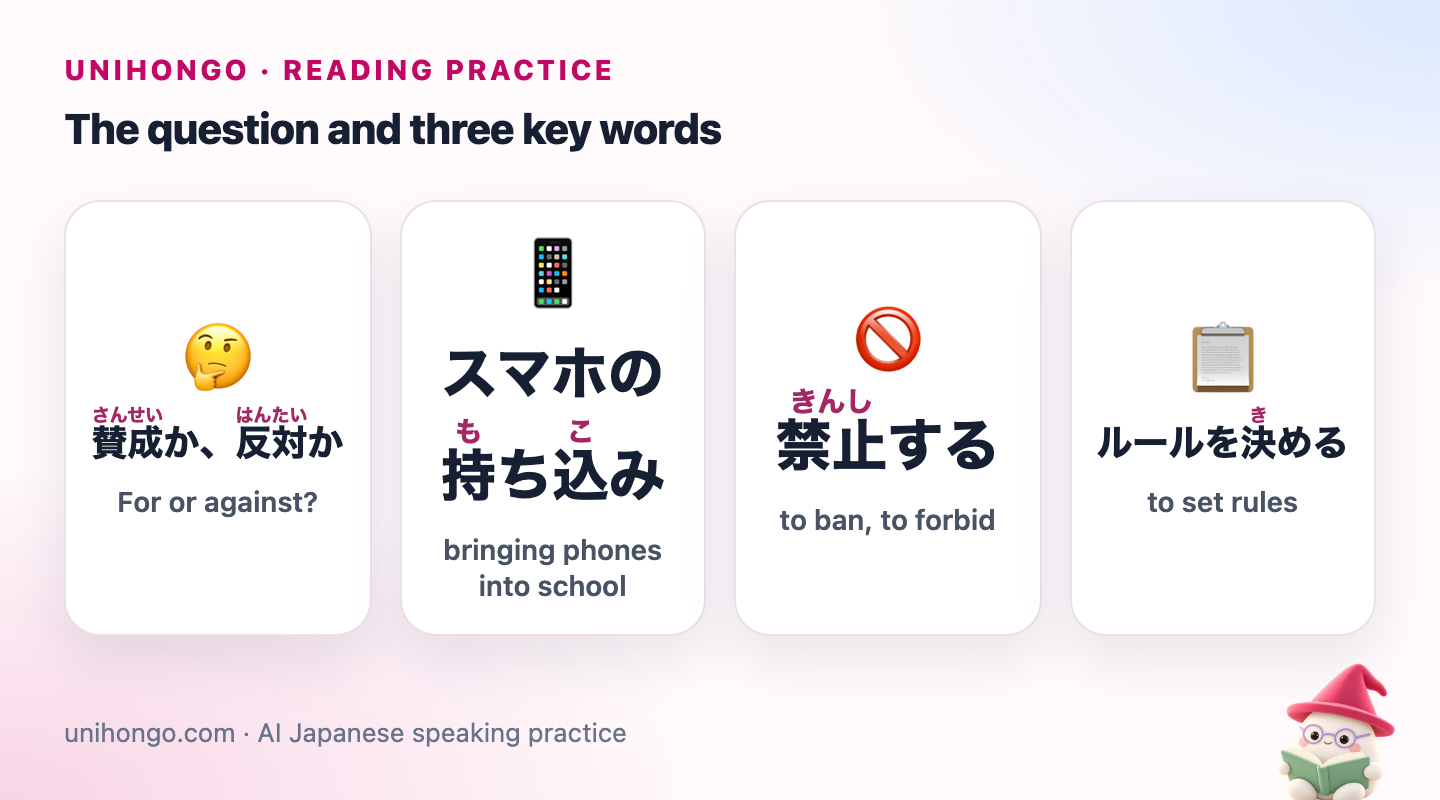
Every opinion text answers one question. Here it is 賛成か、反対か: are you for or against? Learn these four lines first and you can follow the whole argument.
| Japanese | Romaji | Meaning |
|---|---|---|
| 賛成か、反対か | Sansei ka, hantai ka | For or against? |
| スマホの持ち込み | sumaho no mochikomi | bringing phones into school |
| 禁止する | kinshi suru | to ban, to forbid |
| ルールを決める | rūru o kimeru | to set rules |
The essay, part 1: the issue and the other side
The essay is in plain form, the normal style for opinion writing. In this half the writer sets out the problem and gives the other side a fair hearing. Watch for the word that turns the argument.
| Japanese | Romaji | Meaning |
|---|---|---|
| 最近、中学校や高校でのスマートフォンの使用について、さまざまな意見がある。 | Saikin, chūgakkō ya kōkō de no sumātofon no shiyō ni tsuite, samazama na iken ga aru. | These days there are many different opinions about smartphone use in junior and senior high schools. |
| 授業中にゲームをしたり、ネットを見たりする生徒がいるため、全面的に禁止すべきだと言う人もいる。 | Jugyōchū ni gēmu o shitari, netto o mitari suru seito ga iru tame, zenmenteki ni kinshi subeki da to iu hito mo iru. | Because some students play games or browse the internet in class, some people say phones should be banned completely. |
| 友人の話によると、彼の学校では朝、スマホを先生に預けるらしい。 | Yūjin no hanashi ni yoru to, kare no gakkō de wa asa, sumaho o sensei ni azukeru rashii. | According to a friend, at his school students hand their phones to the teacher in the morning. |
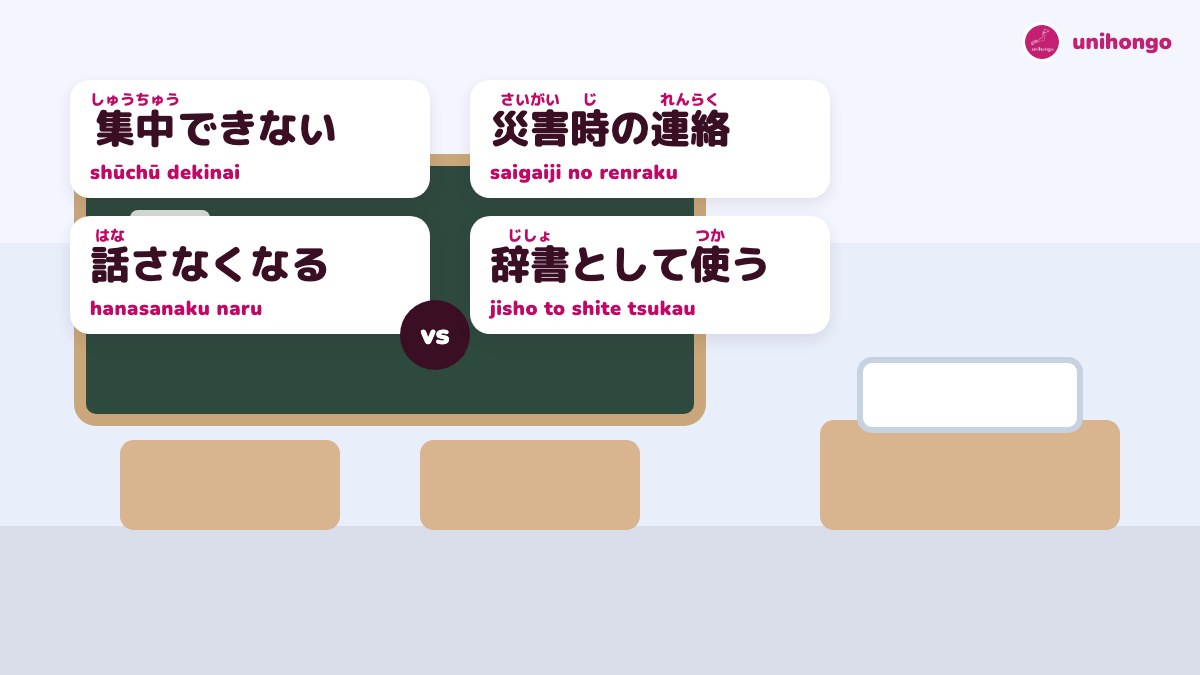
| 確かに、スマホがあれば、授業に集中できない生徒もいるだろう。 | Tashika ni, sumaho ga areba, jugyō ni shūchū dekinai seito mo iru darō. | It is true that if they have a phone, some students probably can't concentrate in class. |
| 休み時間もスマホばかり見ていて、友達と話さなくなるという心配もある。 | Yasumi jikan mo sumaho bakari mite ite, tomodachi to hanasanaku naru to iu shinpai mo aru. | There is also the worry that students look only at their phones during breaks and stop talking to friends. |
| しかし、私は全面的な禁止には反対だ。 | Shikashi, watashi wa zenmenteki na kinshi ni wa hantai da. | However, I am against a complete ban. |
| 理由は三つある。 | Riyū wa mittsu aru. | I have three reasons. |
The essay, part 2: three reasons and a proposal
The second half gives the reasons in order and ends with a proposal. Numbered reasons with 第一に, 第二に and 第三に make the structure easy to follow.
| Japanese | Romaji | Meaning |
|---|---|---|
| 第一に、災害が起きたとき、家族と連絡が取れなければ困る。 | Dai ichi ni, saigai ga okita toki, kazoku to renraku ga torenakereba komaru. | First, if a disaster happens and students can't contact their families, that is a serious problem. |
| 第二に、調べ学習や辞書として使えば、スマホは便利な道具になる。 | Dai ni ni, shirabe gakushū ya jisho to shite tsukaeba, sumaho wa benri na dōgu ni naru. | Second, if they are used for research or as a dictionary, phones become useful tools. |
| 第三に、使い方を学ぶことも、今の時代には大切な教育だと思う。 | Dai san ni, tsukaikata o manabu koto mo, ima no jidai ni wa taisetsu na kyōiku da to omou. | Third, I think learning how to use them is also an important part of education today. |
| 禁止されると、生徒は隠れて使うようになるかもしれない。 | Kinshi sareru to, seito wa kakurete tsukau yō ni naru kamoshirenai. | If phones are banned, students may start using them in secret. |
| そこで私は、授業中は電源を切るなどのルールを、生徒と先生が一緒に決めることに賛成する。 | Soko de watashi wa, jugyōchū wa dengen o kiru nado no rūru o, seito to sensei ga issho ni kimeru koto ni sansei suru. | So I support students and teachers deciding rules together, such as turning phones off during class. |
| 自分たちで決めたルールなら、守ろうという気持ちも強くなるはずだ。 | Jibuntachi de kimeta rūru nara, mamorō to iu kimochi mo tsuyoku naru hazu da. | If students make the rules themselves, they should feel more motivated to keep them. |
| スマホは使い方次第で、敵にも味方にもなる。 | Sumaho wa tsukaikata shidai de, teki ni mo mikata ni mo naru. | Depending on how it is used, a smartphone can be an enemy or an ally. |
| 大切なのは、禁止することではなく、上手に付き合う方法を考えることだ。 | Taisetsu na no wa, kinshi suru koto de wa naku, jōzu ni tsukiau hōhō o kangaeru koto da. | What matters is not banning them, but thinking about how to live with them well. |
Vocabulary notes
Opinion texts reuse a set of abstract words. Learn them here and you will meet them again in newspaper columns and JLPT passages on any topic.
| Japanese | Romaji | Meaning |
|---|---|---|
| 意見 | iken | opinion |
| 全面的に | zenmenteki ni | completely, across the board |
| 預ける | azukeru | to hand over for safekeeping |
| 集中する | shūchū suru | to concentrate |
| 心配 | shinpai | worry, concern |
| 災害 | saigai | disaster |
| 連絡が取れる | renraku ga toreru | to be able to get in touch |
| 調べ学習 | shirabe gakushū | research-based learning (at school) |
| 教育 | kyōiku | education |
| 隠れて | kakurete | secretly, out of sight |
| 〜次第 | shidai | depending on … |
| 付き合う | tsukiau | to deal with, to live with; to go out with |
付き合う has several meanings. Between people it often means to date or to keep company with someone, but with things or problems, as here, it means to live with or deal with them.
Grammar notes: building an argument at N3
1. 〜によると〜らしい: evidence from others. The writer mentions a friend's school as an example, marked as hearsay so it does not sound like a general fact.
2. 〜ば and 〜なければ: conditions in reasons. スマホがあれば (if they have a phone), 連絡が取れなければ (if they can't contact), 使えば (if used). Opinion essays use conditions to show cause and effect.
3. The passive 禁止される: 禁止されると (if it is banned) focuses on the students affected, not on whoever makes the rule.
4. Opinion endings: 〜べきだ (should), 〜だろう (probably), 〜はずだ (ought to, by reasoning) and 〜と思う (I think). The writer uses べきだ only when quoting the other side, and softer endings for their own view, which is typical of careful Japanese opinion writing.
| Japanese | Romaji | Meaning |
|---|---|---|
| ニュースによると、来月から値段が上がるらしい。 | Nyūsu ni yoru to, raigetsu kara nedan ga agaru rashii. | Pattern 1: According to the news, prices are going up from next month. |
| 急がなければ、電車に間に合わない。 | Isoganakereba, densha ni maniawanai. | Pattern 2: If we don't hurry, we'll miss the train. |
| この公園では、ボール遊びが禁止されている。 | Kono kōen de wa, bōru asobi ga kinshi sarete iru. | Pattern 3: Ball games are banned in this park. |
| 約束は守るべきだ。 | Yakusoku wa mamoru beki da. | Pattern 4: You should keep your promises. |
| 彼はもう家に着いているはずだ。 | Kare wa mō ie ni tsuite iru hazu da. | Pattern 4: He should be home by now. |
| Signal | Job in the argument | What to expect next |
|---|---|---|
| 確かに | Admits the other side's point | しかし or でも, then the writer's view |
| しかし | Turns the argument | The writer's real opinion |
| 第一に, 第二に | Numbers the reasons | One reason per sentence |
| そこで | Moves to a proposal | What the writer suggests |
| 大切なのは〜ことだ | States the conclusion | The main message in one sentence |
How the JLPT asks about opinion texts
N3 reading questions on opinion texts usually come in a few familiar shapes. Knowing them lets you read with a purpose instead of translating every sentence.
- 筆者の考えに合うのはどれか: which matches the writer's opinion? Look after しかし and at the final sentence, not at the opinions the writer quotes from others.
- 〜とあるが、なぜか: the text says …, but why? The answer is usually in the sentence just before or after, often marked with から, ため or 第一に.
- この文章で筆者が最も言いたいことは何か: what does the writer most want to say? Choose the option closest to the 大切なのは… sentence.
- Watch for traps: an option that repeats the other side's view (禁止すべきだ) will look familiar, but it is not the writer's opinion.
Practise with this text: cover the comprehension answers below and try to state, in one Japanese sentence, what the writer most wants to say. Then compare it with the final line of the essay. Full mock tests with timed reading sections help you practise this under pressure once single texts feel comfortable.
Comprehension questions
These match the kind of question the JLPT asks about opinion texts: the writer's view, a reason and the conclusion.
- Question 1: What is the writer's opinion about a complete ban?
- Question 2: What is the writer's first reason?
- Question 3: What does the writer propose instead?
| Japanese | Romaji | Meaning |
|---|---|---|
| 全面的な禁止には反対です。 | Zenmenteki na kinshi ni wa hantai desu. | Answer 1: The writer is against a complete ban. |
| 災害のとき、家族と連絡が取れないと困るからです。 | Saigai no toki, kazoku to renraku ga torenai to komaru kara desu. | Answer 2: Because in a disaster it would be a problem not to be able to contact family. |
| 生徒と先生が一緒にルールを決めることです。 | Seito to sensei ga issho ni rūru o kimeru koto desu. | Answer 3: That students and teachers decide the rules together. |
Read it aloud like a debate speech
Opinion texts become much easier once you hear their rhythm. Read this one as if you were presenting it to a class.
- Read part 1 silently and mark 確かに and しかし with arrows.
- Read part 1 aloud in a neutral voice, then make your voice firmer on しかし、私は全面的な禁止には反対だ.
- Read the three reasons aloud, pausing after 第一に, 第二に and 第三に so each reason stands out.
- Practise the long vowels and double consonants in 中学校 (chūgakkō), 集中 (shūchū) and 全面的 (zenmenteki).
- Close the text and give the writer's argument in four sentences: opinion, two reasons, proposal.
Argue the other side out loud
Ask Mocchi to /explain the last sentence, 大切なのは…ことだ, a structure you can reuse in any opinion essay or speech. Then write your own short opinion on a different school topic, such as school uniforms, and ask Mocchi to check it; it will remember the opinion patterns you have practised and build them into your next /quiz.
For speaking, open AI Sensei, choose Ibuki-sensei and ask Ibuki-sensei to take the opposite side and argue for a full ban. Defend the writer's view with the three reasons, then swap sides and argue against yourself.