
The skeleton of a call to make plans
Almost every casual call to make plans uses some version of these four lines. Hear them as signposts: the first opens the call, the next two build the plan, and the last closes it.
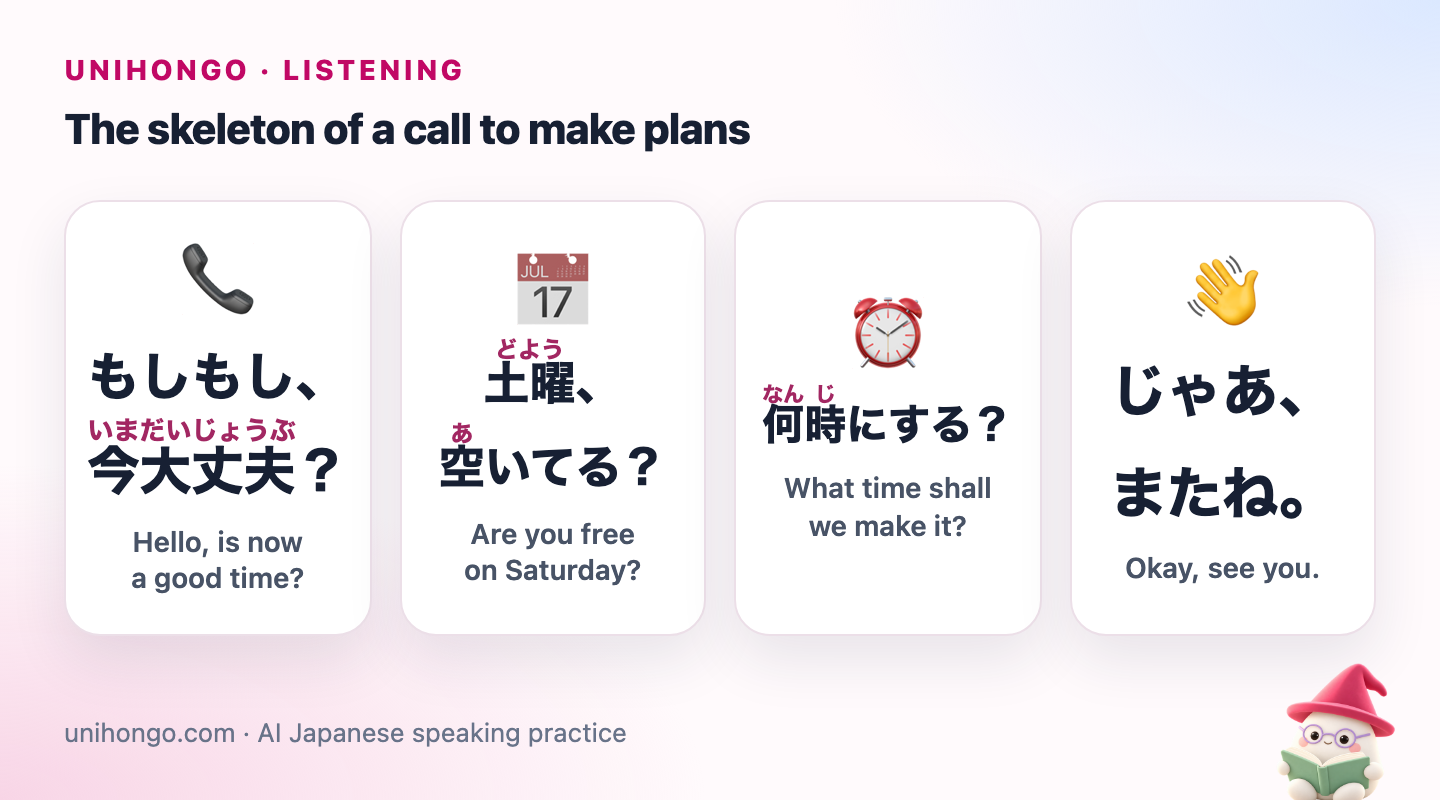
| Japanese | Romaji | Meaning |
|---|---|---|
| もしもし、今大丈夫? | Moshimoshi, ima daijōbu? | Hello, is now a good time? |
| 土曜、空いてる? | Doyō, aiteru? | Are you free on Saturday? |
| 何時にする? | Nanji ni suru? | What time shall we make it? |
| じゃあ、またね。 | Jā, mata ne. | Okay, see you. |
Notice that none of these questions has か. In casual speech a rising tone turns a statement into a question, so 空いてる with a rise means are you free, and with a fall it means I'm free or you're free.
The script: lunch on Saturday
You call your friend Yui to suggest trying a new curry restaurant near the station. Both of you speak casually throughout. Read the whole call once, then read only Yui's lines and predict your own replies.
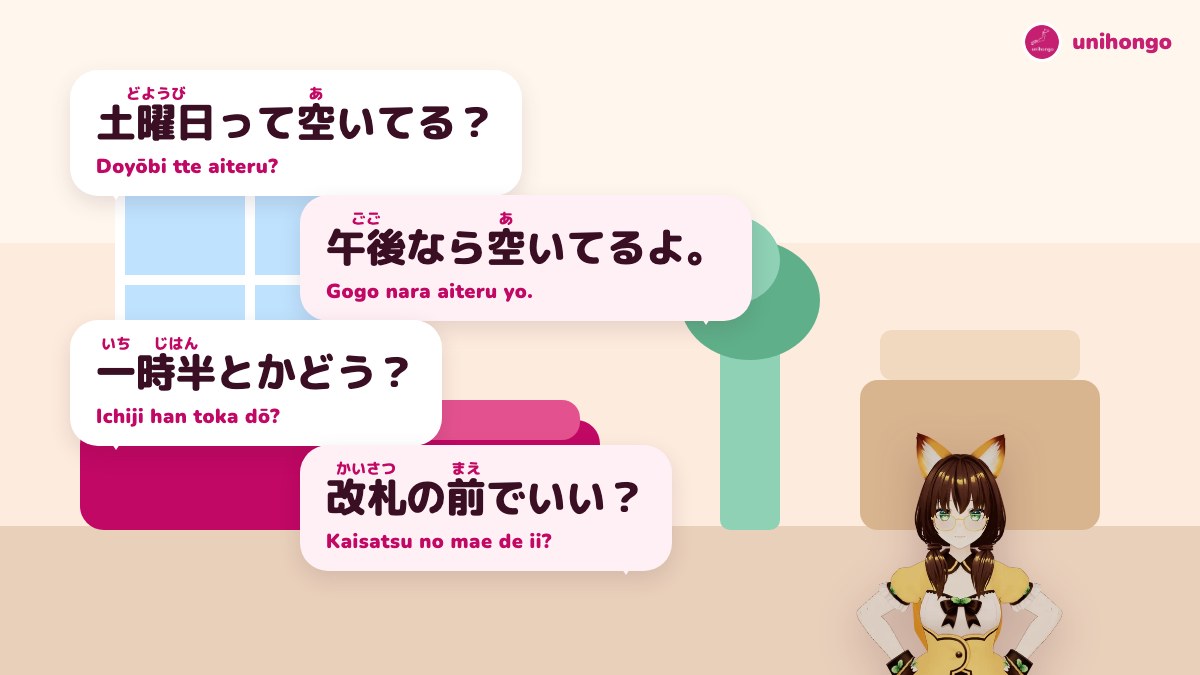
| Japanese | Romaji | Meaning |
|---|---|---|
| もしもし、ゆい?今大丈夫? | Moshimoshi, Yui? Ima daijōbu? | You: Hello, Yui? Is now okay? |
| うん、大丈夫だよ。どうしたの? | Un, daijōbu da yo. Dō shita no? | Friend: Yeah, it's fine. What's up? |
| 土曜日って空いてる? | Doyōbi tte aiteru? | You: Are you free on Saturday? |
| 土曜?午前中はバイトだけど、午後なら空いてるよ。 | Doyō? Gozenchū wa baito da kedo, gogo nara aiteru yo. | Friend: Saturday? I've got my part-time job in the morning, but I'm free in the afternoon. |
| 新しくできたカレー屋さん、行かない? | Atarashiku dekita karē yasan, ikanai? | You: Want to go to the new curry place? |
| あ、駅前のとこ?行きたいと思ってたんだ。 | A, ekimae no toko? Ikitai to omottetan da. | Friend: Oh, the one by the station? I've been wanting to go. |
| じゃあ、何時にする? | Jā, nanji ni suru? | You: So, what time? |
| バイト終わるの一時だから、一時半とかどう? | Baito owaru no ichiji da kara, ichiji han toka dō? | Friend: My shift ends at one, so how about half past one or so? |
| いいよ。どこで待ち合わせる? | Ii yo. Doko de machiawaseru? | You: Sure. Where shall we meet? |
| 改札の前でいい? | Kaisatsu no mae de ii? | Friend: In front of the ticket gates, okay? |
| オッケー。混んでるかもしれないから、早めに行っとくね。 | Okkē. Konderu kamo shirenai kara, hayame ni ittoku ne. | You: Okay. It might be busy, so I'll get there a bit early. |
| ありがとう。遅れそうだったら、LINEするね。 | Arigatō. Okuresō dattara, rain suru ne. | Friend: Thanks. If I'm running late, I'll message you on LINE. |
| わかった。じゃあ、土曜日ね。 | Wakatta. Jā, doyōbi ne. | You: Got it. See you Saturday, then. |
| うん、楽しみにしてる。またね。 | Un, tanoshimi ni shiteru. Mata ne. | Friend: Yeah, looking forward to it. Bye. |
| またね。 | Mata ne. | You: Bye. |
What to listen for
Casual Japanese on the phone is fast mainly because it is short. Particles drop out, verb endings shrink, and some words are clipped. Once you know the regular patterns, most of the speed disappears.
| In the script | Full form | What happened |
|---|---|---|
| 土曜日って | 土曜日は | って marks the topic in casual questions |
| 空いてる | 空いている | The い of いる drops |
| 思ってたんだ | 思っていたのだ | い drops and の becomes ん |
| 行っとく | 行っておく | ておく shrinks to とく |
| 駅前のとこ | 駅前のところ | ところ is clipped to とこ |
| カレー屋さん、行かない? | カレー屋さんに行かない? | The particle に is dropped |
| 一時半とか | 一時半など | とか softens a suggestion |
- の at the end of a question (どうしたの?) asks for an explanation in a gentle way. It is common in friendly speech; a sharp tone can make it sound like a demand.
- ないか questions such as 行かない? are invitations, not negative questions. Answer いいね or 行く行く, not いいえ.
- Listen for the time words: 午前中, 午後, 一時, 一時半. They are the core facts of the call; everything else is wrapping.
- Aizuchi such as うん and あ come quickly and quietly. They mean I'm listening, not always yes.
Common mistakes when you make plans by phone
| Japanese | Romaji | Meaning |
|---|---|---|
| じゃあ、土曜日の一時半ね。 | Jā, doyōbi no ichiji han ne. | You: So, Saturday at one thirty. |
| 行く行く! | Iku iku! | You: I'm in! (casual, enthusiastic) |
| ごめん、土曜はちょっと… | Gomen, doyō wa chotto... | You: Sorry, Saturday's a bit... (soft refusal) |
- Answering 行かない? with いいえ, meaning yes, I'll go. Learners sometimes treat it as a negative question. Say いいね、行こう or うん、行きたい.
- Mixing です into casual questions: 土曜日は空いてるですか sounds odd. Choose casual (空いてる?) or polite (空いていますか).
- Forgetting to confirm the plan at the end. Friends usually repeat the day, and often the time, before hanging up: じゃあ、土曜日の一時半ね.
- Hanging up without a closing. A quick じゃあ、またね is enough, but silence followed by hanging up feels abrupt.
A three-pass listening routine
- Pass 1, the plan only: listen without the text and fill in four boxes: day, time, place, activity. Ignore everything else.
- Pass 2, the casual forms: listen again and raise a finger each time you hear a contraction (てる, とく, とこ, って). Count them and compare with the table above.
- Pass 3, the feelings: read along and note how each speaker sounds: interested, unsure, happy. Mark the lines that are questions only because of rising intonation.
- Pass 4 if you have time, a day later: listen to the friend's lines only and answer aloud, without reading your own lines.
For audio, a friend who speaks Japanese can read Yui's part for you, or you can record both sides yourself at a natural pace and listen back later. Phone audio is thinner than face-to-face speech, so try listening through one earbud too.
Shadowing for casual intonation
Casual speech is mostly carried by intonation, so this is a good script for shadowing pitch rather than individual sounds. Copy the rise on 空いてる? and 行かない?, the light falling ね in 土曜日ね, and the warm, slightly long うん.
Shadow line by line at first. When you can keep up, shadow the whole call in one go with no pauses, the way a real call flows. If you lose your place, keep mumbling the rhythm rather than stopping.
| Japanese | Romaji | Meaning |
|---|---|---|
| 今、電話平気? | Ima, denwa heiki? | You: Okay to talk now? (casual) |
| あとでかけ直すね。 | Ato de kakenaosu ne. | Friend: I'll call you back later. (casual) |
| ごめん、電波悪いかも。 | Gomen, denpa warui kamo. | Friend: Sorry, the signal might be bad. (casual) |
The same call in polite Japanese
If you call a colleague or someone you do not know well, the plan stays the same but the language changes. Compare these lines with the casual ones above.
| Japanese | Romaji | Meaning |
|---|---|---|
| もしもし、リーです。今、お時間大丈夫ですか。 | Moshimoshi, Rī desu. Ima, ojikan daijōbu desu ka. | You: Hello, this is Lee. Do you have a moment now? (polite) |
| 土曜日は空いていますか。 | Doyōbi wa aite imasu ka. | You: Are you free on Saturday? (polite) |
| 一緒にお昼でもいかがですか。 | Issho ni ohiru demo ikaga desu ka. | You: Would you like to have lunch together? (polite) |
| では、一時半に改札の前でお願いします。 | Dewa, ichiji han ni kaisatsu no mae de onegai shimasu. | You: Then, at one thirty in front of the gates, please. (polite) |
| では、失礼します。 | Dewa, shitsurei shimasu. | You: Goodbye. (polite way to end a call) |
Make the call for real
Write your own version of the plan as a casual LINE message and send it to Mocchi with /correct. Mocchi fixes the Japanese, explains each change, and notes whether you tend to slip into polite forms with friends, so it can come back to that later.
Then make the call out loud. In AI Sensei, ask Hana-sensei to play a friend who is busy on Saturday morning and to speak casually, the way Yui does. You have to find a time that works, so you cannot rely on the script.