
Nature in four kanji
Many nature idioms are lists: flowers, birds, wind, moon; spring, summer, autumn, winter. Others pair a colour with a landscape, such as purple mountains and clear water. Because they are so visual, they are popular as names for inns, sweets, sake and art exhibitions.
The most famous is a set of four natural images that together mean the beauty of nature itself.
| Japanese | Romaji | Meaning |
|---|---|---|
| 花鳥風月を楽しむ。 | Kachō fūgetsu o tanoshimu. | To enjoy the beauty of nature. |
| 花鳥風月を愛でる暮らし | Kachō fūgetsu o mederu kurashi | A life spent appreciating nature. (literary) |
The four headline expressions
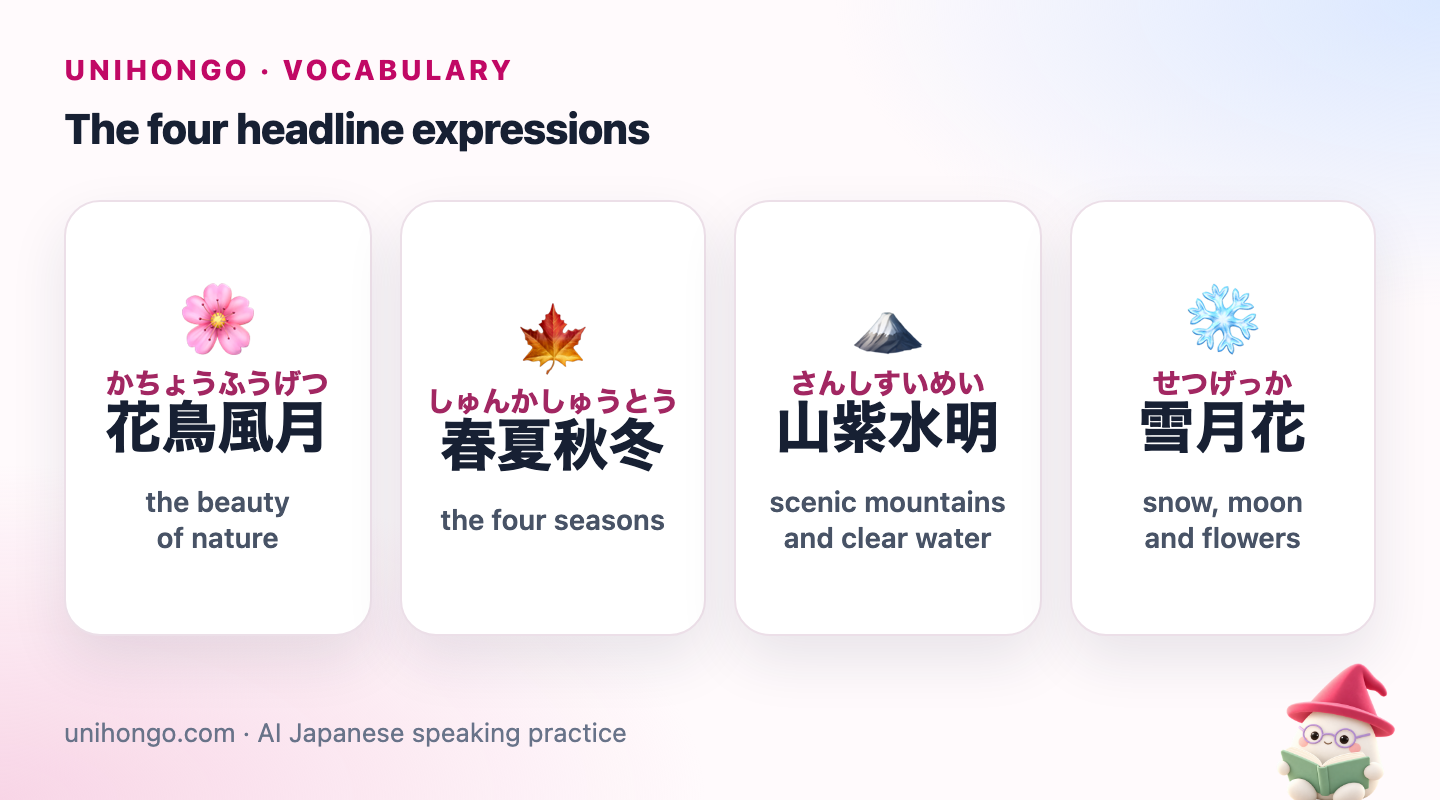
| Japanese | Romaji | Meaning |
|---|---|---|
| 花鳥風月 | kachō fūgetsu | the beauty of nature |
| 春夏秋冬 | shunka shūtō | the four seasons |
| 山紫水明 | sanshi suimei | scenic mountains and clear water |
| 雪月花 | setsugekka | snow, moon and flowers |
Listen to the readings. 春夏秋冬 uses on-readings (shun, ka, shū, tō), not the native words haru, natsu, aki, fuyu. 雪月花 becomes setsugekka with a small tsu, the same sound change you see in many compounds.
These are the expressions you are most likely to see in the wild. 花鳥風月 and 雪月花 are popular as names for inns, restaurants, sweets and sake. 春夏秋冬 is everywhere, from tourism leaflets to song titles. 山紫水明 appears in local tourism slogans for towns proud of their rivers and hills.
Literal and real meaning
| Expression | Literal picture | Real meaning | Where you meet it |
|---|---|---|---|
| 花鳥風月 | Flowers, birds, wind, moon | Nature's beauty; refined arts | Art, poetry, names of inns and shops |
| 春夏秋冬 | Spring, summer, autumn, winter | The four seasons; all year | Everyday speech, tourism |
| 山紫水明 | Purple mountains, bright water | Beautiful, clean scenery | Travel writing, local guidebooks |
| 雪月花 | Snow, moon, flowers | Seasonal beauty | Poetry, sake and sweet names |
| 風光明媚 | Wind and light, bright and lovely | Scenic, picturesque | Brochures, travel talk |
| 晴耕雨読 | Farm when sunny, read when it rains | A quiet, self-paced life | Talk about retirement or slow living |
山紫水明 is said to have been used to praise the scenery of Kyoto, where hazy mountains can look purple in the evening light. Today it describes any place with clear rivers and beautiful hills, and many towns use it in their tourism slogans.
Five more idioms for landscapes and seasons
| Japanese | Romaji | Meaning |
|---|---|---|
| 風光明媚 | fūkō meibi | picturesque, scenic |
| 風光明媚な港町ですね。 | Fūkō meibi na minatomachi desu ne. | What a picturesque harbour town. (polite) |
| 晴耕雨読 | seikō udoku | farming in sun, reading in rain |
| 定年後は晴耕雨読の生活をしたい。 | Teinengo wa seikō udoku no seikatsu o shitai. | After retiring, I want a quiet life of farming and reading. |
| 三寒四温 | sankan shion | three cold days, four warm days |
| 三寒四温で春が近づいてきました。 | Sankan shion de haru ga chikazuite kimashita. | With the warm and cold days alternating, spring is getting close. |
| 白砂青松 | hakusha seishō | white sand and green pines |
| 森羅万象 | shinra banshō | all things in the universe |
| 春夏秋冬、楽しめる町です。 | Shunka shūtō, tanoshimeru machi desu. | It's a town you can enjoy all year round. |
Where these idioms really appear
Most of these expressions are rare in casual conversation. If you said 山紫水明ですね on a hike, your friend would understand, but it might sound like a line from a guidebook. They are much more common in writing: travel brochures, a hotel's welcome message, the opening of a formal letter, or the name of a product.
Seasonal letters are a good example. Formal Japanese letters traditionally begin with a seasonal greeting, and some writers use idioms such as 三寒四温 in February or March. In casual talk, people usually prefer plain words such as 景色がきれい (the view is beautiful) or 暖かくなってきた (it's getting warmer).
| Japanese | Romaji | Meaning |
|---|---|---|
| 三寒四温の候、いかがお過ごしでしょうか。 | Sankan shion no kō, ikaga osugoshi deshō ka. | In this season of alternating cold and warm days, how are you? (formal letter) |
| 景色がきれいだね。 | Keshiki ga kirei da ne. | The view is beautiful. (casual, everyday) |
Mini dialogue: on a mountain trail
Two friends reach a viewpoint over a river valley. One uses a literary idiom with a smile; the other answers in plain Japanese. This mix is typical: idioms add a touch of humour or appreciation, but the conversation stays casual.
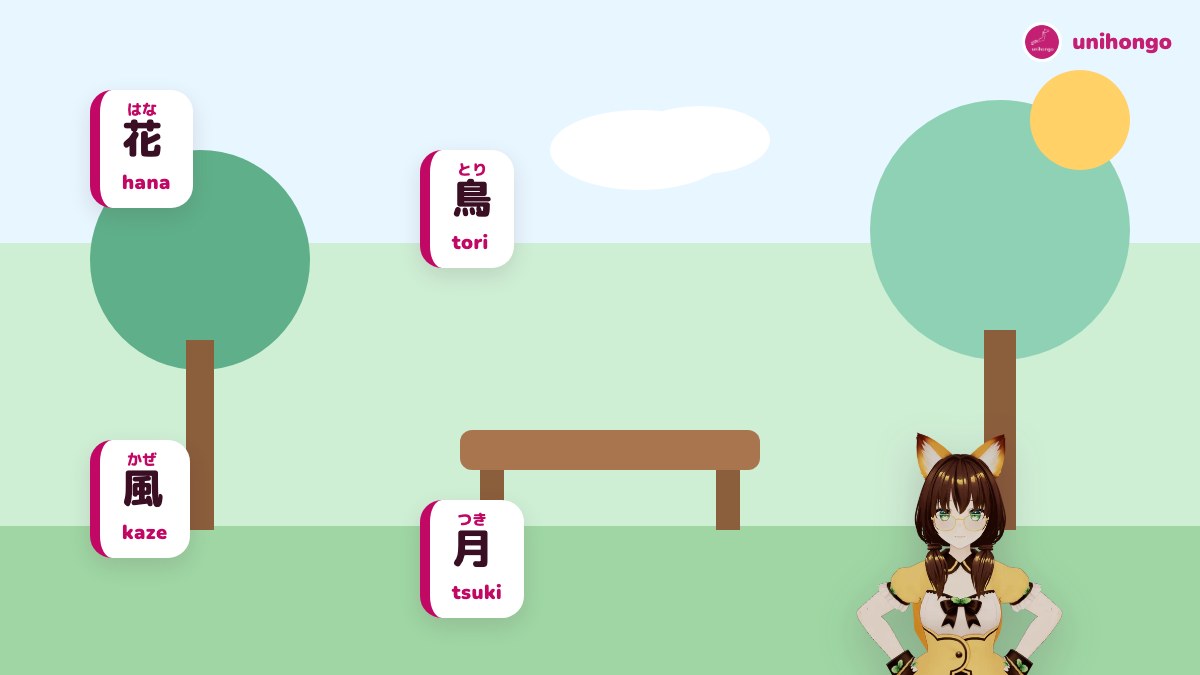
| Japanese | Romaji | Meaning |
|---|---|---|
| わあ、すごい景色! | Wā, sugoi keshiki! | Friend A: Wow, what a view! |
| まさに山紫水明だね。 | Masani sanshi suimei da ne. | Friend B: Truly mountains and clear water, like a poem. |
| 難しい言葉知ってるね。 | Muzukashii kotoba shitteru ne. | Friend A: You know some fancy words. |
| ガイドブックで覚えたんだ。 | Gaidobukku de oboetan da. | Friend B: I learned it from a guidebook. |
| 秋にもまた来たいな。 | Aki ni mo mata kitai na. | Friend A: I want to come back in autumn too. |
| ここは春夏秋冬、どの季節もいいらしいよ。 | Koko wa shunka shūtō, dono kisetsu mo ii rashii yo. | Friend B: Apparently every season is lovely here. |
Mistakes to avoid
If you write a seasonal letter or a travel essay in Japanese, one well-chosen idiom near the beginning sets a graceful tone. After that, return to plain description: what you saw, heard and felt. Readers enjoy the idiom more when it is not surrounded by others.
- Reading 春夏秋冬 as haru natsu aki fuyu. As an idiom it is shunka shūtō.
- Calling 雪月花 a four-character idiom. It has three kanji; call it a set phrase.
- Using 三寒四温 in autumn. It belongs to the end of winter and the start of spring.
- Saying 花鳥風月 to mean a beautiful view. It refers to nature's beauty in general, often with an artistic sense; for a specific view, 風光明媚 or plain きれいな景色 fits better.
- Overusing literary idioms in casual chat. One, said with a smile, is charming; several in a row sound like a brochure.
Seasons in everyday Japanese
The idioms in this post are mostly literary, but the attention to seasons behind them is very much alive in everyday speech. Small talk in Japan often opens with the weather or the season: the days are getting longer, the cherry blossoms have started, the leaves are turning. These lines do the same job as a seasonal idiom, in plain, friendly Japanese.
Haiku poetry makes this explicit with kigo, season words, which place a poem in a particular time of year. You do not need to write haiku, but noticing season words will help you understand why idioms such as 雪月花 and 花鳥風月 feel so natural in Japanese. Each points to a scene that most readers can picture immediately.
A good habit is to pair each literary idiom with a plain everyday line. Learn 三寒四温 for reading and formal letters, and 暖かくなったり寒くなったりですね for chatting with a neighbour. Learn 山紫水明 for a travel essay, and 景色がきれいですね for the actual view. This gives you both registers and keeps you from sounding like a brochure.
| Japanese | Romaji | Meaning |
|---|---|---|
| 日が長くなりましたね。 | Hi ga nagaku narimashita ne. | The days have got longer, haven't they? (polite small talk) |
| 桜が咲き始めましたね。 | Sakura ga sakihajimemashita ne. | The cherry blossoms have started to bloom. |
| 紅葉がきれいな季節ですね。 | Kōyō ga kirei na kisetsu desu ne. | It's the season of beautiful autumn leaves. |
| 暖かくなったり寒くなったりですね。 | Atatakaku nattari samuku nattari desu ne. | It keeps going from warm to cold, doesn't it? |
Take these idioms outside
Ask Mocchi for a short seasonal reading with /read, for example a five-line description of a mountain town in early spring that uses 三寒四温 and 山紫水明. Mocchi adjusts the text to your level, and you can ask for the meaning of any line or for a quick quiz on the idioms afterwards.
Then describe a trip out loud. In AI Sensei, ask Ibuki-sensei to chat about seasonal events and places, and use 春夏秋冬 and 風光明媚 to describe somewhere you have been. The session report afterwards lists the vocabulary you used and anything to fix.