
Why anime characters shout four kanji
Four kanji have a strong visual and sound rhythm: two beats, then two more. That makes them perfect for a title card, a technique name or a line yelled before a final blow. Many come from the classics, so they also bring a sense of old martial tradition.
For learners, these idioms are a fun entry point, because you often hear them before you study them. The trick is to separate the drama from the meaning, so you can recognise them in the news too.
| Japanese | Romaji | Meaning |
|---|---|---|
| 一騎当千の強さだ! | Ikki tōsen no tsuyosa da! | Strong enough to take on a thousand! (dramatic) |
| あの選手は一騎当千だね。 | Ano senshu wa ikki tōsen da ne. | That player is worth a whole team. (casual praise) |
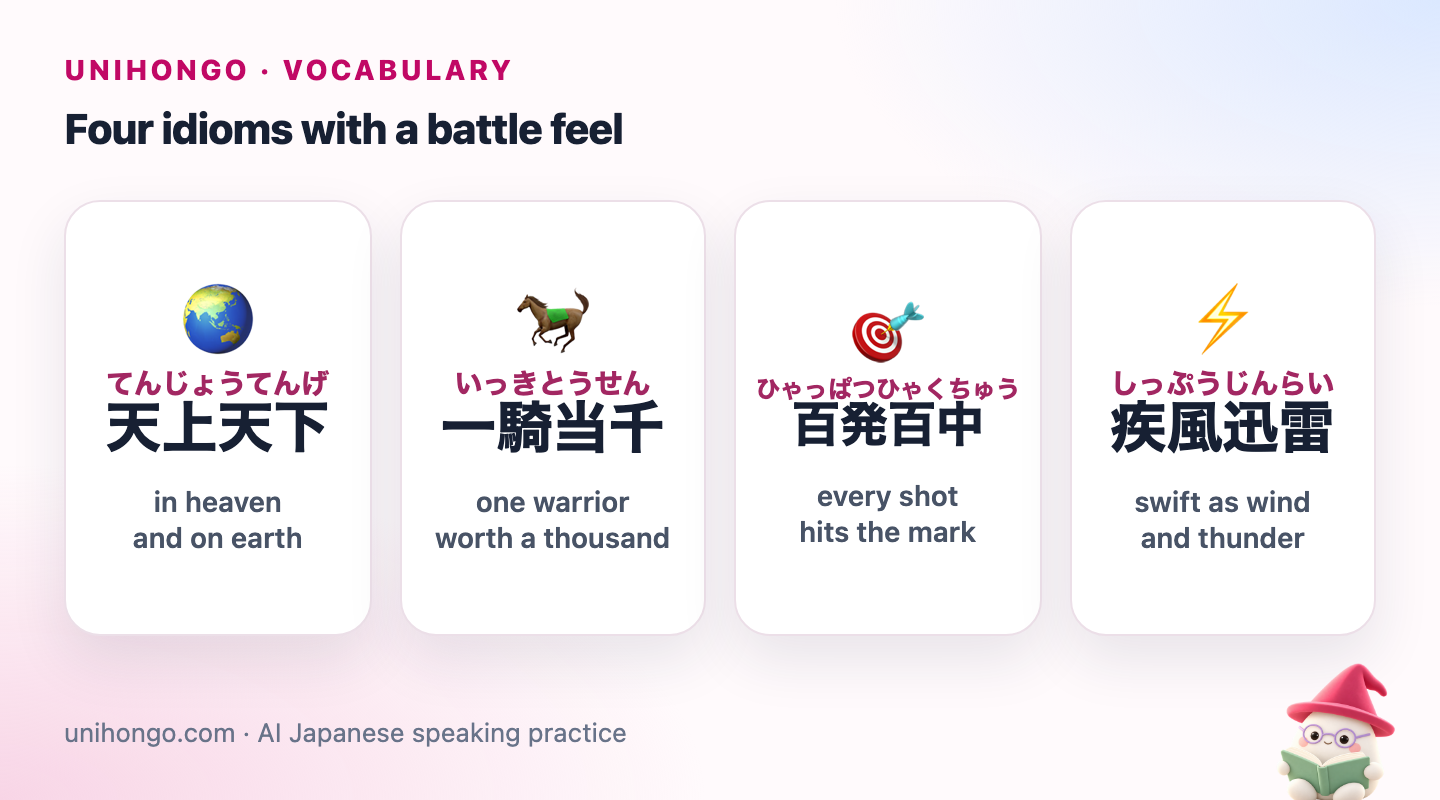
Four idioms with a battle feel
| Japanese | Romaji | Meaning |
|---|---|---|
| 天上天下 | tenjō tenge | in heaven and on earth |
| 一騎当千 | ikki tōsen | one warrior worth a thousand |
| 百発百中 | hyappatsu hyakuchū | every shot hits the mark |
| 疾風迅雷 | shippū jinrai | swift as wind and thunder |
Notice the readings. 下 in 天上天下 is read ge, not ka or shita. 百発 becomes hyappatsu with a small tsu and a p sound. 疾風 is shippū, with the small tsu again. These sound changes are exactly what makes the idioms punchy.
What each idiom literally says
| Idiom | Literal meaning | Real meaning | Everyday use? |
|---|---|---|---|
| 天上天下 | Above the heavens, below the heavens | The whole world | Rare outside fixed phrases |
| 一騎当千 | One horseman matches a thousand | Extraordinarily strong or skilled | Sometimes, in sports and business |
| 百発百中 | A hundred shots, a hundred hits | Always accurate | Yes, for predictions and guesses |
| 疾風迅雷 | Swift wind, sudden thunder | Very fast and forceful | Mainly in writing |
| 電光石火 | A flash of lightning, a spark from flint | Extremely quick | Yes, often with の早さ |
| 絶体絶命 | Body ends, life ends | A desperate situation | Yes, often as a joke |
Several of these have honest English near-equivalents: 百発百中 is like never missing or being spot on, 電光石火 like lightning-fast, and 絶体絶命 like being up against the wall.
Six more idioms from the battle scene
| Japanese | Romaji | Meaning |
|---|---|---|
| 電光石火 | denkō sekka | lightning-fast |
| 電光石火の速さで片付けた。 | Denkō sekka no hayasa de katazuketa. | I tidied up at lightning speed. |
| 絶体絶命 | zettai zetsumei | a desperate, no-way-out situation |
| 締め切りまであと一時間、絶体絶命だ。 | Shimekiri made ato ichijikan, zettai zetsumei da. | One hour to the deadline: I'm done for. (casual, joking) |
| 一刀両断 | ittō ryōdan | cutting in two with one stroke |
| 社長は反対意見を一刀両断した。 | Shachō wa hantai iken o ittō ryōdan shita. | The president dismissed the objection decisively. |
| 弱肉強食 | jakuniku kyōshoku | the strong eat the weak |
| 唯我独尊 | yuiga dokuson | I alone am supreme |
| 威風堂々 | ifū dōdō | majestic and dignified |
From battle cry to daily life
Many of these idioms live a double life. In a show they are shouted; in conversation they are used with a wink. Saying 絶体絶命 about a phone at one per cent battery is a typical playful use. The table shows how the same idiom shifts tone.
| Japanese | Romaji | Meaning |
|---|---|---|
| 彼女の天気予報は百発百中だ。 | Kanojo no tenki yohō wa hyappatsu hyakuchū da. | Her weather forecasts are always right. |
| この業界は弱肉強食だよ。 | Kono gyōkai wa jakuniku kyōshoku da yo. | This industry is dog-eat-dog. (casual) |
| Idiom | In anime or manga | In daily life |
|---|---|---|
| 百発百中 | A sniper never misses | Your friend always guesses the ending |
| 電光石火 | A strike faster than the eye | Someone answered an email instantly |
| 絶体絶命 | The hero is surrounded | The deadline is in one hour |
| 弱肉強食 | The law of the jungle | Harsh competition in an industry |
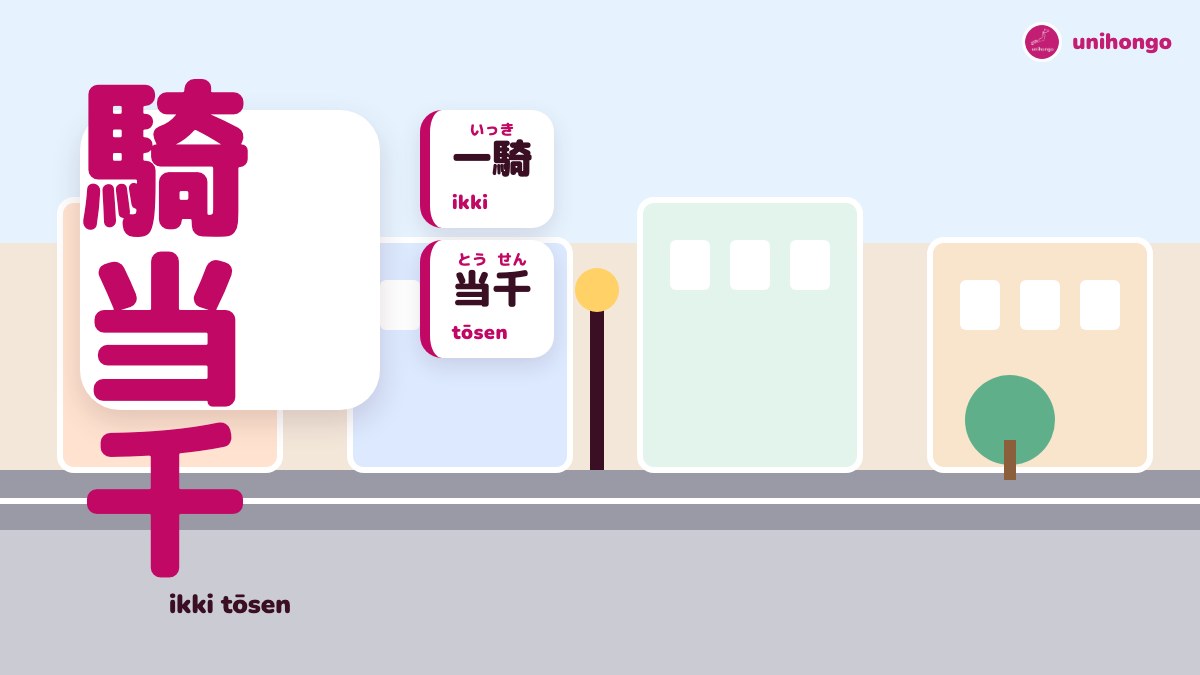
Breaking down 一騎当千
This idiom is a good example of how four kanji pack a scene: one rider, standing against a thousand. Each kanji is useful elsewhere, so learning the parts pays off.
| Japanese | Romaji | Meaning |
|---|---|---|
| 一 | ichi | one |
| 騎 | ki | a mounted warrior |
| 当 | tō | to match, stand against |
| 千 | sen | a thousand |
騎 contains the horse radical 馬 on the left, which is a good memory hook. You also meet it in 騎手 (kishu, jockey). 当 here means to be equal to, the same sense as in 相当 (sōtō, equivalent).
Mini dialogue: two fans after a new episode
| Japanese | Romaji | Meaning |
|---|---|---|
| 昨日の回、見た? | Kinō no kai, mita? | Fan A: Did you see yesterday's episode? |
| 見た!主人公、絶体絶命だったね。 | Mita! Shujinkō, zettai zetsumei datta ne. | Fan B: Yes! The hero was in a hopeless spot. |
| でも最後は電光石火の一撃! | Demo saigo wa denkō sekka no ichigeki! | Fan A: But the last blow was lightning-fast! |
| まさに一騎当千だよ。 | Masani ikki tōsen da yo. | Fan B: Truly one against a thousand. |
| 次の展開、予想できる? | Tsugi no tenkai, yosō dekiru? | Fan A: Can you guess what happens next? |
| 私の予想は百発百中だから任せて。 | Watashi no yosō wa hyappatsu hyakuchū da kara makasete. | Fan B: Leave it to me, my guesses never miss. |
Mistakes fans often make
- Writing 絶対絶命. The correct form is 絶体絶命, with 体, even though 絶対 is a more common word.
- Reading 天上天下 as tenjō tenka. In this phrase 下 is read ge.
- Using 唯我独尊 as a compliment. In modern use it usually means arrogant and self-centred.
- Using battle idioms in a serious setting, such as describing a colleague as 一騎当千 in a formal report. It can work in a speech, but sounds playful in most business writing.
- Assuming every four-kanji attack name is a real idiom. Some shows invent their own; check a dictionary before using one.
Why four kanji sound so cool
Part of the power of these idioms is sound. Yojijukugo are read with on-readings, the Chinese-derived readings of kanji, which tend to be short, hard syllables such as ki, sen, hyaku and rai. Native Japanese words are usually softer and longer. A phrase like shippū jinrai packs four sharp syllable groups into a moment, which is why it works so well as a shout.
The visual side matters too. Four dense kanji on a title card or a character's jacket look balanced and serious, a bit like a crest. Manga artists often print an idiom large in a dramatic panel, sometimes with furigana, so readers can take in both the look and the sound.
For learners, this gives a useful strategy. When you hear a four-syllable-group phrase in a show that sounds like an idiom, write down what you heard in romaji and look it up later. Many shows use real idioms, but some invent technique names that only imitate the pattern. Checking a dictionary tells you whether it is something you can use in real conversation or only in that series.
| Japanese | Romaji | Meaning |
|---|---|---|
| この技の名前、どういう意味? | Kono waza no namae, dō iu imi? | Fan: What does this move's name mean? (casual) |
| 四字熟語だよ。辞書に載ってる。 | Yojijukugo da yo. Jisho ni notteru. | Friend: It's a four-character idiom. It's in the dictionary. |
| かっこいいから使ってみたい! | Kakkoii kara tsukatte mitai! | Fan: It sounds so cool, I want to try using it! |
From watching to speaking
Ask Mocchi to explain any idiom you catch in a show: type /kanji 迅 or paste the line with /explain, and Mocchi tells you whether it is a real idiom, how it is read and whether people use it outside fiction.
Then talk about your favourite series with AI Sensei. Pick Hana-sensei, ask the Sensei to play a fellow fan in casual Japanese, and describe a scene using 絶体絶命 and 電光石火. Afterwards the session report shows which idioms you used and any grammar to fix.