
Why work Japanese loves four-character idioms
In a meeting, you often want to make a point quickly without sounding aggressive. A well-known idiom does both: it names the problem in four kanji and makes the comment sound like shared wisdom rather than personal criticism. That is why phrases like 本末転倒 or 適材適所 come up in ordinary business conversation, not only in speeches.
The most useful of all is a phrase you will see in job ads, evaluation forms and interviews.
| Japanese | Romaji | Meaning |
|---|---|---|
| 臨機応変に対応します。 | Rinki ōhen ni taiō shimasu. | I'll adapt to the situation. (polite) |
| 状況に合わせて臨機応変にお願いします。 | Jōkyō ni awasete rinki ōhen ni onegai shimasu. | Please be flexible and adjust to the situation. |
Four idioms you will hear at the office
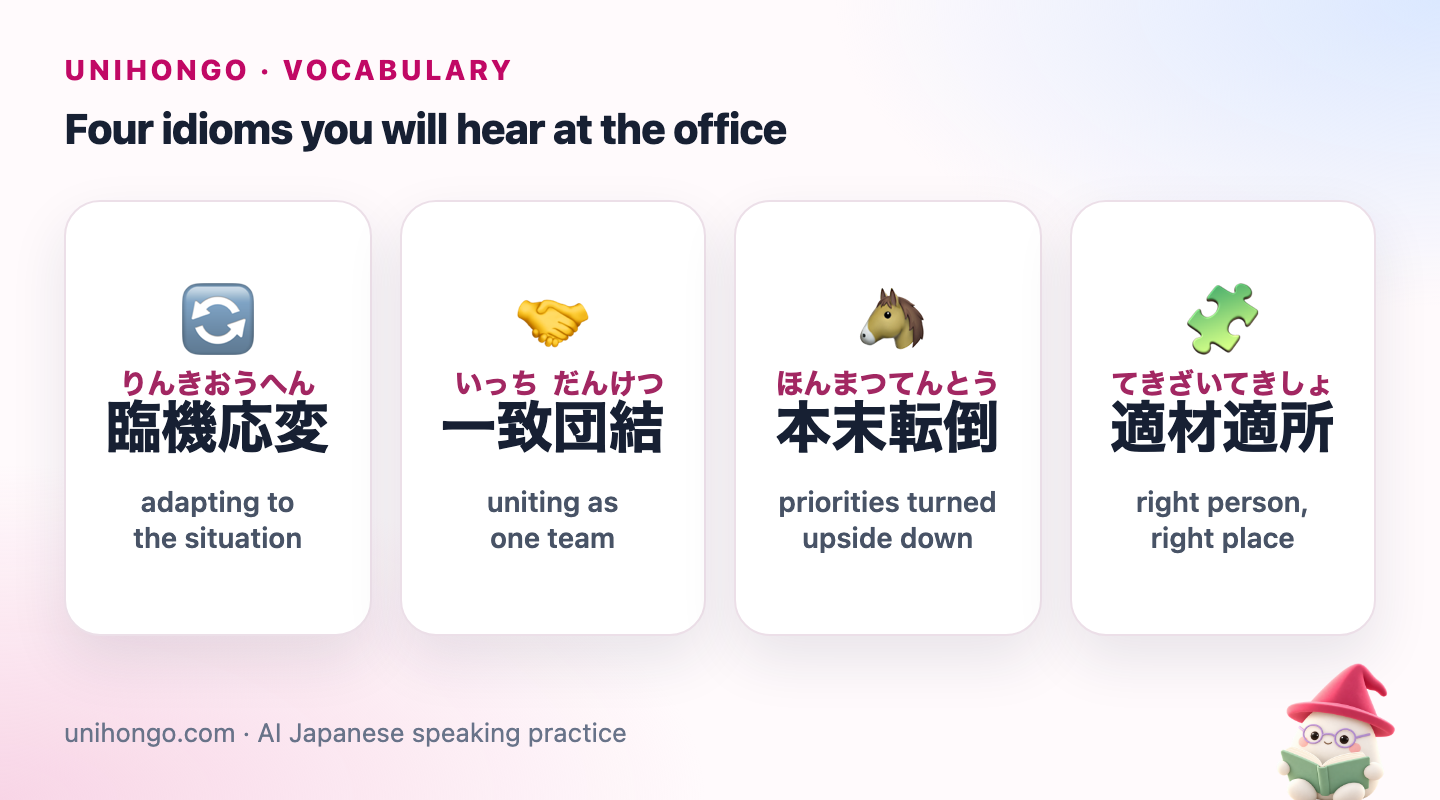
| Japanese | Romaji | Meaning |
|---|---|---|
| 臨機応変 | rinki ōhen | adapting to the situation |
| 一致団結 | itchi danketsu | uniting as one team |
| 本末転倒 | honmatsu tentō | priorities turned upside down |
| 適材適所 | tekizai tekisho | right person, right place |
Two of these are praise (臨機応変, 一致団結), one is a warning (本末転倒), and one is a principle (適材適所). Knowing which is which helps you place them in the right moment of a meeting.
These four also show up in different parts of working life. 臨機応変 appears in job ads and interviews. 一致団結 is the language of kick-off meetings, sports days and year-end speeches. 本末転倒 is a meeting word, usually in a discussion about process. 適材適所 comes up when roles are assigned, in personnel announcements, and in articles about management.
Kanji breakdown
| Idiom | Literal meaning | Real meaning | Typical pattern |
|---|---|---|---|
| 臨機応変 | Facing the moment, responding to change | Being flexible | 臨機応変に対応する |
| 一致団結 | Agreeing as one, binding together | Uniting for a shared goal | 一致団結して取り組む |
| 本末転倒 | Root and tip turned over | Confusing the essential with the trivial | それは本末転倒だ |
| 適材適所 | Fit material, fit place | Assigning people to suitable roles | 適材適所で配置する |
| 単刀直入 | Charging in with a single sword | Getting straight to the point | 単刀直入に言うと |
| 公私混同 | Mixing public and private | Mixing work and personal matters | 公私混同しない |
本末転倒 is built from 本 (root, origin) and 末 (tip, end). When the tip becomes more important than the root, something is backwards. The English near-equivalent is putting the cart before the horse.
Five more idioms for meetings and emails
| Japanese | Romaji | Meaning |
|---|---|---|
| 一石二鳥 | isseki nichō | two birds with one stone |
| 移動中に勉強できて一石二鳥です。 | Idōchū ni benkyō dekite isseki nichō desu. | I can study while commuting, so it's two birds with one stone. |
| 単刀直入 | tantō chokunyū | straight to the point |
| 単刀直入に申し上げますと、予算が足りません。 | Tantō chokunyū ni mōshiagemasu to, yosan ga tarimasen. | To put it plainly, the budget is not enough. (humble) |
| 公私混同 | kōshi kondō | mixing work and private life |
| 会社の備品を私用に使うのは公私混同です。 | Kaisha no bihin o shiyō ni tsukau no wa kōshi kondō desu. | Using company supplies for yourself is mixing work and private matters. |
| 一長一短 | itchō ittan | each has merits and drawbacks |
| どちらの案も一長一短ですね。 | Dochira no an mo itchō ittan desu ne. | Both proposals have their pros and cons. (polite) |
| 前代未聞 | zendai mimon | unheard of, unprecedented |
Polite versions for meetings
The same idiom can sound like a verdict or like a careful suggestion. In Japanese meetings, softened forms are usually safer, especially when you speak to someone senior or comment on their plan. Compare the direct and the softened lines.
| Japanese | Romaji | Meaning |
|---|---|---|
| それだと少し本末転倒になってしまうかもしれません。 | Sore da to sukoshi honmatsu tentō ni natte shimau ka mo shiremasen. | That might end up putting the cart before the horse. (soft) |
| 適材適所で役割を決めましょう。 | Tekizai tekisho de yakuwari o kimemashō. | Let's assign roles to suit each person. |
| チーム一丸となって、一致団結して取り組みます。 | Chīmu ichigan to natte, itchi danketsu shite torikumimasu. | We'll work on it united as one team. |
| Direct | Softened | Effect |
|---|---|---|
| それは本末転倒です | 少し本末転倒になってしまうかもしれません | From a verdict to a concern |
| 単刀直入に言います | 単刀直入に申し上げますと | Humble form for seniors or clients |
| 公私混同ですよ | 公私の区別をつけたほうがいいかもしれません | From an accusation to advice |
The pattern is always similar: add かもしれません, a cushion such as 少し, or switch to humble verbs such as 申し上げる. Listen to how senior colleagues phrase disagreements in your workplace, because each team has its own level of directness.
Mini dialogue: planning a product launch
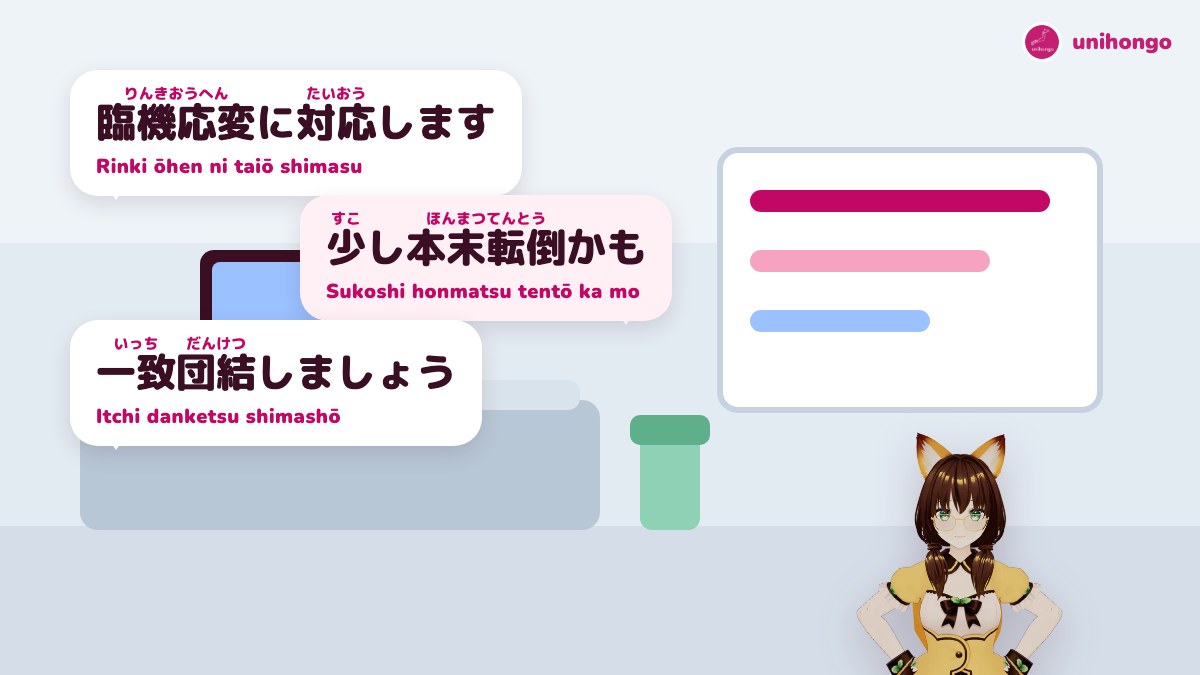
A manager and a team member discuss the launch schedule. The idioms help each speaker make a point briefly: one praises flexibility, one raises a concern softly, and the manager closes with team spirit.
| Japanese | Romaji | Meaning |
|---|---|---|
| 来週、仕様が変わるかもしれません。 | Raishū, shiyō ga kawaru ka mo shiremasen. | Manager: The specs may change next week. |
| 分かりました。臨機応変に対応します。 | Wakarimashita. Rinki ōhen ni taiō shimasu. | You: Understood. I'll adapt as needed. |
| 資料を完璧にするために発売を遅らせる案もあります。 | Shiryō o kanpeki ni suru tame ni hatsubai o okuraseru an mo arimasu. | Manager: One idea is to delay the launch to perfect the documents. |
| それだと少し本末転倒かもしれません。 | Sore da to sukoshi honmatsu tentō ka mo shiremasen. | You: That might be putting the cart before the horse. |
| 確かに。では一致団結して期日に間に合わせましょう。 | Tashika ni. Dewa itchi danketsu shite kijitsu ni maniawasemashō. | Manager: True. Then let's pull together and meet the deadline. |
Mistakes that sound stiff or rude
A note on 前代未聞: it sometimes appears in news headlines about scandals or disasters, so it can carry a negative tone. If you want to praise a record-breaking result, 過去最高 (the best ever) or 初めての快挙 (a first-ever achievement) sound positive and natural.
Finally, remember that idioms do not replace the basic politeness of a Japanese meeting. Phrases such as 恐れ入りますが (I'm sorry to trouble you, but) or 一点よろしいでしょうか (may I raise one point?) before your comment matter more than the idiom inside it. The idiom gives the point; the cushion phrase makes it acceptable.
- Opening every comment with 単刀直入に言うと. Used often, it sounds aggressive; save it for when you really need to be blunt.
- Writing 一致団決. The correct kanji is 結, to tie, as in 結ぶ.
- Calling a superior's plan 本末転倒 directly. Soften with かもしれません, or describe the concern without the idiom.
- Using 前代未聞 for small surprises. It means truly unprecedented, so it sounds sarcastic or exaggerated for a printer jam.
- Overloading an email with idioms. One per message is plenty; more can read like a school essay.
Where you meet these idioms: job ads and reviews
Before you ever hear these idioms in a meeting, you will probably read them. Japanese job ads often describe the ideal candidate with a four-character idiom or two, and 臨機応変 is the clear favourite. Performance reviews and self-evaluation forms use them too, because they compress a judgement into a short, neutral-sounding phrase.
When you write your own self-evaluation or a self-PR for an application, an idiom can make a good headline, but it must be backed by a concrete example. Writing 私の強みは臨機応変に対応できることです and then describing a real situation, such as a supplier cancelling at short notice and how you found an alternative, is far more convincing than the idiom alone.
In email, keep idioms for the body of the message, not the greeting. A sentence such as 適材適所の観点から、担当を変更したいと考えております (from the point of view of putting the right person in the right role, I would like to change who is in charge) is natural in a business email to colleagues. To a client, you would usually explain the reason more directly and politely, without leaning on an idiom.
| Japanese | Romaji | Meaning |
|---|---|---|
| 臨機応変な対応ができる方を募集しています。 | Rinki ōhen na taiō ga dekiru kata o boshū shite imasu. | We are looking for someone who can adapt flexibly. (job ad) |
| 私の強みは臨機応変に対応できることです。 | Watashi no tsuyomi wa rinki ōhen ni taiō dekiru koto desu. | My strength is that I can adapt to situations. (interview) |
| チームで一致団結してプロジェクトを成功させました。 | Chīmu de itchi danketsu shite purojekuto o seikō sasemashita. | Our team pulled together and made the project a success. |
Rehearse the meeting before the real one
Draft the two or three idiom lines you might need this week and send them to Mocchi with /correct. Mocchi adjusts the politeness level for a meeting with a senior colleague and explains why a softer ending works better.
Then open AI Sensei and ask Yamada-sensei to play your manager in a project meeting. Use 臨機応変 when the plan changes and a softened 本末転倒 when a proposal misses the point. Yamada-sensei can switch between casual and polite speech on request, and the session report lists any idiom you used in the wrong slot.