
Praise, criticism or a joke?
Character idioms come with a built-in judgement. Before you learn the translation, learn the direction: is this something you would write in a recommendation letter, something you would say about yourself with a smile, or something you would only say behind someone's back?
A useful habit is to learn each one with a short example that shows its tone. The first line below is the most common self-description in this whole set.
| Japanese | Romaji | Meaning |
|---|---|---|
| 私、優柔不断なんです。 | Watashi, yūjū fudan nan desu. | I'm really indecisive. (polite, self-deprecating) |
| メニューが多いと決められない。 | Menyū ga ōi to kimerarenai. | When the menu is long, I can't decide. (casual) |
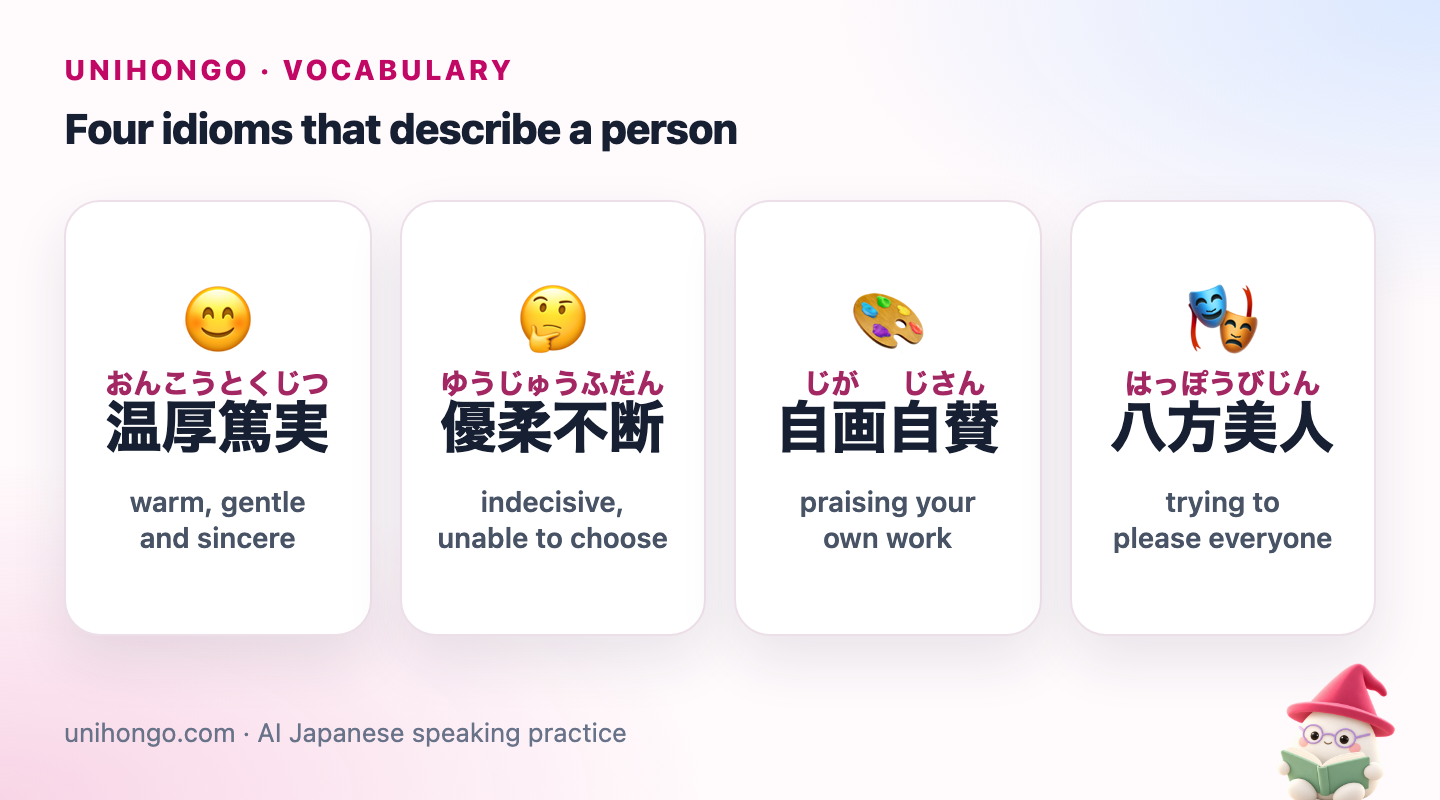
Four idioms that describe a person
| Japanese | Romaji | Meaning |
|---|---|---|
| 温厚篤実 | onkō tokujitsu | warm, gentle and sincere |
| 優柔不断 | yūjū fudan | indecisive, unable to choose |
| 自画自賛 | jiga jisan | praising your own work |
| 八方美人 | happō bijin | trying to please everyone |
温厚篤実 is high praise but formal. 優柔不断 is mild and often said about oneself. 自画自賛 is usually a joke about yourself and a criticism about others. 八方美人 is the one that most often catches learners out, because the kanji look like a compliment.
What the kanji are saying
| Idiom | Kanji pieces | Literal meaning | Real meaning |
|---|---|---|---|
| 温厚篤実 | 温厚 warm and generous + 篤実 earnest and honest | Warm, generous, earnest, true | A gentle, trustworthy person |
| 優柔不断 | 優柔 soft and pliant + 不断 not cutting | Too soft to cut | Unable to make decisions |
| 自画自賛 | 自画 your own painting + 自賛 your own praise | Praising your own picture | Bragging about your own work |
| 八方美人 | 八方 eight directions + 美人 a beauty | A beauty from every side | Pleasing everyone, standing for nothing |
| 天真爛漫 | 天真 natural purity + 爛漫 in full bloom | Innocence in full flower | Open, cheerful, childlike |
| 傍若無人 | 傍に人無きが若し | As if no one were beside you | Acting with no regard for others |
In 優柔不断, 断 means to cut or decide, the same kanji as in 決断 (decision) and 判断 (judgement). A person who is 優柔不断 is too soft to make the cut. Remembering 断 as cut makes the whole idiom transparent.
Five more character idioms
These round out the set. 十人十色 is neutral and very common; 天真爛漫 is usually warm; 品行方正 is formal praise; 傍若無人 is a strong criticism; 才色兼備 is praise but has a dated feel, because it was traditionally used about women's looks and talent together.
| Japanese | Romaji | Meaning |
|---|---|---|
| 天真爛漫 | tenshin ranman | innocent, open and cheerful |
| 娘は天真爛漫な性格です。 | Musume wa tenshin ranman na seikaku desu. | My daughter has a sunny, open personality. |
| 品行方正 | hinkō hōsei | of upright conduct |
| 品行方正な学生でした。 | Hinkō hōsei na gakusei deshita. | He was a model student. (formal) |
| 傍若無人 | bōjaku bujin | acting as if no one else exists |
| 電車で傍若無人に騒ぐ人がいた。 | Densha de bōjaku bujin ni sawagu hito ga ita. | Someone was making a racket on the train with no regard for others. |
| 十人十色 | jūnin toiro | ten people, ten colours |
| 好みは十人十色だよね。 | Konomi wa jūnin toiro da yo ne. | Everyone's taste is different, right? (casual) |
| 才色兼備 | saishoku kenbi | both talented and good-looking |
天真爛漫 is warm when used about children, but about an adult it can carry a hint of naivety, as if the person never quite grew up. Context and tone decide which way it leans: a grandmother praising a cheerful granddaughter means it kindly, while a manager describing a new employee may be making a gentle point about their lack of caution.
傍若無人 is common in news reports and online complaints about rude behaviour in public: loud groups on trains, people blocking shop entrances, drivers ignoring pedestrians. It is a strong word, so it rarely describes a friend, and it is almost never said to someone's face.
Saying it about yourself versus about others
The same idiom can feel completely different depending on whom you describe. Self-description with a criticism idiom is modest and often funny. Using it about a person who can hear you is direct criticism, and Japanese conversation tends to avoid that.
| Japanese | Romaji | Meaning |
|---|---|---|
| 自画自賛ですが、よくできたと思います。 | Jiga jisan desu ga, yoku dekita to omoimasu. | I'm praising my own work, but I think it turned out well. |
| 彼はちょっと八方美人なところがある。 | Kare wa chotto happō bijin na tokoro ga aru. | He tends to try to please everyone. (softened with ちょっと) |
| Idiom | About yourself | About someone else |
|---|---|---|
| 優柔不断 | Light, self-mocking | Mild criticism |
| 自画自賛 | A joke after showing your work | Calls them a show-off |
| 八方美人 | Rare, sounds like a confession | Fairly sharp: two-faced, no backbone |
| 天真爛漫 | Sounds a little self-satisfied | Usually affectionate |
| 温厚篤実 | Never: it sounds like boasting | Formal praise |
Mini dialogue: choosing a new team leader
Two coworkers talk over coffee about who should lead a new project. The idioms carry the judgement, and softeners such as ちょっと and ところがある keep the criticism polite.
| Japanese | Romaji | Meaning |
|---|---|---|
| リーダーは誰がいいと思う? | Rīdā wa dare ga ii to omou? | Coworker A: Who do you think should lead? |
| 山本さんは温厚篤実で信頼できるよ。 | Yamamoto san wa onkō tokujitsu de shinrai dekiru yo. | Coworker B: Yamamoto is kind and sincere, you can trust him. |
| でも、ちょっと優柔不断なところがあるよね。 | Demo, chotto yūjū fudan na tokoro ga aru yo ne. | Coworker A: But he can be a bit indecisive. |
| 佐藤さんは決断が早いけど、八方美人かな。 | Satō san wa ketsudan ga hayai kedo, happō bijin ka na. | Coworker B: Sato decides fast, but maybe tries to please everyone. |
| まあ、人は十人十色だから。 | Mā, hito wa jūnin toiro da kara. | Coworker A: Well, everyone's different. |
Mistakes learners make
A good general rule: when you are not sure how strong an idiom is, describe the behaviour in plain words instead. すぐに決められない人 (someone who cannot decide quickly) carries the same information as 優柔不断 but sounds less like a label. Labels stick, and a four-character label sticks even more, which is exactly why Japanese speakers use these idioms carefully when the person is present.
Also remember that these idioms are much more common in writing and in talk about third parties than in direct conversation. You are far more likely to read 温厚篤実な人柄 in a profile, or hear a friend call a celebrity 八方美人, than to hear anyone use them to someone's face.
- Using 八方美人 as a compliment about someone's looks. It describes behaviour, not appearance, and it is negative.
- Praising your own character with 温厚篤実 or 品行方正. These are for others to say about you.
- Forgetting な. 優柔不断, 天真爛漫, 品行方正 and 傍若無人 work as na-adjectives: 優柔不断な人, not 優柔不断の人 in most cases.
- Using 才色兼備 at work. Comments that pair looks with ability can feel inappropriate in a modern workplace, even when meant kindly.
- Saying a criticism idiom directly to the person. Add ちょっと, ところがある or かな, or choose plain words, which feel less like a verdict.
Character idioms in job interviews
One place where character idioms really matter is the job interview. A very common question is 長所と短所を教えてください, please tell us your strengths and weaknesses. Many candidates answer the weakness half with an idiom from this post, most often 優柔不断, and then reframe it as something positive: I can be indecisive, but that is because I consider every option carefully. Interviewers have heard this many times, so the reframing matters more than the idiom.
The reframing pattern is worth learning on its own. Japanese often softens a negative trait by naming the positive side of the same coin: indecisive becomes careful (慎重), trying to please everyone becomes considerate of others (周りに気を配る), and boasting becomes confident (自信がある). This is not dishonest; it is a way of showing self-awareness without dwelling on faults.
For strengths, avoid praising your own character with formal idioms such as 温厚篤実. Describe behaviour instead, and let the interviewer draw the conclusion. A concrete story about a time you stayed calm with a difficult customer says more than any four kanji. If you do use an idiom about yourself, keep it to the light, self-aware ones, and follow it with an example.
| Japanese | Romaji | Meaning |
|---|---|---|
| 長所と短所を教えてください。 | Chōsho to tansho o oshiete kudasai. | Interviewer: Please tell us your strengths and weaknesses. |
| 短所は優柔不断なところです。 | Tansho wa yūjū fudan na tokoro desu. | You: My weakness is that I can be indecisive. |
| ただ、その分慎重に考えるようにしています。 | Tada, sono bun shinchō ni kangaeru yō ni shite imasu. | You: But because of that, I make a point of thinking things through carefully. |
Practise describing people without offending them
Mocchi is useful here because tone is the hard part. Write three sentences about people you know and type /correct followed by them; Mocchi fixes grammar such as a missing な and tells you when an idiom like 八方美人 sounds sharper than you meant. Over time Mocchi remembers which idioms you tend to misuse and returns to them in your reviews.
For quick recall, make cards for the nine idioms with /create-flashcards and play Flashcard Flip on the games page, matching each idiom to its meaning.