
When four kanji tell a joke
Behind many idioms is a small cartoon: a horse ignoring the wind, a person dashing left and right, a farmer diverting water into only their own field. Seeing the picture makes the meaning obvious and explains why people smile when they use them.
This is the idiom many Japanese parents and teachers sigh when nobody listens.
| Japanese | Romaji | Meaning |
|---|---|---|
| 何を言っても馬耳東風だ。 | Nani o itte mo baji tōfū da. | Whatever I say goes in one ear and out the other. |
| また聞いてないでしょ。 | Mata kiite nai desho. | You weren't listening again, were you? (casual) |
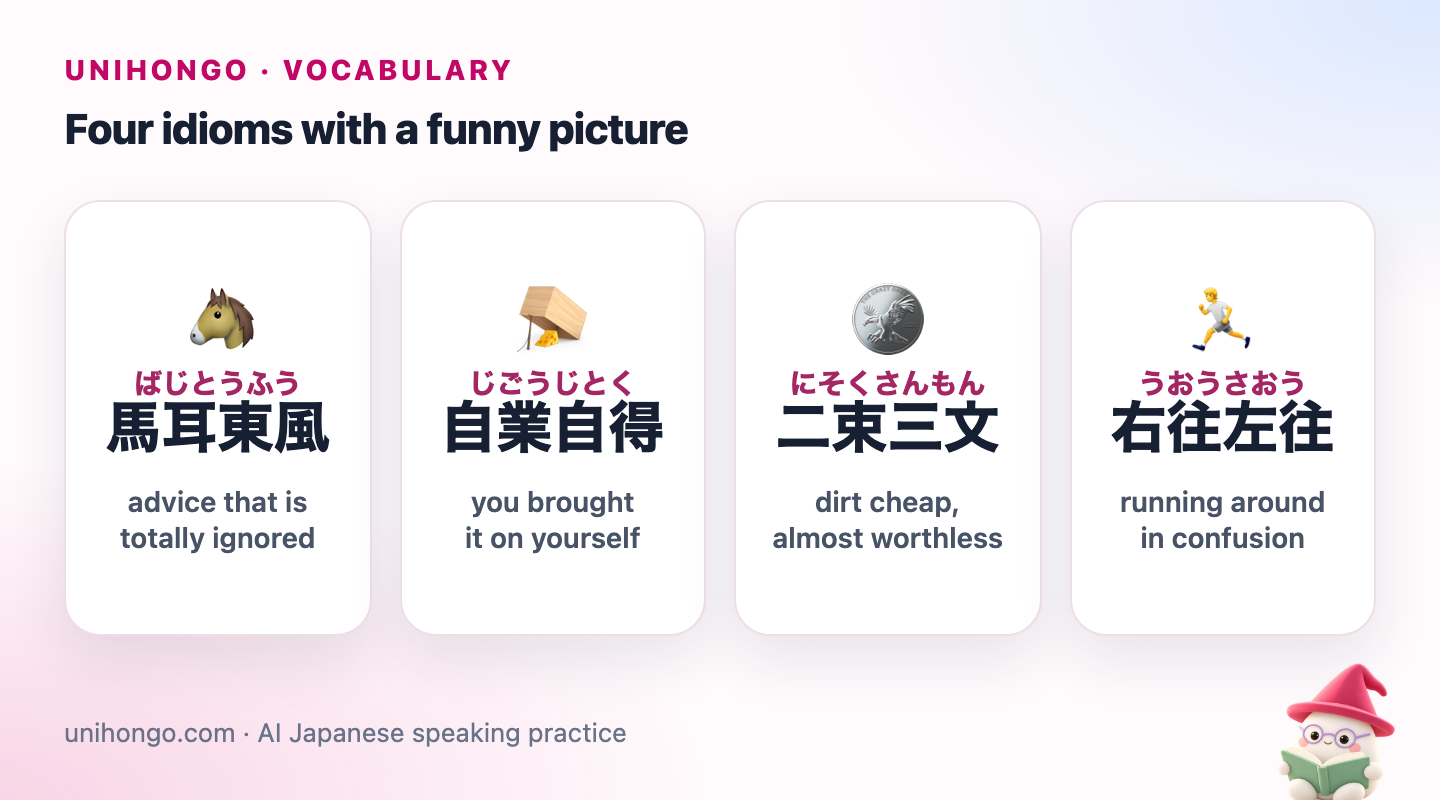
Four idioms with a funny picture
| Japanese | Romaji | Meaning |
|---|---|---|
| 馬耳東風 | baji tōfū | advice that is totally ignored |
| 自業自得 | jigō jitoku | you brought it on yourself |
| 二束三文 | nisoku sanmon | dirt cheap, almost worthless |
| 右往左往 | uō saō | running around in confusion |
The readings hide some surprises. 右往左往 is uō saō, with long vowels on both halves. 二束三文 uses 文, an old coin, read mon. 自業 is jigō, from the Buddhist word for karma, not jigyō, which means business.
The picture and the point
| Idiom | Literal picture | Real meaning | Nearest English |
|---|---|---|---|
| 馬耳東風 | East wind in a horse's ear | Ignoring advice | Water off a duck's back |
| 自業自得 | Your own deeds, your own result | Suffering from your own actions | You reap what you sow |
| 二束三文 | Two bundles, three coins | Almost worthless | For a song |
| 右往左往 | Go right, go left | Running around confused | Like a headless chicken |
| 我田引水 | Drawing water to my own rice field | Arguing for your own benefit | Feathering your own nest |
| 針小棒大 | A needle becomes a stick | Wild exaggeration | Making a mountain out of a molehill |
我田引水 is a lovely image for anyone who has heard a colleague bend every argument towards their own project. In the past, water for rice fields was precious, and diverting it to your own field was the classic selfish act.
Five more ironic idioms
| Japanese | Romaji | Meaning |
|---|---|---|
| 我田引水 | gaden insui | twisting things to your own benefit |
| それは我田引水な意見だね。 | Sore wa gaden insui na iken da ne. | That's a rather self-serving opinion. |
| 針小棒大 | shinshō bōdai | blowing things out of proportion |
| 彼の話はいつも針小棒大だ。 | Kare no hanashi wa itsumo shinshō bōdai da. | His stories are always exaggerated. |
| 竜頭蛇尾 | ryūtō dabi | dragon's head, snake's tail |
| 計画は竜頭蛇尾に終わった。 | Keikaku wa ryūtō dabi ni owatta. | The plan started big and fizzled out. |
| 朝三暮四 | chōsan boshi | fooled by a trick that changes nothing |
| 有名無実 | yūmei mujitsu | in name only |
| そのルールは有名無実化している。 | Sono rūru wa yūmei mujitsuka shite iru. | That rule exists only on paper now. |
竜頭蛇尾 is useful for describing plans, films and novels that start brilliantly and then lose their way. The dragon's head is the exciting opening; the snake's tail is the thin, disappointing ending. English speakers sometimes say a film fizzled out or ran out of steam, which is close.
有名無実 has a dry, slightly bureaucratic irony. People use it for rules nobody follows, titles with no real power, or committees that never meet. Adding 化 turns it into a process: 有名無実化する, to become a rule in name only.
Tone: a joke or a jab?
Irony is easy to get wrong in a second language. The same idiom can be friendly self-mockery or a public criticism. A safe rule: use these about yourself, about fictional characters, or about institutions, and be careful when the person you describe is listening.
| Japanese | Romaji | Meaning |
|---|---|---|
| 二日酔い?自業自得だよ。 | Futsukayoi? Jigō jitoku da yo. | Hangover? Your own fault! (teasing, between close friends) |
| 新宿駅で右往左往しちゃった。 | Shinjuku eki de uō saō shichatta. | I ran around in circles at Shinjuku Station. (casual) |
| Idiom | Light use | Sharp use |
|---|---|---|
| 自業自得 | Laughing at your own hangover | Telling someone their trouble serves them right |
| 馬耳東風 | Joking about your cat ignoring you | Complaining that a manager never listens |
| 針小棒大 | Teasing a friend's fishing story | Criticising media reports |
| 右往左往 | Your own first day at a big station | Describing a company's chaotic response |
Mini dialogue: the decluttering weekend
Two housemates talk about selling old things and a failed new habit. Watch how the idioms keep the tone light and teasing.
| Japanese | Romaji | Meaning |
|---|---|---|
| 古い漫画、全部売ったの? | Furui manga, zenbu utta no? | Housemate A: You sold all your old manga? |
| うん。でも二束三文だったよ。 | Un. Demo nisoku sanmon datta yo. | Housemate B: Yeah. But they went for next to nothing. |
| だから早く売れって言ったのに。 | Dakara hayaku ure tte itta no ni. | Housemate A: I told you to sell them sooner. |
| 馬耳東風でごめん。 | Baji tōfū de gomen. | Housemate B: Sorry I ignored you. |
| ジョギングは続いてる? | Jogingu wa tsuzuiteru? | Housemate A: Are you still jogging? |
| 三日坊主だった。自業自得だね。 | Mikka bōzu datta. Jigō jitoku da ne. | Housemate B: Lasted three days. My own fault, I guess. |
Mistakes to avoid
One last caution about 我田引水 and 針小棒大: in a meeting, either idiom accuses someone of bending the truth. Among friends they are teasing, but in a professional discussion they can cause offence. If you need to raise the point at work, a softer phrase such as 少し大げさかもしれません (that might be a little exaggerated) does the job without the sting.
And when you laugh at yourself with these idioms, the effect is usually charming. Japanese listeners tend to appreciate a speaker who does not take themselves too seriously, and a well-timed 自業自得です about your own mistake often earns a smile.
- Reading 自業自得 as jigyō jitoku. 業 here is gō, karma.
- Using 自業自得 to comfort someone. It blames them; for sympathy say 大変だったね (that sounds tough).
- Writing 右往左住. The second and fourth kanji are 往 and 往: go, go.
- Using 二束三文 for something cheap but good. It means low in value, so praising a bargain needs お得 (a good deal) instead.
- Taking 竜頭蛇尾 as a compliment because of the dragon. It means a strong start and a weak finish.
Irony and self-mockery in Japanese conversation
A lot of everyday Japanese humour is self-deprecating. People laugh at their own laziness, their failed diets, their panic at a big station. Ironic idioms suit this perfectly, because they let you criticise yourself in a slightly grand, mock-serious way. Saying 自業自得 about your own hangover is funnier than saying it was my fault.
三日坊主 is the classic example. Every January, people joke that their New Year resolution will become 三日坊主, and friends tease each other with it when a gym membership goes unused. It is so common that you can use it about yourself in almost any casual conversation.
Friends also use these idioms to tease each other gently, often as a quick comeback. If a friend describes a small problem as a disaster, それ、針小棒大じゃない? (isn't that a bit exaggerated?) gets a laugh. The key is the relationship: with close friends it is playful, with a coworker you barely know it can sound like criticism. When unsure, aim the idiom at yourself.
| Japanese | Romaji | Meaning |
|---|---|---|
| 今年こそ三日坊主を卒業する! | Kotoshi koso mikka bōzu o sotsugyō suru! | This year I'll finally stop giving up after three days! |
| 三日坊主にならないようにね。 | Mikka bōzu ni naranai yō ni ne. | Friend: Don't give up after three days, OK? |
| それ、針小棒大じゃない? | Sore, shinshō bōdai ja nai? | Isn't that a bit exaggerated? (teasing) |
Make the pictures do the work
Because these idioms are so visual, they are easy to remember as images. Ask Mocchi to describe the literal picture of each idiom and let you guess the word; Mocchi explains each answer and returns the ones you miss in your next review. You can also type /create-flashcards and pick a funny photo for each idiom.
Then build sentences with them in the Sentence Builder game on the games page, using your own flashcards, so you practise the particles that go with each idiom.