
Four Osaka words you will hear on day one
Walk through Dōtonbori or a covered shopping street for an hour and these four will reach your ears. Honma means really and replaces hontō; you will hear it from people of every age. Ee is the Osaka form of ii, good, and ee yan means that's great or nice one. Ōkini is the old merchant thank-you, still heard from older shopkeepers. Nande ya nen is the comic retort you will hear between friends and on television, roughly why on earth?! or come on!
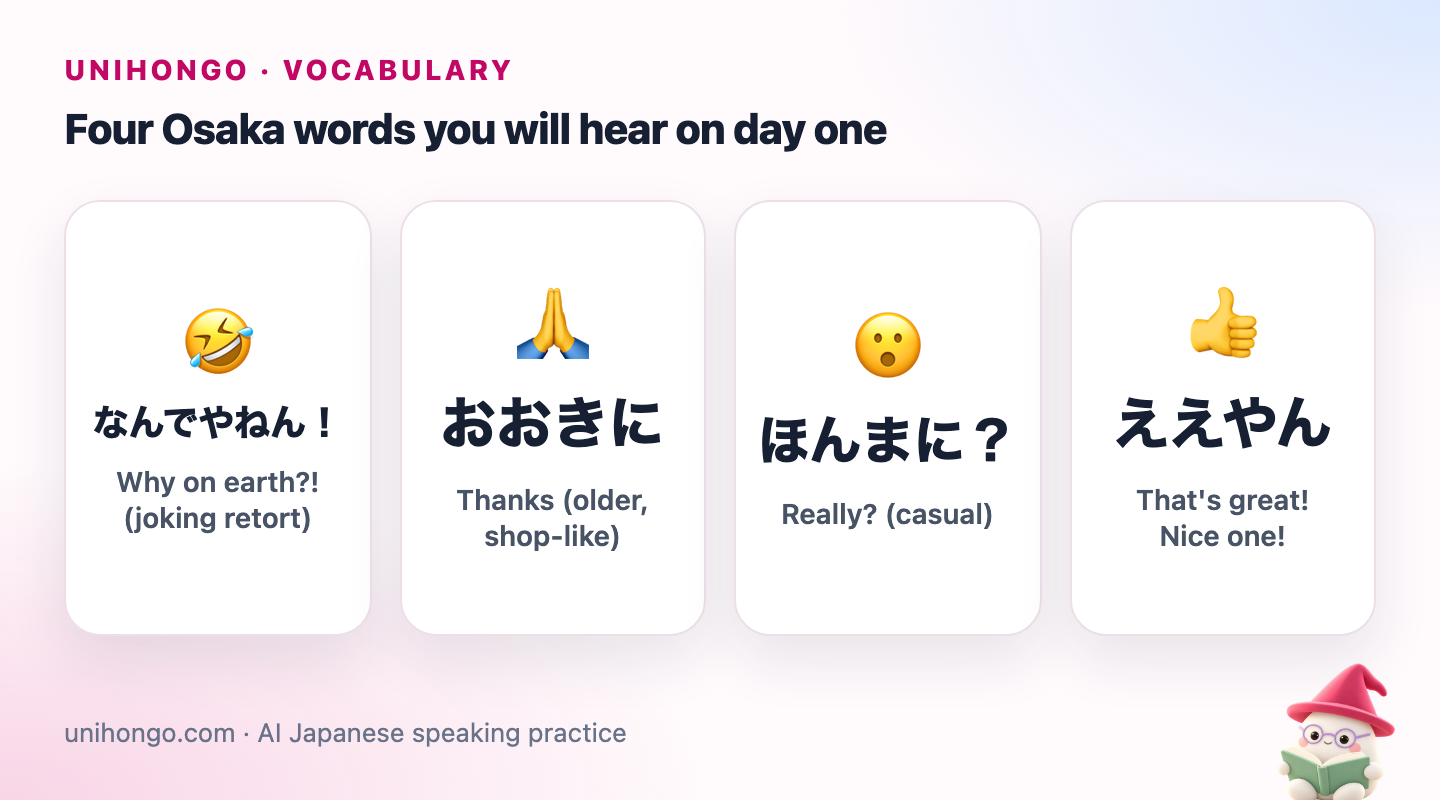
| Japanese | Romaji | Meaning |
|---|---|---|
| なんでやねん! | Nande ya nen! | Why on earth?! (joking retort) |
| おおきに | ōkini | Thanks (older, shop-like) |
| ほんまに? | Honma ni? | Really? (casual) |
| ええやん | ee yan | That's great! Nice one! |
Standard Japanese for the four cards: nande da yo or nande desu ka for nande ya nen, arigatō for ōkini, hontō ni? for honma ni?, and ii ja nai for ee yan. Keep that mapping in your head and most Osaka sentences open up.
The swaps that do most of the work
Osaka-ben is not a different language. Most sentences are standard Japanese with a handful of systematic swaps. Learn these and you can decode far more than you can memorise word by word.
| Japanese | Romaji | Meaning |
|---|---|---|
| そうや。 | Sō ya. | That's right. (standard: sō da) |
| ようわからへん。 | Yō wakarahen. | I don't really get it. (standard: yoku wakaranai) |
| それはあかん。 | Sore wa akan. | That's no good. (standard: sore wa dame) |
| ちゃうちゃう。 | Chau chau. | No, no, that's not it. (standard: chigau chigau) |
| めっちゃおいしい! | Meccha oishii! | It's so tasty! (standard: totemo oishii) |
| ほな、行こか。 | Hona, iko ka. | Right then, shall we go? (standard: jā, ikō ka) |
| Osaka | Standard | Meaning and note |
|---|---|---|
| ya (そうや) | da (そうだ) | The plain copula: it is |
| -hen (わからへん) | -nai (わからない) | Negative verb ending |
| honma (ほんま) | hontō (本当) | Really, true |
| ee (ええ) | ii (いい) | Good, fine |
| akan (あかん) | dame (だめ) | No good, not allowed |
| chau (ちゃう) | chigau (違う) | Not so, wrong |
| meccha (めっちゃ) | totemo (とても) | Very; now heard nationwide in casual talk |
| hona (ほな) | jā (じゃあ) | Well then, in that case |
Lines you hear in shops and markets
In Kuromon Market, Shinsekai or a neighbourhood shōtengai, stall holders often speak more dialect than staff in chain stores, who are trained to use standard service Japanese. Maido is a shopkeeper's hello and thank you in one word, from maido ōkini, thanks as always. Nanbo means how much and is understood all over western Japan.
Bargaining is not normal in Japanese shops, even in Osaka. Makete, give me a discount, is something you will mostly hear as a joke between regulars and the owner, or at a flea market. As a visitor, do not try to haggle in a supermarket or a chain store.
| Japanese | Romaji | Meaning |
|---|---|---|
| まいど! | Maido! | Hi there! / Thanks! (shopkeeper; standard: irasshaimase / arigatō) |
| 毎度おおきに。 | Maido ōkini. | Thanks as always. (older shop talk; standard: itsumo arigatō gozaimasu) |
| これ、なんぼ? | Kore, nanbo? | How much is this? (casual; standard: kore, ikura?) |
| なんぼですか。 | Nanbo desu ka. | How much is it? (polite enough with desu; standard: ikura desu ka) |
| ちょっとまけてや。 | Chotto makete ya. | Knock a bit off, go on. (joking, regulars; standard: sukoshi yasuku shite) |
| アメちゃん、あげるわ。 | Ame chan, ageru wa. | Here, have a sweet. (older Osaka women; standard: ame o ageru yo) |
Nande ya nen and the comic rhythm of Osaka talk
Osaka humour is often described as a double act: the boke says something silly and the tsukkomi corrects it, with nande ya nen as the classic correction. Among friends, people play these roles casually in daily talk. That is why you will hear nande ya nen, a light slap of the hand in the air, and lines that end in a flat, deadpan shiran kedo, I don't know, though.
Shiran kedo has spread across Japan as a joke tag: you say something confidently and then add but I don't really know. Shindoi, exhausting, also comes from western Japan and is now common in casual speech in many places. These are good listening words, and among friends of your own age they are safe to use.
| Japanese | Romaji | Meaning |
|---|---|---|
| なんでやねん。 | Nande ya nen. | Come on, why would that be? (joking; standard: nande da yo) |
| 知らんけど。 | Shiran kedo. | Not that I'd know, though. (joking tag; standard: shiranai kedo) |
| 今日はしんどいわ。 | Kyō wa shindoi wa. | Today has worn me out. (standard: kyō wa tsukareta yo) |
| かまへん、かまへん。 | Kamahen, kamahen. | No problem at all. (standard: kamawanai yo / daijōbu) |
| 自分、どこから来たん? | Jibun, doko kara kita n? | Where are you from? (jibun means you here; standard: anata wa doko kara kita no?) |
Jibun is a trap for learners. In standard Japanese it means oneself, but in casual Osaka speech it often means you, the person I am talking to. If a stallholder says jibun, nihonjin chau yaro?, they mean you're not Japanese, are you?, not something about themselves.
A conversation in a shopping arcade
Here is a typical exchange at a small souvenir stall in an Osaka shōtengai. The shopkeeper speaks Osaka-ben; you answer in simple polite Japanese with one Osaka word at the end. The standard Japanese for each Osaka line is in brackets.
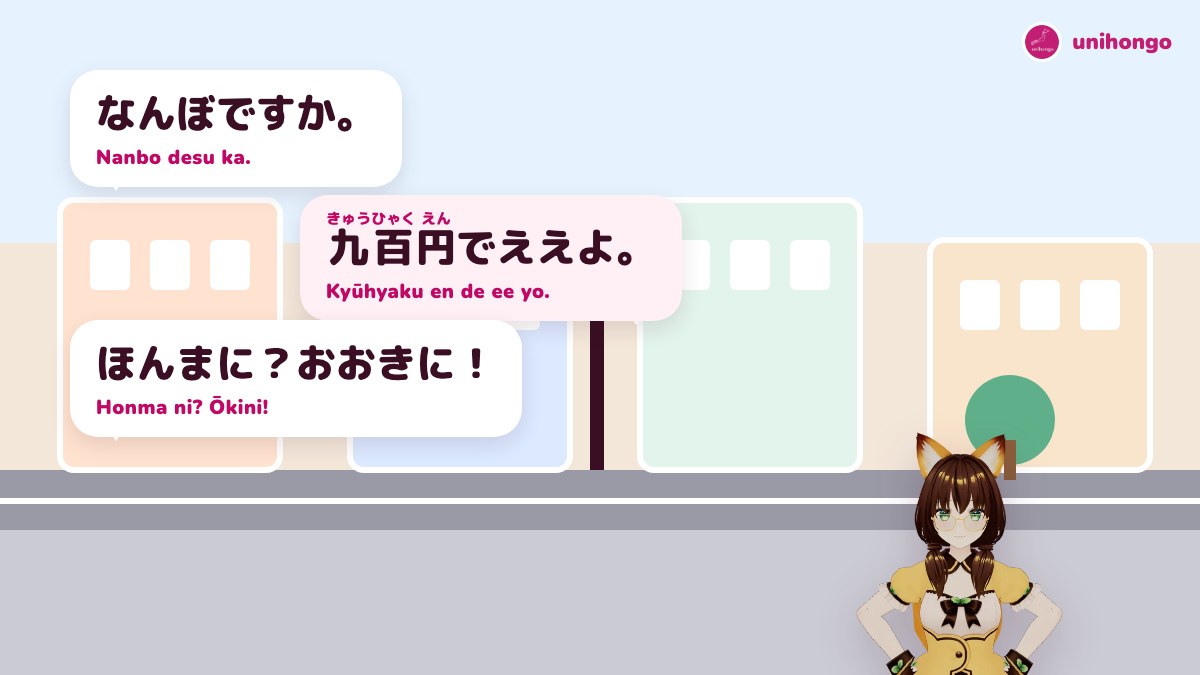
| Japanese | Romaji | Meaning |
|---|---|---|
| いらっしゃい!これ、ええやろ? | Irasshai! Kore, ee yaro? | Shopkeeper: Welcome! Nice, isn't it? (standard: kore, ii darō?) |
| ほんまですね。なんぼですか。 | Honma desu ne. Nanbo desu ka. | You: It really is. How much is it? (standard: hontō desu ne. Ikura desu ka.) |
| 千円やけど、九百円でええよ。 | Sen en ya kedo, kyūhyaku en de ee yo. | Shopkeeper: It's a thousand yen, but nine hundred will do. (standard: sen en da kedo, kyūhyaku en de ii yo) |
| えっ、いいんですか。 | E, ii n desu ka. | You: Oh, really? Is that all right? |
| かまへんよ。自分、どこから来たん? | Kamahen yo. Jibun, doko kara kita n? | Shopkeeper: No problem. Where are you from? (standard: kamawanai yo. Doko kara kita no?) |
| カナダから来ました。 | Kanada kara kimashita. | You: I came from Canada. |
| 日本語、めっちゃうまいやん! | Nihongo, meccha umai yan! | Shopkeeper: Your Japanese is really good! (standard: nihongo, totemo jōzu ja nai) |
| いえいえ、まだまだです。おおきに! | Ie ie, madamada desu. Ōkini! | You: Oh no, I've a long way to go. Thanks! |
| ほな、気をつけてな。 | Hona, ki o tsukete na. | Shopkeeper: Right then, take care. (standard: jā, ki o tsukete ne) |
How much Osaka-ben should a visitor speak?
Osaka people are proud of their speech and generally enjoy it when a visitor notices it, but tastes differ. Some find a learner's ōkini charming; a few find imitated dialect awkward, especially when it is overdone or borrowed from comedy. The safe pattern is simple: understand everything, speak polite standard Japanese, and add one Osaka word where it fits naturally, such as ōkini when leaving a shop or meccha oishii about the food.
Remember that politeness still matters. Osaka-ben is mostly casual. Hotel staff, station staff and staff in department stores will usually speak standard service Japanese to you, and you should answer in the same polite register. There are older polite Osaka forms such as mōkarimakka, are you doing good business?, but they sound like stock merchant phrases today, and you will hear them mostly as a joke or on television.
- Safe to use: ōkini, honma?, meccha oishii, ee desu ne
- Use with friends only: nande ya nen, shiran kedo, akan
- Leave for listening: mōkarimakka, makete, jibun meaning you
- Never with staff or elders: nande ya nen as a reply to something serious
Common learner mistakes
- Thinking Osaka-ben is rude. It sounds direct and quick to some ears, but it has warmth, and Osaka people use polite forms too when the situation calls for them.
- Using nande ya nen as a real question. It is a retort to something silly; for a real why, ask nande desu ka or dōshite desu ka.
- Mixing dialect into polite sentences in odd ways, such as sō ya gozaimasu. If you are speaking politely, stay in standard keigo.
- Copying the comedy accent. Osaka pitch accent differs from Tokyo's, and an exaggerated imitation can sound mocking. Words alone are enough.
- Assuming everyone in Osaka speaks the same way. Speech varies by age, neighbourhood and person, and many people switch to standard Japanese at work.
Tune your ear before you land
Two weeks before the trip, paste an Osaka line you have heard in a video into the chat with Mocchi and type /explain, for example /explain ほな、気をつけてな. Mocchi breaks the sentence into parts, gives you the standard Japanese and notes what is dialect. Ask for a short quiz on the Osaka swaps the next day, and it remembers which ones you missed.
Then rehearse out loud. In AI Sensei, choose the regional dialects topic, pick Ibuki-sensei and ask the Sensei to play a shopkeeper in a shopping arcade while you buy a souvenir. Answer in polite Japanese, ask the price, and end with ōkini; the session report afterwards lists the corrections and the vocabulary you used.