
Relationships in four kanji
Japanese conversation often values what is understood without being said, and one of the best-known idioms celebrates exactly that. Other relationship idioms describe unity, atmosphere, love, or the uneasy alliance of rivals. Together they give you a vocabulary for talking about people that goes beyond 仲がいい (to get along well).
Here is the most famous, in a sentence you might hear between old friends.
| Japanese | Romaji | Meaning |
|---|---|---|
| 私たち、以心伝心だね。 | Watashitachi, ishin denshin da ne. | We can read each other's minds. (casual) |
| 言わなくても分かるよ。 | Iwanakute mo wakaru yo. | I understand even if you don't say it. (casual) |
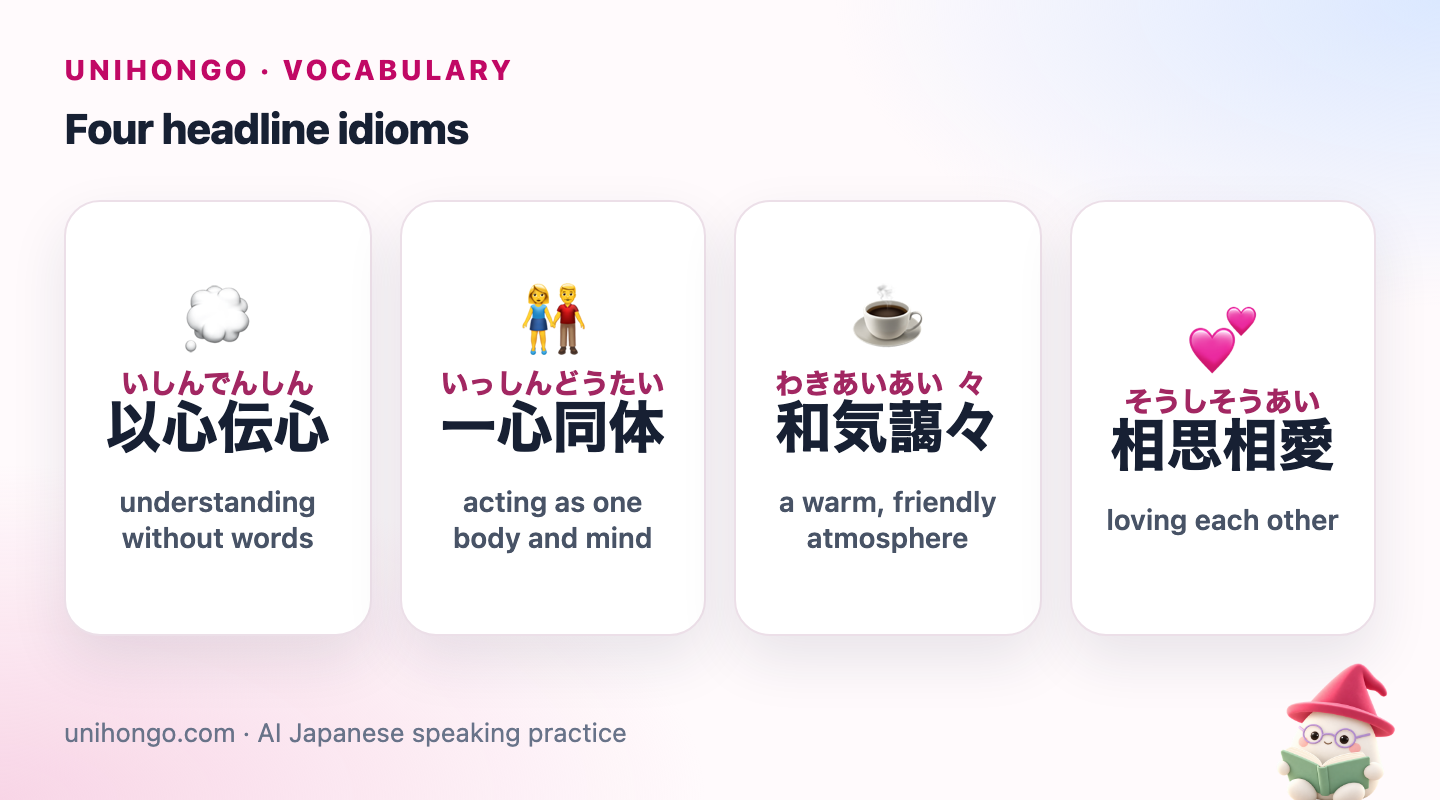
Four headline idioms
| Japanese | Romaji | Meaning |
|---|---|---|
| 以心伝心 | ishin denshin | understanding without words |
| 一心同体 | isshin dōtai | acting as one body and mind |
| 和気藹々 | waki aiai | a warm, friendly atmosphere |
| 相思相愛 | sōshi sōai | loving each other |
以心伝心 and 和気あいあい are everyday words. 一心同体 is common in sports and couples' talk. 相思相愛 is understood by everyone but often used with a playful tone.
In the full kanji form, 和気藹々 includes 藹, a character that most Japanese adults can read but few could write from memory. Many newspapers and websites print it as 和気あいあい, and you will see that form on job ads describing a friendly workplace. Learn to read the kanji version, but write the hiragana version.
相思相愛 is worth knowing in two senses. Among couples it is sincere and a little romantic. In sports and business news, it describes a perfect match between two parties, such as a player and a team that both wanted the transfer, and in that use it sounds light and positive.
What the kanji say
| Idiom | Literal meaning | Real meaning | Tone |
|---|---|---|---|
| 以心伝心 | Transmit heart by heart | Mutual understanding without words | Warm, everyday |
| 一心同体 | One heart, same body | Complete unity | Strong, positive |
| 和気藹々 | Harmonious spirit, gentle and friendly | A pleasant, friendly mood | Warm, everyday |
| 相思相愛 | Thinking of each other, loving each other | Mutual love | Romantic or playful |
| 意気投合 | Spirits throw in together | Hitting it off | Positive, everyday |
| 呉越同舟 | Wu and Yue in one boat | Rivals forced together | Neutral to wry |
以心伝心 comes from Zen Buddhism, where it described teaching passed from master to student directly, mind to mind, without scriptures. Today it is simply a friendly word for knowing what someone means without being told.
呉越同舟 comes from an old Chinese story about the people of two enemy states, Wu (呉) and Yue (越). When a storm hit the boat they were sharing, they helped each other like the left and right hands of one person. The idiom keeps both halves of that story: they are still rivals, but circumstances force them to cooperate.
Five more idioms about people together
| Japanese | Romaji | Meaning |
|---|---|---|
| 意気投合 | iki tōgō | hitting it off right away |
| 初対面ですぐ意気投合しました。 | Shotaimen de sugu iki tōgō shimashita. | We hit it off as soon as we met. |
| 異口同音 | iku dōon | everyone saying the same thing |
| みんな異口同音に反対した。 | Minna iku dōon ni hantai shita. | Everyone objected with one voice. |
| 呉越同舟 | goetsu dōshū | rivals in the same boat |
| 一蓮托生 | ichiren takushō | sharing the same fate, for better or worse |
| こうなったら一蓮托生だ。 | Kō nattara ichiren takushō da. | Now we sink or swim together. (casual) |
| 不即不離 | fusoku furi | neither too close nor too distant |
| 職場の雰囲気は和気あいあいとしています。 | Shokuba no fun'iki wa waki aiai to shite imasu. | The atmosphere at work is warm and friendly. |
Choosing the right idiom
Several of these overlap in English translation, so pick by situation. The table shows which idiom fits common moments.
| Japanese | Romaji | Meaning |
|---|---|---|
| 二人は一心同体のペアです。 | Futari wa isshin dōtai no pea desu. | The two of them are a perfectly united pair. |
| ライバル同士が呉越同舟で協力した。 | Raibaru dōshi ga goetsu dōshū de kyōryoku shita. | The rivals ended up working together. |
| Situation | Best idiom | Why |
|---|---|---|
| You and a friend ordered the same dish without asking | 以心伝心 | Understanding without words |
| A doubles team that moves perfectly together | 一心同体 | Acting as one |
| A friendly club or office | 和気あいあい | Describes the atmosphere |
| You met someone and talked for hours | 意気投合 | Hitting it off quickly |
| Two rival companies form a joint project | 呉越同舟 | Opponents forced together |
| Partners who will share success or failure | 一蓮托生 | Shared fate |
Mini dialogue: catching up with a friend
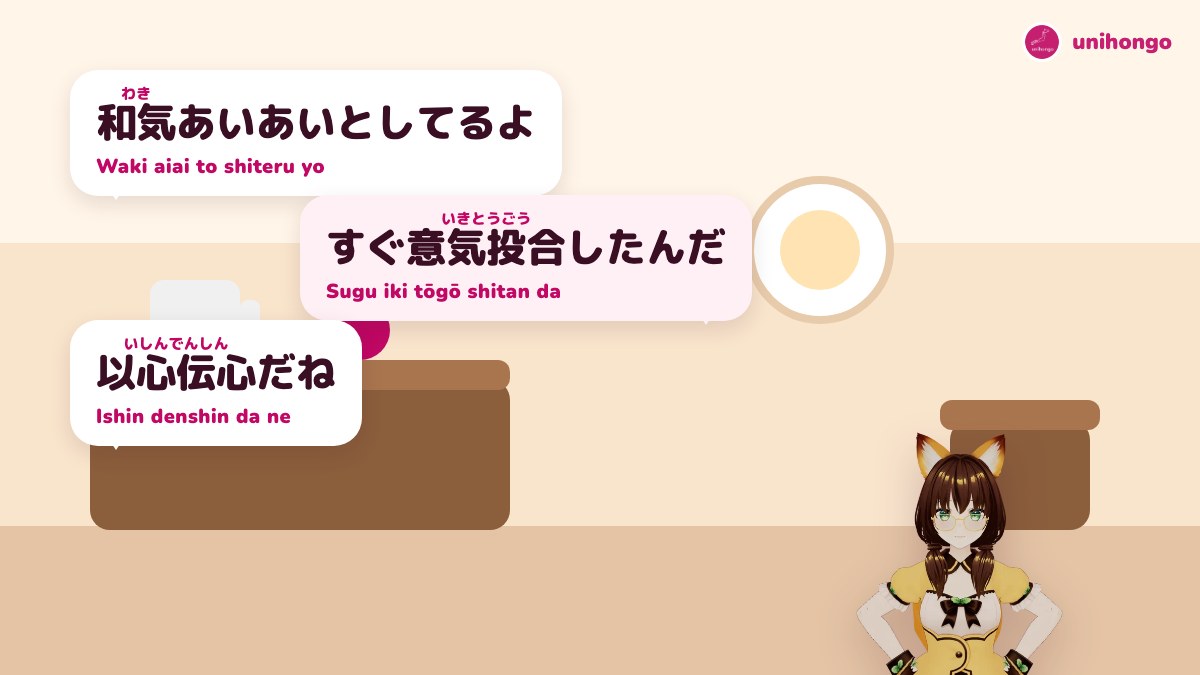
Two friends meet in a café and talk about a new coworker and a new relationship. The idioms come naturally inside casual sentences.
| Japanese | Romaji | Meaning |
|---|---|---|
| 新しい職場はどう? | Atarashii shokuba wa dō? | Friend A: How's the new job? |
| 和気あいあいとしていて楽しいよ。 | Waki aiai to shite ite tanoshii yo. | Friend B: It's really friendly and fun. |
| 隣の席の人とも意気投合したんだ。 | Tonari no seki no hito to mo iki tōgō shitan da. | Friend B: I hit it off with the person next to me too. |
| よかったね。彼氏とは順調? | Yokatta ne. Kareshi to wa junchō? | Friend A: Great. And things with your boyfriend? |
| うん、相思相愛だよ。 | Un, sōshi sōai da yo. | Friend B: Yep, we're crazy about each other. (playful) |
| さすが、以心伝心の二人だね。 | Sasuga, ishin denshin no futari da ne. | Friend A: Of course, you two always know each other's minds. |
Common mistakes
Also watch out for idioms that sound affectionate but are not. 一蓮托生 has a grim edge, and 呉越同舟 implies rivalry. If your goal is simply to say that two people get on well, everyday expressions such as 仲がいい (they get on well) or 気が合う (they click) are safer and just as natural as any idiom.
一心同体 is common in sports commentary about doubles partners or a pitcher and catcher, and in talk about long-married couples. Said by a manager about a team, it can sound like pressure to agree with everything, so in a work setting 一致団結 is often the more comfortable choice.
- Using 呉越同舟 about good friends. It needs rivals or opponents.
- Saying 相思相愛 about a one-sided crush. 相 means mutual; for one-sided love, use 片思い (kataomoi).
- Writing 一身同体. The correct kanji is 心, heart, not 身, body: 一心同体.
- Using 和気あいあい without と. The common pattern is 和気あいあいとした雰囲気 or 和気あいあいとしている.
- Forgetting the dark side of 一蓮托生. It can sound like we are trapped together, so it is not ideal for a wedding speech.
Understanding without words, in practice
以心伝心 points to something many people say about Japanese communication: a lot is left unsaid, and listeners are expected to pick up meaning from context. People often describe this with the phrase 空気を読む, reading the air. How strong this is varies a great deal between families, workplaces, regions and generations, so treat it as a tendency rather than a rule.
For a learner, the practical lesson is not to rely on unspoken understanding yourself. Japanese friends and coworkers will usually be happy if you check what they mean, especially if you do it politely. Phrases such as はっきり言ってくれると助かります (it helps me if you say it clearly) are a friendly way to ask for directness without sounding rude.
With people you know well, 以心伝心 moments are a real pleasure, and naming them with the idiom is a warm way to celebrate a friendship. When a friend hands you exactly the drink you were about to order, 以心伝心だね is the perfect line.
| Japanese | Romaji | Meaning |
|---|---|---|
| 空気を読む | kūki o yomu | to read the room |
| はっきり言ってくれると助かります。 | Hakkiri itte kureru to tasukarimasu. | It helps me if you say it clearly. (polite) |
| つまり、こういうことですか。 | Tsumari, kō iu koto desu ka. | So, do you mean this? (checking politely) |
Turn the idioms into conversation
Start in the chat with Mocchi: ask for a quiz where Mocchi describes a situation and you choose the idiom. Wrong answers come with a short explanation, and Mocchi keeps track of the pairs you mix up for your next session.
Then use them aloud. In AI Sensei, ask Sakura-sensei to play an old classmate at a reunion and tell the Sensei about your friends, your workplace and someone you hit it off with, using 意気投合 and 和気あいあい along the way.