
One public pension, two ways in
Japan's public pension has a base layer that covers every resident, the national pension, and a second layer for employees. Which one you pay into depends on how you work, not on your visa or nationality.
If you work for a company that is enrolled in social insurance, you are in kōsei nenkin, the employees' pension. The premium is a percentage of your pay, your employer pays half, and it is deducted from your salary. If you are a student, self-employed, a freelancer or between jobs, you are in kokumin nenkin, the national pension, and you pay a flat monthly premium yourself with slips, by bank debit or by card. A spouse who is a dependant of a kōsei nenkin member is usually enrolled without paying a separate premium.
| Japanese | Romaji | Meaning |
|---|---|---|
| 年金に入っています。 | Nenkin ni haitte imasu. | I'm enrolled in the pension. |
| 会社の厚生年金に入っています。 | Kaisha no kōsei nenkin ni haitte imasu. | I'm in my company's employees' pension. |
| 学生なので、国民年金です。 | Gakusei na node, kokumin nenkin desu. | I'm a student, so I'm in the national pension. |
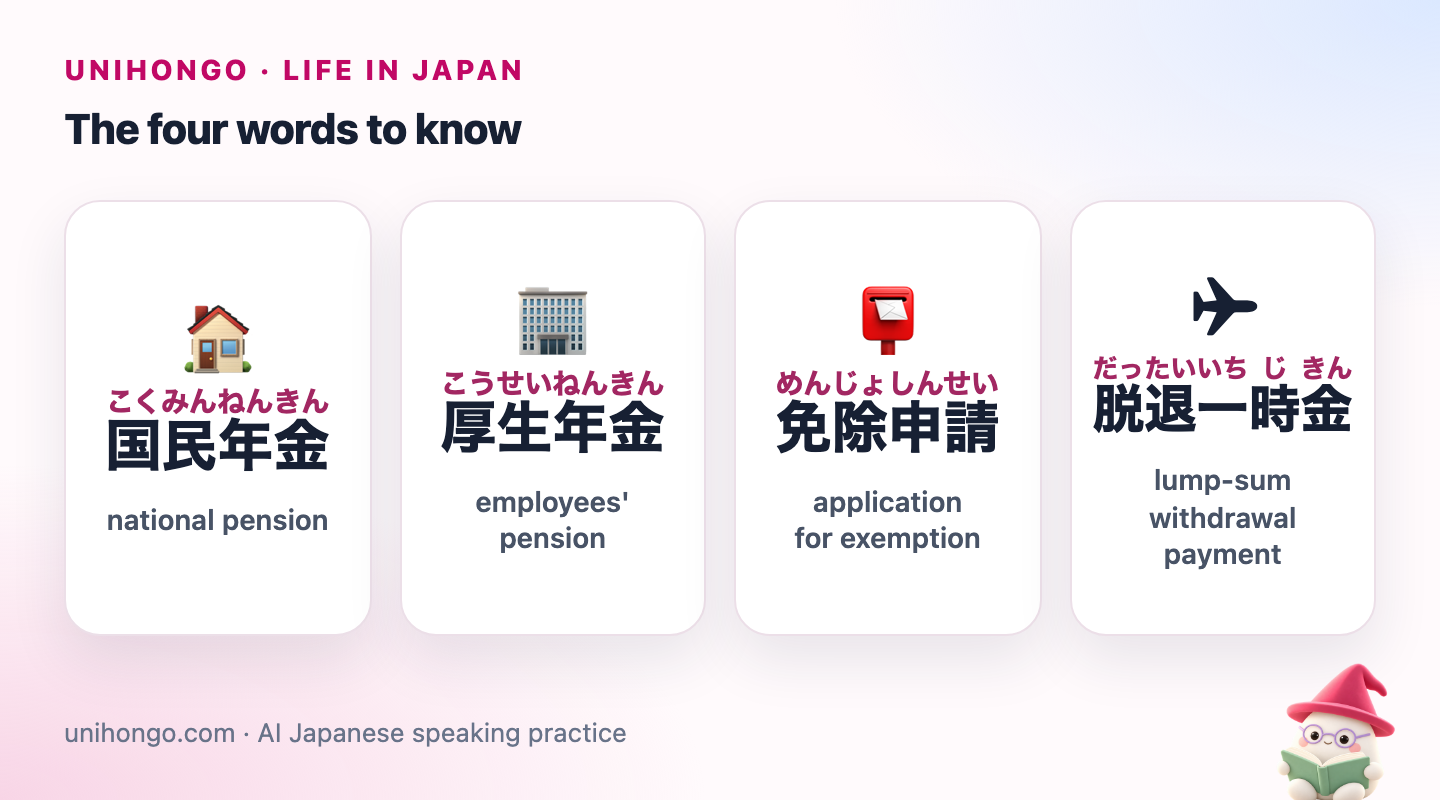
The four words to know
| Japanese | Romaji | Meaning |
|---|---|---|
| 国民年金 | kokumin nenkin | national pension |
| 厚生年金 | kōsei nenkin | employees' pension |
| 免除申請 | menjo shinsei | application for exemption |
| 脱退一時金 | dattai ichijikin | lump-sum withdrawal payment |
| Point | Kokumin nenkin | Kōsei nenkin |
|---|---|---|
| Who | Students, self-employed, unemployed, part-timers not in company insurance | Employees of enrolled companies |
| Premium | Flat monthly amount set each fiscal year | Percentage of pay, half paid by the employer |
| How you pay | Slips, bank debit, card or app | Deducted from salary |
| Where to enrol | City office pension window | Through the employer |
The papers you will receive
Your basic pension number, kiso nenkin bangō, follows you for life, across both schemes. People who joined in the past received a blue pension book, the nenkin techō; newer members receive a basic pension number notice instead. Each year around your birthday, the Japan Pension Service sends the nenkin teikibin, a statement of your record. If you pay kokumin nenkin, you also receive a booklet of payment slips for the fiscal year.
| Japanese | Romaji | Meaning |
|---|---|---|
| 基礎年金番号通知書 | kiso nenkin bangō tsūchisho | basic pension number notice |
| 年金手帳 | nenkin techō | pension book (older format) |
| ねんきん定期便 | nenkin teikibin | yearly pension statement |
| 納付書 | nōfusho | payment slip |
| 未納 | minō | unpaid |
When you cannot pay: exemption and deferral
Not paying and asking not to pay are very different. Unpaid months, minō, count for nothing and can lead to reminders and, in long cases, collection action. Approved exemption or deferral months still count towards the minimum enrolment period needed for a pension, and some exemption types still count partly towards the amount.
| Japanese | Romaji | Meaning |
|---|---|---|
| 保険料を払うのが難しいです。 | Hokenryō o harau no ga muzukashii desu. | It's hard for me to pay the premium. |
| 免除の申請をしたいです。 | Menjo no shinsei o shitai desu. | I'd like to apply for an exemption. |
| 学生納付特例を申し込みたいです。 | Gakusei nōfu tokurei o mōshikomitai desu. | I'd like to apply for the student deferral. |
- Exemption, menjo (免除): full or partial, based on your income and your household's income in the previous year.
- Payment deferral, nōfu yūyo (納付猶予): for people under 50 with low income, based on their own and their spouse's income.
- Student payment special rule, gakusei nōfu tokurei (学生納付特例): for students, based on the student's own income.
- Applications are made at the city office pension window or the pension office, usually each year. Bring your residence card and your pension number.
- Approved months can be paid later, tsuinō (追納), within ten years, which raises your future pension.
Leaving Japan: the lump-sum withdrawal
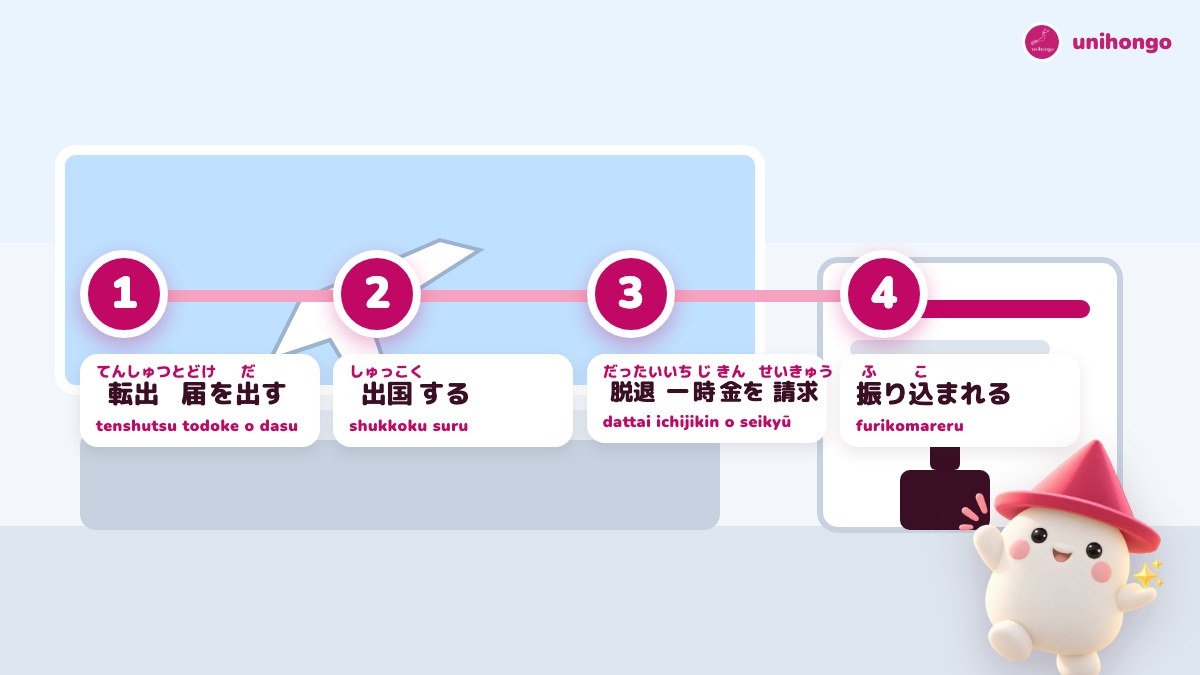
If you leave Japan before qualifying for a Japanese pension, you can usually claim back part of what you paid as a lump-sum withdrawal payment, dattai ichijikin. The main conditions are that you are not a Japanese national, you paid premiums for at least six months, you no longer have an address in Japan, and you claim within two years of leaving. The payment is calculated on a capped number of months, currently up to five years for recent periods, so people who stay longer receive only part of their contributions.
Think before claiming. The withdrawal cancels the pension periods it pays for, and if your home country has a social security agreement with Japan, those periods might instead count towards a pension there. Tax is withheld from the kōsei nenkin part; people often appoint a tax agent before leaving to reclaim it. Check the Japan Pension Service's page in your language for the current forms.
| Japanese | Romaji | Meaning |
|---|---|---|
| 帰国したら脱退一時金を請求できますか。 | Kikoku shitara dattai ichijikin o seikyū dekimasu ka. | Can I claim the lump-sum payment after I go home? |
| 転出届を出してから出国します。 | Tenshutsu todoke o dashite kara shukkoku shimasu. | I'll file the moving-out notice, then leave. |
| 社会保障協定はありますか。 | Shakai hoshō kyōtei wa arimasu ka. | Is there a social security agreement? |
At the pension window
The city office pension window, often labelled 国民年金 or 年金係, handles enrolment, exemption and simple questions about kokumin nenkin. The pension office, nenkin jimusho, handles your full record, kōsei nenkin and the withdrawal payment. Both are used to foreign residents.
| Japanese | Romaji | Meaning |
|---|---|---|
| 国民年金の手続きに来ました。 | Kokumin nenkin no tetsuzuki ni kimashita. | You: I've come about the national pension. |
| 会社を辞めたので、切り替えをお願いします。 | Kaisha o yameta node, kirikae o onegai shimasu. | You: I left my job, so please switch me over. |
| 退職日がわかる書類はありますか。 | Taishokubi ga wakaru shorui wa arimasu ka. | Clerk: Do you have a document showing your leaving date? |
| はい、離職票があります。 | Hai, rishokuhyō ga arimasu. | You: Yes, I have my separation notice. |
| 収入が少ないので、免除も相談したいです。 | Shūnyū ga sukunai node, menjo mo sōdan shitai desu. | You: My income is low, so I'd also like to ask about exemption. |
| では、こちらの申請書に記入してください。 | Dewa, kochira no shinseisho ni kinyū shite kudasai. | Clerk: Then please fill in this application form. |
| 基礎年金番号はわかりますか。 | Kiso nenkin bangō wa wakarimasu ka. | Clerk: Do you know your basic pension number? |
| この通知に書いてあります。 | Kono tsūchi ni kaite arimasu. | You: It's written on this notice. |
What surprises newcomers
- The kokumin nenkin slips arrive even if you plan to leave in two years. Enrolment is not optional.
- Leaving a job means switching to kokumin nenkin yourself at the city office; it does not happen automatically.
- Unpaid premiums can come up when you apply for some visa changes, including permanent residence.
- The withdrawal payment does not refund everything for long stays.
- Ten years of enrolment is the minimum for an old-age pension, and exemption periods count towards it.
- Students over 20 receive kokumin nenkin slips too, unless they apply for the student deferral each year.
- The yearly statement may show months you thought you paid as unpaid; keep receipts, and ask the pension office to check.
Paying kokumin nenkin without missing months
If you are in the national pension, the Japan Pension Service sends a booklet of monthly payment slips, usually in spring for the fiscal year that starts in April. Each slip has a due date at the end of the following month. You can pay at a bank, a post office or a konbini, with some smartphone apps, or set up automatic bank debit or card payment so that you never miss a month.
Paying in advance, zennō (前納), for six months, one year or two years earns a small discount, and automatic debit for the same period is usually the cheapest option. Unpaid months can be paid late for up to two years; after that they are lost unless they were exempt months, which follow the ten-year rule for late payment.
| Japanese | Romaji | Meaning |
|---|---|---|
| 口座振替にしたいです。 | Kōza furikae ni shitai desu. | I'd like to pay by automatic debit. |
| 前納 | zennō | paying in advance |
| 納付書をなくしました。 | Nōfusho o nakushimashita. | I lost my payment slips. |
| 未納の分を払いたいです。 | Minō no bun o haraitai desu. | I'd like to pay the months I missed. |
Rehearse the pension window
Ask Mocchi to put the pension words from this guide into a short quiz with /quiz, and to explain the difference between menjo and nōfu yūyo in simple Japanese. Mocchi notes the words you miss and brings them back in your next review.
Then say it out loud: in AI Sensei, ask Ibuki-sensei to play the city office pension clerk while you switch from company pension to kokumin nenkin and ask about an exemption. Ask the Sensei to speak at normal speed once you are comfortable.