
What kakutei shinkoku is
Kakutei means fixed or final, and shinkoku means declaration. In the return you declare your income for the previous calendar year, subtract deductions, calculate the income tax, and compare it with the tax already withheld. If you paid too much you get a refund (kanpu); if you paid too little you pay the difference.
The return also feeds into your resident tax. The tax office passes the information to your city, so you do not file a separate resident tax return when you file kakutei shinkoku.
| Japanese | Romaji | Meaning |
|---|---|---|
| 確定申告をします。 | Kakutei shinkoku o shimasu. | I'm going to file a tax return. |
| 去年の所得を申告します。 | Kyonen no shotoku o shinkoku shimasu. | I declare last year's income. |
| 税金が戻ってくるかもしれません。 | Zeikin ga modotte kuru ka mo shiremasen. | I might get some tax back. |
Four words on every form
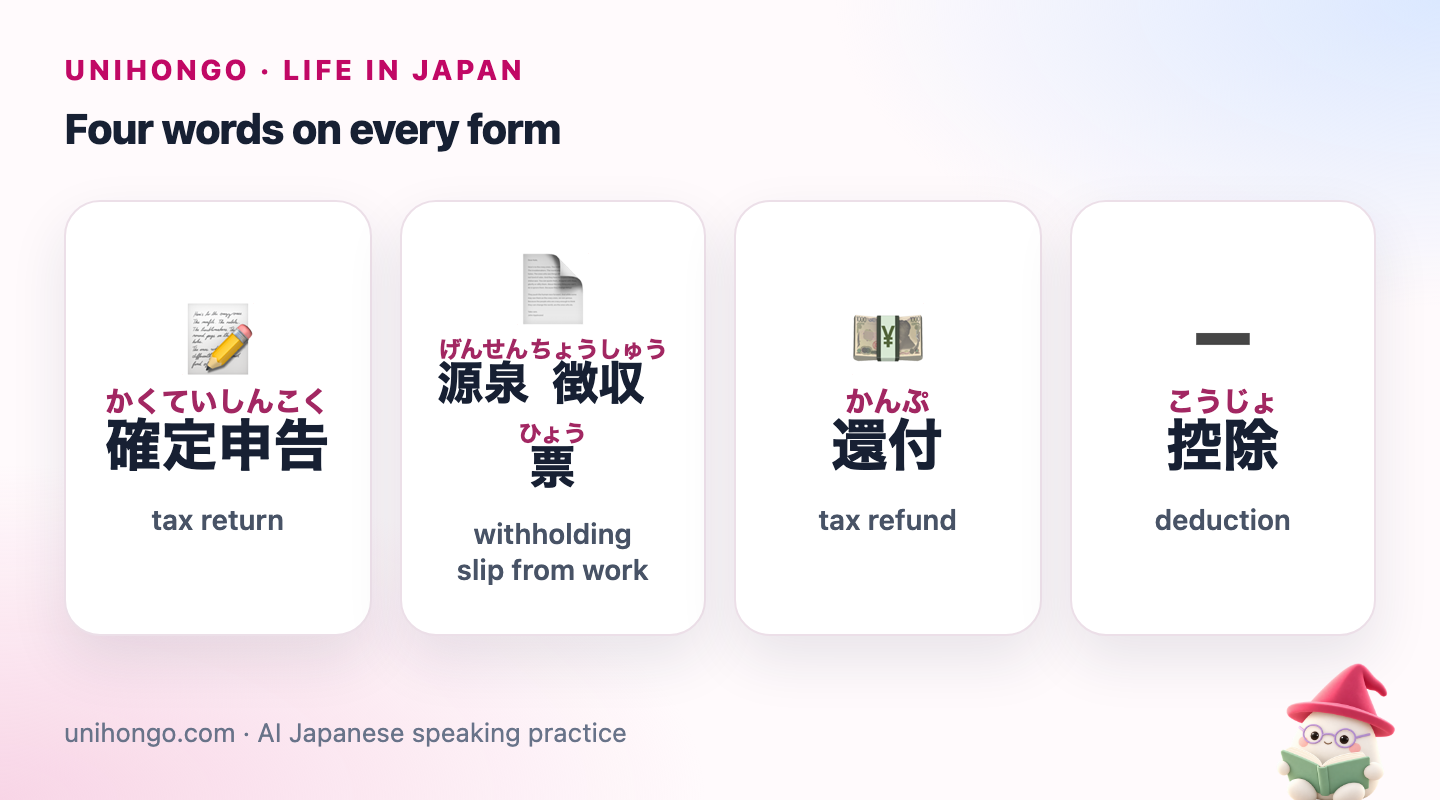
| Japanese | Romaji | Meaning |
|---|---|---|
| 確定申告 | kakutei shinkoku | tax return |
| 源泉徴収票 | gensen chōshūhyō | withholding slip from work |
| 還付 | kanpu | tax refund |
| 控除 | kōjo | deduction |
Your employer gives you the gensen chōshūhyō by the end of January, or when you leave the company. If you lost it, ask HR to reissue it: gensen chōshūhyō o saihakkō shite itadakemasu ka.
Who must file and who files by choice
The exact rules and amounts are set in the tax law and change from time to time, so treat these as the common cases and check the National Tax Agency's page for your year.
| Situation | Usually |
|---|---|
| Self-employed, freelance or business income | Must file |
| Salary from two employers | Must file in most cases |
| Employee with side income above the set amount | Must file |
| Very high salary | Must file |
| Left a job mid-year and not adjusted by a new employer | Should file, often for a refund |
| Large medical bills, furusato nōzei to six or more places | Files by choice to claim the deduction |
| First year of a housing loan deduction | Files by choice; later years via the employer |
Refund-only returns, kanpu shinkoku, are not limited to the February to March season: you can file them from January, and for several past years. Returns that show tax to pay must be filed in the season.
The season and the documents
| Japanese | Romaji | Meaning |
|---|---|---|
| 控除証明書 | kōjo shōmeisho | deduction certificate |
| 医療費控除の明細書 | iryōhi kōjo no meisaisho | medical expense deduction statement |
| 還付金の振込先 | kanpukin no furikomisaki | bank account for the refund |
| 納付期限 | nōfu kigen | payment deadline |
| 生命保険料控除証明書 | seimei hokenryō kōjo shōmeisho | life insurance deduction certificate |
| 社会保険料控除 | shakai hokenryō kōjo | deduction for social insurance premiums |
| 扶養控除 | fuyō kōjo | deduction for dependants |
- January: employers hand out withholding slips; insurance companies and pension offices send deduction certificates.
- From January: refund returns can be filed.
- Mid-February to mid-March: the main filing period. Tax due is paid by the mid-March deadline, unless you set up automatic debit (furikae nōzei), which takes it later.
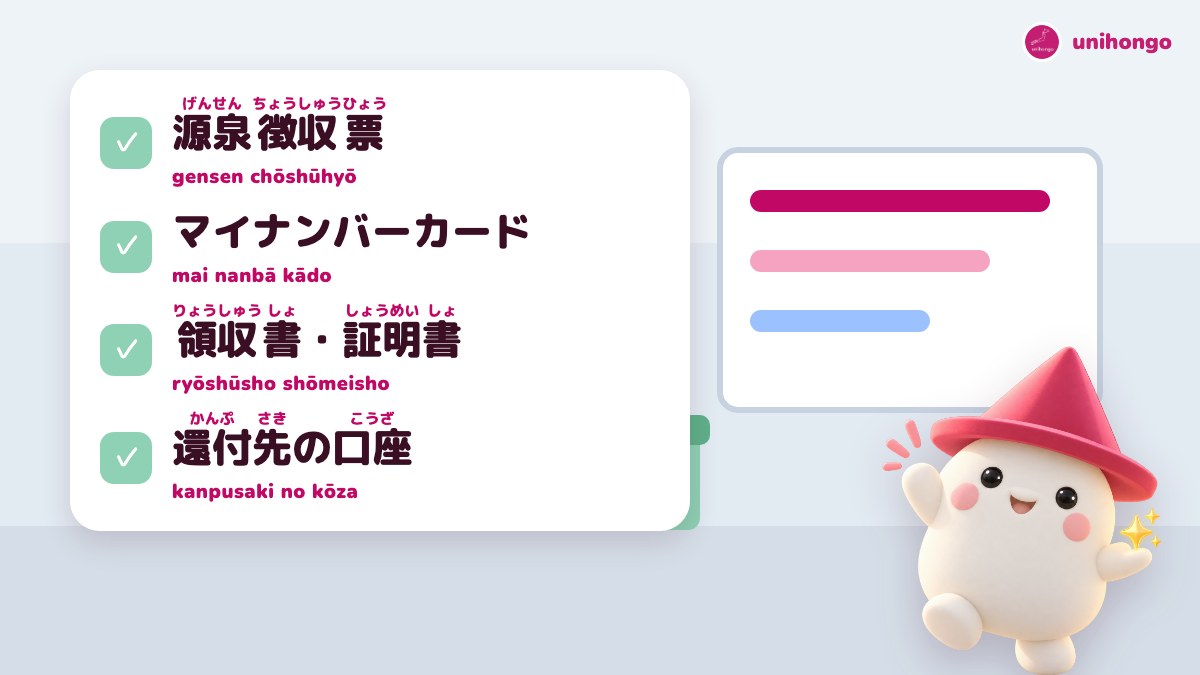
- Gather your My Number card or notice and photo ID, withholding slips, deduction certificates (控除証明書), receipts or the medical expense statement (医療費控除の明細書), and your bank details for a refund.
- Spring: refunds arrive in your bank account, often within weeks for online returns.
Deduction certificates come from different places. Life and earthquake insurance companies send theirs in autumn; if you paid national pension premiums yourself, the Japan Pension Service sends a certificate too, and national health insurance premiums you paid can be deducted using your payment records. Medical receipts are not submitted any more: you list them on the statement and keep them at home for several years.
e-Tax, the online form or the tax office
All three routes start from the same place: the National Tax Agency's online tax return creation page, kakutei shinkokusho tō sakusei kōnā. It asks questions, does the arithmetic and produces the forms.
| Route | How it works | Fits when |
|---|---|---|
| e-Tax | Sign in with your My Number card on a smartphone or with a card reader, then submit online | You have a My Number card and its PIN |
| Print and post | Complete the online form, print it, sign and post it or drop it at the tax office | You have no card reader or prefer paper |
| Consultation venue | Staff help you enter the return on a terminal during the season | It is your first return or your case is unusual |
If you file for a business, ask about the blue return, aoiro shinkoku (青色申告), which gives extra deductions but must be applied for in advance and needs proper bookkeeping. If you leave Japan with tax matters open, appoint a tax agent before you go.
At the consultation venue
Consultation venues are crowded in early March. Go early in the season, bring every document in one folder, and know what you want before you reach the desk. Staff speak Japanese, sometimes with simple English; short, clear sentences work best.
| Japanese | Romaji | Meaning |
|---|---|---|
| 確定申告の相談に来ました。 | Kakutei shinkoku no sōdan ni kimashita. | You: I've come for help with my tax return. |
| 入場整理券はお持ちですか。 | Nyūjō seiriken wa omochi desu ka. | Staff: Do you have an entry ticket? |
| 医療費控除を受けたいです。 | Iryōhi kōjo o uketai desu. | You: I want to claim the medical expense deduction. |
| 源泉徴収票とレシートを持ってきました。 | Gensen chōshūhyō to reshīto o motte kimashita. | You: I brought my withholding slip and receipts. |
| マイナンバーカードの暗証番号はわかりますか。 | Mai nanbā kādo no anshō bangō wa wakarimasu ka. | Staff: Do you know your My Number card PIN? |
| この欄には何を書けばいいですか。 | Kono ran ni wa nani o kakeba ii desu ka. | You: What should I write in this box? |
| 還付金はどの口座に振り込みますか。 | Kanpukin wa dono kōza ni furikomimasu ka. | Staff: Which account should the refund go to? |
| こちらの口座でお願いします。 | Kochira no kōza de onegai shimasu. | You: This account, please. |
| 控えを持って帰ってください。 | Hikae o motte kaette kudasai. | Staff: Please take your copy home. |
Before you leave, make sure you have a copy of the return, the hikae. You may need it later to prove your income, for example when renewing a visa, applying for a loan or enrolling a child in daycare.
Mistakes that delay a refund
- Waiting until the last week, when venues have long queues and some stop handing out tickets early in the day.
- Forgetting the withholding slip from a job you left in spring.
- Filing a return after using the furusato one-stop exception without listing the donations.
- Entering a bank account under a different name; refunds go only to the taxpayer's account.
- Forgetting that a mistaken return can be corrected: ask the tax office about filing an amended return rather than ignoring it.
- Not knowing the My Number card PIN. Several wrong attempts lock the card, and unlocking it means a trip to the city office.
- Claiming a family member abroad as a dependant without the documents the tax office requires, such as proof of relationship and of money sent.
After you file: refunds, payments and corrections
If your return shows a refund, it is paid into the account you entered, usually a few weeks after an online return and somewhat longer after a paper one. You can check progress through e-Tax, and the tax office sends a notice when the money is paid. If your return shows tax to pay, you can pay at a bank, at a konbini with a QR code printed from the online system, by card through the official payment site, or by automatic debit if you applied for it in advance.
Mistakes happen. If you find that you claimed too little, for example you forgot a receipt, you can ask for a correction, kōsei no seikyū. If you claimed too much, file an amended return, shūsei shinkoku, before the tax office contacts you. Both are routine, and the tax office telephone consultation centre can tell you which applies. Keep a copy of your return and the documents for several years.
| Japanese | Romaji | Meaning |
|---|---|---|
| 還付金はいつ振り込まれますか。 | Kanpukin wa itsu furikomaremasu ka. | When will the refund be paid? |
| 申告内容に間違いがありました。 | Shinkoku naiyō ni machigai ga arimashita. | There was a mistake in my return. |
| 修正申告 | shūsei shinkoku | amended return (paid too little) |
| 更正の請求 | kōsei no seikyū | request for correction (paid too much) |
| 振替納税 | furikae nōzei | paying tax by automatic debit |
| 税務署から電話がありました。 | Zeimusho kara denwa ga arimashita. | I had a call from the tax office. |
Read the form before you file
The online form asks dozens of yes-or-no questions in Japanese. Copy any question you cannot follow into Mocchi and ask for a plain explanation; for a full sentence, /explain breaks down each word and the grammar. Mocchi remembers the tax words you have already met, so the second year's return is far easier than the first.
If you plan to go to a consultation venue, rehearse the conversation first: ask Hana-sensei in AI Sensei to play the staff member at the desk and practise explaining your income and the deduction you want.