
Nine time proverbs at a glance
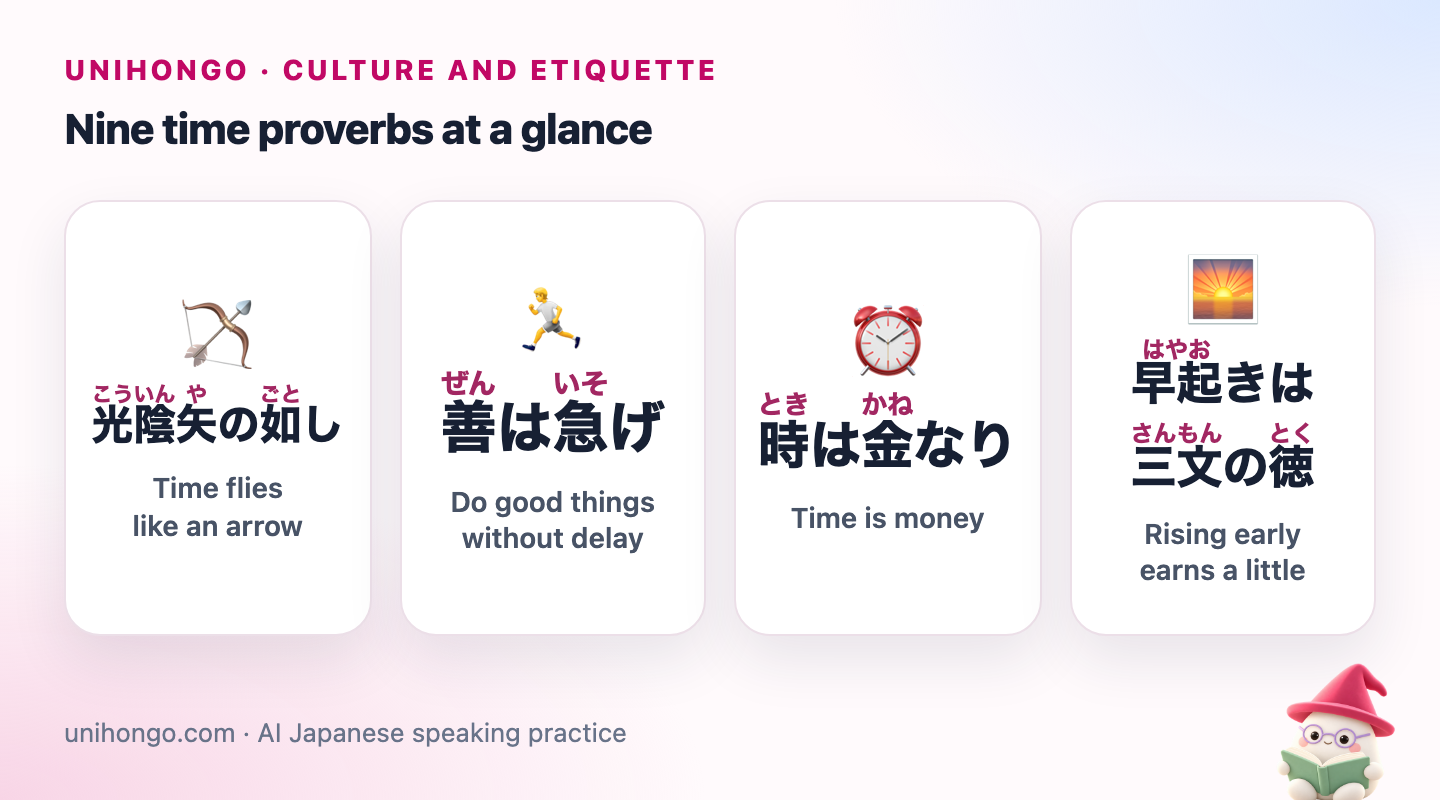
Four are about time passing, four push you to act now, and one is about being too late.
| Japanese | Romaji | Meaning |
|---|---|---|
| 光陰矢の如し | Kōin ya no gotoshi | Time flies like an arrow |
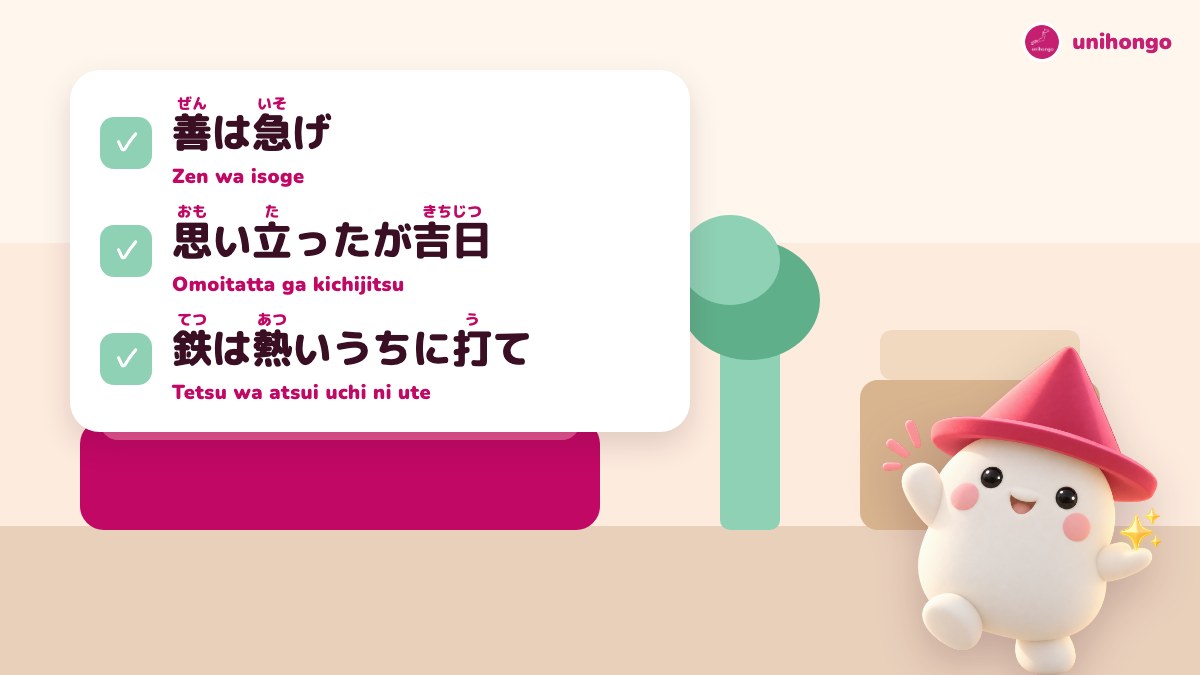
| 善は急げ | Zen wa isoge | Do good things without delay |
| 時は金なり | Toki wa kane nari | Time is money |
| 早起きは三文の徳 | Hayaoki wa sanmon no toku | Rising early earns a little |
| 思い立ったが吉日 | Omoitatta ga kichijitsu | The day you decide is the lucky day |
| 鉄は熱いうちに打て | Tetsu wa atsui uchi ni ute | Strike while the iron is hot |
| 明日は明日の風が吹く | Ashita wa ashita no kaze ga fuku | Tomorrow blows its own wind |
| 歳月人を待たず | Saigetsu hito o matazu | Time waits for no one |
| 後の祭り | ato no matsuri | After the festival: too late |
Time passing: 光陰矢の如し and 歳月人を待たず
光陰矢の如し sounds elegant and a little formal. 光陰 combines light and shadow, day and night, and 如し is the classical form of のようだ. You will hear it in graduation speeches, New Year letters, company anniversaries and wedding toasts, and people use it in writing to open a reflection on the past year. In everyday chat the same feeling usually comes out as あっという間, in the blink of an eye, or 早いね, that went fast.
歳月人を待たず, the years do not wait for people, comes from a Chinese poem by Tao Yuanming, and is often used as a push to make the most of youth or the present. It is literary and appears mainly in speeches and writing; the English time and tide wait for no man is a close match.
| Japanese | Romaji | Meaning |
|---|---|---|
| 光陰矢の如しで、もう卒業です。 | Kōin ya no gotoshi de, mō sotsugyō desu. | Time has flown; it's already graduation. |
| 一年、あっという間だったね。 | Ichinen, atto iu ma datta ne. | The year went by in a flash. (casual) |
| 歳月人を待たず。今を大切にしましょう。 | Saigetsu hito o matazu. Ima o taisetsu ni shimashō. | Time waits for no one. Let's value the present. (speech) |
Act now: 善は急げ, 思い立ったが吉日 and 鉄は熱いうちに打て
善は急げ, hurry with good things, is one of the most used proverbs in daily Japanese. When a friend suggests a good plan, booking the trip, calling an old teacher, signing up for the class, 善は急げ means let's do it now before we lose the chance. It is cheerful and often followed by a decision: じゃあ、今すぐ予約しよう.
思い立ったが吉日 says the day you decide to do something is a lucky day, so there is no need to wait for a special date. This is a gentle dig at the habit of waiting for a lucky day on the calendar, and it is popular with people starting a hobby, a diet or a language. 鉄は熱いうちに打て, strike the iron while it is hot, came from a Western saying and means act while conditions are right. In Japanese it also has a special use about education: teach people while they are young and flexible.
| Japanese | Romaji | Meaning |
|---|---|---|
| 善は急げだ。今すぐ申し込もう! | Zen wa isoge da. Ima sugu mōshikomō! | No time like the present. Let's apply now! |
| 思い立ったが吉日、今日から始めます。 | Omoitatta ga kichijitsu, kyō kara hajimemasu. | Today's the day: I'm starting now. |
| 鉄は熱いうちに打てで、すぐ復習しよう。 | Tetsu wa atsui uchi ni ute de, sugu fukushū shiyō. | Strike while it's hot: let's review right away. |
Time is money, and the early-bird coin
時は金なり is the Japanese rendering of time is money. It shows up in business talk, productivity articles and the occasional complaint about long meetings. Because it came from English, it sounds neutral and modern despite the classical なり.
早起きは三文の徳, getting up early brings three mon of benefit, uses an old small coin, the 文, to say the gain is small but real. It is the Japanese early bird catches the worm, and people use it when early rising pays off: a quiet train, a free parking space, the best seat at a café. Both spellings 徳 and 得 are common.
| Japanese | Romaji | Meaning |
|---|---|---|
| 時は金なり。会議は三十分で終わらせよう。 | Toki wa kane nari. Kaigi wa sanjuppun de owaraseyō. | Time is money. Let's finish the meeting in 30 minutes. |
| 早起きは三文の徳だね。電車がすいてた。 | Hayaoki wa sanmon no toku da ne. Densha ga suiteta. | Getting up early paid off. The train was empty. |
Too late, or not worried: 後の祭り and 明日は明日の風が吹く
後の祭り, after the festival, describes the moment you realise you should have acted earlier. Once the festival is over, preparation is useless. It is common in conversation and usually follows a regret: もっと早く予約すればよかったけど、後の祭りだ.
明日は明日の風が吹く, tomorrow the wind of tomorrow will blow, is the relaxed opposite: do not worry about tomorrow, it will take care of itself. People say it to cheer someone up or to shrug off a bad day. It is close to the English tomorrow is another day. Be aware it can sound careless if the problem is serious and needs action today.
| Japanese | Romaji | Meaning |
|---|---|---|
| チケット、売り切れだった。後の祭りだ。 | Chiketto, urikire datta. Ato no matsuri da. | Tickets sold out. Too late now. |
| まあ、明日は明日の風が吹くよ。 | Mā, ashita wa ashita no kaze ga fuku yo. | Oh well, tomorrow is another day. |
Mini dialogue: signing up for a class
A learner tells a friend about a Japanese conversation class that starts next month. The friend pushes for a decision with two time proverbs.
| Japanese | Romaji | Meaning |
|---|---|---|
| 来月から会話クラスがあるんだけど、どうしようかな。 | Raigetsu kara kaiwa kurasu ga aru n da kedo, dō shiyō ka na. | You: There's a conversation class from next month. Should I go? |
| 興味あるなら、善は急げだよ。 | Kyōmi aru nara, zen wa isoge da yo. | Friend: If you're interested, don't wait. |
| でも、まだ忙しいし。 | Demo, mada isogashii shi. | You: But I'm still busy. |
| 定員になったら後の祭りだよ。 | Teiin ni nattara ato no matsuri da yo. | Friend: Once it's full, it'll be too late. |
| 確かに。思い立ったが吉日、今日申し込む! | Tashika ni. Omoitatta ga kichijitsu, kyō mōshikomu! | You: True. Today's the day: I'll sign up now! |
English equivalents and register
| Japanese | Nearest English | Where you hear it |
|---|---|---|
| 光陰矢の如し | Time flies | Speeches, letters, writing |
| 善は急げ | No time like the present | Everyday conversation |
| 時は金なり | Time is money | Business, articles |
| 早起きは三文の徳 | The early bird catches the worm | Everyday conversation |
| 鉄は熱いうちに打て | Strike while the iron is hot | Advice, education |
| 後の祭り | Too late; the ship has sailed | Everyday conversation |
A common mistake is using 後の祭り as a warning about the future. It describes a lateness that has already happened, or one that will happen if you wait: もう後の祭りだ, or 待っていたら後の祭りになるよ.
Talking about time passing in everyday speech
Most of the time, people express the feelings behind time proverbs with plain, everyday phrases. Learning these lets you react naturally in conversation and save the proverbs for moments that call for them.
あっという間 means in the time it takes to say ah, in a flash: 一年があっという間だった, the year flew by. いつの間にか means before you knew it, and 気づいたら, when I noticed, describes suddenly realising how much time has passed. 早いもので, it is quick, is a set opener in letters and speeches: 早いもので、入社して五年になります, time flies; it has been five years since I joined. It is a natural, polite substitute for 光陰矢の如し. For the act-now side, people simply say 今のうちに, while you still can, or せっかくだから, since we have the chance.
The year end is when you will hear these most. Expect 今年もあっという間でしたね in shops, offices and New Year cards.
| Japanese | Romaji | Meaning |
|---|---|---|
| 今年もあっという間でしたね。 | Kotoshi mo atto iu ma deshita ne. | This year flew by too, didn't it. |
| いつの間にか夜になっていた。 | Itsu no ma ni ka yoru ni natte ita. | Before I knew it, it was night. |
| 早いもので、日本に来て三年になります。 | Hayai mono de, Nihon ni kite sannen ni narimasu. | Time flies: it's been three years since I came to Japan. |
| 今のうちに予約しておこう。 | Ima no uchi ni yoyaku shite okō. | Let's book while we still can. |
Give the proverbs a deadline
Time proverbs are best practised by acting on them. Tell Mocchi on Unihongo your goal and how much time you have, for example: /plan I want to pass N4 in December and can study a little every evening. Mocchi builds a 60-day path of small daily tasks around it, ticks off what you finish and adjusts the plan with /adjust-plan when life gets busy. That is 思い立ったが吉日 in practice.
For the vocabulary itself, turn the nine proverbs into flashcards and race through them in Vocabulary Dash on the games page. A quick round at the end of the day keeps the readings fresh without taking much time.